
Executive Summary
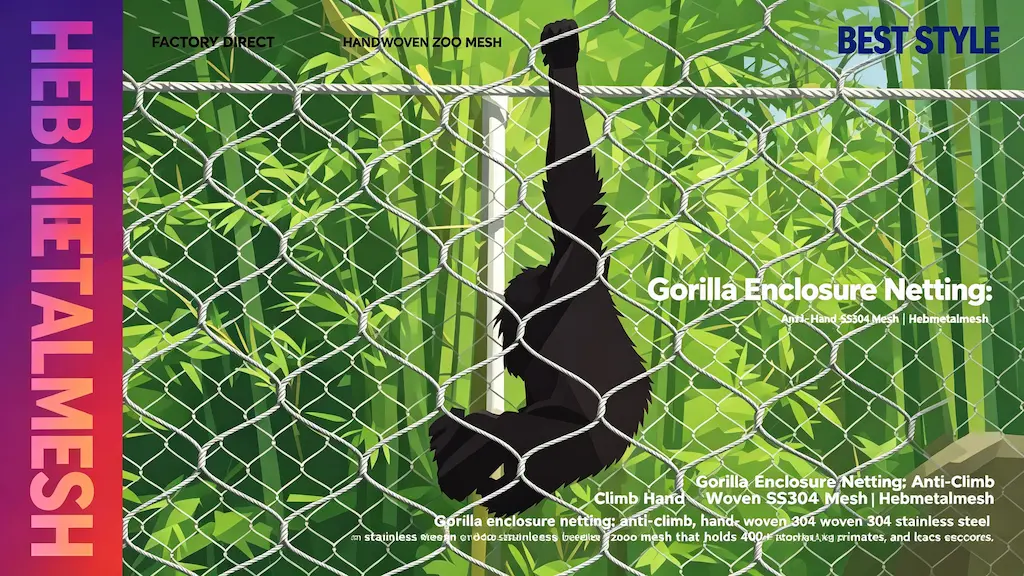
The netting for a gorilla enclosure must do what no ordinary fence can: hold an animal that can exert roughly ten times human strength. Gorilla enclosure netting built from hand-woven 304 stainless steel rope mesh is the industry answer, because it combines high tensile strength with a smooth, unclimbable surface and decades of corrosion-free service. This guide answers the practical questions in order: what a gorilla can do to a fence, how hand-woven stainless steel zoo mesh compares to welded and coated alternatives, what aperture and cable diameter to specify, how anti-climb geometry stops escapes, how the mesh supports natural behaviors, and what installation, maintenance, and cost look like over the life of the exhibit. The reference specification for any build is the anti-climb gorilla enclosure netting product page.
Specifying Gorilla Enclosure Netting? Get a Free Quote
Send us your gorilla group size, enclosure dimensions, and climate. We return a mesh grade, aperture, and cable diameter recommendation within 24 hours.
Request My Free Quote →Quick Answer: What Netting Do Gorillas Need?
A gorilla enclosure needs netting that is structurally unbreakable, visually transparent, and physically unclimbable. Hand-woven stainless steel rope mesh in 304 grade delivers all three. A silverback can exceed 180 kg, and an adult gorilla can pull, push, and climb with forces far beyond human capability; welded wire and coated products fail under that load. The practical specification is a gorilla enclosure mesh woven from solid stainless cable, with an aperture that prevents gripping and an anti-climb top geometry that defeats scaling. The primate mesh range covers the standard options.
Key Takeaways
- Adult gorillas generate far more force than welded wire or coated fencing can survive.
- Hand-woven stainless steel mesh has no welds, so it has no weld-joint failure mode.
- Aperture and cable diameter are set by gorilla size, grip, and climbing force — not by guesswork.
- Anti-climb design is a geometry problem: smooth strands, tight grip points, and an inward top overhang.
- The mesh doubles as enrichment surface, supporting climbing and other natural behaviors.
- Installation tension and border cables determine field performance more than panel price.
- 304 stainless steel suits most sites; 316 is specified for salt-air or heavy-spray locations.
What a Gorilla Can Do to a Fence
The first design fact is the animal. A male lowland gorilla stands up to 1.7 meters, weighs up to 180 kg or more, and is estimated to be several times stronger than the strongest human pound for pound. Gorillas also climb. Juveniles climb trees routinely; adults test boundaries with their full weight. Any enclosure barrier has to survive that force, applied daily, in the same spots, for decades.
The second design fact is the behavior. Gorillas are intelligent and curious; an enclosure that reads as a puzzle will be investigated. They chew, pull, and test edges. A welded wire panel fails at its joints — the weld bead is both the weak point and the gripping edge. A coated panel loses its coating, then corrodes from the bite site outward. This is why gorilla cages fence, gorilla cage netting, and gorilla enclosure fencing are specified as structural systems, not as fencing.
Hand-Woven vs Welded vs Coated: The Material Comparison
The selection question when choosing netting for gorilla enclosures is not whether to use mesh, but which construction survives a gorilla.
| Property | Hand-woven stainless steel mesh | Welded wire mesh | Coated / polymer mesh |
| Load resistance | High — solid strands, no welds | Low — weld joints fail under force | Low — coating removed, then strands |
| Climb resistance | High — smooth round strands | Low — weld beads are gripping edges | Low — coating marks and tears |
| Corrosion | 304/316 stainless, no coating to lose | Galvanizing wears at contact points | Coating damage exposes core |
| Service life | Decades | Years | Years |
| Transparency | High at viewing distance | Moderate | Moderate |
| Enrichment value | Excellent — safe grip and swing surface | Poor — sharp edges | Poor — coatings mark easily |
Stainless steel gorilla mesh and the wider hand woven stainless steel zoo mesh family share one construction: solid stainless cable woven into panels, with no welds and no coating to fail. The weave absorbs impact without permanent deformation, and the round strand surface gives a gorilla nothing to grip — a genuinely anti-climb mesh rather than a coated product that wears away. For the broader material logic, our animal barrier netting guide explains where rope mesh is specified across zoo builds.
Gorilla Enclosure Mesh Size: Aperture and Cable Diameter
Two numbers define the spec: aperture and cable diameter. The gorilla enclosure mesh size starts with the smallest body part that must stay inside. Gorilla enclosures commonly use apertures around 2 x 2 inches, and the exact figure is verified against the residents — a juvenile’s head or hand sets the practical limit, not the adult’s. The aperture must be too small to grip as a handhold and too small to pass any body part through.
Cable diameter follows gorilla size and activity. Adult gorillas need heavier cable than smaller primates because they hang their full weight on the panel and pull against it; a common specification is 3 mm to 4 mm stainless cable, in a weave tight enough to hold tension under load. Cable diameter and aperture are specified together, because the same animal sets both.
Anti-Climb Safety Design
Gorilla enclosure fence mesh — like all gorilla enclosure safety mesh — is judged by its worst possible contact, and the top of the fence is where gorillas test escape. An anti climb gorilla mesh combines several measures: the smooth strand surface removes handholds; the aperture prevents toeholds; and the top of the panel is finished with an inward overhang or offset barrier that defeats scaling. Strong climbers do not need a purchase point — they need to be denied one entirely.
The rest of the perimeter is where escapes actually happen. The ground line must be buried, tied into a concrete curb, or finished with a kickboard so the mesh cannot be pushed up from below. Corners need reinforced border cable where two tension directions meet. Panel seams need continuous clamps or welded rings, never clips that a determined hand can work loose. Gates need double-door transfer and locks that the animals cannot operate. For a full walkthrough of these systems on a working exhibit, see our gorilla exhibit fence guide.
Supporting Natural Behaviors Inside the Enclosure
A gorilla enclosure is a habitat, and the mesh is part of it. Gorillas climb, swing, and brachiate; a properly tensioned panel gives them a safe grip surface that doubles as enrichment. The same stainless netting used on the perimeter can be tensioned internally as hammocks, angled climbing panels, and visual partitions, so the animals move through a three-dimensional space rather than a box.
This is where natural behaviors — climbing, swinging, foraging, and social movement — are supported by design. An enriched enclosure reduces stress and aggression, which is animal welfare delivered through structure rather than routine. The design also needs to serve the other side of the glass: transparent panels keep sightlines open so visitors watch a gorilla troop as if in the wild, which is the point of wildlife conservation in a zoo setting. For a deeper look at how these exhibits are built, see our gorilla habitat safety guide.
Zoo Exhibit and Private Facility Considerations
The same netting serves public exhibits and private facilities, with slightly different priorities. In a zoo, gorilla exhibit netting carries a double duty: contain the animals and keep the public at a safe viewing distance, often with a double-barrier system. In a sanctuary or private collection, the priorities shift to keeper safety and animal comfort, but the containment standard stays the same.
Transparency matters in both. A gorilla enclosure that reads as open space reduces stress for the animals and creates a better experience for visitors, and the round-strand mesh delivers that without sacrificing strength. For guidance on ethical habitat design and the wider welfare conversation, see our pieces on gorilla habitat solutions and the gorilla habitat project.
Installation and Tensioning
Gorilla enclosure mesh installation determines whether the specification performs. The two classic field failures are sagging panels and loose edges: sag appears when panels are not pre-stretched and tensioned to spec; loose edges appear when border cables are undersized or clamps skipped. Both turn a tensioned barrier into a slack net — and a slack net invites testing.
Installation is a professional job. Tensioning stainless steel rope mesh requires jacks, torque specifications, and experience reading a panel under load. Over-tension stresses the frame; under-tension creates slack. The installer works from the same spec sheet that selected the mesh, verifying aperture and tension on site. For a step-by-step procedure, our primate enclosure mesh installation guide walks through the same discipline applied to a full build.
Maintenance and Longevity
Hand-woven stainless steel netting is a low-maintenance system, and low maintenance means inspection, not neglect. The open weave drains and dries quickly, which limits biological buildup, and the panels clean with water and standard sanitizers. The material needs no painting and no chemical treatment, which removes the largest recurring upkeep costs of coated alternatives.
The maintenance discipline is a scheduled perimeter check: tension, seams, clamps, and the ground line. A loose clamp or a stretched border cable is an early warning that costs nothing to fix and a great deal to ignore. Monthly inspection is a reasonable baseline, with an immediate check after storms or any reported escape attempt. For the long-term cost picture, including how cable diameter and grade move the budget, see what drives zoo enclosure fencing cost.
Sourcing and Value
Gorilla enclosure netting is a specification purchase: the value is in the weave quality, the tolerance, and the border cable work. A reliable supplier asks about the gorilla group before quoting, confirms the aperture against the residents, and provides a tensioning spec rather than just selling panels. For guidance on what separates a dependable source from a margin-driven one, read where to find quality zoo mesh.
The comparison that matters is cost per year of safe service. A stainless hand-woven panel that lasts decades without replacement, repainting, or weld repair is routinely cheaper over the exhibit’s life than a coated product replaced every few years — even at a higher initial price. This value logic is why hand-woven stainless panels are the default for serious gorilla facilities.
FAQ
What is the best netting for a gorilla enclosure? Hand-woven stainless steel rope mesh in 304 grade. It has no welds to fail, cannot be chewed through, resists corrosion, and stays transparent — the only construction that reliably contains an adult gorilla for decades.
What gorilla enclosure mesh size should I use? Apertures around 2 x 2 inches are common, verified against the smallest body part that must stay inside. Cable diameter follows gorilla size and climbing force — commonly 3 mm to 4 mm stainless cable for adults. Specify both together.
Can a gorilla break stainless steel mesh? No. Stainless steel rope mesh is structurally unbreakable by a gorilla: 304 stainless strands exceed anything the animal can deform, and the smooth round surface gives it nothing to grip. Welded and coated products are the ones that fail.
How do you stop gorillas from climbing the mesh? Anti-climb geometry: smooth strands, an aperture too small to grip, a tensioned top edge, and an inward overhang or offset barrier. The mesh is the containment medium; the top geometry is the escape prevention system.
How often should gorilla enclosure netting be inspected? Monthly as a baseline — tension, seams, clamps, and ground line — with an immediate check after storms or escape attempts. Daily visual checks of gates and locks are standard keeper practice.
Conclusion
Gorilla enclosure netting is a specification exercise, not a shopping decision. Specify hand-woven 304 stainless steel rope mesh, set the aperture and cable diameter from the residents, build in anti-climb top geometry, install to tension, and inspect on schedule. Done that way, the mesh holds the animal, disappears from the visitor’s view, and earns its cost every year of a decades-long service life. The same enclosure design principles extend to the whole primate collection; our primate enclosure safety guide is a useful next read.
If you are ready to spec your build, send us your gorilla group and dimensions. We will confirm the gorilla habitat netting specification that fits your animals, your climate, and your budget.
Ready to Spec Your Gorilla Enclosure?
Tell us the gorilla group size, enclosure footprint, and site climate. We reply with a mesh grade, aperture, and cable diameter recommendation within 24 hours.
Talk to a Mesh Specialist →