
Executive Summary
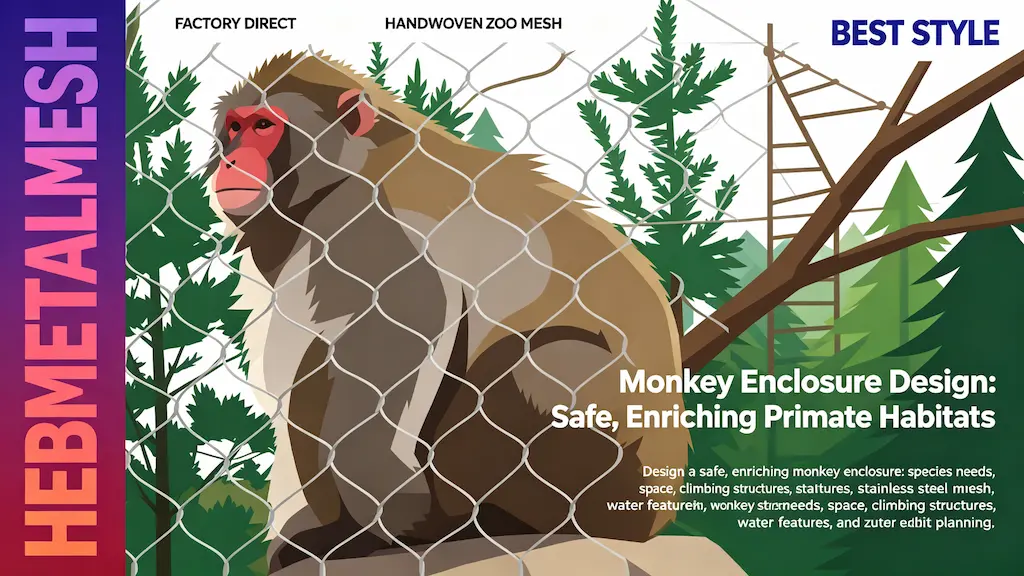
Monkey enclosure design is a balance between one question that never changes and a dozen variables that always do. The question: how do you keep a curious, strong, highly social animal inside a space that still feels like a jungle? The variables are species, climate, budget, and equipment. This guide walks the full process — species behavior, space, climbing structures, the mesh envelope, water features — with lessons from real zoo and sanctuary builds, where a monkey enclosure project fails not because the material was cheap but because the design ignored how the animal moves and tests its world. Containment gets the most space here, because that is where safety, longevity, and animal welfare meet. If you are planning a build, the primate enclosure mesh product page is the place to start.
Ready to Spec Your Monkey Enclosure?
Tell us the species, enclosure footprint, and site climate. We reply with a mesh grade, aperture, and cable diameter recommendation within 24 hours.
Talk to a Mesh Specialist →Key Takeaways
- Design from behavior first: arboreal monkeys live in the vertical plane, so height beats floor area.
- The mesh envelope is the costliest decision; get aperture, cable diameter, and grade right the first time.
- Enrichment reduces stress, aggression, and escape attempts; it is part of the safety system.
- Water features raise the corrosion load, including on the mesh grade.
- Plan maintenance access before concrete is poured; a hard-to-reach enclosure becomes unsafe.
- Materials follow environment: 304 inland, 316 near salt air or constant spray.
Start With the Species, Not the Blueprint
The fastest way to waste a budget is to start a monkey enclosure project with a floor plan and ask later what lives in it. A squirrel monkey and a macaque share the word “monkey” and almost nothing else: one weighs under a kilogram and fits through surprisingly small gaps, the other weighs ten times more and treats a fence as a puzzle.
So the first step in how to design a monkey enclosure is a species profile: adult weight, arm span, jump distance, social structure, and wild habitat. That profile sets the mesh aperture, the cable diameter, the vertical space, and the enrichment that will actually be used. Keep it on the drawing table — every decision below traces back to it, and the result is a primate habitat the animal reads as home.
Space Planning: Monkey Enclosure Space Requirements
Monkey enclosure space requirements are usually quoted as floor area per animal; that number is a starting point, not a design. Monkeys flee, play, and sleep upward, so usable vertical volume matters more than raw square meters.
Think in layers: a high climbing zone near the roof, a mid-level platform zone for social grooming, and a ground zone that is not the only floor the animal touches. Plan for double the height you think you need, and make the enclosure deeper than it is wide along the viewing side so the animal can retreat to a quiet back zone.
Give the animals two paths between zones so a subordinate can move away from a dominant one without being cornered. This monkey enclosure safety design point only shows up in practice, so build it in from the start.
Climbing Structures: The Third Dimension
The skeleton inside the enclosure is where most physical and mental life happens, so monkey enclosure climbing structures deserve the same engineering attention as the perimeter. Size branches, ropes, platforms, and poles for the species, space them to match natural reach, and arrange them so no animal must cross open ground.
Use real hardwood branches, replaced in rotation; the texture and scent are part of the enrichment. Thick maritime-grade rope adds flex that wood cannot. Cable mesh panels stretched as hammocks or bridges add usable surface without cluttering the space — the same stainless steel netting used on the perimeter works indoors. Add platforms at varied heights, each landing larger than the animal’s reach.
Fix everything so it cannot be dismantled: monkeys will work bolts loose. Use lock washers, recessed fixings, and connectors rated for several animals swinging at once.
Enrichment: Monkey Enclosure Enrichment Ideas That Work
Monkey enclosure enrichment ideas only count if the animals use them, and they vote daily. The most reliable category is foraging: scatter feeders, puzzle boxes, and live plants that take effort to harvest, spread so no single feed point becomes a crowding point.
Rotation is the secret: fifteen enrichment items installed once become a static exhibit in a month; the same items rotated weekly stay novel for years. Run separate cycles for structures, scent items, puzzle feeders, and social stimuli.
Enclosure enrichment is also a safety tool: a busy monkey is not testing the fence. Facilities with repeated escape attempts almost always run under-enriched exhibits.
The Mesh Envelope: Monkey Enclosure Fencing Mesh
The perimeter has two jobs that cannot fail: keeping the animal in and keeping people safe. That is why mesh selection is the heart of the monkey enclosure fencing mesh decision.
Stainless steel rope mesh is the standard for primate exhibits for three reasons: it is effectively unchewable — monkeys have strong jaws, and polymer alternatives get damaged over years; it is transparent, so sightlines stay open for animals and visitors; and it lasts — a properly tensioned stainless steel enclosure mesh outlives the rest of the exhibit.
Two specifications matter: aperture and cable diameter. Aperture is set by the smallest part of the smallest resident — if a juvenile can fit a head through, it can sometimes fit a whole body through. Cable diameter follows adult weight; heavier primates need 3 mm or 4 mm cable in a tighter weave. Border cables and proper tensioning remove the two most common field failures: sagging panels animals climb like ladders, and loose edges that become handholds.
Grade follows environment: 304 stainless steel is the workhorse inland; 316 is worth the premium where salt air, high humidity, or constant spray will hit the mesh. These decisions belong in sustainable zoo enclosure design, and your monkey enclosure materials selection should be written into the spec sheet, not improvised at the shop.
For more, see how stainless steel rope wire mesh works as a monkey exhibit barrier and how secure monkey habitat netting is built for the same job.

Monkey Enclosure Safety Design
Monkey enclosure safety design assumes every boundary will be tested, because it will be. The mesh is only part of the system; the joints are the rest. Seams need continuous clamps or welded rings, never clips a determined hand can work loose, and corners fail where two tension directions meet — reinforce them with corner plates and heavier border cable.
Below ground, ground-dwelling species excavate along the mesh base, so bury the mesh, tie it into a concrete curb, or finish it with a kickboard that removes the purchase point. Above ground, the top edge needs a tensioned border cable; for strong climbers, an inward overhang or offset wire is standard zoo practice.
Inside, injury prevention is animal welfare: no sharp strand ends, no gaps that can trap a limb, no dead-end spaces where a subordinate can be cornered. The door system deserves the most paranoid engineering of all — double-door transfer, self-latching locks, and a keeper never inside with the animals unless transfer gates are locked. Our double-door monkey enclosure guide has the full checklist.
Jungle Habitat Design: Plants, Water, and Climate
A jungle habitat should read as a place the animal belongs, not a room it is kept in. Every plant must be confirmed non-toxic for the species, and planting should be layered — canopy, mid-story, ground cover — so the space has depth from every angle. Give the plants a season to establish, or the residents will strip the exhibit bare in a month.
Water earns its place beyond aesthetics: a stream, pool, or misting system raises humidity for tropical species and becomes a natural enrichment feature. But water changes the corrosion profile of everything nearby, so mesh grade and water feature are linked decisions. If you plan monkey enclosure water features, budget for 316 stainless steel where spray reaches, and design drainage that keeps standing water off the mesh base.
Climate follows species. Many monkeys are tropical animals in temperate zoos; they need a heated retreat and shaded zones. A jungle habitat design fails if the animals huddle by a heater instead of using the space — thermal comfort is a design variable, not an afterthought.
Zoo Exhibit Design: Visitors and Education
In a public facility, the monkey enclosure visitor experience is a design input from day one: visitors should see the animals in the climbing zone, not just on the ground. That means sightline planning — where the barrier stands, at what height, and how interior structures relate to it. Double-mesh or glazed barriers with an air gap protect both audiences and are now expected in modern facilities.
The best monkey enclosure projects double as conservation messaging: signage on the species, its wild habitat, and its threats; a keeper talk point; a scheduled feeding window. This is where zoo monkey enclosure design earns its place in the mission, not just the budget.
Visitor flow matters on the other side of the glass too: wide viewing areas lower noise pressure, and calmer crowds mean calmer animals. Both audiences are managed by the same plan.
Equipment and Fittings: Doors, Locks, and Maintenance Access
The equipment layer is what makes the enclosure work on a Tuesday morning. Good monkey enclosure design and equipment planning go hand in hand, and monkey enclosure maintenance access is not a convenience — it is a safety system. Keeper entrances should be at human scale with clear sightlines, holding areas need service access that avoids the main exhibit, and shift doors should operate from outside with locks the residents cannot open and staff cannot forget.
Plan the daily chores: surfaces reachable without ladders, drains that actually drain, substrate replaceable without closing the facility. An enclosure that is hard to maintain gets maintained less. Feed stations should be serviceable from keeper walkways, not from inside the mesh.
Materials and Budget: What Actually Drives Cost
Monkey enclosure materials selection is where the plan meets the invoice, and the surprise in most budgets is the mesh. A quality stainless steel perimeter is the largest single line item and the one place where cutting corners costs the most over the exhibit’s life. Getting the spec right once — grade, cable diameter, aperture, tensioning hardware — beats replacing a degraded fence in year five.
For the full breakdown, see what drives zoo enclosure fencing cost: cable diameter and grade drive material price, height and perimeter drive quantity, site conditions drive installation. Structural steel, planting, water features, and holding areas are the other major lines. A common mistake is undersizing the containment to fit a budget, then retrofitting at a higher cost. If funds are tight, phase the enrichment and landscaping, never the barrier.
Sustainability and Long Life
Projects built once and lasting decades are the sustainable ones, and material choice is the biggest lever. Stainless steel netting is fully recyclable, needs no paint or chemical treatment, and resists UV. For the wider picture, read how natural habitats for zoo animals are built and maintained.
Maintenance is the other half of longevity: a yearly inspection of seams, clamps, and tension costs almost nothing and prevents the failures that close exhibits. Keep spare clamps and a length of border cable on site.
FAQ
How much space does a monkey enclosure need? It depends on the species. Prioritize vertical volume and layering over floor area, and check the species’ jump distance and group size. Zoo guidelines state minimums per animal; the real target is usable volume at several levels.
What mesh size is safe for monkeys? Aperture is set by the smallest resident: no head, hand, or foot should pass through. Cable diameter follows adult weight and climbing force. A specialist supplier should size both for your species rather than guess.
Can monkeys climb stainless steel mesh? They can climb almost anything given enough grip. Tensioning and border cables minimize purchase points, and strong climbers may need an inward overhang at the top. The mesh is the containment medium; the geometry is the security system.
Is stainless steel rope mesh expensive? More than polymer alternatives upfront, but it lasts decades and resists chewing and UV. Over the exhibit’s life it is usually the cheapest option per year of safe service.
How often should the enclosure be inspected? At least annually for seams, clamps, and tension, and immediately after any storm or reported escape attempt. Daily visual checks of gates and locks are standard keeper practice.
Conclusion
Good monkey enclosure design is not one clever idea; it is a chain of decisions where the weakest link sets the standard. Understand the species, give it vertical space, build climbing structures it will use, enrich on a rotation, and wrap all of it in a mesh envelope that cannot be chewed, climbed out of, or corroded away. The primate enclosure design principles in this guide — behavior first, containment non-negotiable, enrichment continuous, maintenance planned — apply whether you build for a zoo, a sanctuary, or a private collection.
If you are ready to start a monkey enclosure project, send us your species and your dimensions. We will confirm the gibbon enclosure netting specification that fits your animals, your climate, and your budget.
Ready to Spec Your Monkey Enclosure?
Tell us the species, enclosure footprint, and site climate. We reply with a mesh grade, aperture, and cable diameter recommendation within 24 hours.
Talk to a Mesh Specialist →