
Executive Summary
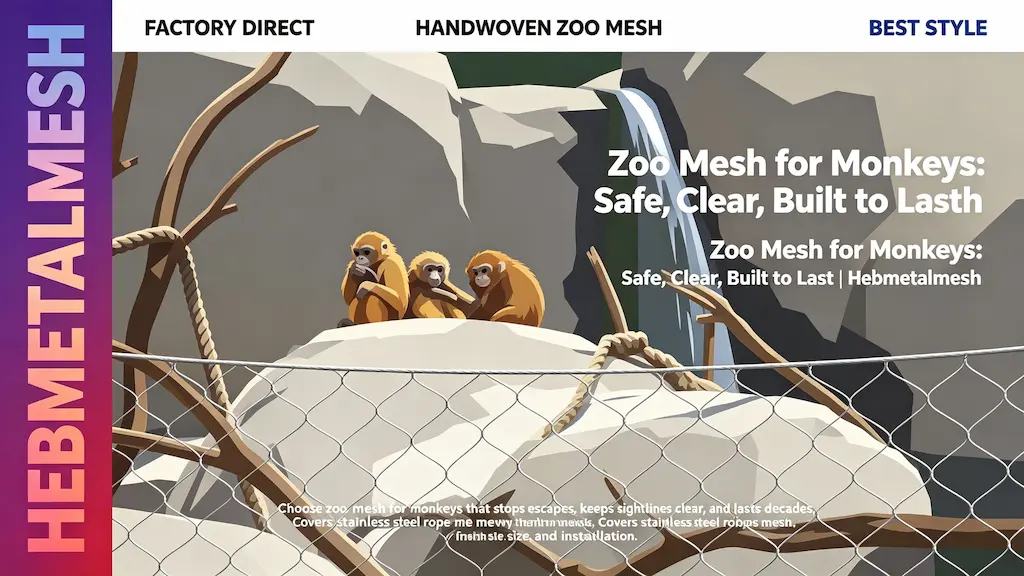
Zoo mesh for monkeys has to do three jobs at once, and every product decision touches all three. It must contain an animal that is stronger and smarter than visitors assume, it must stay transparent enough that the exhibit reads as a jungle rather than a cage, and it must survive decades of weather, cleaning, and deliberate testing by its residents. This guide walks through the full selection: species profile, mesh size for monkey enclosure, why stainless steel rope mesh is the default, how the barrier supports natural behaviors, and what installation and maintenance involve — written for zoo architects, keepers, and procurement teams who need a defensible spec sheet. If you are specifying a build, the monkey proof enclosure netting product page is where the technical details live.
Specifying Zoo Mesh for Monkeys? Get a Free Quote
Send us the species, enclosure footprint, and climate. We return a mesh grade, aperture, and cable diameter recommendation within 24 hours.
Request My Free Quote →Key Takeaways
- The mesh spec starts with the species: weight, reach, and jaw strength set cable diameter and aperture.
- Aperture is the safety dimension: it is set by the smallest body part that must stay inside.
- Stainless steel rope mesh wins on three counts: unchewable, transparent, and long-lasting.
- Visibility is a design tool: clear sightlines improve the visitor experience and reduce animal stress.
- The barrier should support natural behaviors; climbing surfaces attach to or hang from the mesh.
- Installation quality matters more than panel price; tension and border cables prevent field failures.
- Grade follows environment: 304 stainless steel inland, 316 where salt air or constant spray is present.
The Three Jobs of Zoo Mesh for Monkeys
Before any catalog is opened, define what the mesh must accomplish. A monkey exhibit netting does not hold still animals; it contains animals that test boundaries every day. So the first job is containment. The second is revelation: a zoo mesh for monkey exhibit that blocks sightlines fails its audience even if it holds the animals. The third is longevity — the barrier must survive sun, rain, cleaning chemicals, and curious hands for decades.
Every decision in this guide — material, aperture, cable diameter, tensioning, installation — serves one of these three jobs. When a spec seems to trade one against another, revisit the three jobs and decide which matters most for your species and site.
Start With the Species: What Lives in the Exhibit
The most common mistake in monkey exhibit design is choosing mesh before knowing the residents. A marmoset colony, a capuchin troop, and an orangutan require entirely different specifications. Body weight drives cable diameter: small primates need lighter mesh, while heavy apes need cable that will not deform under climbing force. Hand and head size drive aperture: if a juvenile can fit a hand through, it can sometimes fit a whole body through.
Species also drives behavior. Some monkeys are deliberate fence-testers; others are accidental escape artists that exploit a gap you thought too small. Some chew; all climb. Write a species profile — adult weight, reach, jaw strength, group dynamics — and keep it next to the drawing. The profile is the foundation of the entire primate habitat, and every later decision in this guide references it.
Mesh Size for Monkey Enclosure: The Aperture Decision
The mesh aperture is the gap between adjacent cables, and it is the dimension that determines both safety and visibility. For a monkey enclosure, aperture is set from the bottom up: the smallest part of the smallest resident that must not pass through. A marmoset can squeeze through an opening that looks harmless to a human eye, so the panel spec must start with a measurement of the animal, not a visual guess.
Larger primates present the opposite problem: an aperture right for a marmoset is unnecessarily dense for an orangutan, cutting visibility and raising cost for no safety gain. The answer is a species-specific aperture — tight enough that no head, hand, or foot passes, open enough that sightlines stay clear. This is where monkey exhibit mesh panels differ from generic fencing: the panel is engineered for one animal, not every animal.
Specify aperture and cable diameter together, because the same animal sets both. A specialist supplier should confirm them for your species. For a deeper look, the monkey enclosure mesh sizing guide covers the common cases.
Why Stainless Steel Rope Mesh Is the Default
Stainless steel zoo mesh for monkeys is no longer a premium option; it is the baseline other materials are measured against, for three reasons.
First, it is effectively indestructible to the residents. Monkeys have strong jaws and persistent teeth, and polymer or coated-wire products develop damage over years of testing. Stainless steel rope mesh cannot be chewed through, and its smooth strands give teeth nothing to grip.
Second, it is transparent. A properly tensioned stainless steel cable mesh panel is nearly invisible at viewing distance, keeping the exhibit open for visitors and for the animals’ own sightlines — a welfare feature, not just a cosmetic one.
Third, it lasts: the panel installed today is still holding tension when the surrounding structure is renovated. The monkey proof enclosure netting page lists available apertures and cable diameters for the common primate species.
Visibility: The Barrier That Disappears
A successful monkey exhibit is a conversation between animal and visitor, and the mesh is the window that makes it possible. Monkey enclosure visibility mesh is engineered for exactly this: high transparency at distance, no glare, no visual noise. Visitors should see the animals in the climbing zone, not a pattern of wire.
This clarity pays for itself in the visitor experience: an exhibit where a child can watch a troop swing from branch to branch creates the kind of memory that drives return visits. And the effect runs both ways — animals that can see their keepers and environment without a visual wall are calmer, with fewer stress-related behaviors.
The trade-off is real: a mesh open enough to see through is only safe if the aperture is correct for the species. That is why aperture and visibility are set together in the same specification process, not optimized separately.
Enrichment Through the Barrier: Supporting Natural Behaviors
The best monkey exhibit mesh does more than contain — it supports the behaviors that keep primates healthy. Climbing mesh for monkey exhibits can be tensioned internally as hammocks, bridges, and angled panels the animals use as structure. Combined with branches, ropes, and platforms, the mesh becomes part of the enrichment system rather than a wall around it.
Natural behaviors are the goal: climbing, swinging, foraging, social movement. An exhibit designed around them has lower stress, fewer aggression incidents, and fewer escape attempts — a busy monkey is not a fence-tester. When enrichment is part of the plan, the mesh and the interior structure are designed together, because the same panels often serve both jobs.
This is where a thoughtful zoo mesh for primate exhibits outperforms generic fencing: containment and climbing surface in one system.
Safety and Animal Welfare: The Details That Matter
Monkey exhibit safety mesh is judged by its worst possible contact, not its average use. The smooth, rounded surface of stainless steel rope mesh prevents the abrasions and entrapment injuries that sharper materials cause. Strand ends must be terminated properly — no exposed wire tips, no snag points — and panel seams need continuous clamps, never clips a determined hand can work loose.
Escape prevention is a system, not a material: an escape proof monkey mesh starts with the correct aperture and ends with disciplined installation. The mesh is the largest component, but the joints, corners, gates, and ground line are where escapes actually happen. Corners need reinforced border cable where two tension directions meet; the base must be buried or tied into a curb for ground-dwelling species; gates need double-door transfer and locks the residents cannot operate.
Inside the exhibit, animal welfare means no gaps that can trap a limb, no dead-end spaces where a subordinate can be cornered, and platform edges visible from the keeper walkway. For the full door and transfer checklist, see our monkey enclosure fencing guide.
Installation: Where Plans Become Barriers
Monkey habitat mesh installation is a precision job, and the field failures that close exhibits are almost always installation failures. The two classics are sagging panels and loose edges: sag develops when panels are not pre-stretched and tensioned to spec; loose edges appear when border cables are undersized or clamps skipped. Both turn a barrier into a climbing frame.
Professional installation is strongly recommended because tensioning stainless steel rope mesh requires jacks, torque specs, and experience reading a panel under load. A slack panel is a ladder for a primate; an over-tensioned panel can stress the frame. The installer should work from the same spec sheet that selected the mesh, verifying aperture and tension on site rather than assuming them.
Safety during installation matters for the crew too — protective gloves and eyewear, proper rigging, and adherence to the site’s safety plan. The mesh protects animals and the public; the install crew deserves the same standard.
Maintenance: Low Maintenance Zoo Mesh Is Still Maintained
Stainless steel rope mesh is a low maintenance zoo mesh, but “low maintenance” is not “no maintenance.” It resists corrosion and needs no painting or chemical treatment, saving a large share of the upkeep budget compared to coated products. The open weave drains and dries quickly and cleans easily with water and standard sanitizers — an important point for disease control in a primate facility.
The discipline that matters is inspection. Walk the perimeter monthly and check tension, seams, clamps, and the ground line. A loose clamp, a stretched border cable, or a panel with slack are early warnings that cost nothing to fix and a great deal to ignore.
Grade selection supports this program: 304 stainless steel handles inland climates well; 316 is the right call where salt air, high humidity, or constant water spray reaches the mesh. Choosing the right grade at specification time is the cheapest maintenance decision you will make.
Cost and Long-Term Value
Stainless steel rope mesh for monkeys costs more upfront than coated wire or polymer alternatives, and that comparison misses the point. The relevant number is cost per year of safe service: a stainless panel that lasts two decades without replacement, repainting, or repeated repair is routinely the cheapest option over the exhibit’s life.
For a detailed breakdown — cable diameter, grade, panel size, site conditions — see our guide to what drives zoo enclosure fencing cost. The short version: do not save money by downgrading containment. If the budget is tight, phase the enrichment and landscaping, never the barrier.
Sourcing the Right Panels
Once the spec is set — species profile, aperture, cable diameter, grade — sourcing is about who can actually build to it. Quality matters in the weave, the tolerance, and the border cable work. For guidance on what separates a reliable supplier from a margin-driven one, read where to find quality zoo mesh.
A good supplier asks about your species before quoting, confirms the aperture against your residents, and provides a tensioning spec rather than just selling panels. That consultation is part of the product — it is how the three jobs of the mesh get delivered on site.
FAQ
Stainless steel rope mesh is the industry standard: unchewable, transparent, corrosion-resistant, and long-lasting. Aperture and cable diameter depend on your species.
Measure the smallest part of the smallest resident that must not pass through — head, hand, or foot — and set the aperture from that. Cable diameter follows adult weight and climbing force. Confirm both with a specialist supplier.
More upfront than coated alternatives, but it lasts decades without replacement or repainting — usually the cheapest option per year of safe service.
Monthly is a reasonable baseline for tension, seams, clamps, and the ground line. Inspect after any storm, structural work, or reported escape attempt, and check gates and locks daily.
They can climb almost anything given enough grip. Tensioning and border cables minimize purchase points, and strong climbers may need an inward overhang at the top. The mesh is the containment medium; the geometry is the security system.
Conclusion
Selecting zoo mesh for monkeys is a specification exercise, not a shopping decision. Start with the species, set the aperture from the animal, choose stainless steel rope mesh for strength, transparency, and longevity, install to tension spec, and maintain on a schedule. Done that way, the mesh disappears from the visitor’s view, stays out of the escape log, and earns its cost every year of its long service life. For the wider context, our guide to designing primate exhibits is a useful next read.
If you are ready to spec your build, send us your species and dimensions. We will confirm the monkey exhibit mesh specification that fits your animals, your climate, and your budget.
Ready to Spec Your Monkey Exhibit?
Tell us the species, enclosure footprint, and site climate. We reply with a mesh grade, aperture, and cable diameter recommendation within 24 hours.
Talk to a Mesh Specialist →