
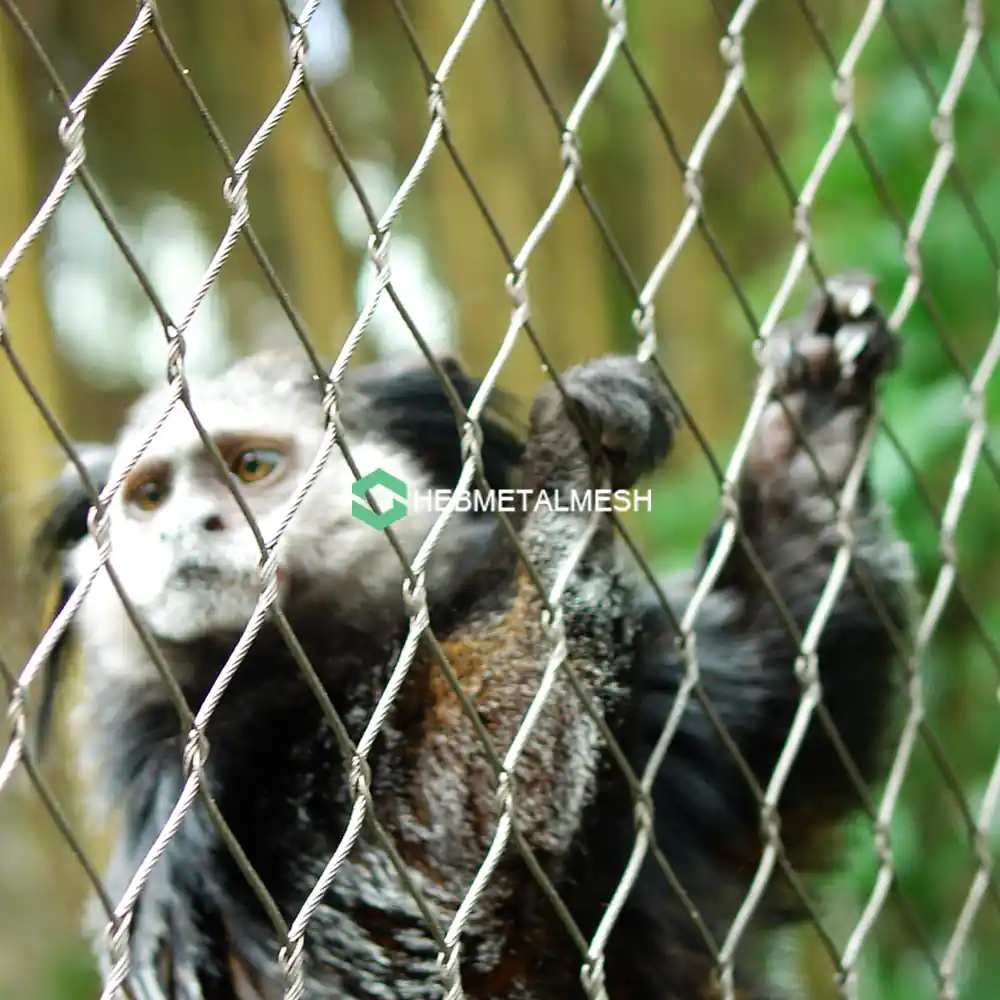
Monkey enclosure mesh is the most critical safety component in any primate habitat. This guide covers everything zoo directors, facility managers, and procurement specialists need to know: material grades (304 vs 316 stainless steel), aperture sizing by species, tensile strength requirements, installation best practices, and cost considerations. Whether you’re building a new gibbon exhibit or upgrading a macaque enclosure, choosing the right stainless steel rope mesh determines animal welfare, visitor experience, and 15-30 years of maintenance-free operation. Key takeaway: Handwoven stainless steel mesh outperforms welded wire and galvanized alternatives in durability, safety, and long-term ROI—making it the industry standard for modern zoological facilities across North America and Europe.
📦 Ready to Order? Get a Firm Quote & Free Sample Kit
Stop waiting on slow overseas replies. We provide transparent, all-inclusive pricing with shipping to the US and EU. Request swatches of our 1.6mm, 2.0mm, and 3.2mm handwoven cable mesh to test chew-resistance and finish before you buy.
Introduction
Selecting the right monkey enclosure mesh is arguably the single most important safety decision you will make for a primate exhibit. The integrity of your barrier determines not only the security of your animals and the safety of the public but also your long-term maintenance costs and the overall quality of the habitat.
Unlike heavy iron bars or chain-link fencing, modern stainless steel rope mesh allows for natural light and airflow, which is critical for the health of monkeys in both indoor and outdoor exhibits. It acts as a nearly invisible barrier that holds up to the high-energy lifestyle of primates—climbing, swinging, chewing, and testing every edge.
This guide provides zoo directors, exhibit designers, and procurement specialists with the essential technical criteria for selecting stainless steel cable mesh. We’ll cover materials, specifications, installation, and procurement—everything you need to make an informed decision for your facility.
Why this matters: Monkeys are intelligent, strong, and relentless when it comes to testing enclosure barriers. A poorly chosen mesh can lead to escapes, injuries, costly replacements, and reputational damage. Getting it right the first time saves money, protects animals, and delivers a superior visitor experience.
Understanding Monkey Enclosure Mesh – What It Is and Why It Matters
Definition and Purpose
Monkey enclosure mesh is a specialized primate containment system designed to securely house monkeys, apes, and other primates in zoological settings. Unlike general-purpose fencing, it must address three core functions simultaneously:
- Security: Preventing escape by intelligent, agile animals that can climb, jump, and problem-solve
- Safety: Protecting animals from injury (no sharp edges, no toxic materials) and visitors from contact
- Visibility: Providing unobstructed views for an immersive guest experience
The Evolution from Traditional Barriers to Modern Mesh
Traditional enclosures used iron bars, chain-link fencing, or solid walls. Each had major drawbacks:
- Iron bars: Expensive, obstructed views, and monkeys could grip and climb them
- Chain-link: Prone to rust, could be chewed through, and created injury risks
- Solid walls: Poor ventilation, dark interiors, and terrible visitor experience
The shift to “immersion” zoo design—where visitors feel connected to animals in naturalistic habitats—demanded a better solution. Handwoven wire mesh emerged as the answer: strong enough to contain, flexible enough to absorb impact, and transparent enough to virtually disappear. Today, stainless steel rope mesh is the industry standard for modern primate exhibits.
If you’re building long-term primate habitats, our professional stainless steel monkey net delivers unbeatable durability for zoo and sanctuary projects.
Types of Monkey Enclosure Mesh Materials
Stainless Steel Rope Mesh – The Industry Standard
Stainless steel rope mesh is the gold standard for monkey enclosure mesh. Here’s why:
- Superior Material Performance: Resists constant wear, biting, and pulling from active primates
- Non-Toxic Safety: Unlike wood or coated materials that may degrade or chip, high-grade stainless steel is safe for curious primates that may chew on their surroundings
- Weather-Resistant Resilience: Handles extreme temperature fluctuations, high humidity, and direct UV exposure without rot or corrosion
- Zero Maintenance: Once installed, stainless steel cable mesh requires no special cleaning or coating
Material selection is only half the equation—the right mesh specifications depend entirely on your primate species. Explore our complete monkey enclosure mesh by species guide for detailed recommendations on aperture, wire diameter, and construction type for every primate from tamarins to gorillas.
304 vs 316 Stainless Steel:
Both grades are available in ferruled or knotted mesh constructions with rope constructions including 7×7, 7×19, and 1×19. Handwoven stainless steel cable mesh offers the best combination of strength, flexibility, and safety.
Finish Options:
- Natural steel finish: Clean, modern look that blends with surroundings
- Black oxide finish: Sleek black appearance that blends with foliage, reduces glare, and provides extra corrosion protection
Welded Wire Mesh
Welded wire mesh offers strength and rigidity at a lower initial cost. However, it has significant limitations for primate enclosures:
- Lack of flexibility: Cannot absorb impact like rope mesh
- Potential for sharp edges: Welded joints can break or become sharp over time
- Limited lifespan: More prone to corrosion and fatigue
Galvanized Steel and PVC-Coated Options
These are cost-effective alternatives for specific applications but come with trade-offs:
- Galvanized steel: Prone to rust over time; zinc coating can be toxic if chewed
- PVC-coated: Aesthetic variety but coating wears and needs inspection
Recommendation: For most commercial enclosures (zoos, sanctuaries), stainless steel monkey mesh is the most reliable choice. The long-term savings from zero maintenance and a 15-30 year lifespan make it more economical than cheaper alternatives.
Key Specifications – How to Choose the Right Mesh for Your Primates
Choosing the right monkey enclosure mesh requires matching specifications to your specific primate species and environment. Here’s a quick-reference guide:
Data compiled from Hebmetalmesh specifications
Always choose the smallest aperture your budget allows for the species—this prevents head/limb entrapment. For extra-heavy primates, prioritize wire thickness over aperture size to resist dynamic swinging impacts.
Break strength is measured in Newtons (N). Quick conversion: ~4.45 N = 1 lbf. A 7,500 N cable can withstand roughly 1,685 lbs of sudden pull—critical for brachiating apes.
When in doubt between two gauge sizes, size up in wire diameter. The marginal cost increase is minimal compared to the risk of a costly escape or mesh replacement.
Aperture (Mesh Opening) Size by Species
The aperture—the open space between wires—must be small enough to prevent escape but large enough for visibility and airflow.
- Small primates (marmosets, tamarins): 20mm – 30mm (¾″ – 1.2″)
- Medium primates (capuchins, lemurs): 38mm (1.5″)
- Large primates (macaques, baboons, gibbons): 51mm (2″)
- Very large/active: 76mm (3″) or larger
General rule: Choose an aperture that prevents escape and limb entrapment while allowing good air circulation.
Wire/Cable Diameter
Wire diameter determines strength, durability, and chew-resistance.
- 1.2mm – 1.6mm: Small primates, lightweight applications
- 2.0mm: Medium-heavy primates, higher tensile load
- 2.4mm: High-agility species, dynamic safety
- 3.2mm+: Maximum security, heavy-duty applications
- For small primates like marmosets and tamarins, a 1″ × 1″ aperture is essential to prevent escape. Shop our 1×1 small monkey enclosure mesh designed specifically for delicate species.
- Medium-sized primates such as capuchins, spider monkeys, and lemurs require a 1.5″ × 1.5″ aperture—enough space to climb safely while staying secure. View our 1.5×1.5 monkey climbing net for detailed specifications.
- For macaques, baboons, and gibbons, the industry-standard choice is 2″ × 2″ aperture with 5/64″ cable. See our 2×2 heavy-duty monkey mesh—field-tested in zoos across North America and Europe.
- Great apes and high-impact species demand maximum security. Explore our 2×2 × 1/8″ gorilla-grade mesh with a break strength of 1,600 LBS—built to withstand dynamic loads.
Tensile Strength and Break Load
Tensile strength measures how much force the mesh can withstand before breaking. For monkey enclosures, higher is better.
With the same 2″ × 2″ aperture, upgrading from 2.0mm to 3.2mm cable increases break strength by 137% (676 → 1,600 LBS). This is the single most impactful specification change for high-agility or heavy primates.
• 676 LBS: Small to medium primates (marmosets, capuchins) – budget-friendly.
• 920 LBS: Large primates (macaques, baboons) – balanced safety.
• 1,600 LBS: Extra-heavy / high-impact species (gibbons, orangutans) – maximum security.
Break strength is tested under static load. Dynamic loads (jumping, swinging) can generate forces 2–3× higher. Always apply a safety factor of at least 3× when calculating your required strength.
Key point: Fence mesh acts as a primary structural barrier, not just a secondary enclosure. It must withstand dynamic loading—the sudden impact of monkeys leaping onto or pulling against the barrier.
Finish Options
- Natural steel: Raw finish, durable, blends with surroundings
- Black oxide: Aesthetic, reduces glare, extra corrosion protection
- Ultrasonic bath cleaned: Removes manufacturing residues for safety
Safety and Compliance Standards
Animal Welfare Considerations
Monkey enclosure mesh must prioritize animal welfare:
- Non-toxic materials: Avoid zinc and PVC coatings that can be toxic if chewed
- Smooth surfaces: Prevent hand and joint injuries
- Flexibility: Absorb impact during brachiation (swinging)
- Bite-proof: Stainless steel 304 and 316 are impervious to primate jaws; they will not fray, snap, or release dangerous metal shards
Regulatory Requirements
While specific regulations vary, most US facilities follow AZA (Association of Zoos & Aquariums) guidelines. Key requirements include:
- Primary enclosures constructed of at least 9-gauge wire mesh or equivalent
- Minimum enclosure dimensions and climbing height requirements
- Fully enclosed structures including roof coverage
- Footer or anti-dig specifications for ground-level security
Always verify your local and state regulations before purchasing.
Installation Best Practices
Pre-Installation Planning
Proper installation is critical for security.
- Accurate measurement: Measure dimensions precisely; order custom sizes if needed
- Frame design: Use stainless steel tube framing or galvanized steel posts
- Quantity estimation: Account for overlaps, waste, and future repairs
Tensioning and Fixing Methods
Monkey enclosure mesh can be fixed on stainless steel tube frames or tensioned with stainless steel fittings. Primary edge-fixing methods ensure the mesh stays taut and escape-proof:
- Edge-fixing: Secure mesh along perimeter with stainless steel hardware
- Tensioning: Use stainless steel fittings to maintain tautness
- Overlap requirements: Overlap at posts by at least three meshes
- Border options: 30+ different border plans available for various installation needs
Critical: Never use soft hardware. Always pair stainless mesh with matching stainless steel cable components to prevent galvanic corrosion.
Enclosure Design Essentials
- Minimum height: 10+ feet for climbing species
- Curved tops: Prevent swinging escapes
- Buried mesh or concrete footings: At least 3 feet deep to prevent digging
- Fully enclosed: Include roof coverage—monkeys climb
- Tree integration: Specialized interface details accommodate tree growth and movement
The steps above provide a solid foundation, but proper installation requires meticulous attention to tensioning, hardware selection, and safety protocols. Read our complete monkey enclosure mesh installation guide for a detailed step-by-step walkthrough with tool checklists, common mistake warnings, and post-installation inspection procedures.
Maintenance and Longevity
The Case for Zero-Maintenance Stainless Steel
Once installed, high-quality stainless steel rope mesh requires no special cleaning or coating. It offers:
- 15-30 year service life with minimal upkeep
- No rust even in humid tropical environments
- No rot, corrosion, or degradation
Inspection Checklist
While stainless steel mesh is virtually maintenance-free, routine inspections are recommended:
- Check for any damage from fallen branches or external impact
- Inspect tensioning hardware for tightness
- Verify no gaps have developed at edges or overlaps
- Look for signs of chewing (unlikely with stainless steel, but always check)
Procurement Considerations for European and American Buyers
Supplier Evaluation Criteria
When sourcing monkey enclosure mesh, evaluate suppliers on:
- Material certifications: SGS, ISO9001
- Customization capabilities: Mesh size, panel dimensions, roll sizes
- Export experience: Familiarity with North American and European shipping
- Quality standards: CE certification, SGS certification
For US zoological facilities, the AZA (Association of Zoos & Aquariums) establishes the gold-standard accreditation requirements for primate enclosures and animal welfare.
In the United States, USDA Animal Welfare Act regulations set the legal framework for nonhuman primate housing, including minimum enclosure standards and mesh specifications.
Once you’ve determined the right specifications for your primate species, the next step is finding a reliable supplier. Read our complete guide on where to buy monkey enclosure mesh for factory-direct pricing, supplier evaluation criteria, and shipping logistics to the US and Europe.
Cost Factors and Budgeting
Pricing examples (2025-2026):
The ~$1,328 entry option is ideal for small primate exhibits. However, for large or high-agility species, the 2″ × 2″ × 5/64″ at $1,920–$2,325 offers the best balance of cost and safety for most zoo applications.
The 1/8″ Heavy Duty is available in custom roll sizes up to 30′ × 60′—perfect for large-scale exhibits. While priced at $2,325+, you eliminate waste from splicing standard rolls, often saving 10–15% in total material costs.
All prices are factory-direct (no middleman markups). Factor in zero maintenance over 15–30 years—stainless steel mesh delivers a lower total cost of ownership than galvanized or PVC-coated alternatives that need replacement every 5–10 years.
Total cost of ownership: While stainless steel has a higher upfront cost, the 15-30 year lifespan and zero maintenance make it more economical than galvanized or PVC-coated alternatives that require replacement every 5-10 years.
Lead Times and Logistics
- Production:30 working days typical
- Shipping: Varies by destination; many suppliers offer free shipping to US
- Packaging: Film-wrapped panels, carton-packed for protection
Case Studies and Real-World Applications
Drusillas Zoo Park – Colobus Monkey Habitat
Base Structures designed and installed a stainless steel webnet enclosure at Drusillas Zoo Park in the UK, creating a spacious, immersive habitat for colobus monkeys. The project featured:
- High-tensile stainless steel webnet supported by steel posts
- Mesh integrated around existing trees with specialized interfaces
- Maximized usable volume for free swinging
- Additional closure netting at perimeter to eliminate escape risk
The result: “A high-quality structure that works brilliantly for both the animals and our visitors.”
Philadelphia Zoo – Treetop Trail
Philadelphia Zoo’s Treetop Trail features approximately 700 feet of tunnels made of flexible stainless steel mesh. Steel rings installed every few feet support the weight of the monkeys and the mesh. This design transformed the dynamic for both human and non-human primates.
London Zoo – Snowdon Aviary
London Zoo’s restored Snowdon Aviary uses 50mm aperture, 1.5mm gauge stainless steel mesh for its monkey occupants—closer to the architect’s original vision.
Conclusion
Choosing the right monkey enclosure mesh is one of the most important decisions you’ll make for your primate exhibit. Stainless steel rope mesh—particularly handwoven 304 or 316 grade—delivers the durability, safety, and aesthetics that modern zoological facilities demand.
Ready to order? Explore our complete monkey enclosure mesh product line for factory-direct pricing and custom roll sizes up to 30′ × 60′.
Key takeaways:
- Match aperture and wire diameter to your specific primate species
- Choose stainless steel for 15-30 years of maintenance-free operation
- Never compromise on installation—proper tensioning and hardware matter
- Factor total cost of ownership, not just upfront price
Whether you’re building a new gibbon exhibit or upgrading an existing macaque enclosure, investing in high-quality monkey enclosure mesh protects your animals, your visitors, and your reputation.
Ready to spec your project? Our team of enclosure specialists can help you select the right mesh for your species, climate, and budget.
FAQs
Q1: What size mesh is best for monkey enclosures?
The optimal mesh size depends on the primate species. For small monkeys like marmosets and tamarins, a 20mm – 30mm (¾″ – 1.2″) aperture is recommended. For medium primates like capuchins and spider monkeys, 38mm – 51mm (1.5″ – 2″) is suitable. For larger species such as macaques, baboons, and gibbons, 51mm – 76mm (2″ – 3″) provides the right balance of security and visibility. Always choose an aperture small enough to prevent escape or limb entrapment while allowing adequate airflow and visitor visibility.
Q2: What is the most durable material for monkey enclosure mesh?
Stainless steel rope mesh is the industry standard for durability. Grade 304 stainless steel offers excellent corrosion resistance for most environments, while grade 316 provides superior protection in coastal or highly humid conditions. Handwoven stainless steel mesh can last 15 to 30 years with virtually no maintenance. Unlike galvanized or PVC-coated alternatives, stainless steel is chew-proof, rust-resistant, and non-toxic to primates.
Q3: How much does monkey enclosure mesh cost?
Pricing varies significantly by specification. Standard rolls of 2″ × 2″ stainless steel monkey mesh typically range from $1,920 to $2,325 per roll, while 1.5″ × 1.5″ small primate mesh runs approximately $1,328 for an 8′ × 60′ roll. Custom sizes, thicker cables, and 316-grade materials increase costs. However, the long-term savings from zero maintenance and a 15-30 year lifespan make stainless steel mesh more economical over time compared to cheaper alternatives.
Q4: How do you install monkey enclosure mesh?
Proper installation is critical for security. The mesh is typically fixed to a stainless steel tube frame or tensioned using stainless steel fittings. Key techniques include:
- Edge-fixing methods to keep the mesh taut
- Overlapping at posts by at least three meshes
- Ensuring the enclosure is fully enclosed including the roof
- Burying the mesh or installing a concrete footing at least 3 feet deep to prevent digging
Never use soft hardware—always pair stainless mesh with matching stainless steel components to prevent galvanic corrosion. Professional installation is recommended for large-scale zoo exhibits.
Q5: Can monkeys chew through stainless steel mesh?
No. High-quality stainless steel mesh—particularly in 304 or 316 grade with wire diameters of 1.6mm or greater—is virtually chew-proof. Monkeys are notorious for testing enclosure barriers, and standard galvanized or welded wire can be damaged by their strong jaws. Stainless steel rope mesh does not fray, snap, or release dangerous metal shards if chewed. It also contains no zinc or toxic coatings, making it safe even when primates explore with their mouths.
📦 Ready to Order? Get a Firm Quote & Free Sample Kit
Stop waiting on slow overseas replies. We provide transparent, all-inclusive pricing with shipping to the US and EU. Request swatches of our 1.6mm, 2.0mm, and 3.2mm handwoven cable mesh to test chew-resistance and finish before you buy.
Reviews
Review 1 – Zoo Director
“We upgraded our primate exhibit with Hebmetalmesh’s 2″ × 2″ stainless steel rope mesh, and the transformation has been remarkable. The mesh is virtually invisible, giving visitors an immersive experience while keeping our macaques and gibbons completely secure. After two years of constant climbing and swinging, there’s zero visible wear. No rust, no sagging, no maintenance—just peace of mind.”
— Sarah Mitchell, Zoo Director, Midwest Wildlife Park
Review 2 – Facility Manager
“Managing a 15-acre primate sanctuary means I don’t have time for constant fence repairs. Hebmetalmesh’s handwoven stainless steel mesh solved all our problems. We installed 1.5″ aperture for our capuchins and spider monkeys, and the chew-proof design has held up against even our most determined escape artists. The 316-grade material handles our humid coastal climate perfectly. Five years in, it looks as good as day one.”
— James Rodriguez, Facility Operations Manager, Coastal Primate Rescue
Review 3 – Procurement Specialist
“We sourced monkey enclosure mesh from multiple suppliers before finding Hebmetalmesh. The difference is night and day. Their factory-direct pricing on custom roll sizes saved us nearly 20% compared to competitors, and the lead time was half what we expected. The SGS-certified 304 stainless steel met every specification we required. Our procurement team now specifies Hebmetalmesh as the standard for all our primate exhibits.”
— Linda Chen, Senior Procurement Officer, National Zoological Foundation
Review 4 – Sanctuary Operator
“Building enclosures for marmosets and tamarins requires a very specific mesh—small enough to prevent escape, yet durable enough to withstand their constant activity. Hebmetalmesh’s 1″ × 1″ × 3/64″ mesh was the perfect solution. The handwoven construction means no sharp edges to injure delicate hands, and the black oxide finish blends beautifully with our naturalistic habitat design. Installation was straightforward, and the team provided excellent technical support throughout.”
— Dr. Emily Watson, Director, Primate Welfare Sanctuary
Review 5 – Maintenance Supervisor
“Before switching to stainless steel rope mesh, we were replacing sections of our monkey enclosure fencing every 3–4 years. Galvanized wire just couldn’t handle the chewing and corrosion. Hebmetalmesh’s 2.4mm heavy-duty mesh has been installed for over six years now with absolutely zero maintenance required. No rust, no breaks, no sharp wires. The upfront cost was higher, but the long-term savings have been substantial—easily 60% lower total cost of ownership.”
— Mike Thompson, Maintenance Supervisor, Metropolitan Zoo