
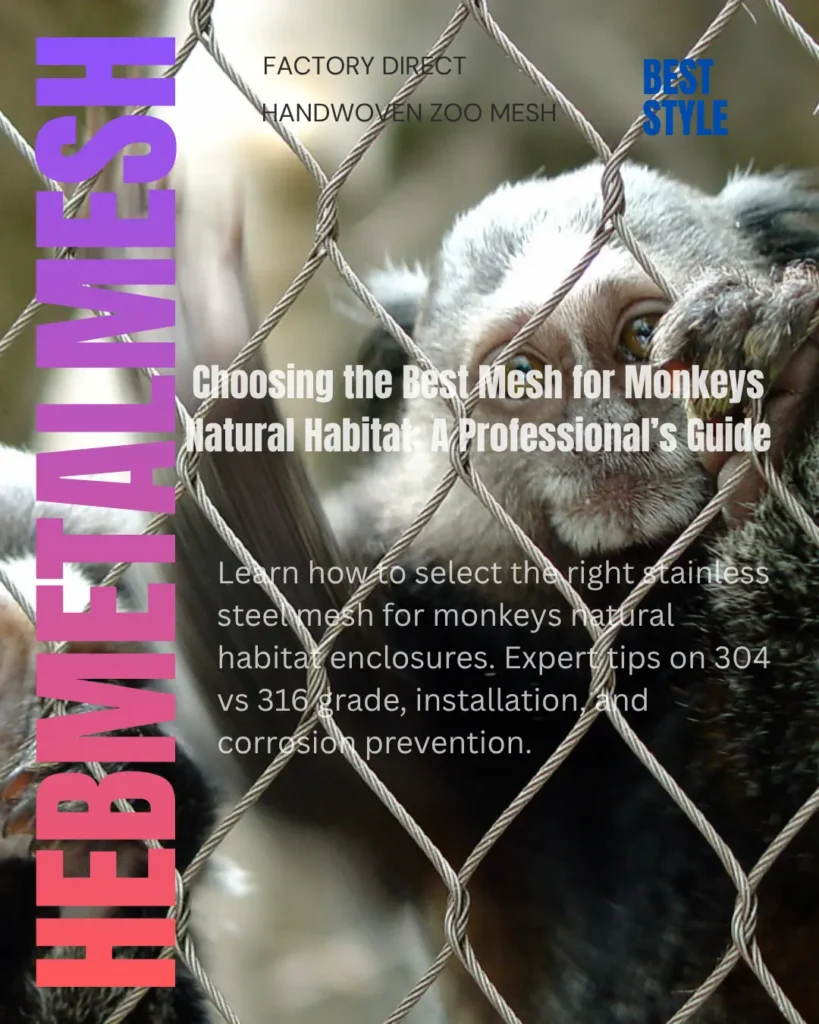
This guide helps zoo curators, sanctuary managers, and procurement professionals select the optimal stainless steel cable mesh for creating secure, long-lasting monkeys natural habitat enclosures. We break down the technical differences between 304 and 316 grades, explain essential wire rope construction specs, and highlight how to avoid low-quality materials to ensure primate safety and long-term durability in any climate.
Understanding the Requirements of a Secure Primate Enclosure
Creating a secure enclosure for a monkeys natural habitat is a delicate balancing act. As facility managers and zoo curators, the primary objective is to bridge the gap between the complex needs of wild primates and the constraints of a managed environment. The goal is to provide maximum enrichment—allowing for natural behaviors like climbing, leaping, and social grooming—while maintaining an absolute, escape-proof perimeter.
Modern design prioritizes animal welfare by utilizing high-transparency materials that allow the public to view animals without obstruction, while simultaneously providing the animals with a “wild” feel. Stainless steel cable mesh has become the industry standard for this purpose. Unlike traditional chain-link fencing, stainless steel mesh is non-toxic, resistant to primate teeth and claws, and offers superior visibility. It acts as a nearly invisible barrier that holds up to the high-energy lifestyle of primates. For a deeper look at how to optimize these structures, explore our comprehensive insights into monkey enclosure mesh.
When planning, you must account for specific species behaviors. A species like the spider monkey, which is highly arboreal and spends its life swinging, requires a different mesh configuration than a terrestrial macaque. For swinging species, you need larger, more flexible spans that accommodate movement, whereas for smaller, inquisitive species like marmosets, the aperture (the opening size of the mesh) must be small enough to prevent limb entrapment or escape.
Material Selection: Engineering the Perfect Barrier
Choosing the right material is not just a procurement decision; it is an engineering choice that dictates the lifespan of your enclosure. From a professional China stainless steel cable mesh factory with 10+ years of export experience, we see too many facilities fail because they chose the wrong grade for their climate.
304 vs. 316 Grade Selection
The golden rule is climate-based. Grade 304 stainless steel is an excellent, cost-effective choice for inland environments where moisture levels are moderate and there is no exposure to harsh chemicals or salt air. However, if your facility is coastal or located in a region with high salinity, 316 grade is mandatory. The addition of molybdenum in 316 steel provides the necessary resistance against chloride-induced corrosion—the primary cause of “tea staining” and rust in seaside zoos.
Technical Deep Dive: 7×7 vs. 7×19 Construction
Beyond the steel grade, the wire rope construction determines how the mesh handles physical stress.
- 7×7 Construction: This consists of 7 strands with 7 wires each. It is semi-rigid and has high breaking strength. We recommend this for static perimeter panels where the mesh is stretched tight and does not undergo constant, repetitive flexing.
- 7×19 Construction: This consists of 7 strands with 19 wires each. It is significantly more flexible and offers superior fatigue resistance. We recommend this for swinging zones or high-activity areas where primates are constantly putting tension on the cables. Using 7×19 prevents metal fatigue and snapping over time.
Comparison Table: 304 vs. 316 Stainless Steel
| Feature | 304 Grade | 316 Grade |
|---|---|---|
| Corrosion Resistance | Good (Inland/Dry) | Excellent (Coastal/Wet) |
| Molybdenum Content | None | 2%–3% |
| Typical Lifespan | 10–15 years | 20+ years |
| Primary Use | General containment | Coastal/Urine exposure |
| Cost | Baseline | Moderate Premium |
By matching the wire rope construction to the activity level of the primates and the chemical nature of the environment, you ensure a safe, long-lasting habitat that minimizes maintenance headaches.
Manufacturing Excellence: Beyond the Surface
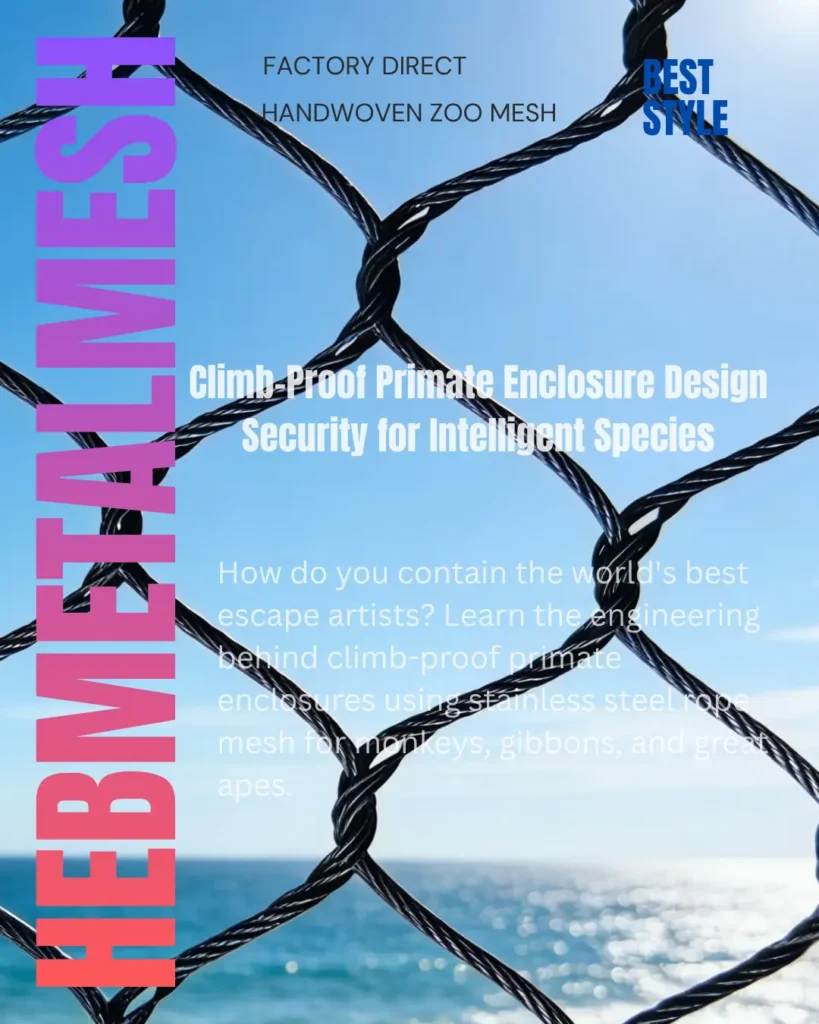
When sourcing materials for a monkeys natural habitat, the surface finish is more than a cosmetic choice—it is a critical barrier against environmental degradation. From a professional China stainless steel cable mesh factory with 10+ years export experience, we have observed that the difference between a pristine enclosure and one plagued by oxidation often comes down to the polishing process.
Electrolytic vs. Mechanical Polishing
We offer two primary finishes for our cable mesh:
- Mechanical Polishing: This traditional method uses abrasive materials to smooth the surface. While it creates a bright, reflective shine, it leaves microscopic grooves that can trap debris, moisture, and primate waste. Over time, these pockets become focal points for surface corrosion.
- Electrolytic Polishing: We highly recommend this for primate enclosures. By using an electrochemical process to remove a microscopic layer of the surface, we achieve a uniform, ultra-smooth finish. This process significantly improves corrosion resistance, as it removes the surface contaminants that mechanical polishing can overlook. A smoother surface means less residue accumulation, which is vital in habitats where animal hygiene is a priority.
Quality Verification and ASTM Compliance
How can you be sure the “316 grade” you are buying is actually 316? We take no shortcuts. We ensure molybdenum content—the key element for corrosion resistance—through rigorous third-party spectral analysis on every batch of raw material.
To guarantee performance, we subject our finished products to accelerated salt spray testing under ASTM B117 standards. By simulating extreme coastal conditions, we verify that our mesh maintains its integrity long before it ever reaches your job site. Our quality control protocol ensures you are investing in a product built to withstand the harshest environments. To see how these specifications fit into your project, feel free to explore our full range of metal mesh products.
Installation and Fabrication: Solving Common Pitfalls
Even the highest-quality stainless steel mesh will fail if it is improperly installed. The longevity of your enclosure depends on the tensioning method and the precision of the fabrication.
Choosing the Right Edge Fixing
We categorize our installations based on three primary fixing methods, each suited to different structural needs:
- Sleeve (Ferrule) System: The industry standard for high-security primate containment. It provides a permanent, mechanical lock that is nearly impossible for monkeys to tamper with or pull apart.
- Buckle System: Offers a high-strength connection while allowing for slightly more adjustment during the initial setup phase.
- Winding (Knot) System: Primarily used for aesthetic or non-structural applications. While beautiful, we generally recommend sleeve or buckle systems for larger, strong-jawed primates.
Troubleshooting Installation
A common mistake in large-scale enclosures is “slack creep,” where oversized mesh panels begin to sag after a few months of usage. To prevent this, we utilize precision-engineered border cables and specific tensioning hardware that allows for periodic tightening. When working on complex geometries, ensure your team utilizes adequate cable grips and distributes tension evenly across all anchor points. For detailed guidance on building a secure structure from the ground up, refer to our guide on designing the ultimate monkey cage.
Aperture Sizing for Species Safety
The most important safety factor is matching your aperture size to the primate species. A “one-size-fits-all” approach leads to disaster.
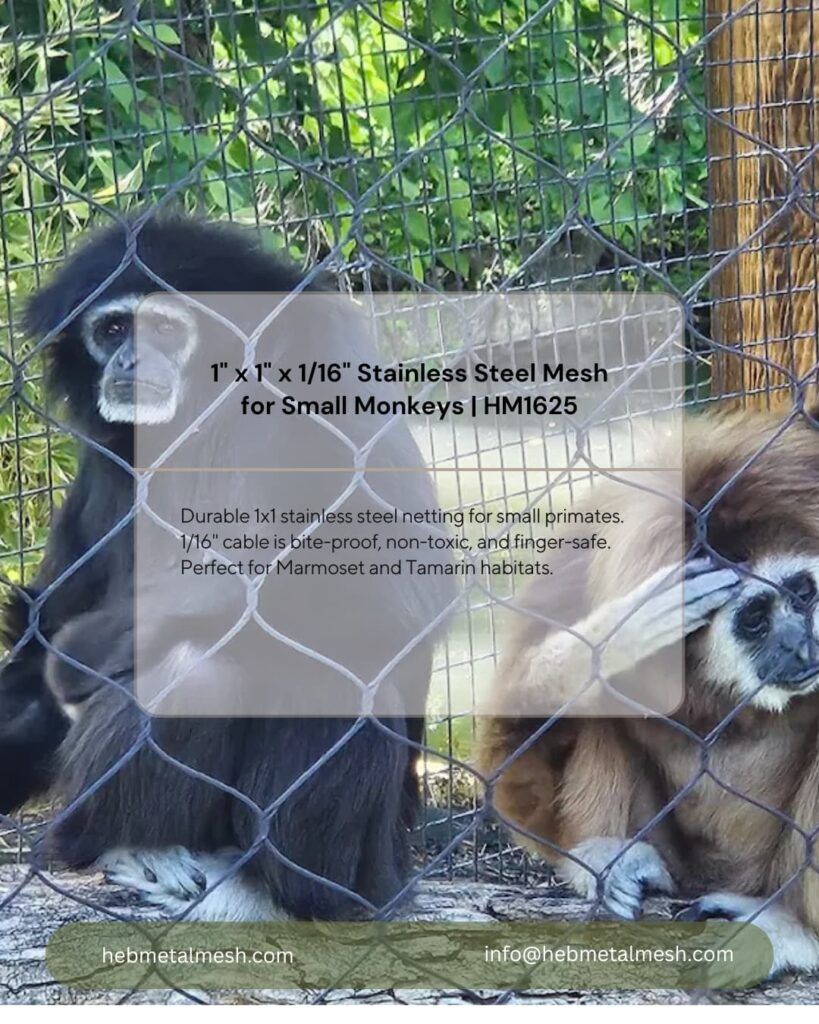
- For Marmosets/Small Primates: We utilize a 25 mm × 25 mm aperture. This prevents the animal from passing limbs through the mesh or becoming stuck.
- For Macaques/Larger Primates: A 51 mm × 51 mm aperture is typically sufficient. This allows for excellent visibility while maintaining the structural rigidity required for larger, stronger animals.
Logistics and Quality Assurance
When you are sourcing high-tensile stainless steel mesh for a monkeys natural habitat, the journey from the factory floor to your job site is as critical as the manufacturing process itself. We understand that mesh panels are large, delicate, and often expensive; therefore, we treat logistics as a vital component of our quality assurance.
Export Packing Standards
From a professional China stainless steel cable mesh factory with 10+ years export experience, we have standardized our packing to eliminate damage during long-haul shipping. Every panel is first secured with protective materials to prevent friction or bending during transit. We then wrap the mesh in high-grade, waterproof plastic film to guard against moisture, salt spray, and humidity—essential for maintaining the surface integrity of your 316-grade stainless steel.
Finally, each unit is mounted on a fumigated, heat-treated wooden pallet. This ensures compliance with international ISPM-15 standards, preventing customs delays and ensuring that your shipment arrives in pristine condition. Whether you are receiving a single crate or a full container, our packing ensures that the mesh arrives flat, taut, and ready for immediate installation.
Upgrading Aging Infrastructure
Many zoos and sanctuaries face the challenge of replacing rusted or failing chain-link fencing. Replacing aging infrastructure does not have to be a full-scale demolition project. By using modular stainless steel panels, you can often “overlay” or replace specific sections of an enclosure without needing to displace your primate groups for extended periods.
When planning an upgrade, prioritize the high-traffic zones—the areas where animals climb, jump, and interact with the mesh most frequently. If your current enclosure is showing signs of fatigue, switching to our high-tensile, hand-woven stainless steel cable mesh can immediately increase both the safety and the aesthetic appeal of your primate habitat. For projects requiring quick deployment, our 1.5×1.5 monkey climbing net serves as a robust, pre-fabricated solution for common enclosure repairs, offering an instant improvement in both durability and animal enrichment.
Key Takeaways
To ensure the success of your primate enclosure project, keep these four essential principles in mind during your planning and procurement phases:
- Grade Matters: Never use 304 in coastal or high-ammonia environments. In areas where animal waste or salt air is present, 316 grade is a non-negotiable requirement for long-term health and structural integrity.
- Construction: Always choose 7×19 wire rope construction for high-activity areas where monkeys exercise most. Its superior flexibility is specifically designed to prevent metal fatigue and snapping caused by constant movement.
- Safety First: Always prioritize certified, UV-stabilized ferrules (sleeves) during fabrication. Using high-quality, professional-grade ferrules is the only way to ensure the structure remains truly “escape-proof” against strong-jawed primates.
- Professional Sourcing: Before finalizing your purchase, verify your factory’s testing standards—specifically ISO 9227 (salt spray testing). Transparent quality data is your best defense against premature material degradation and unexpected maintenance costs.
Frequently Asked Questions
Prevention starts with material selection and surface treatment. By choosing 316-grade stainless steel and opting for electrolytic polishing, you create a smooth, corrosion-resistant surface that rejects contaminants. Regular cleaning with fresh water to remove mineral deposits or uric acid buildup will further extend the lifespan of your mesh.
Aperture selection depends entirely on the size of the primate. For small, nimble species like marmosets, we recommend a 25 mm × 25 mm aperture to prevent limb entrapment. For larger primates, such as macaques or spider monkeys, a 51 mm × 51 mm aperture is usually preferred to provide better visibility while maintaining the strength required for their weight and power.
When selecting mesh for an outdoor zoo, evaluate three factors: the local climate, the specific animal species, and the enclosure size. If you are near the ocean, 316 grade is essential. If the animals are highly active, ensure you specify 7×19 construction for the swinging areas to handle the mechanical load over time.
The best method is using dedicated turnbuckles and heavy-duty perimeter tensioning cables. This allows for precise adjustments during installation and provides the ability to “tighten” the panels if minor slack occurs due to thermal expansion or heavy animal usage.
While 316 grade carries a moderate price premium due to the addition of molybdenum, it is significantly more cost-effective over the life of the project. Using 304 in a corrosive environment often leads to premature failure, meaning you will pay for the cost of replacement and labor within 5–7 years, whereas 316 grade is engineered to last 20+ years.
Need Expert Guidance for Your Primate Enclosure?
From custom aperture sizes to grade selection, we help zoos and sanctuaries worldwide build safe, durable habitats. Get a free project consultation and quote today.
Get Your Custom Quote