
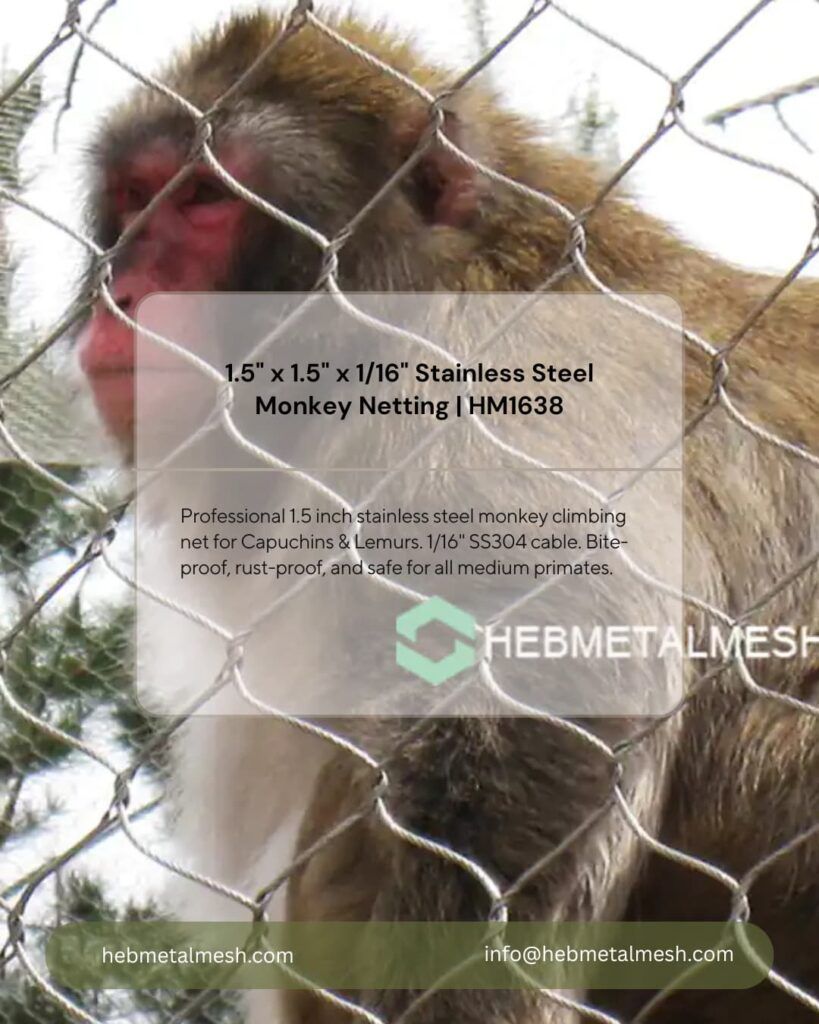
Most monkey escapes are not the mesh giving way. A primate does not push a panel down the way a large cat leans on one; it works at a closing, at a fixing, or at a single strand it can grip and worry. So there is no catalogue item called monkey enclosure mesh to buy. There is a specification to place, and the half of it that decides whether the animal stays inside is the fastening rather than the fabric — the monkey proof hardware, usually left to whoever hangs the panels.
Executive Summary
Buying mesh for a primate enclosure is a specification exercise, not a purchase. Three decisions govern it, and only two live in the mesh. The aperture has to deny the smallest body that will ever be inside, which in a breeding group means a juvenile rather than the adult in front of you. The cable diameter has to survive the strongest mouth and hand working on it, which for a macaque or a baboon is not its body weight. The third decision is the fastening: the clips, bolts, latches and frame details that a monkey will test long before it tests the mesh. The reference specification is the monkey proof enclosure netting product page.
Buying for a primate collection? Send the species, the counts, whether the group breeds and the site exposure. We will return the mesh numbers with a fastener schedule and the fixing faces.
Quick Answer:
Quick Answer: You cannot buy a monkey-proof enclosure; you can only buy a monkey-proof fixing. Set the aperture from the smallest body that must not pass and the cable from the strongest jaw and hand in the collection, then insist the hardware is priced as a line: one-way or captive fasteners with nothing to rotate, no finger gap behind a fitting, non-removable hinge pins, gates with a two-motion latch, and every nut and cut end off the inside face.
Key Takeaways
- A monkey defeats the fixing, not the panel. The enclosure is only as strong as the parts a hand can reach.
- Aperture and cable are independent. The tightest aperture and the heaviest jaw are rarely on the same animal.
- Reach matters as much as force, because a hand passes through an opening a body cannot.
- Nothing on the assembly should be rotatable, hookable, re-usable, tappable or grip-able.
- Hardware is a quotation line, not an installer’s choice. If it is not in the enquiry, it is not specified.
For the species and behaviour facts behind these numbers, the primate research material published by the Smithsonian National Zoo is a sensible starting point.
Why the Panel Is Not the Problem
Mesh is bought on the assumption that the animal will attack the largest part of the barrier. Primates invert that. Their strength is modest next to a large felid’s, but their hands and their patience are not, and the study of primate problem-solving is largely a catalogue of animals opening closures and dismantling objects they were never given a tool for.
The failure record of a monkey enclosure therefore reads differently from a big-cat one. Panels rarely tear out. What fails is a spring clip that was never moused, a wing nut left exposed, a hinge pin that lifts, or a gate closing to its post with a finger-sized gap. When a primate does go through the mesh rather than around it, it goes through one strand, working it until it fatigues — roughly 2% of that strand’s breaking load, which is why the fabric survives and the animal walks to the closure instead.
Three Numbers, and Only Two Are in the Mesh
A specifier who wants to buy monkey proof fixings has to begin with what the mesh must do, and the brief should carry two of those decisions as separate numbers.
| Group | Typical adult mass | Aperture that denies the body | Cable diameter that resists the jaw |
| Marmosets, tamarins, squirrel monkeys | 100 g – 1 kg | 20 mm | 1.2 – 1.6 mm |
| Capuchins, smaller macaques | 1 – 5 kg | 25 mm | 1.6 – 2.0 mm |
| Macaques, vervets, langurs | 4 – 9 kg | 38 mm | 2.4 – 3.2 mm |
| Baboons, mandrills | 20 – 40 kg | 50 mm | 3.2 mm |
The aperture is set by the smallest animal that must not pass, which in a breeding group is an infant, so state the breeding status. The cable is set by the jaw and the hand rather than by body mass, because a primate that grips one wire and hangs on it puts its whole weight onto a single strand, and the same animal may chew that strand at the cross point where two ropes bear. Aperture also settles reach: the tighter the opening, the less a hand gets through, and the fewer fittings within that arm’s length stay reachable.
The first two decisions are mesh specification, covered in detail by the monkey barrier page on this site — aperture for hand safety, gauge by species, height and overhang. This page is about the third.
What the Animal Actually Works On
| Target | What a primate does with it | What closes the hole |
| The opening | Reaches a hand or forearm through it | Aperture below the smallest body that must not pass |
| One strand | Grips, pulls and worries it at the cross point | Heavier cable; a woven panel tolerates one broken wire |
| Cable at a crossing | Chews it; the coating goes first | Heavier cable, and no coating where teeth work |
| A fastener | Rotates a nut, lifts a clip, taps out a pin | One-way, captive or shrouded hardware |
| The closure | Opens whatever a person can open | A two-motion latch, operating point out of reach |
Every row has a hardware answer a buyer can put in writing.
What Monkey Proof Hardware Has to Do
Five rules cover most of the subject, and they apply to every part a hand can touch.
Nothing to turn. Any exposed thread will eventually meet a primate’s fingers. Monkey proof nuts are not a separate product; what exists is a nut that cannot be rotated from inside, such as a shear nut or a nut on a shank that snaps off at a set torque. Monkey proof bolts follow the same logic, and monkey proof fasteners means the same: a bolt is safe when its working end faces out and the inside shows a smooth, flush, non-rotating face.
Nothing to hook. A fitting is only as secure as the gap behind it, and if a fingertip fits between a plate and the frame, the animal has a purchase. Monkey proof clips should be chosen for that gap rather than for price, because a clip with an open mouth is a mechanism, and a mechanism can be learned.
Nothing to re-use. Quick-release hardware is designed to be opened by a person, and a person is not the only animal in the building. Where a release is needed, put it out of reach or behind a cover. Primate proof fasteners are, in practice, fasteners with no free end, no spring action and no gap.
Nothing to tap out. Monkey proof hinges, clevis pins and drop bolts must be non-removable or retained by something a finger cannot defeat. A gate that lifts off its pin is not latched, however good the latch is.
Nothing to grip. A proud bolt head is a step, a lever and an edge at once. Monkey proof frame details should place the head outboard and leave the inside face flush. This is where primate proof hardware differs from ordinary stainless hardware: the specification is not “stainless fittings” but a named fastener, a named head, a stated operating face and a stated gap.
The Closure Is Not a Panel
Doors and gates are the only parts designed to be opened, so they are the only parts where a determined animal has both a target and a lesson to learn. A gate must latch in two motions — lift and turn, press and slide, lift and swing. Monkey proof latches should never work in a single movement, and a monkey proof gate latch should sit on the keeper side, where it cannot be reached, seen or learned from within. Monkey proof locks have the same requirement: the mechanism belongs outside the reachable volume.
The gap between leaf and post should be no wider than the mesh aperture, or a small animal squeezes through the gate line instead of the panel. The gate must also meet the ground through a threshold detail rather than stand above a gap. And the hinge side is a route too: check monkey proof door hardware for a pin that lifts out, because a removable pin turns the strongest gate into the weakest point.
Terminations, Penetrations and Two Metals
A rope panel is generally terminated on an edge cable held by a swage ferrule at each end, and that termination sets the tension the panel carries. It is the strongest point in the assembly and the most interesting one to a hand. A monkey proof ferrule has no accessible seam to work at; a monkey proof wire clamp should be a rated, closed fitting rather than an open U-bolt; and no clamp should present a free end inside the enclosure.
Where a frame is bolted through, the detail is called out the same way: head outboard, flush inside, no exposed hole edge within reach. Two smaller items belong here. A cut rope end leaves a burr on one face, so state whether it is cut outboard or capped. And stainless mesh against a galvanised steel frame forms a galvanic corrosion cell at every contact, so either the assembly is stainless steel rope mesh on a stainless frame, or the contacts are insulated. One drawing habit follows: put aperture tolerance on the schedule, because a woven edge is a run of rope and a slanted panel carries a wider tolerance than a square one.
What to Put in the Enquiry
The brief for a monkey enclosure should carry nine lines: species with counts and breeding status; the smallest body that must not pass; aperture and cable diameter as two numbers; grade and finish, with 304 and 316 chosen by exposure rather than fashion; panel or roll format with a take-off by area; the fastener type and the face it is operated from; the closure schedule, every gate, keeper door and shift door with its latch type; the frame material and whether heads can be detailed flush; and the inspection interval. The four fixing groups — edge cable, ferrules, tensioning hardware and anchors — add 10 to 20 percent to a mesh-only figure. If your facility already has an escape history, the wire mesh for monkey enclosure write-up on this site is the companion read, and the monkey proof enclosure netting reference page carries the mesh side of the same specification.
The other half of the buying question, how panels are fabricated, edged and fixed to their posts, is dealt with on the modular panel system page. For a collection that pushes rather than probes, the gorilla exhibit fence note explains why the load case and the manipulation case are specified separately.
Inspection and the Two Things That Move
Two things move in service, and both are inspection items rather than design items. Cable tensioning is the first: tension loss accumulates through the first season as ropes settle and panels creep, which is why a panel that cannot be re-tensioned was mis-detailed when ordered. The second is abrasion at the cross point, where a hand works the same two ropes against each other.
A weekly round should check every fixing and every closure, look for a polished crossing, and log a loose strand in a defect register. Repair needs parts, so order spare panels and hardware with the first delivery; reordering a specific fastener in year three is far harder than reordering mesh.
Frequently Asked Questions
Not every one, but enough of them. A primate learns a mechanism, and one that works in a single motion will be learned. Assume any fastener visible from inside will eventually be operated.
It needs the widest part of its body to fit, which for an infant is far less than the adult beside it. That is why the aperture follows the smallest animal that must not pass, and why a gate line must be held to the same number as the mesh.
Not panel after panel, but they do work at rope — at a cut end, at a loose strand, and at the crossing where two ropes meet. A hand-woven panel is forgiving: one broken wire costs about 2% of that strand’s capacity, so the panel stays tensioned.
Rolls suit long, straight runs on simple frames; panels suit an enclosure divided into bays with fixed connection points. Either way, write the fastener and the fixing face into the order.
Where to Go From Here
The mesh is the easy half. Send the collection, the smallest animal that must not pass and the site exposure, and the aperture, cable, grade and panel format follow. Then insist on the other half in writing — the fastener, the closure and the fixing face — because that is the part an escape will test.
Specify the whole enclosure, not just the panel. Send the species, the counts, the smallest animal that must not pass and the site exposure, and we will return the mesh numbers with a fastener schedule. Start the conversation.