
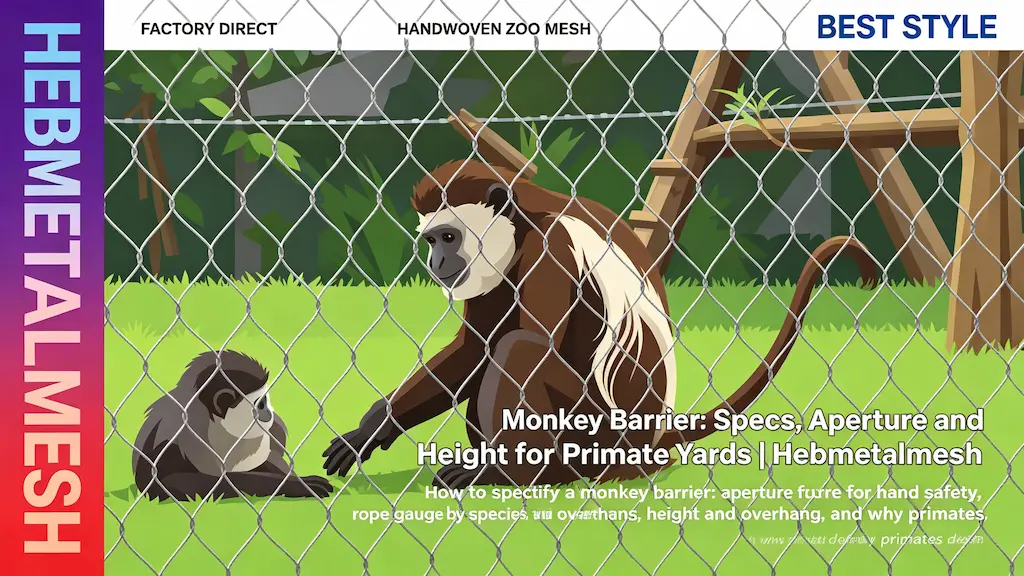
A monkey barrier is not judged by whether it holds a monkey in — most rigid materials manage that on day one. It is judged by whether it still holds one in after five years of a troop that tests every latch, works every seam, learns every loose strand, and can pass an object through a gap you did not know existed. That is why the specification starts with hands and gap geometry rather than with strength: the animal is an escape artist with opposable thumbs, and the barrier has to defeat the hand before it defeats the body.
Executive Summary
Primate enclosures fail for two reasons that have nothing to do with breaking strength. The first is aperture: an opening that contains a marmoset may still admit a child’s arm on the other side, and an opening that stops a macaque’s body may still let it reach through and pull. The second is geometry: a vertical face is a climbing wall, and a mesh that a monkey can push outward becomes a step. A working monkey barrier therefore resolves aperture to the hand, adds a standoff or a second layer where the public can reach, runs unbroken to the canopy level, and is tensioned on a closed perimeter so nothing deflects into reach. The reference specification is the monkey enclosure netting product page.
Quick Answer:
What is the best monkey barrier for a zoo exhibit? Hand-woven stainless steel rope mesh, sized by species — 1.6 mm rope at 25 mm for marmosets and tamarins, 2.0 mm at 38 mm for squirrel monkeys and small cercopithecines, 2.4 mm at 38 mm for macaques and gibbons, and 3.2 mm at 51 mm for baboons and large macaques. Where the public can reach the mesh, add a standoff line or a second layer so no hand gets through, and specify SS316 in humid or coastal climates.
Key Takeaways
- Aperture is a hand problem, not a body problem. Resolve the opening to the smallest hand on either side of the fence.
- Deflection is containment failure. A mesh that pushes outward under weight becomes a ledge and then a gap.
- The top matters more than the middle. Most escapes happen at the crown, the corners, or the door.
- Gauge follows species energy, not body mass. Brachiating and leaping primates load a barrier differently from terrestrial ones.
- Primates learn. Any detail that can be worked loose eventually will be, so design out the loose-able parts.
Primate welfare and public safety are both covered by published accreditation standards, and the Smithsonian National Zoo is one of the institutions whose primate work and enclosure practice are publicly documented.
Why Primates Defeat Ordinary Barriers
Every other enclosure type on a zoo site is designed around an animal that pushes, bites, or charges. Primates do all three and add two more: they grip, and they learn. A welded panel that would hold a hoofstock animal indefinitely will be worked at its welds by a troop that has nothing else to do on a Tuesday afternoon, and a knotted plastic net is a toy.
That behavioural profile changes what “adequate” means. The test is not a static load case but a persistent one, applied at the same point by the same animal for weeks. It is also why troop size belongs in the specification: a group of four tests a boundary far less intensively than a group of twenty, and the number of animals changes both the duty cycle on the mesh and the social pressure that drives exploration of the edges.
Aperture and the Hand Problem
Start with the smallest hand that will ever be near the fence, because that is the constraint that governs everything else. On the animal side, an infant primate’s hand sets the lower bound. On the public side, a child’s arm sets it. Where those two requirements conflict — and for larger species they usually do — you resolve it with geometry rather than by picking a compromise aperture.
The two tools are the standoff line and the double net system. A standoff line keeps the public far enough back that an outstretched arm cannot reach the mesh at all; a working hand clearance figure is around 600 mm from any surface a visitor can stand on. A double net system runs a second, tighter layer offset from the first, so the outer layer denies the hand while the inner layer does the containment. Both are standard in monkey barrier for zoos work, and both are cheaper than the incident that follows not doing either.
Rope Gauge and Code by Species
Monkey containment mesh is selected from the same code grid as every other stainless rope mesh, and the two numbers that matter are rope diameter and aperture.
| Primate group | Rope diameter | Aperture | HM code |
| Marmosets, tamarins | 1.6 mm | 25 mm | HM1625 |
| Squirrel monkeys, small guenons | 2.0 mm | 38 mm | HM2038 |
| Macaques, langurs | 2.4 mm | 38 mm | HM2438 |
| Gibbons, siamangs | 2.4 mm | 51 mm | HM2450 |
| Baboons, large macaques | 3.2 mm | 51 mm | HM3250 |
Brachiating species are the exception to the table above: the gibbon enclosure netting range is built around long unbroken spans at canopy level rather than around a single face. Gauge is set by energy rather than by weight. A 3.2 mm rope carries roughly 7 kN and a 2.4 mm rope about 4.4 kN, and the reason a leaping or brachiating species needs the heavier figure is the dynamic load it delivers on landing, not the kilograms it weighs standing still. Where a collection spans several sizes, specify to the smallest species present and use the heavier code only on the faces that take the impact — this is the usual monkey barrier specification approach for mixed exhibits.
Height, Crown and the Enclosed Yard
A monkey barrier height decision is really a decision about whether the yard is open-topped or fully enclosed. Small species and any exhibit without a reliable electric or overhang detail should be fully enclosed, with the mesh carried over the crown. Larger species can run open-topped, but only with a genuine inward overhang — the top 600–900 mm leaning in at 45–60° — because a vertical crown is simply the last rung of a ladder.
Where the enclosure is planted, the canopy level becomes part of the barrier. Trees inside the yard have to be pruned or positioned so that no branch, and no swaying branch, brings a monkey within reach of the mesh. Leave real sway clearance between the farthest foliage and the panel, and check it after a season of growth rather than at planting.
The same rule applies to the monkey run — the narrow connecting enclosure that links an outdoor monkey yard to its indoor night quarters. Runs are often built as an afterthought and are the commonest escape point on a site, because they are low, narrow, and full of door hardware.
Structure, Tension and Deflection
A hand-woven panel is flexible by design, and that flexibility is what lets it absorb a landing instead of resisting it. It is also the reason the frame has to be stiff. Monkey barrier panels should hang from a closed, tensioned perimeter — tube steel or a catenary cable — sized so the mesh never becomes part of the load path, and so that the whole face returns flat after being loaded.
What you are controlling is mesh deflection. A panel that bows outward under a climbing animal does three bad things at once: it opens a gap at the edge, it gives the next animal a handhold, and it slowly works the seaming rope. Aim for a face that deflects under load and recovers, and re-tension after the first season because a new panel settles.
Climbing structures inside the yard are fine and necessary, but they must be independent of the mesh. A climbing frame bolted to the barrier transfers every landing into the fence and hands the troop a lever. Build it freestanding, keep it clear of the panel, and anchor it to its own footing.
Doors, Shifts and Night Quarters
Most primate escapes happen at a door, not in a panel. Every opening into the yard needs a guillotine door or a sliding leaf that a keeper operates from outside, with a latch the animals cannot work from inside — primates defeat spring catches, so the standard is a pinned or locked fitting rather than a sprung one.
Night quarters need the same attention as the day yard. A holding area that is only mesh-and-light is not a retreat; give it a solid visual barrier on at least one side so subordinate animals can break line of sight, and a feeding platform at height so the dominant animals cannot monopolise the food. Where infants are hand raising cases, the mesh on the holding side needs to be the tightest code in the project, because an infant will pass through an opening that contains an adult.
What It Costs
Monkey barrier cost tracks gauge and aperture in the same way as every other stainless specification: tighter apertures use more rope per square metre, and heavier gauge costs more at the same opening. Primate work sits between the aviary-grade planning band of roughly $10–22 per square metre and the carnivore-grade band of $20–38, depending on where in the code grid the species lands. Frame steel, doors, and roof structure sit on top and are usually the larger line.
Alloy is a site decision rather than a species one. SS304, at roughly 18% chromium and 8% nickel, is adequate inland; SS316 adds molybdenum and is the correct call in humid, tropical, or coastal locations and in any yard washed down with chlorinated water. The threshold is set out in our 304 vs 316 mesh comparison.
The two items institutions forget to budget are the sample panel — checked in the exact code before the production run — and a first-season re-tension visit. Both cost very little relative to the project and both prevent the failure mode that a monkey barrier design is meant to avoid.
Frequently Asked Questions
Hand-woven stainless steel rope mesh sized by species, with a standoff or second layer wherever the public can reach the mesh. Resolve the aperture to the hand, not the body.
25 mm for marmosets and tamarins, 38 mm for squirrel monkeys, macaques, and langurs, and 51 mm for gibbons and baboons. Where a child’s arm could reach, add a standoff line instead of shrinking the mesh.
Fully enclose small species, and for open-topped yards carry the barrier to working height with a genuine inward overhang of 600–900 mm at 45–60°. Height without an overhang is a climbing wall.
Not universally, but it is the standard answer wherever the public can approach the mesh. The outer layer denies the hand; the inner layer does the containment.
Specify to the smallest species present so nothing escapes, and use the heavier gauge on the faces that take dynamic loads from leaping or brachiating animals.
Primate specifications land between the aviary band of about $10–22 and the carnivore band of $20–38 per square metre, depending on gauge and aperture. Frame, doors, and roof structure are additional.
The Bottom Line
Specify for the hand, then for the geometry, then for the load. A monkey containment barrier that denies a grip, keeps the public behind a standoff, carries its mesh over the crown or under a real overhang, and hangs on a stiff tensioned perimeter will hold a troop for decades — and it will do it without looking like a cage. Our zoo containment barrier guide covers the public-side geometry in more detail, the hand woven fencing guide explains why the interlace outlasts a weld or a crimp, and our tiger habitat guide shows how the same space-and-enrichment logic applies to a large carnivore yard. The full monkey enclosure netting range lists every code.
Ready to specify your primate yard? Contact our enclosure team with your species list and yard dimensions.