
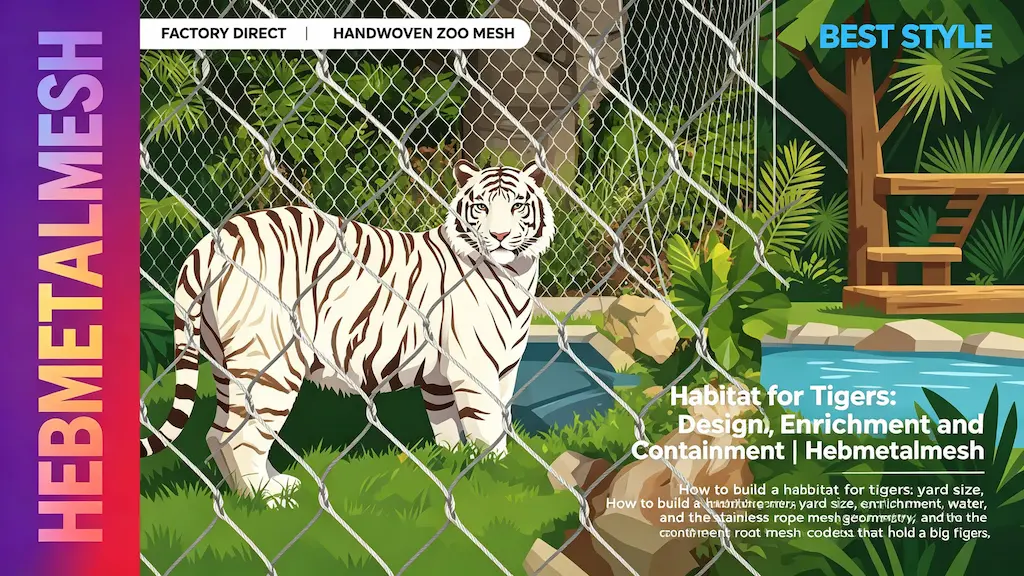
A habitat for tigers is judged by behaviour, not by floor area. The question is not how big the yard is but whether the cat in it patrols, swims, climbs, and rests in different places across the day — and whether the boundary doing the containing disappears from the visitor’s view while it does so. Five decisions get you there: how much ground and vertical volume you give the animal, what the microclimate does in August, how the enrichment programme is rotated, where the paw reach line falls, and which mesh code carries the load. Get the first four right and specify the fifth badly, and you still end up with an enclosure nobody trusts.
Executive Summary
Modern tiger yards fail in predictable ways: too flat, too hot, too bare, and too visible. Building a habitat for tigers that works means giving the animal several hundred square metres of outdoor ground per cat with real vertical structure, water it can enter, shade it can choose, and a den structure it can withdraw into — then enclosing all of it in a barrier that neither the cat nor the public can read as a cage. The mesh decision is the last one, not the first, but it is the one that determines whether the rest of the design survives contact with a 200 kg animal. The reference specification is the tiger enclosure netting product page.
Quick Answer:
What does a habitat for tigers need? Several hundred square metres of outdoor ground per animal with varied terrain, a water body the cat can enter, deep shade and a heated den structure, vertical climbing structure up to 3–4 m, and a rotation of enrichment that changes what the animal investigates each week. The boundary should be hand-woven stainless rope mesh at 3.2 mm rope and 76 mm aperture, at least 5 m high with an inward-leaning overhang, on SS316 in humid or coastal climates.
Key Takeaways
- Space is measured in usable volume, not footprint. Flat ground of any size is under-enriched; a smaller yard with real climb height is better used.
- Water and shade are welfare items, not landscaping. Tigers are the only big cats that routinely enter water, and heat load drives whether the yard is used at all in summer.
- Enrichment only works if it changes. A static yard becomes furniture to the animal within weeks.
- Paw reach, not body size, sets the aperture. A tiger hooks with a forepaw; the opening has to deny that.
- Panel height and overhang are geometry decisions. A 5 m vertical with no overhang is a climb, not a barrier.
The species is not abundant enough for enclosure design to be a purely local matter — the tiger is listed as Endangered, and the International Union for Conservation of Nature maintains the Red List assessment that frames why captive breeding space matters at all.
Ground, Volume and Habitat for Tigers Size
Habitat for tigers size starts with the animal’s ranging behaviour, and good habitat for tigers design follows the range rather than the shape of the available land. A tiger is a solitary territorial cat that covers ground in a shifting loop rather than patrolling a fixed line, so the shape of the yard matters as much as its area. A long narrow run produces pacing; a broad yard with two or three sightline breaks produces patrolling. The working range for a modern outdoor yard is several hundred square metres per animal, but what turns area into usable habitat is relief — a raised mound, a fallen-log platform, a rock outcrop that gives the cat a place to sit above its own ground.
Vertical structure is where most older exhibits fail. Tigers climb more readily than their reputation suggests, and climb height in the 3–4 m range is achievable with a suitably braced log or rockwork. Every elevated platform needs two things designed in from the start: a route down that does not put the cat next to the boundary, and enough clearance that a cat on the platform cannot reach the mesh.
Water, Shade and Microclimate
Water, shade and shelter are habitat for tigers requirements rather than optional extras. Tigers swim, and they swim often. A pool large enough for the animal to fully immerse — not a drinking bowl — is one of the highest-value features in any outdoor habitat for tigers, because it simultaneously delivers enrichment, thermoregulation, and a behaviour visitors recognise. It also has to be serviceable: filtration accessible from outside the yard, and a drain line a keeper can clear without entering the enclosure.
Shade has to be structural rather than incidental. Naturalistic planting gives dappled cover but takes years to mature and gets destroyed by the cat; a purpose-built shade structure over part of the yard gives immediate relief. In hot climates, plan for a cooled indoor den structure as well, so the animal can retreat from peak heat rather than being shut in and losing yard access for the whole afternoon.
Enrichment That Changes
A static enclosure is a furnished room, and the animal learns it in a fortnight. Habitat for tigers enrichment works on a rotation: scents moved between sites, feed delivered in ways that require work, novel objects introduced and removed, and substrate changed in a corner of the yard. An enrichment rotation calendar is the cheapest welfare upgrade available to most institutions, and it costs staff time rather than capital.
Planting deserves a specific note. In a zoo habitat for tigers, naturalistic planting inside the boundary is largely sacrificial — the cat will destroy it — so the usual approach is to plant densely outside the boundary for screening and to use robust structural elements inside. What matters is that the animal has options: something to scratch, something to submerge in, something high to sit on, and somewhere it cannot be seen.
Containment Geometry: Height, Overhang and Paw Reach
Habitat for tigers barrier design is geometry before it is material. The working figures are a minimum barrier height of around 5 m on the public faces, with the top 600–900 mm leaning inward at roughly 45–60°. That overhang is what defeats a climbing cat: a vertical face is a ladder, an inward lean is not. Corners need particular attention, because two meeting faces give a cat a brace to push against.
The second geometric constraint is paw reach. A tiger does not need to fit through an opening to be dangerous — it needs to get a forepaw through and hook. At the visitor interface, that means either a small enough aperture to deny the paw, or a standoff that keeps the public beyond the reach line. This is the single most common reason a compliant-looking barrier is still not safe.
Finally, the yard needs a transfer chute linking it to the holding area, sized so a cat can be shifted without sedation and with a guillotine door that a keeper operates from outside. Tiger yard fencing details matter less than this: most incidents happen at doors and shifts, not in the middle of a panel.
Choosing the Mesh
Habitat for tigers mesh selection comes down to three numbers. Rope diameter sets the impact capacity — 3.2 mm rope carries roughly 7 kN, which is the figure that matters when a 200 kg animal hits the boundary at speed. Aperture sets the containment: 76 mm is the standard for tigers and lions, while the 51 mm code is preferred for leopards and for any face where a paw must be denied outright. Habitat for tigers fencing on the public faces typically runs the 76 mm code at 3.2 mm rope, HM3276, with HM3250 used where the reach line is tighter; both codes appear in the tiger enclosure netting range.
The third number is the alloy. SS304 at roughly 18% chromium and 8% nickel is adequate inland; SS316 adds molybdenum and is the correct call in humid, tropical, or coastal locations, and in any yard washed down with chlorinated water. Our 304 vs 316 mesh comparison covers the threshold. The same specification logic applies across the big cats — see the lion enclosure netting and leopard enclosure netting ranges for how the code shifts with body size and climbing habit.
Panels, Sightlines and Keeper Access
Habitat for tigers panels are woven to the yard rather than cut from stock, and they run up to roughly 9 m by 18 m — about 30 ft by 60 ft — in a single piece. That matters for two reasons. A full-height barrier face can hang as one seamless panel with no horizontal joint for a cat to work at, and the absence of intermediate posts keeps the sightline clean from the viewing area. A cat behind a mesh with a post every two metres reads as caged; the same cat behind a single uninterrupted span reads as being in a landscape.
Keeper access has to be designed rather than added. Service gates should open away from the animal side, shift doors should be operable from outside the yard, and every hinge and latch should be stainless — a galvanised fitting in a wet cat enclosure will stain and then fail inside a few seasons. Where the mesh meets a structure, close the gap; cats test edges, and the junction between a panel and a wall is where they start.
What It Costs
Habitat for tigers cost is dominated by groundworks, water, and structures rather than by the mesh. Carnivore-grade hand-woven stainless runs roughly $20–38 per square metre as a planning range for the mesh itself, and the total project is typically several multiples of that once excavation, pool plant, rockwork, and shade structures are counted. The useful exercise is to price the boundary once at the correct code and once at the cheapest alternative, then divide by thirty years — at which point the boundary stops being the line item worth attacking.
Habitat for tigers planning should also budget for the two things institutions routinely forget: a sample panel in the exact code, checked before the production run, and a first-season re-tension visit, because a new panel settles.
Frequently Asked Questions
Plan on several hundred square metres of outdoor ground per animal, but treat shape and relief as equally important. A broad yard with sightline breaks and real climb height is used far better than a larger flat run, which tends to produce pacing.
One with water the cat can fully enter, structural shade over part of the yard, and a cooled indoor den structure, so the animal keeps yard access through peak heat. Microclimate decides whether a yard is usable in summer.
3.2 mm rope at 76 mm aperture, HM3276, for most faces. Move to 51 mm, HM3250, where the paw reach line has to be denied, and specify SS316 in humid, tropical, or coastal locations.
Not strictly, but it is the single highest-value feature in an outdoor habitat for tigers. It delivers enrichment, cooling, and a natural behaviour visitors recognise. Design the filtration for servicing from outside the yard.
Yes — panels are woven to the drawing up to about 9 m by 18 m, so an existing face can usually be re-clad as a single seamless panel rather than pieced from stock.
The Bottom Line
The best habitat for tigers is the one the cat uses end to end: ground it patrols, height it climbs, water it enters, shade it chooses, and somewhere it can disappear. Build those in first and the containment becomes a straightforward specification exercise — 3.2 mm rope, 76 mm aperture, five metres with an inward overhang, SS316 where the air is wet, and panels woven full-height so there is no seam to work at. Our zoo containment barrier guide covers the public side of that boundary in detail, and the hand woven fencing guide explains why the interlace outlasts a weld or a crimp.
Ready to specify your tiger yard? Contact our enclosure team with your yard dimensions and animal numbers.