
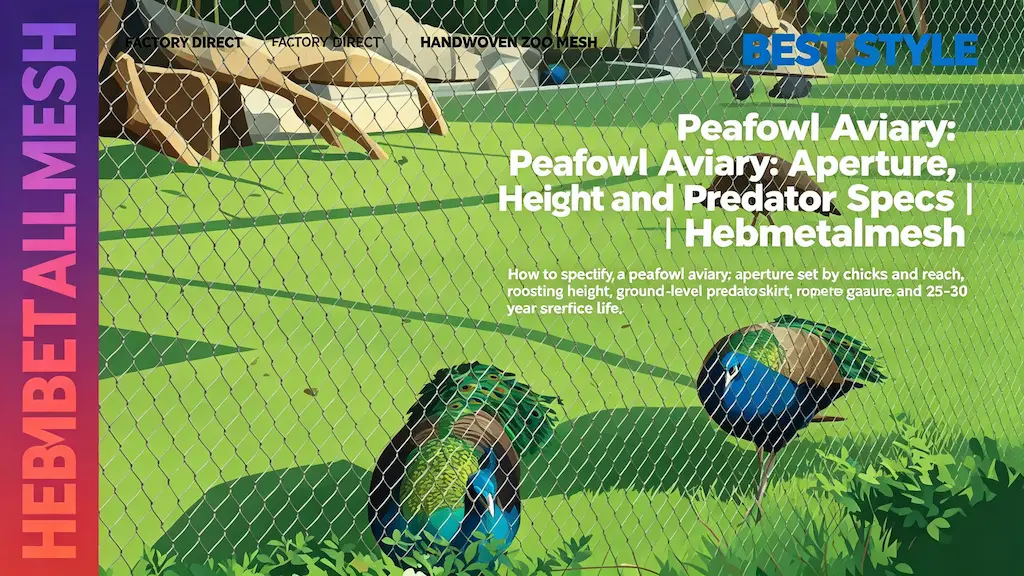
Peafowl break enclosures in a way no other large bird does: they fly up rather than out. A peacock launches vertically, clears two metres from a standing start, and spends the night on a branch. That single habit sets the height, the aperture, and the ground detail of any peafowl aviary — and it is why so many otherwise well-built enclosures end up with the birds on the roof and a net that was never asked to do that job.
The second thing to plan for is the display fan: a mature male drags up to 1.5 m of feather behind him, and the mesh cannot have a burr, a weld nub, or a cut end anywhere near it, because the feathers will find it.
Executive Summary
Talk to an enclosure engineer before you fix the fence line. Send your bird numbers, plan dimensions, and site climate — we will return a marked-up specification with codes, break forces, and a budget price. Contact Hebmetalmesh
A peafowl aviary has four requirements pulling in different directions: tall, because the birds roost high and fly up; fine at the bottom, to hold peachicks and refuse a fox; smooth, because a long train catches on anything raised; and forgiving, because a startled peacock hits the boundary at speed.
Hand-woven rope mesh answers all four: it spans tall without intermediate joints, has no weld or crimp to snag feathers, and absorbs impact rather than returning it.
Quick Answer:
A peafowl aviary should run 3 m or more in height, with the top closed or fitted with a 600–900 mm inward overhang, on 38 mm aperture at 2.0 mm rope in SS304 or SS316. The bottom 600 mm should be finer — 25 mm — to hold peachicks and refuse foxes and rats. Use 2.4 mm rope for large free-ranging runs and mixed collections. Panels weave to about 9 m by 18 m in one piece; correctly tensioned, the mesh lasts 25–30 years. Those three numbers are the peafowl aviary specification in full.
Key Takeaways
- Peafowl fly up, not out. Height and a closed or overhung top matter more than perimeter strength.
- The bottom 600 mm is a different specification. Chicks and foxes set it, not the adult bird.
- The train sets the finish. No welds, crimps, or cut ends where a male walks.
- Gauge buys stiffness, not strength. Even 1.6 mm rope exceeds what a 6 kg bird can break.
- Grade is a site decision. SS316 for coastal, tropical, and chlorinated washdown; SS304 inland.
- Roosting bars drive the plan. Birds need a high, dry perch away from the mesh.
What peafowl actually do to an enclosure
Peafowl are heavy, strong fliers that live on the ground: an adult weighs 4–6 kg, forages by scratching, and roosts off the ground every night. Four behaviours follow, and each is a line in the specification.
They launch vertically. A peacock needs no run-up: from a standing start it clears two metres and reaches a branch or a rooftop, so a 2 m wall is not a wall. Anything below about 3 m is an enclosure you have decided to wing clip for — a management choice, not a design one.
They roost high. Roosting bars at 2.5–3 m are the difference between a calm bird and a stressed one. Place them away from the mesh: a bird that can reach the net from its perch will work at it all night.
They scratch and dust-bathe. Ground foraging and a dust bath keep the substrate at the fence line disturbed, and the bottom of the panel takes abrasion from grit and claws.
They grow a long train. Train length on a mature male reaches 1.5 m, carried and dragged for months each year. Barbs catch on anything raised — a weld nub, a cut wire end, a misaligned crimp. That is the strongest argument against welded and ferruled mesh here, and it has nothing to do with strength.
Aperture: chicks and reach, not the adult
Peafowl aviary aperture is usually chosen by looking at the adult, which is the wrong reference. A 51 mm opening will not pass the body or skull of a mature bird; the problems are everything else.
- Peachicks are the escape artists. A week-old chick passes openings an adult cannot, repeatedly. If you rear in the enclosure, the mesh must be chick-tight.
- Reach works inward too. A fox does not need to get in, only to reach in and take a chick or an egg — the same number holds both.
- The head still matters. A bird that can push its head through can be grabbed from outside, and one that gets it stuck is a real injury risk.
The practical answer is two zones. Run 38 mm as the field aperture: it refuses an adult head and blocks most reach while reading as near-invisible at ten metres. Run 25 mm through the bottom 600 mm, which holds chicks in and keeps foxes, rats, and corvids out. Reserve 51 mm for the outer face of a large free-ranging run with no chicks reared.
If the budget allows one change, take the fine bottom band before heavier rope: a chick that cannot leave and a fox that cannot reach are worth more than breaking load you will never use.
Gauge, and why height is the hard part
Peafowl aviary gauge is chosen on stiffness and abrasion, not strength. A 6 kg bird cannot break a 1.6 mm rope; figures run roughly 4.4 kN at 2.4 mm and 7 kN at 3.2 mm — enormous margin. What gauge buys is how well a tall panel holds its shape and how long it survives grit at the base.
| Application | Aperture | Rope Ø | Code | Notes |
| Chick-rearing pen, bottom band | 25 mm | 1.6 mm | HM1625 | Bottom 600 mm of any run |
| Standard zoo peafowl aviary | 38 mm | 2.0 mm | HM2038 | Default for adult displays |
| Large free-ranging run | 38 mm | 2.4 mm | HM2438 | Where spans are long |
| Mixed collection with primates | 38 mm | 3.2 mm | HM3238 | Stiffness and abuse |
Every code above appears in the peacock enclosure mesh range; a peafowl aviary supplier should quote all four columns from your drawing without a round of questions.
Peafowl aviary height is where projects go wrong. 3 m is the working minimum for a wing-clipped or habituated group; 4–5 m is correct for fully winged birds, because it puts the roost and the flight path inside the mesh rather than above it. Above 5 m, add value only if the plan area supports a real flight — height over a small footprint simply gives the bird more wall to hit.
The top is not optional. Either close it with the same mesh, which is the right answer wherever foxes, corvids, or birds of prey are present, or fit a 600–900 mm inward overhang. An open top with a vertical lip does not work: a launching peacock goes straight up and over.
Peafowl aviary size in plan follows the birds rather than the mesh. Allow generous ground area for ground foraging and a dust bath, keep the roosting bar high and dry, and site both away from the fence line so the mesh is not a perch or a wall the birds pace along.
Ground level and predators
The base detail decides whether the enclosure works, and it is where most specifications are silent.
- A fine bottom band at 600 mm handles chicks and predators reaching in.
- Bury or skirt the base. Fox proof means a pinned skirt turning outward at the foot, or an apron buried 300 mm. A terminated panel invites digging.
- Rats are the chick killer. Rat proof at the base of a rearing pen is 25 mm or finer with no gaps at the door.
- Watch the gate. Peafowl test gates constantly, and a gap under a door leaf is the commonest escape route in a sound aviary.
Where the collection is free ranging, height and roosting matter more than perimeter. Birds let out by day return to a high roost at dusk if one is inside the enclosure; without it they find the nearest tree, usually outside.
Alloy, panel size and installation
Peafowl aviary grade is a site decision. SS304, roughly 18% chromium and 8% nickel, suits inland and temperate sites. SS316 adds molybdenum, typically 2–3%, resisting chloride pitting on coastal sites, in tropical humidity, and under chlorinated washdown. Both are austenitic and both outlast the frame. The full comparison is in our 304 vs 316 mesh guide.
Avoid galvanized wire. Peafowl peck and scratch at the base of a panel constantly, and zinc is a cumulative toxin in birds.
Custom peafowl aviary panels are the default rather than an upgrade. Woven to the exhibit rather than cut from stock, they run up to about 9 m by 18 m in one piece, so a full-height face hangs as a single panel. That matters here: a horizontal joint is a ledge, and a bird roosting at 3 m meets it at chest height. Take each panel as tall as the design allows, and never trim before installation — only after all four edges are fixed, or the geometry pulls out of square.
Peafowl aviary installation runs in a fixed order: brace the frame plumb; hang the field slack; work outward from the centre of each run so the geometry evens up; tension the perimeter cable, then the field. A peafowl aviary frame must be in the same alloy family as the rope — a stainless panel on galvanized clamps has installed a five-year component inside a thirty-year barrier.
Peafowl aviary tension is set by feel. Too slack and the panel sags into a pocket a wing catches in; too tight and you preload the rope until it stops absorbing impact. Aim for a face that deflects under a firm push and returns flat, and re-tension at twelve months.
Cost and lifespan
Peafowl aviary cost tracks kilograms of stainless per square metre, which tracks rope diameter against aperture. A 1.6 mm rope at 25 mm is the light end and 2.0 mm at 38 mm the standard. Planning ranges for aviary work land around $10–22 per square metre, with a tall peafowl exhibit mid to upper band because height puts many square metres on every linear metre.
Two items belong in the budget and usually are not: the sample panel, and the first-year re-tension. Skipping the first is how a project discovers an aperture or finish problem after installation.
Peafowl aviary lifespan is 25–30 years. Peafowl aviary maintenance is washing once or twice a year with fresh water plus tension checks — more often on coastal or dusty sites — and there is no coating to renew. Our bird exhibit mesh guide sets out the same arithmetic across the wider bird collection.
Sizing a peafowl exhibit next to the rest of the collection
Peafowl sit at the awkward end of an avian collection: too heavy for finch-grade netting, too ground-oriented for a raptor specification, and likelier to go over the top than through it. The roosting and flight problem is closer to a crane enclosure, where height and a startled, heavy body set the terms. The snagging problem is unique to the train. And the base-detail work — fine band, skirt, gate sweep — is the same discipline a primate enclosure demands at ground level, for the same reason: the smallest animal in the plan sets the aperture.
Start from the ground: fix the substrate, dust bath, and drainage, set the bottom band for chicks, take the roost inside the mesh, then choose the gauge. That order avoids the two mistakes that are expensive to correct later — an open top, and a base that is not chick-tight. The peacock enclosure mesh catalogue lists every code and break force, and the bird netting page covers the rest of the collection.
Frequently Asked Questions
3 m is the working minimum for wing-clipped or habituated birds; 4–5 m is correct for fully winged stock. Peafowl launch vertically, so a 2 m wall is not a barrier.
25 mm through the bottom 600 mm of any enclosure where chicks are reared; it also stops foxes reaching in and keeps rats out.
Only with a 600–900 mm inward overhang and habituated birds. Close it with the same mesh wherever foxes, corvids, or raptors are present.
SS304 inland and temperate; SS316 near the coast, in tropical humidity, or with chlorinated washdown. Never galvanized — zinc is a cumulative toxin in birds.
No. Break loads run roughly 4.4 kN at 2.4 mm and 7 kN at 3.2 mm. Gauge is bought for stiffness over a tall span and abrasion life at the base, not for strength.
How long does the mesh last? 25–30 years. Washing once or twice a year plus periodic re-tensioning; no coating to renew.
Get a marked-up specification for your peafowl exhibit. Send your bird numbers, plan dimensions, and site climate. We will return codes, break forces, panel sizes, and a delivered price — no obligation. Request a quote from Hebmetalmesh
Hebmetalmesh weaves hand-woven stainless steel rope mesh to order for zoos, aviaries, and wildlife facilities. Husbandry guidance referenced in institutional work is published by the Association of Zoos and Aquariums.