
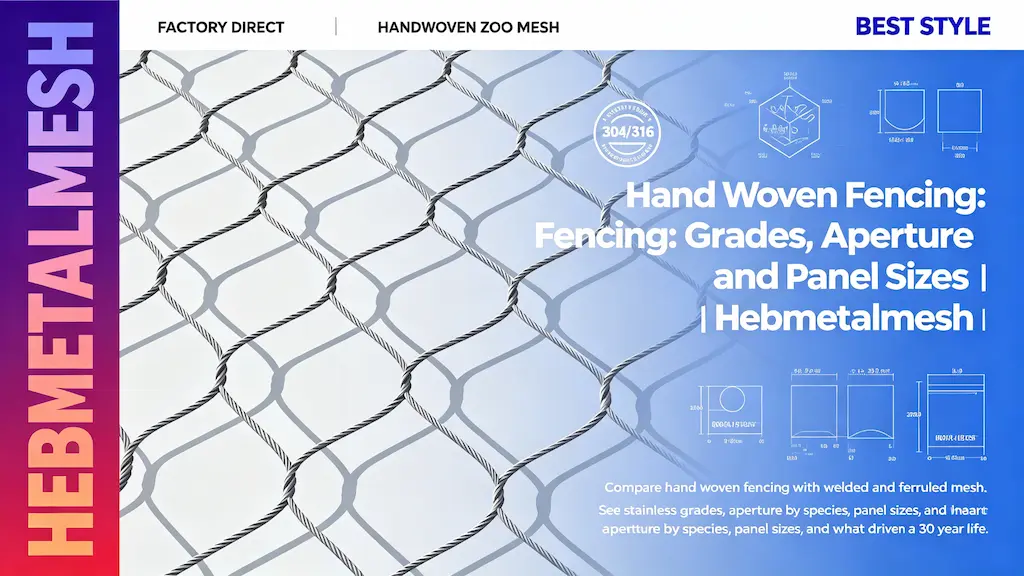
Three decisions decide whether an animal fence still works in year twenty: how the strands are joined, which stainless grade they were drawn from, and whether the panel was woven for the exhibit or trimmed to fit. Hand woven fencing is the only option that optimizes all three — no weld to crack, no crimp to corrode, no seam across a barrier that has to hold. Everything else trades one away for a lower quote, and the bill arrives later as a rebuild.
Executive Summary
Enclosure failures almost always start at a junction. A weld that looked sound on day one work-hardens and cracks under repeated impact; a crimped sleeve traps moisture and becomes the first rust bloom on the fence. Because hand woven fencing carries load through continuous interlaced rope instead of across a joint, it removes the most common failure point entirely. The rest of the specification is then driven by the animal and the site: aperture small enough to deny a paw or a head, gauge heavy enough to absorb a charge, and a stainless grade matched to chlorides and wash-down chemistry. The reference specification is the animal fence mesh product page.
Quick Answer:
What is hand woven fencing? A barrier panel made from stainless steel wire rope that is interlaced by hand on a jig, so every crossing is a continuous strand passing over and under its neighbour rather than a weld or a crimped sleeve. With no joint, there is nothing to crack, unwind, or corrode preferentially. Specified with the right rope gauge, aperture, and alloy, it delivers a 25–30 year outdoor service life for zoo and wildlife enclosures.
Key Takeaways
- The joint is the failure point, so remove it. Welds crack and ferrules corrode; an interlace does neither.
- Aperture is set by anatomy, not budget. The opening must deny a paw, a head, or a beak at the animal’s narrowest dimension.
- Gauge is set by energy. Climbing species need flexibility; charging species need mass in the rope.
- Grade is set by the site. Chlorides and chlorinated wash water are what defeat SS304.
- Panel size is a design decision. Woven-to-fit panels eliminate the horizontal seam that animals work at and keepers snag on.
Accredited institutions do not treat enclosure materials as a purchasing afterthought. The Association of Zoos and Aquariums publishes the accreditation standards that most North American exhibits are designed against, including the containment criteria a fence has to satisfy.
What “Hand Woven” Actually Means
A hand woven panel starts as stainless steel wire rope — fine austenitic wires laid helically into a strand — and is built on a weaving jig that holds the rope spacing while an operator interlaces each strand over and under its neighbours. The result is a diamond aperture that holds its geometry with no fixing at the crossings: pull one way and it narrows, pull the other and it opens, because the interlaced crossings slide against each other instead of pivoting on a rigid joint.
That sliding is the whole point. It lets the panel absorb a charge, flex under wind, and return to shape, instead of transferring the load into a weld or sleeve. The finished edge is finished as a selvage edge, where the rope paths are closed off so the panel cannot unravel if a strand is ever cut — which matters when a keeper has to trim around a door frame or a service penetration on site.
Hand Woven Fencing vs Welded Mesh
The comparison is not close once you look at behaviour under load, and it is the most useful hand woven fencing vs welded distinction to understand before pricing either option.
| Property | Hand woven rope panel | Welded wire mesh |
| Joint at every crossing | None — interlaced rope | Rigid weld nugget |
| Response to impact | Flexes and returns | Transfers to weld, then cracks |
| Corrosion weak point | None in the field of the panel | Weld heat-affected zone |
| Flexibility on curved frames | Conforms in both directions | Bends on one axis only |
| Typical service life | 25–30+ years | 8–15 years |
Welded mesh is cheaper and adequate for behind-the-scenes holding, quarantine, and utility runs. It is not a public containment material for large mammals: the weld is both the stiffest and most brittle part of the assembly, which is exactly what you do not want where an animal tests the boundary.
The Ferrule Question
Between the two sits ferruled cable mesh, which crosses ropes and compresses a sleeve over each pair. It beats welded mesh and is widely used, but a modest panel carries several thousand sleeves, and each is a crevice, a galvanic risk if the sleeve alloy differs from the rope, and a hard spot that takes the abrasion of rubbing and clawing. Hand woven panel fencing has none of these — the structural reason its service life runs longer, since the wire rope itself is identical.
Choosing the Grade
Hand woven fencing grade is a site decision, not an animal decision. SS304, at roughly 18% chromium and 8% nickel, handles the overwhelming majority of inland installations. SS316 adds molybdenum, and that addition is what resists chloride pitting when the air carries salt, the enclosure sits in a humid tropical climate, or the keepers wash down with chlorinated water. The premium is typically 10–15%, and it is the cheapest insurance in the entire specification.
Whatever grade you buy, ask for the mill certificate. It is the document that ties the coil to its alloy analysis, and it is the only way to verify that the 316 you paid for is the 316 that arrived. Our 304 vs 316 mesh comparison covers the coastal threshold in detail, and the galvanized vs stainless comparison explains why a zinc coating is a countdown rather than a protection.
Aperture and Gauge by Animal
Rope diameter and aperture are chosen together, and both follow anatomy. The rule for aperture is the animal’s narrowest dimension — a paw for a cat, a head for a primate or bird, a calf for a hoofstock animal that might kick through.
| Animal group | Rope diameter | Aperture | HM code |
| Small birds, finches | 1.2 mm | 20 mm | HM1220 |
| Parrots, pigeons | 1.6 mm | 38 mm | HM1638 |
| Small primates, marmosets | 2.0 mm | 38 mm | HM2038 |
| Gibbons, larger primates | 2.4 mm | 38 mm | HM2438 |
| Leopards, medium cats | 3.2 mm | 51 mm | HM3250 |
| Lions, tigers, bears | 3.2 mm | 76 mm | HM3276 |
Two clarifications save most mis-specifications. First, a smaller aperture is not automatically better: it costs more because it uses more rope per square meter, and it darkens the view for visitors. Second, gauge is about energy, not weight — a 3.2 mm rope carries roughly 7 kN and a 2.4 mm rope about 4.4 kN, so the heavy gauges exist to absorb a charge, not merely to hold a heavier animal. Our tiger enclosure netting range sits at the top of that table; the aviary netting range sits at the bottom, and the logic is identical at both ends.
Panel Size and Zero Waste
Hand woven fencing panel size is where custom fabrication pays for itself. Panels are woven to the exhibit, not cut from stock, running up to 9 m by 18 m in a single piece. A full-height barrier face therefore hangs as one seamless panel, with no horizontal joint for an animal to work at and no mid-panel splice to corrode or snag.
The same made-to-measure logic drives cost efficiency. Because each panel is woven to the drawing, zero waste cutting is achievable on most layouts — you are not buying a 30 m roll to cover a 23 m run and binning the offcut. Where a layout genuinely produces a remnant, it is usually reusable as a shift door, a service gate infill, or a quarantine panel. Ask your supplier for the panel yield on the drawing before you accept a square-meter price.
Installation
Hand woven fencing installation follows a fixed sequence: set and square the frame, hang the panel from its top edge, pull the lower edge down to the target tension, then lace the vertical seams with continuous rope so the joint carries the same load as the field of the panel. Trim last, because a trimmed edge cannot be re-tensioned. Use stainless fittings throughout; one galvanised shackle in a wet enclosure will stain the mesh below it within a season.
Correct tension matters more than most installers expect. Too slack and the fence sags into a pocket an animal can climb; too tight and you preload the rope until it stops absorbing impact. Aim for a face that deflects under a firm push and returns flat. Because flexible fencing conforms in both directions, it is also the practical choice for curved frames that force rigid materials into visible facets.
Lifespan and Maintenance
Hand woven fencing lifespan is 25–30 years outdoors in the right grade, and the reason is simple: with no coating there is nothing to chalk, flake, or renew, so service life tracks the alloy rather than the finish. Hand woven fencing maintenance is correspondingly dull — wash the panel once or twice a year with fresh water, more often on coastal sites, and inspect at the same time for broken wires at the crossings, loose seaming rope, and any fitting showing rust.
Re-tension after the first season, because a new panel settles slightly, and re-tension again if you ever see it drum in wind. That is the whole regime. It is why a hand woven fence is a capital asset rather than a consumable line item.
What It Costs
Hand woven fencing price tracks gauge and aperture: fine apertures use more rope per square meter, and heavy gauge costs more than light at the same opening. As a planning range, aviary-grade material runs roughly $10–22 per square meter and carnivore-grade roughly $20–38, before frame steel, gates, and labour — which on most projects is the larger line. The honest comparison is cost per year of service, and on that basis one hand woven installation outlasts three or four rounds of welded or coated mesh.
Specifying and Ordering
A complete hand woven fencing specification has five lines: alloy grade, rope diameter, aperture, panel dimensions, and edge treatment. Add the frame and fitting alloys and a supplier can quote without a round of questions. There are only two broad hand woven fencing types in practice — standard diamond interlace, and a heavier interlace above roughly 2.4 mm rope — so the work is in the numbers, not in choosing a product family.
Custom hand woven fencing is the default rather than the upgrade, since panels are woven to the drawing in any case. Before committing, ask for a sample panel in the exact code you intend to buy and check the aperture, the rope feel, and the edge finish against it. For hand woven fencing for zoos specifically, confirm that the supplier will supply the mill certificate with the shipment and stands behind the sample matching the production run. A hand woven fencing supplier who cannot quote aperture and gauge from a species list is selling mesh by the roll, not an enclosure system.
Frequently Asked Questions
Permanent zoo and wildlife enclosures where the barrier must contain large or climbing animals, stay visually unobtrusive, and last decades. Specify by species and site rather than buying by the roll.
25–30 years outdoors in the correct grade. The limiting factors are alloy choice and fitting compatibility, not the rope, so specify SS316 where chlorides are present.
It carries comparable load but behaves differently: the interlace flexes and returns, while a weld transfers load into a brittle nugget that eventually cracks. For impact loading, the interlace is the safer choice.
51 mm at 3.2 mm rope for leopards and medium cats, moving to 76 mm for lions, tigers, and bears. The opening must deny a paw at the animal’s narrowest dimension.
Plan on roughly $10–22 for aviary-grade and $20–38 for carnivore-grade material, depending on gauge and aperture. Frame, gates, and installation sit on top and are usually the larger cost.
Yes, and it is the normal method. Panels are woven to the drawing up to 9 m by 18 m, so a full-height face hangs as one piece with no mid-panel seam.
The Bottom Line
Specify the joint before you specify the steel. Once the crossing is an interlace rather than a weld or a crimp, the rest of the fence becomes a sequence of honest measurements: the animal’s narrowest dimension for aperture, the energy it delivers for gauge, the site’s chloride load for grade, and the drawing for panel size. Handwoven fencing rewards that discipline with a barrier nobody has to revisit for a generation — and the same logic governs the rest of the boundary, which our zoo containment barrier guide covers from the public side. The full animal fence mesh page lists every code.
Ready to specify your enclosure? Contact our enclosure team with your species list and exhibit dimensio