
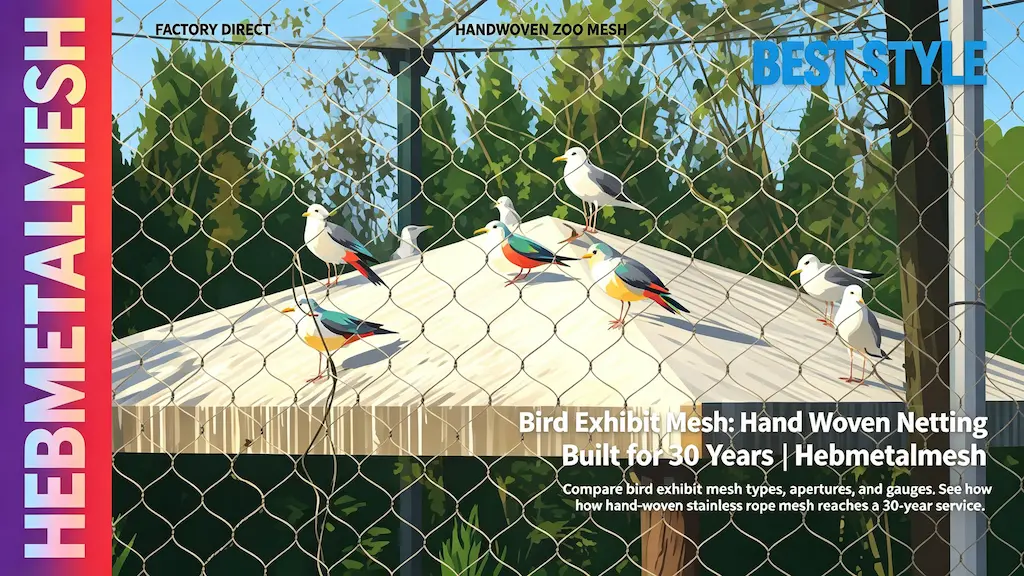
Most of what the market sells as bird netting is a five-year product, and zoos keep buying it for thirty-year buildings. Hand-woven stainless steel rope mesh is the only bird exhibit mesh that closes that gap: no coating to renew, no ferrule to corrode, no UV embrittlement, and a documented outdoor life measured in decades. The catch is that “stainless” alone is not a specification — aperture, gauge, alloy, and joint construction each decide whether your aviary still holds birds in year twenty-five.
Executive Summary
Bird exhibit mesh for zoos solves a different problem than garden netting. A public aviary has to contain birds that chew, keep out predators that climb, resist a visitor who pushes on it, and stay almost invisible from the path. Those four demands eliminate polypropylene knotted netting, extruded plastic mesh, and light welded wire almost immediately. What survives the filter is hand-woven stainless rope mesh, sized by species: the finest aperture and lightest gauge that still stops every bird in the collection, on SS316 wherever the air carries salt. The reference specification is the aviary netting product page.
Quick Answer:
What is the best bird exhibit mesh for a zoo aviary? Hand-woven stainless steel wire rope mesh with no ferrules, on SS304 inland and SS316 in coastal or humid climates. Size the aperture to the smallest bird you keep — 20 mm for finches and waxbills, 25 mm for small parakeets and quail, 38 mm for parrots, pigeons, and medium raptors — and set the rope gauge from the largest bird’s bite and body weight, from 1.2 mm up to 3.2 mm. Specified this way, the material reaches a thirty-year outdoor life with washing and inspection only.
Key Takeaways
- The joint, not the wire, sets the lifespan. A crimped ferrule is a crevice and a wear point at every crossing; a hand-woven crossover has neither.
- Aperture is a containment and welfare decision. Too large and small birds escape or predators reach in; too small and you pay for steel you do not need and lose sightlines.
- Gauge follows the beak. Hookbills destroy light netting from the inside; finches never test it at all.
- Alloy grade is a site decision, not a species decision. Chlorides and chlorinated wash-down water drive the SS316 call.
- Life-cycle cost is where hand-woven wins. One installation outlasts five or six rounds of plastic netting.
Exhibit standards are not paperwork you file and forget. Accredited institutions design against published animal-care frameworks, and the World Association of Zoos and Aquariums maintains the guidance most institutions reference when they write enclosure criteria.
Why Ordinary Bird Netting Fails in Exhibits
Retail bird netting is engineered for seasonality: cheap, light, and good for two to five seasons before ultraviolet exposure makes it brittle. On a farm you re-net the row each year. In a permanent aviary the same material means scaffolding, bird capture, and re-installation every few years, plus escapes from degraded netting nobody has noticed yet.
Plastic netting is also chewable. Parrots, cockatoos, and some waterfowl work a soft mesh until a strand parts, and the opening widens fast. Galvanized welded wire resists chewing but its coating fails at the welds and stains a public structure. Neither is a thirty-year answer.
The material that is: stainless steel wire rope woven into a diamond panel. Each rope is a bundle of fine austenitic stainless wires laid helically, so the panel flexes in both directions, absorbs a bird strike rather than resisting it, and carries load along continuous strands instead of across brittle joints.
Five Product Families Compared
| Product family | Typical service life | Chew resistance | Visual impact | Realistic use |
| Knotted polypropylene | 2–5 years | Very poor | Low when new | Seasonal crop protection |
| Extruded plastic mesh | 3–7 years | Poor | Moderate | Temporary holding, quarantine |
| Galvanized welded wire | 8–15 years | Good | High | Budget enclosures, behind-the-scenes |
| Ferruled stainless cable mesh | 15–25 years | Excellent | Very low | General zoo enclosures |
| Hand-woven stainless rope mesh | 25–30+ years | Excellent | Very low | Permanent public aviaries |
The gap between the last two rows is the point of this article. Both use the same wire rope and the same alloy. They differ in how the crossings are made.
Hand Woven Versus Ferruled Construction
A ferruled panel crosses two ropes and compresses a metal sleeve — usually aluminium or stainless — over the pair. There are two sleeves at every intersection, so a modest panel carries several thousand. Each one is a crevice where moisture sits, a place for a galvanic couple between dissimilar metals, and a hard spot that takes the abrasion of branch rubbing and beak contact.
Hand woven bird exhibit mesh removes the sleeve entirely. The rope passes over and under its neighbours in a continuous interlace, so there is no compression point, no dissimilar metal, and nothing to work loose. The trade-off is craft: it is woven by hand on a jig, which costs more per square meter and takes longer to produce. What that premium buys is the gap between a twenty-year and a thirty-year asset — a real difference in bird exhibit mesh lifespan, and why large public aviaries specify it.
Matching Aperture and Gauge to the Species
Every serious bird exhibit mesh specification begins with one measurement: the head and body width of the smallest bird you intend to hold. Then it works outward to the largest beak in the collection.
| Bird group | Rope diameter | Aperture | HM code |
| Finches, waxbills, small softbills | 1.2 mm | 20 mm | HM1220 |
| Canaries, small finches in flight | 1.2 mm | 25 mm | HM1225 |
| Budgerigars, small parakeets, quail | 1.6 mm | 25 mm | HM1625 |
| Lorikeets, lineolated parakeets, pigeons | 1.6 mm | 38 mm | HM1638 |
| Conures, medium parrots, ducks | 2.0 mm | 38 mm | HM2038 |
| Amazons, African greys, small raptors | 2.4 mm | 38 mm | HM2438 |
| Macaws, cockatoos, large raptors | 3.2 mm | 38 mm | HM3238 |
| Mixed-species free flight, long spans | 2.0 mm | 51 mm | HM2050 |
Aperture width is the controlling dimension, not rope thickness. A 20 mm opening holds the smallest passerines and denies access to snakes and most rodents; 38 mm is the psittacine standard because it stops a head while still admitting light and air. Where visitors can reach the mesh, keep the opening small enough that no hand passes and no beak can hook a sleeve — ask your parrot enclosure mesh supplier about a tighter inner line at contact height if you house hookbills.
Large raptors change the calculation again, because the load is no longer a bird bumping the wall but a bird hitting it at speed; see the eagle enclosure netting range for the heavier gauges. Tall wetland species need the opposite treatment — maximum span with minimum visual weight, which is how the crane aviary mesh codes are built.
Where the Thirty Years Actually Comes From
The thirty-year claim is metallurgy plus geometry, not marketing arithmetic. Hand-woven rope mesh is austenitic stainless — SS304 at roughly 18% chromium and 8% nickel inland, SS316 with molybdenum bearing stainless for coastal air, tropical humidity, or enclosures washed with chlorinated water. Molybdenum resists pitting where chlorides sit, and it is the cheapest upgrade in the specification.
With no organic coating there is nothing to chalk, flake, or renew, so netting service life tracks the alloy rather than the finish: wash a panel a few times a year, inspect for stray strands, and it keeps its strength for decades. That is the basis for the thirty year service life figure and the service life expectancy a capital budget should model. Mesh service life shortens in two situations — sustained salt spray exposure without SS316, and long-term contact with copper or carbon-steel fittings. Both are avoidable at design stage.
Our 304 vs 316 mesh comparison sets out the grade decision, including the coastal threshold where the premium stops being optional.
Frames, Panels and Tension
A woven panel is only as good as the structure carrying it. The bird exhibit mesh frame should be a closed perimeter — tube steel or a tensioning cable catenary — sized so the mesh never joins the load path. Set the bird exhibit mesh gauge first, then size the frame; reversed, you get a heavy frame on an undersized panel, or a light one that lets the panel drum in wind.
Panels are woven to the exhibit, not cut from stock. Single panels run up to 9 m by 18 m, so a full-height aviary face hangs as one piece with no horizontal seam to pick at. On site the routine is fixed: hang from the top edge, pull the lower edge down to the target bird exhibit mesh tension, then lace vertical seams with continuous rope so the joint carries the same load as the field.
Bird exhibit mesh tension matters more than people expect. Too slack and the panel sags into a pocket that birds land in; too tight and you preload the rope until it stops absorbing impact. Aim for a face that deflects when pushed and returns flat.
Installation and the Walk-Through Detail
Bird exhibit mesh installation is a two-person job on small aviaries and a rigging job on large ones, but the sequence never changes: frame, hang, tension, seam, then trim. Trim last — a trimmed edge cannot be re-tensioned. Use stainless fittings throughout; one galvanised shackle in a wet aviary stains the mesh within a season and corrodes out within a few.
The failure point in any walk through exhibit is the doorway, not the wall. A single door is an escape waiting to happen. Build a vestibule with two doors and a short dark corridor between, mesh the corridor ceiling as carefully as the walls, and fit self-closing hardware on both leaves. Birds test doors, rarely field panels.
Cost and Procurement
Bird exhibit mesh cost tracks two variables: gauge and aperture. Fine apertures use more rope per square meter, so a 20 mm panel costs materially more than a 51 mm panel in the same gauge. In planning terms, aviary-grade hand-woven stainless runs roughly $10–22 per square meter for the mesh; frame steel, gates, and labour sit on top and are usually the larger line.
That bird exhibit mesh price looks steep next to plastic until you divide it by years. A cheap polypropylene install replaced five or six times over thirty years — plus capture labour each time and the escapes nobody budgets for — lands well above one stainless installation. Ask any bird exhibit mesh supplier for the life-cycle number, not just the square-meter figure.
Maintenance
Bird exhibit mesh maintenance is deliberately boring. Wash the panel once or twice a year with fresh water — more often on coastal sites — to remove chloride films. Inspect at the same time for broken wires at the crossings, loose seaming rope, and rusting fittings. Re-tension after the first season, because a new panel settles, and again if it ever drums in wind. That is the whole regime, and it is why bird exhibit mesh durability is structural rather than consumable.
Frequently Asked Questions
Hand-woven stainless steel rope mesh with no ferrules, on SS304 inland or SS316 in coastal and humid sites. Match the aperture to your smallest bird and the gauge to your largest beak.
Correctly specified hand-woven stainless reaches 25–30 years and beyond. Alloy grade and fittings limit it, not the rope — so avoid salt spray exposure on SS304 and dissimilar metals in the frame.
A 20 mm opening holds finches, waxbills, and small softbills and denies access to snakes and most rodents. Use 25 mm for small parakeets and quail, and 38 mm once the collection is parrots, pigeons, or raptors.
The rope is identical; the crossing differs. Hand-woven panels carry roughly 7 kN at 3.2 mm rope and about 4.4 kN at 2.4 mm with no crimped sleeve, so there is no crevice to corrode and nothing to work loose.
Aviary-grade hand-woven stainless falls in a $10–22 per square meter planning range depending on gauge and aperture, before frame, gates, and installation. Fine apertures cost more because they use more rope.
Ask for the alloy certificate, the rope construction, and whether panels are truly hand-woven or ferruled. A supplier who cannot quote aperture and gauge by species is selling netting, not an enclosure system.
The Bottom Line
Permanent aviaries fail at the joints, the fittings, and the doorways — rarely in the middle of a well-built panel. Specify bird exhibit mesh by species rather than bundle price, spend the small premium on molybdenum-bearing stainless where the air is wet or salty, and hang full-height panels on a frame that carries its own load. Do that and the netting stops being a line item you revisit every few years. Our zoo containment barrier guide covers the public side, and the full bird netting specification page lists every code.
Ready to specify your aviary? Contact our enclosure team with your species list and exhibit dimensions.