
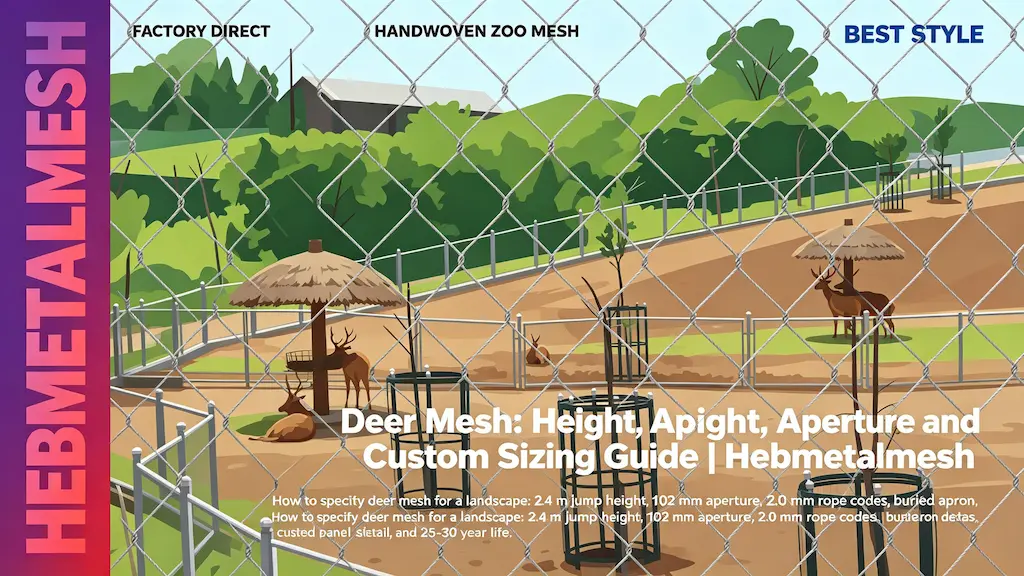
Most deer fencing fails for one of three reasons: the deer jump it, they go under it, or the owner gives up on a plastic net that sagged, tore, and went brittle within five years. All three are specification problems, and all three are solved before a single post goes in the ground.
The numbers are not guesswork. An adult white-tailed deer clears 1.8 m from a walk and close to 2.4 m when motivated; it pushes under any bottom edge it can lift; and a buck will shred a young tree in one night during the rut. This guide sets out the height, aperture, rope diameter, and base detail that answer each of those behaviours, and how custom sizing removes the joints that fail first. The reference specification is the garden netting product page.
Executive Summary
Send your run lengths and heights before you order stock sizes. We weave panels to your dimensions, so a long boundary arrives as one piece instead of a chain of overlaps. Contact Hebmetalmesh
A working deer barrier has four requirements. It must be tall enough that a motivated animal chooses not to jump. It must be pinned at the bottom so nothing pushes under. It must be fine enough in aperture that a head, a leg, or a fawn does not go through. And it has to survive thirty winters of sun, frost, and salt without a maintenance cycle.
Hand-woven stainless rope mesh is the only material that meets all four at a reasonable whole-life cost: it carries impact by deflecting, has no coating to degrade, and — woven to order — has no horizontal seam along a long run.
Quick Answer:
Deer mesh should be 2.4 m finished height on the boundary of any planted area, in 2.0 mm stainless rope at 102 mm aperture (code HM20102) for open views, or 76 mm (HM2076) where fawns, small livestock, or dogs are also being excluded. Pin the bottom edge and turn a 200-300 mm apron outward on the ground; that detail, not height, is what stops a deer going under. Grade SS304 inland, SS316 within about 5 km of salt water. Woven to your dimensions and correctly tensioned, the fence runs 25-30 years. That is the working deer mesh specification in one paragraph.
Key Takeaways
- Height stops the jump; the base stops the push. Most failures are at the bottom, not the top.
- 102 mm aperture is invisible at 15 m and still refuses a deer’s head.
- 2.0 mm rope is ample. A deer cannot break it; stiffness over a 2.4 m span is why you buy it.
- Plastic netting is a five-to-seven-year product. Stainless is a thirty-year one, and the whole-life maths favours stainless.
- Custom sizing removes the seam. Every overlap is a future sag point.
- Deer density sets the height. More animals per square kilometre means more pressure on the line.
Deer population density has risen across much of North America and Europe over the last fifty years, and range shifts for several species are tracked in the IUCN Red List assessments, so anecdotally rising browse pressure on gardens is not imagination.
What deer actually do to a planted boundary
Four behaviours drive every line of the specification, and they change with the season.
They browse. Browse pressure peaks in spring on new growth — young tree leaders, nursery stock, hosta, and orchard row blossom — and again in late winter when natural forage is thin. A fence that protects a mature shrub border may still lose an entire season of new shoots if the top of the plant is reachable.
They rub. During the rutting season a buck strips bark from a young tree in a single night. An antler rub at the base of a 40 mm trunk kills the tree by girdling it, and the animal will return to the same stem. Rubbing is a trunk problem, not a boundary problem, and it needs its own detail.
They bed where it is quiet. In fawn season does leave fawns in tall grass, often along a fence line where nothing walks. A barrier with a blind bottom can separate a fawn from the doe, so keep the base open to sight — a mesh panel is far kinder here than a solid board fence.
They test the same place repeatedly. Deer use habitual crossing points. Where deer density is high — suburban edges commonly run several times a rural figure — the same gap gets found every night, which is why one weak section writes off the whole run.
Deer mesh height: the jump, and the two cheaper tricks
Deer mesh height is usually argued about in feet, when the question is really about how badly the animal wants what is on the other side. A hungry deer in a high-pressure area clears 1.8 m without effort and 2.4 m when it has reason. So:
| Situation | Finished height | Comment |
| Boundary of a planted garden or orchard | 2.4 m (8 ft) | The standard that actually works |
| Low-pressure rural boundary | 2.0 m | Acceptable where deer density is low |
| Vegetable plot inside a larger fenced area | 1.5-1.8 m | Deer are already excluded from outside |
| Individual young tree | 1.2-1.8 m guard | Stops rubbing and browsing on one stem |
Two alternatives beat adding height where a 2.4 m fence would spoil a view or blow the budget.
A double fence is two 1.2 m barriers set about 1.2 m apart. Deer judge a jump badly when they cannot see the landing, so they refuse it — the same fence material, less visual impact, and roughly the same cost as one tall line.
An outward lean works on the same principle: set the posts at 10-15 degrees outward and the animal cannot judge the take-off. It is less reliable than the double fence on a boundary the deer already know, but on a new line it is very effective and it looks intentional in a designed garden.
Aperture, gauge, and which code to order
Deer mesh gauge is chosen for stiffness, not strength. A 100 kg animal cannot break a 2.0 mm rope; what gauge buys is how well a 2.4 m face holds its shape between posts over thirty years.
| Application | Aperture | Rope Ø | Code | Notes |
| Open boundary, view matters | 102 mm | 2.0 mm | HM20102 | Lightest, least visible |
| Garden with fawns or dogs | 76 mm | 2.0 mm | HM2076 | Stops small animals too |
| High-pressure or public boundary | 76 mm | 2.4 mm | HM2476 | Extra stiffness on long spans |
| Individual tree guard | 76 mm | 1.6 mm | HM1676 | Wrapped around stakes at one stem |
Full details for the two workhorse codes sit on the HM20102 and HM2076 pages; everything else in the range is woven to order, including non-standard heights.
Deer mesh aperture has a lower limit as well. Below about 50 mm the mesh starts to read as a screen rather than a fence, catches wind and leaf litter, and costs more stainless for no additional exclusion — 102 mm refuses an adult head and 76 mm refuses a fawn. If rabbits are the real problem, that is a different product and a much finer net at the bottom only.
Deer mesh frame spacing should be 2.5-3.0 m for a 2.4 m face. Wider spacing saves posts and costs you the shape of the panel within two seasons.
The bottom edge, the gate, and the tree you forgot
The base detail is where most deer fences quietly fail, and it is almost never in the drawing.
- Pin the bottom. A buried apron — 200-300 mm of mesh turned outward and pinned or trenched into the ground — removes the push-under entirely.
- Watch frost heave. In freezing climates the ground lifts the bottom edge each winter; re-check every spring and re-pin before the growing season.
- Gate to match. A gate 300 mm shorter than the fence is an open invitation. Build the leaf to full height and latch it positively.
- Guard the stems. Wrap young tree trunks in the same mesh as a cylinder 1.2-1.8 m high, staked clear of the bark, so an antler rub hits wire instead of cambium.
- Keep the base visible. A doe will not cross a line she cannot see through, and an open base avoids separating bedded fawns.
Stainless against the two cheap alternatives
Deer mesh grade is a straightforward site decision. SS304, roughly 18% chromium and 8% nickel, suits inland and suburban sites. SS316 adds molybdenum, typically 2-3%, and is the right choice on coastal sites, in tropical humidity, or where the line is washed with chlorinated water. Both are austenitic, neither needs a coating, and both outlast the posts.
Plastic and polypropylene deer netting is the common alternative and it is cheaper on day one. It is also a five-to-seven-year product: UV embrittles it, it sags permanently once stretched, it tangles deer and birds, and it has to be replaced twice inside the life of one stainless installation. Galvanized wire lasts longer than plastic but the coating is consumed — expect rust staining on paving and planting after ten to fifteen years, sooner on a coastal site. The full comparison is in our galvanized versus stainless guide.
Custom sizes, installation and cost
Every run is different: a boundary is rarely a round number of metres, and a stock panel leaves an awkward part-panel that becomes the sag point. Deer mesh custom size is therefore the default rather than an upgrade — we weave to the length and height you give us, and custom deer mesh panels run up to about 9 m by 18 m in one piece, so a 40 m boundary is four panels rather than twenty overlapping rolls. A deer mesh supplier who only sells stock sizes is selling you the seams.
Deer mesh installation runs in a fixed order: set posts plumb at 2.5-3.0 m centres; hang the panel slack; work outward from the centre of each run so the diamond geometry evens up; draw the perimeter cable first; tension the field; then pin the bottom apron. Our hand woven fencing guide sets out the same sequence for long runs.
Deer mesh tension should leave the face slightly springy — firm enough to look deliberate, slack enough to absorb an impact rather than return it. Re-tension at twelve months once posts and ground have settled.
Deer mesh for gardens sits at the lower end of the price band. Deer mesh cost is driven by rope diameter and finished height rather than by aperture: a $10-20 per square metre planning range covers a 2.4 m boundary at 2.0 mm and 102 mm, while the same line in 2.4 mm at 76 mm lands toward the top of it.
Deer mesh maintenance is minimal: a fresh-water wash once a year where irrigation spray or road salt reaches the line, a look at the bottom edge each spring, and a tension check annually. Deer mesh lifespan is 25-30 years with no coating to renew — durable deer mesh is a one-time purchase rather than a recurring one. The wider range, including heavier zoo-grade codes, is listed on the deer enclosure mesh page, and the garden netting range covers finer work for beds and borders.
Frequently Asked Questions
2.4 m (8 ft) on a planted boundary. Where that is not acceptable, use two 1.2 m fences set 1.2 m apart, or lean the line outward 10-15 degrees.
102 mm stops an adult; 76 mm is the choice where fawns, dogs, or small livestock are also being excluded. Finer than 50 mm is wasted material.
Yes, if the bottom is free. Turn a 200-300 mm apron outward and pin or trench it, then check it every spring after frost heave.
Over thirty years, yes. Plastic netting is a five-to-seven-year product that sags and embrittles; one stainless installation outlasts three of them.
SS304 inland and suburban. SS316 on coastal sites, in tropical humidity, or under chlorinated irrigation.
Yes. Panels weave to about 9 m by 18 m in one piece, so a long boundary arrives as a few full-height panels instead of overlapping rolls.
Get a quote for your boundary in exact dimensions. Send run lengths, finished height, and site exposure. We will return codes, panel sizes, and a delivered price — no obligation. Request a quote from Hebmetalmesh
Hebmetalmesh weaves hand-woven stainless steel rope mesh to order for gardens, orchards, estates, and deer parks worldwide.