
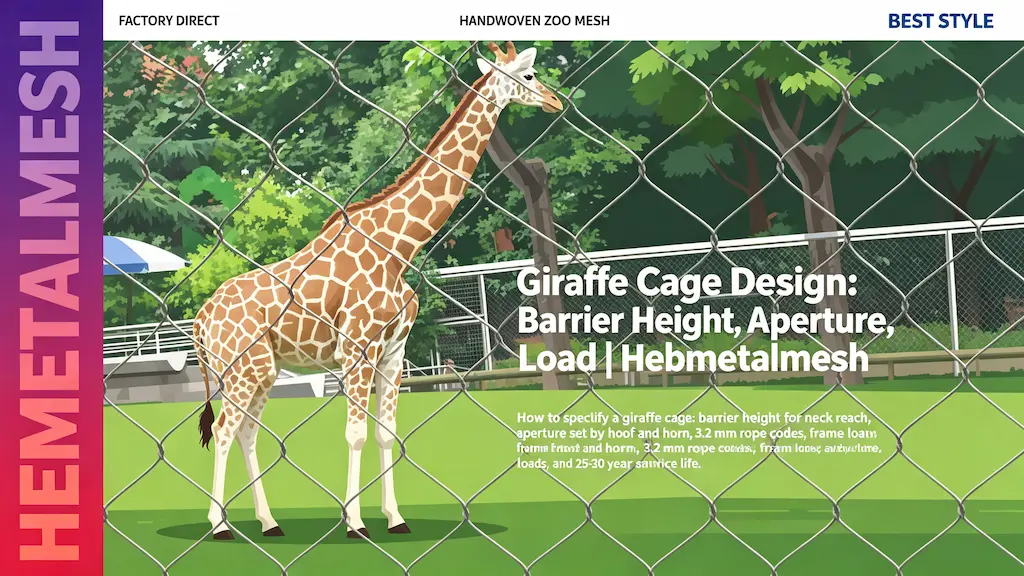
A giraffe does not test a fence the way a cat or a primate does. It does not climb it, chew it, or rattle it. It leans. A 1,200 kg bull puts its chest on a barrier to reach browse on the far side, and the line has to take that load without deflecting into a place where a leg can go through. Everything else in the specification follows from that one behaviour.
The second driver is reach. An adult giraffe stands about 3.3 m at the shoulder and feeds well above five metres, so every decision about height, standoff, and gate placement is made with neck reach in mind rather than body size. This guide sets out the numbers we recommend for a giraffe cage specification, why each one sits where it does, and which product codes deliver them. The reference specification is the animal fence mesh product page.
Executive Summary
Ask an enclosure engineer to review your barrier line before you set the posts. Send the herd composition, plan dimensions, and site climate. We will return a marked-up specification with rope diameters, break forces, panel sizes, and a budget price. Contact Hebmetalmesh
A giraffe cage has three requirements that pull against each other. It must be tall enough that a browsing animal cannot put its neck over the top into an unsafe space. It must be open enough inside the panel to stay visually invisible from the visitor path. And it must absorb a heavy leaning or kicking load without either collapsing or rebounding into the animal.
Hand-woven stainless rope mesh is the only common fencing that satisfies all three at once. A woven diamond panel spans several metres in one piece with no joint at head height, carries the load along continuous rope runs instead of isolated welds, and springs back rather than deforming permanently.
Quick Answer:
A giraffe cage should be built on 3.2 mm stainless wire rope at 76 mm or 102 mm aperture, hung at a minimum finished height of 4.5 m wherever animals can reach the top line, in grade SS304 inland or SS316 within about 5 km of salt water. Aperture above 102 mm risks a hoof or an ossicone; anything under 50 mm costs visibility and adds stainless weight you do not need. Each rope breaks near 7 kN, and a correctly tensioned installation runs 25-30 years with washing and annual tension checks. Those figures are the working giraffe cage design standard.
Key Takeaways
- Height matters more than strength. Shoulder height says nothing about what the animal can reach; neck reach does.
- Aperture is set by the foot and the horns, not the body. Keep it between 50 mm and 102 mm.
- 3.2 mm rope is the giraffe default. Break load is ample; stiffness over a 5 m span is the real reason.
- Absorb rather than resist. A barrier that springs back protects both the animal and the mesh.
- Barn work is a separate specification. Stalls, chutes, and gates take far higher point loads than the yard line.
- Grade is a site decision. SS316 only where chlorides are real; SS304 everywhere else.
Institutional husbandry guidance for giraffes is published by the Association of Zoos and Aquariums, and any barrier line should be reviewed against those current recommendations alongside your own veterinary input.
What a giraffe actually does to a barrier
Giraffes damage fences in four predictable ways, and each one maps to a line in the specification.
They lean. Browse line is usually higher than the fence designer assumes: foliage on the far side pulls the animal forward, and the whole chest load transfers to the top rail. That load is better described as a sustained push than an impact, which is precisely what a flexible rope panel handles well.
They kick. A startled animal delivers a hard front-hoof strike at close range. Kick load analysis matters less than the direction of the strike: sideways into a field panel is absorbed by deflection, while a strike at a corner post or gate jamb is not.
They catch their horns. Ossicone height puts the highest point of a bull near 5.5 m, and those bony knobs are exactly the shape that finds a rectangular opening. A diamond aperture lets them withdraw cleanly; a welded square grid does not.
They walk along the line. Herd animals pace a perimeter, especially near a gate or feeding point. The base of the panel therefore takes constant abrasion from grit and hooves, which is why the bottom edge detail deserves more attention than it usually gets.
Giraffe cage height: shoulder clearance is not reach
Giraffe cage height is the most commonly mis-set dimension in hoofstock work. The instinct is to fence to shoulder height and stop, which leaves a metre of neck above the barrier free to reach whatever sits on the other side — a visitor path, a road, or another exhibit.
Set the finished height as follows:
| Zone | Minimum finished height | Reasoning |
| Perimeter with public beyond | 5.0 m | Keeps neck reach away from people |
| Internal paddock divide | 3.0-3.6 m | Animals on both sides are known stock |
| Giraffe yard fencing beside service roads | 4.5 m | Delivery vehicles pass above the line |
| Holding pen and crush approach | 3.0 m | Animals are habituated and are being handled |
Where a public path sits beside the exhibit, add standoff distance rather than more height. A 1.5-2.0 m planted strip between the visitor rail and the giraffe cage keeps contact deliberate, not accidental, and reads far better than another metre of barrier. The second line is a visitor barrier rather than animal containment — see our zoo containment barrier guidance for how that two-line arrangement is detailed.
Neck reach also governs what you plant. Trees and tall shrubs should sit outside reach of the fence line unless you accept pruning, and browse feeders belong well inside the enclosure so the animal is not pulled toward the mesh.
Giraffe cage aperture, gauge, and codes
Giraffe cage aperture has two limits. Too small, and the mesh stops disappearing at ten metres while adding stainless weight for no strength benefit. Too large, and a hoof, a hock, or an ossicone goes through. The working window is 50-102 mm, and two codes cover almost every project.
| Application | Aperture | Rope Ø | Code | Typical notes |
| Large savanna perimeter | 102 mm | 3.2 mm | HM32102 | Maximum visibility, lightest weight |
| Standard paddock and yard line | 76 mm | 3.2 mm | HM3276 | Default giraffe specification |
| Contact area and feeding zone | 50 mm | 3.2 mm | HM3250 | Where animals push on the line daily |
All three are 3.2 mm rope, so the choice between them is aperture and weight, not strength. Each individual rope carries roughly 7 kN in break load, and a woven panel distributes a lean across many rope runs at once. Full detail for the two workhorse codes is on the HM3276 and HM32102 pages; heavier or finer variants are woven to order.
Giraffe cage panel size follows the fence line. Panels weave up to about 9 m wide by 18 m in one piece, which means a 5 m high face hangs as a single sheet with no horizontal joint at animal height — the detail that most often fails first when a field-mesh design is cut and spliced on site. Every custom giraffe cage panel is woven to the drawing, so there is no trimming at the top edge and no wasted diagonal offcuts.
Frame, gates, and tension
A giraffe cage frame carries loads that a lighter enclosure never sees: a sustained chest push distributed along the top rail, wind over a five-metre face, and the constant preload of a tensioned membrane. Tubular steel posts at 2.5-3.0 m centres suit most yard lines; anything wider lets the panel pocket under load, and a pocket is where a leg eventually goes.
Keep the frame in the same alloy family as the rope. A stainless panel hung on galvanized clamps has installed a five-year component inside a thirty-year barrier, and the fixings sit exactly where runoff collects. Our heavy duty stainless netting comparison covers grade behaviour at those contact points.
Every giraffe cage door is the highest-risk item on the drawing. Give it a dedicated frame independent of the panel tension, use a sliding track rather than a hinged leaf wherever there is space, and size the opening so two animals cannot enter nose-to-tail. Latches should be operable from the keeper aisle without stepping into the animal’s flight path.
Giraffe cage tension sits between two failures. Slack enough to deflect, the panel absorbs a lean or a kick and returns; tightened like a drum skin, it stops absorbing and transfers the load into the posts and the foundation. Aim for a face that moves 30-50 mm under a firm push, then re-tension at twelve months once the whole assembly has settled.
Barn, stalls, and hoof care
Giraffe yard fencing is forgiving; the barn is not. Inside, animals are close to the mesh, often alone, and sometimes under restraint, so both the animals and staff depend on the line behaving predictably.
Specify giraffe barn mesh one step tighter than the yard — HM3250, 3.2 mm at 50 mm — because close contact means an animal can work a foot into an opening it would ignore outdoors. Barn lines should also be brighter than the yard: a black oxide finish that disappears beautifully outside reads as a shadow under artificial light.
For stalls, a giraffe stall divider has to separate animals that can reach each other over the top. Build dividers to full height or accept that contact happens, and use solid lower panels where a bull needs to be separated visually. Normally a stall is open-fronted, with a guillotine-style or sliding section that closes only for management.
Hoof trimming depends on the chute, not the fence. A crush gate and its approach should be the strongest fabrication on the project: a restrained animal leans hard, repeatedly, in a confined space, so posts there get doubled and gusseted, and no reliance is placed on the mesh carrying any part of that load.
Installation, grade, maintenance, and cost
Giraffe cage installation runs in a fixed order: set posts plumb and to the designed centres; hang the panel slack on temporary ties; work outward from the centre of each run so the diamond geometry evens up; draw the perimeter cable first; then tension the field. Sites following our hand woven fencing method note that cutting before all four edges are fixed is what pulls a panel out of square.
Grade is decided by chlorides. SS304, roughly 18% chromium and 8% nickel, handles inland and temperate sites. SS316 adds molybdenum, typically 2-3%, and is worth the premium on coastal sites, in tropical humidity, and anywhere the line is washed with chlorinated water. Giraffe urine and dung are mildly corrosive against the lower rope runs, which is another argument for washing rather than coating.
Giraffe cage maintenance is undemanding: fresh-water wash once or twice a year, a visual inspection of ferrules and end fittings every six months, and an annual tension check. There is no coating to renew, and damaged sections are repaired by replacing one panel rather than cutting a piece out. Any giraffe cage manufacturer should be able to quote the repair panel by drawing reference ten years after installation.
Planning budgets for hoofstock work land around $18-32 per square metre installed, driven mostly by the stainless weight in tall faces and by post centres rather than by the rope itself. Two items are usually omitted and should not be: a sample panel for review, and the first-year re-tension visit.
Frequently Asked Questions
Five metres where the public or a road sits beyond the line; 3.0-3.6 m for internal divides and handling areas. Shoulder height is irrelevant to what the neck can reach.
50-102 mm. Below 50 mm you lose visibility and add weight for nothing; above 102 mm a hoof or an ossicone can go through.
No. Break load is roughly 7 kN per rope; the reason to stay at 3.2 mm is stiffness across a five-metre span, not fear of failure.
Use a tighter code, HM3250, because animals are in close contact, and skip black oxide where artificial light makes it read as a shadow.
SS304 inland and temperate. SS316 within roughly 5 km of salt water, in tropical humidity, or under chlorinated washdown.
25-30 years with washing and annual tension checks, and no coating cycle to budget for.
Need a marked-up specification for your giraffe exhibit? Send your herd numbers, plan dimensions, and site climate. We will return codes, break forces, panel sizes, and a delivered price — no obligation. Request a quote from Hebmetalmesh
Hebmetalmesh weaves hand-woven stainless rope mesh to order for zoos, wildlife parks, and hoofstock facilities worldwide.