
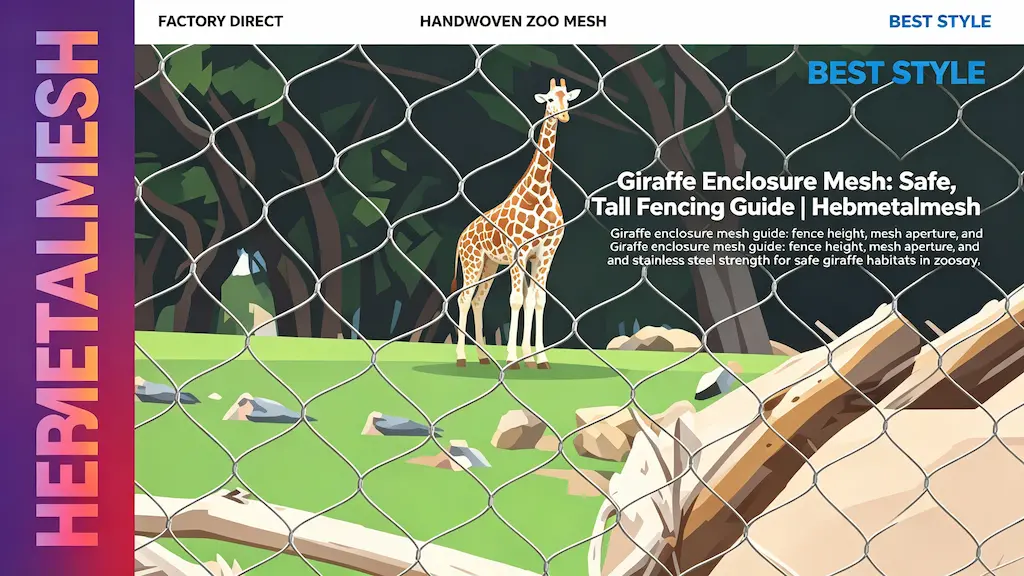
A giraffe enclosure is the hardest fence line in any zoo to get right. The giraffe is the tallest land animal, it leans on barriers with the weight of a small car, and it can reach a surprising distance with that neck — yet it does not climb and it jumps poorly. Those facts decide the mesh. The right giraffe exhibit mesh is a hand-woven stainless steel rope net that is tall enough, strong enough, and open enough for visitors to see the animal clearly. Plain giraffe netting fails at its welds, so the panel has to be continuous cable from top rail to footing.
Executive Summary
Giraffe enclosures need a barrier taller and more impact-resistant than almost any other land animal because the giraffe stands up to 5.5 m (18 ft) and presses a fence with tonnes of force. Hand-woven stainless steel rope mesh meets that brief: it runs full height with no climb ledges, absorbs herd impact without a single weld failing, and stays visually open for guests. Aperture runs 76–102 mm with 2.0–3.2 mm cable, and SS316 is the choice within 5 km of the coast. The reference specification is the animal fence mesh product page.
Building or renovating a giraffe exhibit? Send the herd size, yard dimensions, and public-setback distance, and we will return a top-rail height, cable grade, and planning estimate. Request a Giraffe Mesh Quote
Quick Answer
What mesh works for a giraffe exhibit? A hand-woven stainless steel rope mesh with 2.0–3.2 mm cable and a 76–102 mm aperture, tensioned on a frame whose top rail clears at least 5.5–6 m. SS304 suits inland yards; SS316 suits coastal or high-humidity sites. That combination holds a leaning, kicking herd while keeping the barrier nearly invisible to visitors.
Key Takeaways
- A giraffe exhibit mesh must clear 5.5–6 m because the animal is the tallest on land.
- Giraffes lean and kick but do not climb, so impact strength matters more than climb-proofing.
- Aperture 76–102 mm with 2.0–3.2 mm cable; keep 76 mm minimum so a calf cannot wedge its head.
- SS304 works inland; SS316 is the safe call within 5 km of salt water.
- Heavy-grade planning cost runs about $20–38/m² for the cable and ferrules.
The IUCN lists the giraffe as Vulnerable, so accredited venues also frame their herds as conservation ambassadors — another reason the exhibit barrier should look intentional and last decades.
Why Giraffe Fencing Is Unlike Any Other Enclosure
Most enclosure design starts with climbing or digging. Giraffes do neither. What they do is lean — a bull can rest half its weight against a rail while browsing — and kick. That shifts the design problem from “stop the escape artist” to “hold a moving load of up to a tonne at 6 m height.” A large mammal mesh built from continuous cable is the only common option that does this without a rigid post every metre, and hand woven giraffe netting is how that cable becomes a panel rather than a welded sheet.
The neck is the other wildcard. A giraffe can stretch its head well over a low barrier to grab browse on the public side, so the mesh has to extend above the animal’s reach or sit behind a planted setback. That is why giraffe neck height mesh is specified to the animal’s full standing height plus a margin, not to a nominal fence height.
Herds add a third load case. Giraffes loaf in loose groups, and several animals can line a fence at once. Unlike a big cat’s point impact, this is a distributed lean — but it lasts longer, so hoofstock mesh is tensioned tighter and fixed closer at the corners than a carnivore panel.
How Tall? Sizing the Top Rail and Overhead Plane
Plan the top rail at 5.5–6 m above the finished grade, and add 300–450 mm of buried turn-out at the base so a foal cannot duck under. Where the yard borders a public path, set the mesh behind a 2–3 m planted or walled setback so the neck cannot reach guests even at full stretch. An open giraffe tower netting style — a tall, single, taut plane — reads as “no fence” to visitors while still clearing the animal, and the same height rule applies to smaller giraffe pens mesh sections built for calves or vet holding.
Choosing Aperture and Cable for Giraffes
Giraffes have large heads, so the aperture can be generous: start at 76 mm (HM2076, 2.0 mm cable) for cows and calves, and move to 102 mm (HM32102, 3.2 mm cable) for bull yards where the heavier animal needs the stiffer sheet. The 76 mm floor matters because a calf’s head, while smaller than an adult’s, can still wedge in anything larger. A giraffe savanna mesh layout for a mixed-species plain uses 102 mm so zebra and giraffe can share one barrier, while a giraffe savanna netting panel at 76 mm keeps calves safe and adults visible in a single-species yard.
Material: SS304 or SS316
SS304 (18% chromium, 8% nickel) covers inland yards with normal humidity. SS316 adds molybdenum for chloride resistance and is the right call for any giraffe stock netting installed within about 5 km of the coast or in a constantly wet climate. Both alloys are non-toxic if an animal mouths the cable, which matters for a species that investigates fences with its lips.
Alternatives Compared
Specifiers sometimes ask whether a cheaper fence can do the job. The comparison below is why hand-woven rope mesh wins on lifecycle cost even at a higher sticker price.
| Option | Height to 6 m | Impact resistance | Sightline | Lifespan |
|---|---|---|---|---|
| Chain link | Poor (opaque) | Medium | Poor | 8–15 yr |
| Welded wire | Hard | Low–medium | Fair | 3–5 yr at welds |
| Wood / rail fence | Good | Medium | Fair | 10–20 yr, rots |
| Polymer netting | Hard | Low | Good | 2–4 yr (UV) |
| Hand-woven SS rope mesh | Excellent | High | Excellent | 25–30+ yr |
For a giraffe exhibit fencing line that guests view up close, only the rope mesh disappears while still holding the load — which is why a giraffe containment mesh system is now the default for new exhibits and why a giraffe mesh panel outlasts every rigid alternative on the list.
Installation: Tension, Base, and Setback
Fix the top rail first, then tension the sheet from the centre outward so it stays flat at full height. Use turnbuckles rather than relying on cable stretch, which is near zero. Close the bottom edge against a concrete curb or bury it 300–450 mm turned outward so a giraffe run mesh section cannot be undermined. Fixing centres tighten as the span grows: 300–400 mm along the top edge, closer at corners and on any panel a bull can reach.
A giraffe paddock mesh install should also keep the public-side plane at least 2 m from the handrail, so the neck cannot bridge the gap. Support overhead spans on a secondary cable grid so falling branches or a leaning animal cannot over-load a single line. A giraffe corral mesh yard follows the same rule at its contact posts.
Planning the Budget
Indicative planning ranges, not quotes: heavy-grade giraffe mesh for large mammals runs about $20–38/m² depending on cable diameter and aperture, plus a cutting and ferrule fee for irregular shapes. A factory giraffe mesh order priced per square metre plus fabrication usually beats welded panels that need field modification. Two traps are common: a fence too short invites a lean-over, and a fence too light stretches under herd load, so match the cable to the bull weight and the aperture to the calf head.
Conservation and Standards
The IUCN lists the giraffe as Vulnerable, and WAZA and AZA enclosure standards emphasize both animal welfare and safe public viewing. The rope-mesh approach supports those standards because it removes weld failure points and keeps the barrier continuous and open. A qualified giraffe mesh supplier will supply the alloy certificate and aperture schedule a curator needs for sign-off, which is why a giraffe fencing for sale enquiry is best answered with a documented system rather than loose roll. A giraffe holding mesh rated for herd impact and a giraffe habitat mesh sized to the full animal height together close the spec.
FAQ
Plan the top rail at 5.5–6 m above grade. The giraffe is the tallest land animal, so a giraffe yard mesh must clear the full standing height plus a margin, not a nominal fence height.
Use 76 mm (HM2076) as the floor. A calf’s head is smaller than an adult’s but can still wedge in anything larger, so a giraffe habitat mesh panel should never open beyond 102 mm even in a bull yard.
Within about 5 km of salt water choose SS316. The added molybdenum resists chloride pitting that would eventually weaken SS304, so a giraffe corral mesh by the sea should be 316 by default.
Giraffes neither climb nor jump well; their risk is leaning and kicking. A giraffe holding mesh rated for herd impact handles that load, which is why climb-proofing is less important than impact strength here.
Installed correctly, 25–30 years or more — versus 3–5 for welded wire and 2–4 for polymer netting. That lifespan is why hand woven giraffe mesh is specified for permanent exhibits over cheaper alternatives.
Conclusion
A giraffe exhibit mesh program succeeds when the barrier is specified to the animal’s height and herd load rather than to a generic fence height, and when the product is continuous stainless cable that cannot fail at a single weld. Hand-woven rope mesh delivers the 5.5–6 m clearance, impact resistance, and clear sightlines a modern giraffe exhibit needs, and it does so for a lifecycle cost below any rigid alternative. For panels, apertures, and a planning estimate sized to your herd, the animal fence mesh product page is the reference specification, and our team can return a recommendation from a simple yard sketch.