
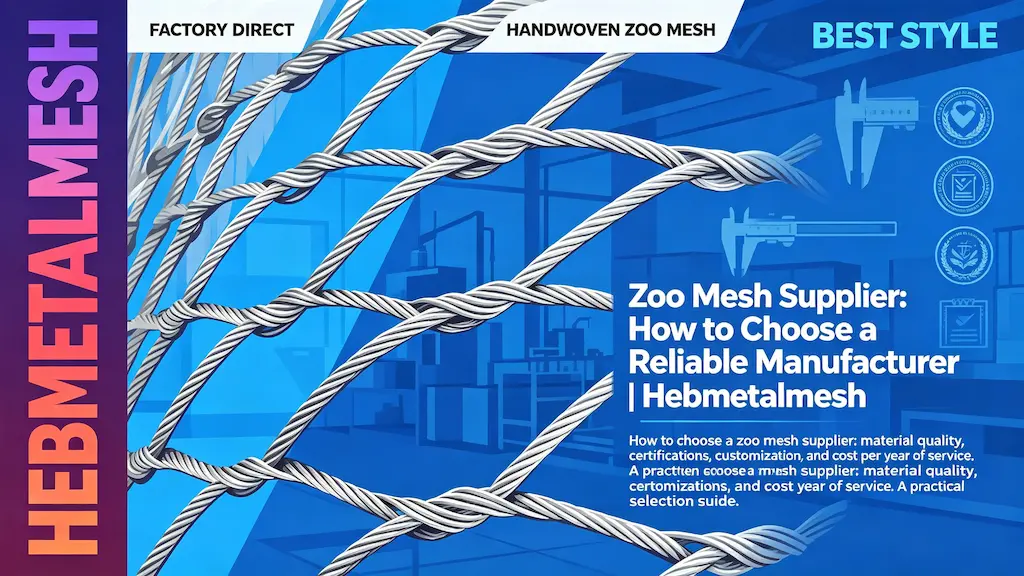
Modern zoos, wildlife parks, and sanctuaries need enclosure barriers that protect animals, reassure keepers, and stay nearly invisible to visitors. A single barrier has to stop an escape, survive decades of weather and animal contact, and vanish visually so guests can watch the animals. Hand-woven stainless steel rope mesh has become the default answer to that brief, and it is the product family this guide covers for every zoo venues mesh decision.
Executive Summary
Zoo and animal venues face one enclosure problem with three hard constraints: the barrier must block escape, survive weather and animal contact for decades, and disappear visually so guests keep a clear view of the animals. Hand-woven stainless steel rope mesh meets all three at once. It is specified by aperture size rather than by species, so one product family serves aviaries, primate islands, big-cat rows, and hoofstock paddocks. The reference specification is the animal fence mesh product page.
Specifying mesh for a new or renovated venue? Send us the species list, panel sizes, and a sketch of the enclosures, and we will return an aperture and cable recommendation with a planning estimate. Request a Venue Mesh Quote
Quick Answer
What mesh should a zoo venue use? A hand-woven stainless steel rope mesh with the aperture matched to the species’ head and paw size — 25–51 mm for small birds and monkeys, 51–76 mm for primates and medium mammals, 76–102 mm for big cats and hoofstock. SS304 suits inland venues; SS316 is the safe choice within about 5 km of salt water. This keeps animal venues mesh escape-proof without blocking the sightline keepers and guests rely on.
Key Takeaways
- zoo venues mesh must balance escape security, animal welfare, and clear visitor sightlines.
- Hand-woven stainless steel rope mesh outlasts chain link, welded wire, and polymer netting.
- Aperture — not wire thickness — drives which species a panel can hold.
- SS304 works inland; SS316 is the safe choice within 5 km of salt water.
- Planning cost runs $10–22/m² for aviary grade and $20–38/m² for carnivore grade.
The World Association of Zoos and Aquariums (WAZA) publishes animal-welfare and enclosure guidance that most accredited venues design against, so the aperture and viewing recommendations below track that direction.
Why Zoo Venues Need a Different Kind of Mesh
A farm fence is built to keep livestock in a field. A zoological mesh installation is built to keep a climbing, digging, jumping, or flying animal exactly where the designer intended, while a few meters away a family watches it through what looks like empty air. That combination — security plus transparency — is what disqualifies most off-the-shelf fencing.
Chain link is opaque at distance and snags claws and beaks. Welded wire rusts at every weld and fails at a single node. Polymer netting goes brittle under UV and loses tension within a few seasons. By contrast, netting for zoo venues built from continuous stainless cables has no single failure point: a cable that is cut still holds because its neighbours carry the load. That redundancy is why flexible venues mesh is now specified for walk-through aviaries and overhead primate crossings where a tear could mean a real escape. For guest-facing walk-through exhibits, animal venues netting rated by aperture keeps people and animals safely separated without a visible wall.
Hand-Woven Stainless Steel Rope Mesh, Explained
The product is a grid of stainless steel cables joined at every crossing by a pressed ferrule. Because the crossings are hand-woven rather than welded, the sheet stays supple and conforms to curved frames, rocky outcrops, and tree trunks. That is the core reason hand woven netting is preferred over rigid panels for naturalistic exhibits.
Two alloys are used. SS304 (18% chromium, 8% nickel) covers inland venues with normal humidity. SS316 adds molybdenum for chloride resistance and is the right call for any stainless netting for venues built within about 5 km of the coast or in constantly wet climates. Rope diameter runs 1.2–3.2 mm and aperture runs 20–102 mm, so the same manufacturing method scales from finch flight cages to elephant-yard barriers.
Panels are produced up to roughly 9 m × 18 m and shipped rolled, then tensioned on site. A venues mesh manufacturer will usually cut to the exact rectangle or trapezoid the enclosure needs, which removes the on-site splicing that weakens rigid mesh.
Choosing the Aperture by Zone
Aperture is the single variable that decides which animal a panel can hold. The rule is simple: the opening must be smaller than the animal’s head and smaller than the smallest paw that could get a grip. The table below maps common venue zones to a starting aperture.
| Venue zone | Species example | Starting aperture | Cable diameter |
|---|---|---|---|
| Small bird aviary | Finch, parakeet | 25 mm (HM1220) | 1.2 mm |
| Mixed avian | Pheasant, curassow | 38–51 mm (HM1638) | 1.6 mm |
| Primate island | Macaque, gibbon | 51–76 mm (HM2051) | 2.0 mm |
| Medium mammal | Deer, chevrotain | 76 mm (HM2076) | 2.0 mm |
| Big cat row | Lion, tiger | 76–102 mm (HM3276) | 3.2 mm |
| Hoofstock yard | Zebra, antelope | 102 mm (HM32102) | 3.2 mm |
The same zoological netting product therefore covers a whole park if the designer orders by aperture rather than by species page. A venues mesh supplier will keep all six apertures in stock so a venue can standardize on one installer and one spare-parts list.
Alternatives Compared
Specifiers sometimes ask whether a cheaper fence can do the job. The comparison below is why hand woven venues netting wins on lifecycle cost even when its sticker price is higher.
| Option | Escape security | Sightline | Lifespan (active climb path) | Notes |
|---|---|---|---|---|
| Chain link | Medium | Poor | 8–15 yr | Snags claws, opaque |
| Welded wire | Medium | Fair | 3–5 yr | Fails at welds |
| Galvanized hardware cloth | Low–medium | Fair | 6–12 yr | Rusts at cut edges |
| Polymer netting | Low | Good | 2–4 yr | UV brittle |
| Hand-woven SS rope mesh | High | Excellent | 25–30+ yr | No single failure point |
For a zoo venues fence that guests view up close, the sightline column alone often settles the decision: only the rope mesh disappears.
Installation and Tensioning for Venues
A panel is only as good as its edge. Fix the top rail first, then tension from the centre outward so the sheet stays flat. Use turnbuckles or pre-tensioned frames rather than relying on the cable’s stretch, which is near zero. For zoo venues barrier work on an overhead plane, support the sheet on a secondary cable grid so a falling branch cannot over-load a single span. Where a venue still runs legacy animal venues fencing, the rope mesh is often retrofitted over the existing frame to extend its service life without a full rebuild.
The base matters most for diggers. Close the bottom edge against a concrete curb or bury it 300–450 mm and turn it outward, so a zoo perimeter barrier cannot be undermined. Fixing centres tighten as the span grows: 300–400 mm along the top edge, closer at corners and on any panel a heavy animal can reach.
Planning the Budget
Indicative planning ranges, not quotes: aviary-grade stainless venues netting runs about $10–22/m², and carnivore-grade panels run about $20–38/m² depending on cable diameter and aperture. A venues netting manufacturer will usually price per square metre plus a cutting and ferrule fee, so irregular shapes cost a little more than rectangles but still beat welded panels that need field modification.
Two cost traps are common. First, cheap fence that fails in five years costs more than stainless mesh that lasts thirty. Second, a zoo venues netting project specified too tight on aperture wastes cable on small exhibits and too open on large ones lets an animal through. Match the aperture to the zone and the budget follows.
Compliance and Standards
Accredited venues design to WAZA and, in North America, AZA enclosure standards, which emphasize both animal welfare and safe public viewing. The rope-mesh approach supports those standards because it removes weld failure points and keeps the barrier continuous. A zoological netting supplier familiar with venue work will supply the alloy certificate and aperture schedule a curator needs for sign-off, which is why zoological netting for zoos is increasingly bought as a documented system rather than loose roll. A qualified animal venues netting supplier will do the same for mixed-species parks and supply a single aperture schedule that covers every zone on site.
FAQ
For macaques and similar medium primates, start at 51–76 mm with 2.0 mm cable; gibbons need the tighter end because they can hook slender fingers through larger openings. Match the panel to the animal, not the enclosure name.
Yes, when the aperture fits the species. Small passerines need 25 mm (HM1220) so a head cannot pass, and the smooth cable avoids the feather and foot snags that chain link causes — which is why mesh for animal venues with fine apertures is used in walk-through aviaries.
Within about 5 km of salt water choose SS316. The added molybdenum resists chloride pitting that would eventually weaken SS304, so stainless netting for venues by the sea should be 316 by default.
Installed correctly, 25–30 years or more on an active climb path, versus 3–5 years for polymer netting and 6–12 for galvanized hardware cloth. That lifespan is the main reason netting for animal venues is specified for permanent exhibits.
Yes. Because the same hand woven venues netting is made from 20 mm to 102 mm aperture, a park can standardize on one system and one spare-parts list across aviaries, primate islands, and hoofstock yards.
Conclusion
A zoo venues mesh program succeeds when the barrier is specified by aperture and alloy rather than by a species name, and when the product is continuous stainless cable that cannot fail at a single weld. Hand-woven rope mesh delivers the escape security, animal welfare, and clear sightlines a modern venue needs, and it does so for a lifecycle cost below any rigid alternative. For panels, apertures, and a planning estimate sized to your species list, the animal fence mesh product page is the reference specification, and our team can return a recommendation from a simple enclosure sketch.