
Executive Summary
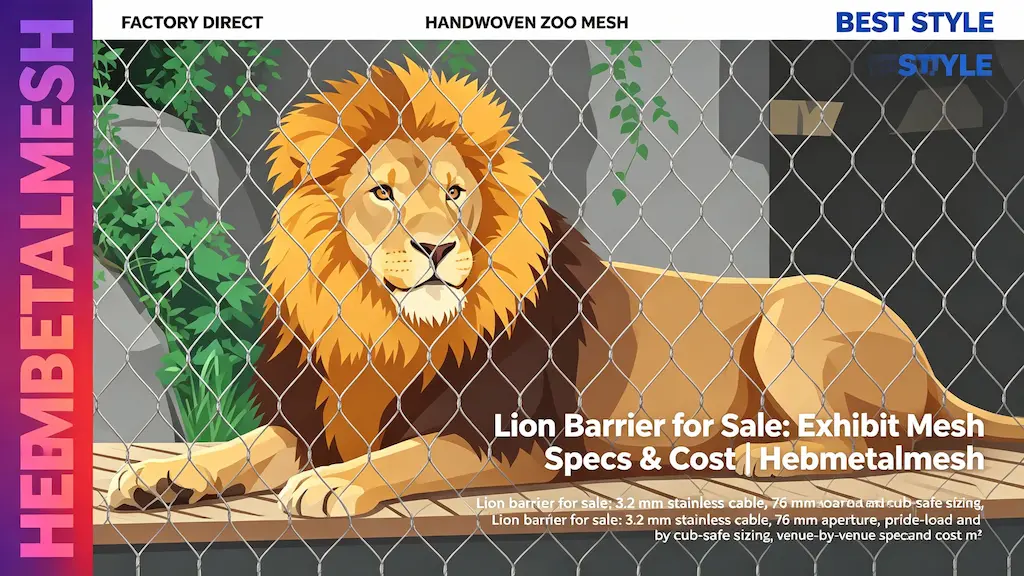
A lion barrier for sale is not a fencing purchase — it is a containment system sized against an animal that bites, claws and leans its full weight on the line, and lives in a group able to load one wall at once. An adult male Panthera leo runs 150–250 kg and clears 3 m from a standing start; a new-born cub weighs about 1.5 kg and fits through an opening no adult could pass. Those two animals set the specification from opposite ends. The reference build is 3.2 mm (1/8″) stainless cable at 76 mm (3″) square — code HM3276 — in 316 stainless steel: open enough for sightlines, tight enough to refuse a paw and a cub’s head. Hand-woven mesh matters because a lion fails a barrier at its joints, not mid-strand. This guide covers the lion enclosure aperture, cable and wire diameter selection, the breaking load question, venue-by-venue specification, lion barrier mesh installation and lion barrier mesh cost. The reference specification is the lion enclosure netting product page.
Specifying a Lion Exhibit, Run or Holding Wall?
Send the opening dimensions, how many animals will share the space, and whether cubs are expected. We return an aperture, cable diameter, panel layout and fixing schedule within 24 hours.
Get My Free Lion Barrier Layout →Quick Answer: What Mesh Does a Lion Barrier Need?
Use 3.2 mm (1/8″) stainless cable at 76 mm (3″) square — code HM3276 — in 316 stainless for public frontage and any wall a pride can reach together. 76 mm is the widest opening that still refuses an adult paw and a cub’s skull; 3.2 mm absorbs a 190 kg animal hitting the line without permanent set. Move to 102 mm only on overhead planes. Drop to 25 mm in a cubbing den. Tension every edge and close the base.
Key Takeaways
- Size the aperture from the cub; size the cable from the adult.
- 3.2 mm / 76 mm (HM3276) in 316 is the reference build for a zoo lion barrier mesh.
- A pride loads one wall simultaneously — design for the group, not one animal.
- Welded wire and chain link fail at the joint, which is where a lion works.
- Containment is lost at the base and the overhead plane, not mid-panel.
Containment standards are not advisory. Big cat barriers sit inside the accreditation framework of the Association of Zoos and Aquariums (AZA), whose institutions maintain primary and secondary containment plus documented barrier inspection — the mesh is one component of a system that also includes shift doors, stand-off barriers and keeper protocol.
A Lion Is a Different Load Case
Lions are the only truly social cats, and that changes the engineering. Where a tiger enclosure is designed around one or two animals, a pride of five or six adults crosses an exhibit together and several can end up against the same wall at once — resting shoulder-to-shoulder, or reacting to the same stimulus on the visitor side. The barrier sees a distributed live load and a point impact load arriving together.
The second difference is how a lion attacks a barrier: it does not just push, it bites and rakes. A big cat gripping the weave and pulling transfers force into a single intersection — precisely where a welded grid fails, because the weld is a heat-affected zone weaker than the wire either side of it. Claws hook and lever rather than slide, and a 190 kg male leaning on the plane delivers sustained load that deforms any barrier not tensioned to structure.
Why the Usual Mesh Types Fail
The page previously published at this URL recommended galvanized hardware cloth, high-tensile mesh and welded wire. Its aperture advice — 3 inch or smaller — was directionally right; the material advice was not, and the reason is joint behaviour.
- Galvanized hardware cloth — thin zinc coating, welds as the load path. A lion grips and pulls, breaking welds at the intersection; once the coating is gone the base steel rusts from the joint outward.
- Welded wire mesh — strong in the strand, weak at the weld. Acceptable as a secondary line, not as primary containment for a big cat.
- Chain link — the knuckled selvage leaves open hooks, and a diamond stretched under load opens into a paw-sized gap.
- High-tensile fixed-knot field fence — built for livestock impact, not sustained bite-and-pull.
Stainless steel lion mesh in hand-woven mesh construction avoids the failure mode: continuous cable runs through ferrule-clamped intersections instead of terminating at a weld, so load is shared across every node with no heat-affected zone to fracture. That is the difference between a barrier that is merely strong and one that is genuinely lion proof mesh.
Aperture: The Cub Sets the Number
Mesh aperture is measured across the flat opening of the diamond, and it is the one dimension that cannot be corrected after the panel is hung.
| Risk being designed against | What it demands | Aperture |
| Cub head and body passage | Skull cannot pass | 76 mm; 25 mm in a cubbing den |
| Adult paw and claw reach | Paw cannot pass to the shoulder | 76 mm |
| Visitor finger reach | Hand cannot reach the animal | 76 mm plus stand-off |
| Mane and ruff snagging | Hair releases cleanly | 76 mm, smooth cable |
| Overhead climb-out | Body cannot pass the top plane | 76–102 mm overhead |
That is why the aperture question and cub safety resolve to the same number. Going wider — 102 mm is common on macropod yards — starts admitting a cub and a reaching paw. Going tighter buys nothing once the cub is weaned.
Wire Diameter and Breaking Load
Wire diameter sets how the panel responds to impact, and it scales with the square of the steel content — which is also why it drives price.
| Cable | Imperial | Typical lion use | Notes |
| 1.6 mm | 1/16″ | Cubbing dens, quarantine | Close centres, short spans |
| 2.0 mm | 5/64″ | Quarantine, low-pressure holding | Light; not for public frontage |
| 2.4 mm | 3/32″ | Off-exhibit runs, transfer | Moderate impact |
| 3.2 mm | 1/8″ | Standard lion barrier mesh (HM3276) | Absorbs a charge, resists bite-pull |
| 3.2 mm / 102 mm | 1/8″ | Overhead planes, wide spans (HM32102) | Long spans, fewer anchors |
The breaking load of a 3.2 mm 316 strand runs well above anything one animal can deliver, which is the point: the cable is never the weak link. Failures start at the ferrules, the border cable termination and the anchors. Specify stainless ferrules and clamps throughout — a galvanized clamp on stainless cable is a galvanic couple that corrodes at the point carrying tension.
304 or 316
304 stainless steel (18% chromium, 8% nickel) is correct for dry inland sites. 316 stainless steel adds molybdenum for chloride resistance and is the right call within about 5 km of salt water, wherever bore or recycled water is used for washing, or where the barrier is disinfected routinely. Most coastal parks should treat 316 as standard. Finish is the last decision: bright Nature reads as a metallic sheen; black oxide disappears against planting and dark rockwork.
Pride Loading: Why Group Housing Changes the Math
A barrier for a single animal is sized for one impact. A barrier for a pride is sized for a group arriving at the same wall, and for the behaviour that goes with it — animals standing on one another at a corner, a cub knocked against the mesh, and sustained resting load along the public-facing section.
Three consequences follow. Corners need anchors sized for combined tension from two directions. The lower 1.5 m, where animals lean and are pushed by others, is worth one diameter heavier than the wall above. And every penetration — shift-door frame, water or browse pass-through — must be re-terminated to the border cable.
Venue-by-Venue Specification
Different spaces inside the same facility are different barriers. A single “lion spec” applied everywhere over-builds the night house and under-builds the public front.
| Venue | Load case | Build | Notes |
| Public exhibit front | Crowd, pride, charge | 3.2 mm / 76 mm (HM3276) | Reference zoo lion barrier mesh; 316 coastal |
| Off-exhibit run — lion run mesh | Pride, lower impact | 2.4–3.2 mm / 76 mm | Overhead plane required |
| Holding / night house — lion holding mesh | Pair or single | 3.2 mm / 51–76 mm | Tighter near keeper access |
| Cubbing den | 1.5 kg cubs | 1.6–2.0 mm / 25 mm (HM1625) | Cub safety over visibility |
| Quarantine | Single animal | 2.0–2.4 mm / 51 mm | Cleanable smooth surface |
| Transfer chute / shift | Restrained movement | 3.2 mm / 51 mm | No snag points |
| Overhead plane | Climb-out | 2.4–3.2 mm / 76–102 mm | Panels to 9 m × 18 m |
A lion venue mesh plan that separates these spaces puts the budget where the risk is: the public front and overhead plane take the money, the night house gets a tighter, lighter build.
Panels, Spans and Fixing Centres
Each lion barrier panel is woven to the opening rather than cut from roll stock, up to 9 m × 18 m, so a 6 m exhibit wall is a single panel with no horizontal joint — and a seam is where a claw finds purchase. Custom lion mesh panels ship with the border cable already terminated, so the crew is not re-ferruling mesh at height, which is also safer for keeper safety during install.
Fixing centres tighten as the span grows: 300–400 mm along the top edge, closer at corners. Where a walk-through shares the structure, the aviary side follows different logic — see aviary netting; for a second big-cat house, the tiger enclosure range and leopard enclosure range carry near-identical tables.
Lion Barrier Mesh Installation
- Fix the perimeter first. Stainless border cable on all four sides, anchored at 1.5–2.5 m centres, with corner anchors sized for combined two-direction tension.
- Hang from the top. Clamp the top edge at 300–400 mm spacing, then tension downward and across until all sag is gone — a sagging panel is a claw trap and a climb ladder.
- Close the base. Terminate on a base rail and either bury a 300–450 mm apron turned outward or fix to a concrete upstand.
- Border every penetration. Shift doors, service openings and gate frames get a re-terminated cut-out, never a raw edge.
- Re-tension at 30 days, then inspect each season and after any storm.
Lion Barrier Mesh Cost
Lion barrier mesh cost is driven by steel content, which scales with the square of the wire diameter — a 3.2 mm panel costs roughly double a 2.0 mm panel of the same area. Carnivore-grade stainless steel rope mesh in 2.4–3.2 mm cable plans at roughly 20–38 per m². Structure, anchors, overhead framing and freight are quoted separately, and on a tall public exhibit the supporting steel usually costs more than the mesh.
The comparison that matters is cost per year of service: a welded galvanized build re-clad along the wear band every six to ten years costs several times more across 25 years than one stainless installation. Full code tables are on the stainless steel rope mesh page. Buying factory direct lion mesh removes the trading margin, but verify the mill certificate and ferrule specification with any lion barrier mesh supplier before comparing prices.
Five Specification Mistakes
- Sizing for the adult only — the cub sets the aperture.
- Welded or galvanized wire on a public front — the joint fails before the strand.
- Mixing metals — galvanized fittings on stainless cable corrode at the tension point.
- Leaving the base open or the overhead off — containment is lost at the edges.
- Over-specifying the mesh, under-specifying the structure — the substrate fails first.
FAQ
76 mm (3 inch) square for adults; 25 mm in a cubbing den. 76 mm refuses an adult paw and a cub’s skull while staying readable at distance.
The weld is weaker than the wire either side of it. A lion grips and pulls at a single intersection, which is exactly where welded grid fractures.
They can, and the overhead plane is what stops them. The smooth cable does not give a claw the purchase that chain link does.
304 is fine at dry inland sites. Choose 316 within about 5 km of salt water, where bore or recycled water is used for washing, or where the barrier is disinfected routinely.
Indicatively 20–38 per m² for carnivore-grade 2.4–3.2 mm cable, with structure, anchors and freight quoted separately.
20–30+ years in 316 and 304 service, against three to five years for polymer netting and under a decade for galvanized welded product on an active front.
Specifying Your Barrier
A lion barrier succeeds on four numbers: aperture, cable diameter, alloy and base detail — plus the discipline to close every edge and penetration. Get those right and the enclosure contains cubs, holds a pride, and survives a decade of leaning, biting and clawing. For the full specification tables, start from the lion enclosure netting product page.
Send the opening dimensions, how many animals will share the space, and whether cubs are expected — we will return an aperture, cable diameter, panel layout and landed price within 24 hours. Contact us to start.