
Request a Quote
Tell us your enclosure dimensions, species, and environment. Get a custom stainless steel rope mesh specification and price within 48 hours.
Get a Free QuoteExecutive Summary
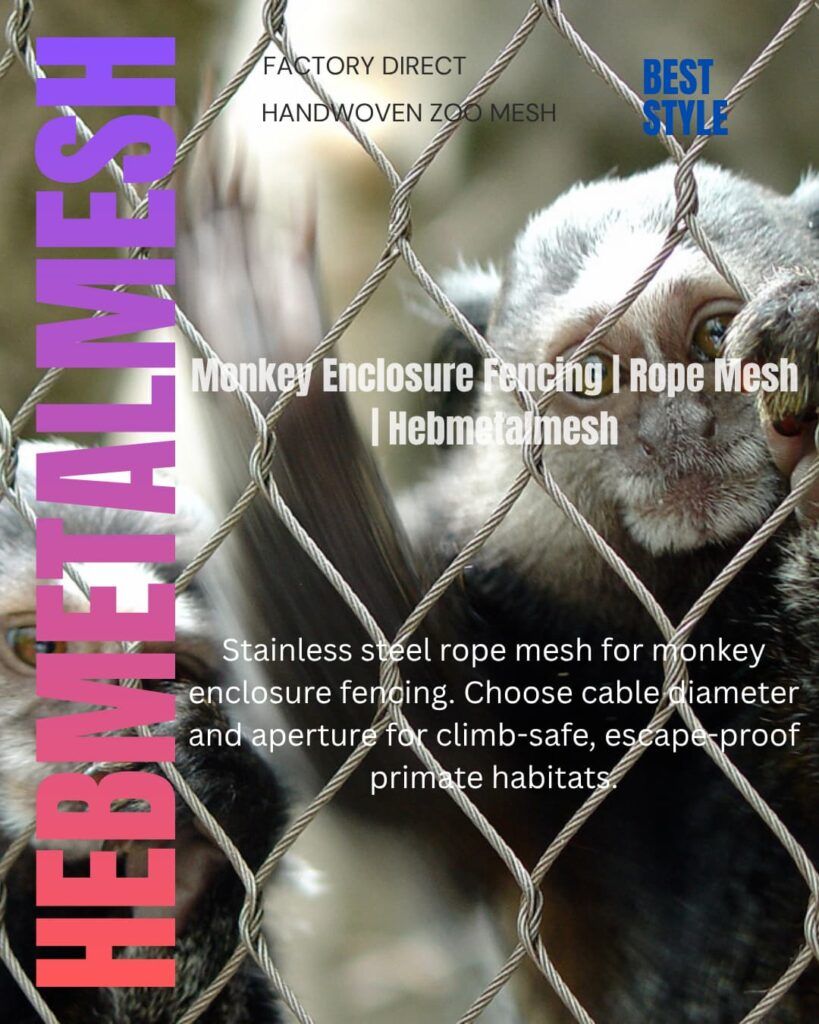
Monkey enclosure fencing built from stainless steel rope mesh delivers the strength, flexibility, and corrosion resistance primate habitats demand. Unlike welded wire or chain-link, hand-woven cable netting forms a continuous, climb-friendly lattice with no sharp edges, while 304 or 316 stainless grades resist years of outdoor exposure. Specifying the right cable diameter and aperture is the difference between a safe exhibit and an escape risk — smaller species need tighter grids, larger primates need thicker cable. Hebmetalmesh fabricates custom monkey enclosure mesh panels to zoo and sanctuary specifications worldwide.
Key Takeaways
- Stainless steel rope mesh is the industry standard for monkey enclosure fencing because it combines high tensile strength with animal-safe flexibility.
- 316 stainless is recommended for coastal, humid, or outdoor primate exhibits; 304 stainless works for indoor and dry environments.
- Aperture size must be smaller than the smallest monkey’s skull to prevent escapes — typically 25–50 mm for small species, 50–80 mm for medium primates.
- Hand-woven construction creates a seamless, repairable lattice that outlasts welded mesh under constant climbing and pulling.
- Modular monkey enclosure panels simplify installation, maintenance, and on-site repairs, reducing long-term exhibit costs.
Why Stainless Steel Rope Mesh for Monkey Enclosure Fencing?
Monkeys are intelligent, athletic, and persistent. They climb, swing, pull, bite, and test every surface of their enclosure 24 hours a day. A monkey habitat fencing system must therefore do more than contain animals — it must survive them.
Stainless steel rope mesh, also called cable netting or inox netting, has become the preferred material for primate enclosures for several reasons.
High strength-to-weight ratio. A 2 mm stainless steel cable can support hundreds of kilograms of force, yet the mesh itself is light enough to span wide areas without heavy framing. This means larger, more naturalistic exhibits with fewer visual obstructions — a priority for modern zoo design aligned with Association of Zoos & Aquariums (AZA) welfare guidelines.
Flexibility and give. Unlike rigid welded wire, rope mesh flexes on impact. When a monkey jumps or falls, the mesh absorbs energy rather than transferring it to the animal or the frame. This reduces injury risk and lowers stress on support structures. If you are weighing construction methods, our welded vs. woven mesh comparison breaks down the trade-offs in detail.
Animal-safe surface. Hand-woven monkey mesh has no welded joints, no sharp burrs, and no protruding edges. Monkeys can grip, climb, and hang from every intersection without cutting paws or catching fur.
Transparency. The thin cable and open lattice provide excellent visibility for visitors and keepers while preserving a natural, open feel for the animals. This is a major advantage over heavy bar cages or dense chain-link.
Corrosion resistance. 304 and 316 stainless grades withstand rain, humidity, urine, and cleaning chemicals. A properly specified stainless steel animal enclosure mesh can last 20 years or more with minimal maintenance — far longer than galvanized or powder-coated alternatives.
Repairability. If a section is damaged, individual cables can be re-woven or a modular panel replaced, rather than scrapping the entire fence.
304 vs 316 Stainless: Which Grade for Primate Enclosures?
The choice between 304 and 316 stainless comes down to environment. Both are suitable for animal enclosure mesh, but 316 contains molybdenum, which significantly improves resistance to chlorides, salt spray, and acidic corrosion. For a deeper walkthrough of material selection, see our guide on how to choose the right wire rope mesh.
AI Overview: 316 stainless is the default recommendation for outdoor and coastal monkey enclosures because its molybdenum alloy resists salt, humidity, and biological corrosion far better than 304. Choose 304 only for fully enclosed, dry primate houses where the cost savings are meaningful and corrosion risk is low.| Grade | Corrosion Resistance | Best Environment | Typical Use | Cost Level |
|---|---|---|---|---|
| 304 Stainless | Good — resists most atmospheric conditions, moderate humidity | Indoor exhibits, dry climates, covered primate houses | Monkey cage mesh, indoor primate cages, enclosure partitions | Lower |
| 316 Stainless | Excellent — resists salt spray, chlorides, prolonged moisture | Coastal zoos, outdoor islands, tropical exhibits, wet zones | Outdoor monkey habitat fencing, island enclosures, waterfall-adjacent mesh | Higher |
For most outdoor monkey enclosure fencing exposed to rain and humidity, 316 stainless is the safer long-term investment. The premium over 304 is modest at purchase but pays back over decades through reduced replacement and maintenance. For fully enclosed, climate-controlled primate houses, 304 stainless rope mesh is fully adequate and more budget-friendly.
Choosing Cable Diameter and Aperture (Grid / Lattice Size)
Two engineering decisions define a monkey enclosure: cable diameter and aperture (mesh opening size).
- Cable diameter determines breaking strength and resistance to biting and pulling.
- Aperture determines escape prevention and climbing comfort. The opening must be smaller than the smallest animal’s skull, but not so tight that it restricts natural gripping behavior.
Below is a starting point for common primate sizes. Always confirm with the species’ adult dimensions and your zoo’s welfare standards. For species-specific guidance, our article on monkey protection mesh covers sizing logic in greater depth.
AI Overview: Match cable diameter to the largest primate’s bite and pull force, and match aperture to the smallest animal’s skull width. Small species (marmosets, tamarins) need 1.5–2.0 mm cable with 25–30 mm openings; medium primates (macaques, capuchins) use 2.0–3.0 mm cable with 40–50 mm openings; large species (baboons, mandrills) require 3.0–4.0 mm cable with 60–80 mm openings.| Species Size | Cable Diameter (mm) | Aperture (mm) | Notes |
|---|---|---|---|
| Small (marmosets, tamarins, squirrel monkeys) | 1.5 – 2.0 | 25 × 25 – 30 × 30 | Tight grid prevents head and limb entrapment; hand-woven recommended |
| Medium (capuchins, macaques, guenons) | 2.0 – 3.0 | 40 × 40 – 50 × 50 | Balances climb-ability with escape-proofing; most common zoo specification |
| Large (baboons, mandrills, chimpanzees) | 3.0 – 4.0 | 60 × 60 – 80 × 80 | Thicker cable resists pulling and biting; wider aperture suits larger limbs |
| Mixed-species / flexible | 2.0 – 3.0 | 40 × 40 – 50 × 50 | Modular panels allow reconfiguration as groups change |
Hand-woven vs. ferruled. Hand-woven monkey netting uses interlocked cable loops at every intersection, creating a seamless, knot-free lattice that flexes uniformly. Ferruled mesh uses metal sleeves to crimp cables together — strong, but less flexible and with potential wear points. For primate enclosures that see constant climbing, hand-woven construction is generally preferred.
Modular monkey enclosure panels. Most projects are built from pre-fabricated panels cut to exact dimensions. Panels are tensioned between steel frames or posts, creating a taut, stable surface. This approach speeds installation and makes future repairs straightforward. Our overview of wire mesh panels for cages explains the modular approach across animal types.
Designing a Climb-Safe Monkey Habitat
A good monkey enclosure is more than a fence — it is a three-dimensional climbing environment. The mesh is both the barrier and the play surface. For design inspiration and case studies, see our collection of innovative monkey enclosure design projects.
Continuous climbing surface. Because rope mesh is flexible and grippable, it can wrap walls, ceilings, and even curved structures. Design the enclosure so monkeys can move from ground to canopy without dead ends or flat, unclimbable zones. For highly arboreal species like gibbons, tall vertical spans are essential — our gibbon enclosure netting page details the extra height and tension requirements.
No entrapment corners. Avoid sharp angles where limbs or tails can get caught. Use curved frames and ensure the mesh is tensioned smoothly around all edges.
Canopy and roof netting. Most primate escapes happen overhead. A fully meshed roof — not just a flat wire lid — allows natural climbing and brachiation while preventing escape. Overlap roof and wall mesh by at least one full grid and secure with stainless steel clips or continuous weaving.
Structural attachment. Monkey enclosure panels attach to steel posts, frames, or existing building structures. All hardware must be stainless steel (matching the mesh grade) to avoid galvanic corrosion. Anchor points should be outside animal reach or fully shielded.
Integration with enrichment. The mesh itself is enrichment, but it should also support ropes, platforms, feeders, and puzzle devices. Plan attachment points during design rather than retrofitting later.
Double-entry keeper access. Every primate enclosure needs a two-door airlock system. Mesh the airlock walls to the same specification as the main exhibit — weak points here are a common escape route. For broader context on zoo safety, our article on netting for zoos: protecting animals and visitors covers public-safety design principles.
Installation, Maintenance, and Inspection
Proper installation determines how long the fence performs. Rope mesh must be evenly tensioned so no section sags or flaps. For a complete step-by-step walkthrough, read our guide on how to attach wire mesh to metal frames — one of our most referenced technical articles.
Installation best practices:
- Unroll panels carefully and avoid kinking cables.
- Attach top edge first, then sides, then bottom, tensioning progressively.
- Use stainless steel clips or ferrules at every frame attachment point.
- Leave a small tension margin — mesh will settle slightly after installation.
- Inspect every intersection before the exhibit goes live.
Routine maintenance:
- Hose down monthly to remove dust, food residue, and urine.
- Check tension quarterly; retighten if any panel shows more than 50 mm of deflection under hand pressure.
- Inspect for broken strands, stretched apertures, or corrosion spots during each cleaning.
- Replace damaged cable sections immediately — monkeys will exploit any weakness.
For a detailed maintenance schedule, our maintenance tips for stainless steel wire rope mesh covers cleaning products, inspection checklists, and common failure modes.
Why modular panels reduce cost. When a section is damaged beyond repair, a single panel can be unclipped and swapped in under an hour. With welded mesh or chain-link, repairs mean cutting out sections and re-welding on site — slower, more expensive, and more disruptive to animals.
Hebmetalmesh Advantage
Hebmetalmesh is a factory-direct manufacturer of stainless steel rope mesh for animal enclosures, including monkey habitat fencing, primate cage mesh, and zoo monkey mesh.
- Custom fabrication. Every project is made to spec — cable diameter, aperture, panel size, and grade (304 / 316 inox) tailored to your species and environment.
- Hand-woven and ferruled options. We recommend hand-woven monkey netting for high-activity primate exhibits.
- Zoo and sanctuary experience. Our zoo mesh factory has supplied enclosures for primates, big cats, birds, and ungulates across multiple continents.
- Export-ready packaging. Panels are crated for sea freight with full documentation.
- Engineering support. We provide load calculations, aperture recommendations, and installation guidance for each project.
For a quote on monkey enclosure rope mesh, send your dimensions, species list, and environment (indoor / outdoor / coastal) and we will return a specification and price within 48 hours.
Browse Spec Sheet
Get our full stainless steel rope mesh catalog — cable diameters, aperture sizes, 304/316 grade data, and load test results.
Handwoven Stainless Steel NettingFrequently Asked Questions
What is the best mesh for a monkey enclosure?
Stainless steel rope mesh is widely considered the best monkey enclosure mesh for zoos and sanctuaries. It offers high tensile strength, animal-safe flexibility, corrosion resistance, and excellent visibility. Hand-woven construction is preferred for high-activity primates because it creates a seamless, repairable lattice without sharp weld points.
How small should monkey enclosure mesh aperture be?
The aperture must be smaller than the smallest monkey’s skull to prevent escape. For small species like marmosets, 25–30 mm openings are standard. Medium primates such as macaques typically use 40–50 mm, while large species like baboons may use 60–80 mm. Always verify against adult skull measurements and your institution’s welfare standards.
Is 304 or 316 stainless better for outdoor primate cages?
For outdoor monkey enclosure fencing — especially coastal, tropical, or high-humidity locations — 316 stainless is the better choice because its molybdenum content resists salt and chloride corrosion. 304 stainless is suitable for indoor exhibits and dry climates. The small cost premium for 316 is justified by decades of additional service life in wet environments.
Can hand-woven rope mesh be repaired on site?
Yes. Hand-woven monkey netting can be repaired by re-weaving individual cables or replacing a single modular panel. This is a major advantage over welded mesh, which often requires cutting and re-welding. Keep a small stock of matching cable and stainless clips on hand for quick repairs, and schedule quarterly tension and strand inspections.
How long does stainless steel monkey enclosure fencing last?
A properly specified and maintained stainless steel monkey enclosure can last 20 years or more. 316 grade in outdoor conditions typically exceeds 25 years, while 304 in indoor environments can last indefinitely. Lifespan depends on grade, environment, tension maintenance, and prompt repair of any damaged strands.
Ready to specify monkey enclosure fencing for your project? Contact Hebmetalmesh with your dimensions and species list — we will recommend the right cable diameter, aperture, and stainless grade for a safe, escape-proof primate habitat.