
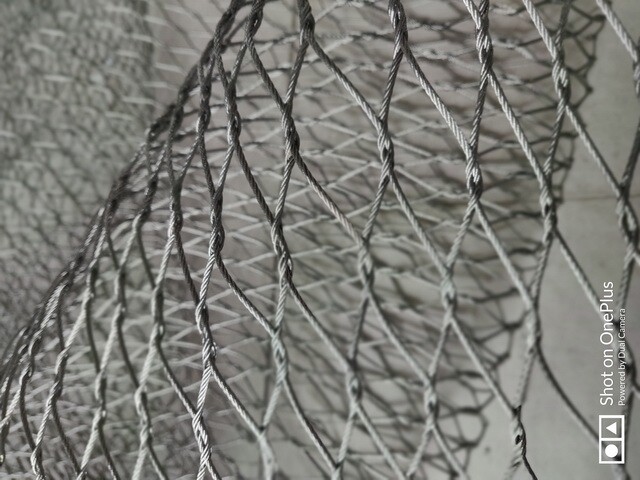
Welded vs woven mesh wire fences is settled by the mesh manufacturing process, not by a pull test. A welded panel is an assembled grid: straight lengths of wire laid across each other and fused at every crossing. A woven panel is a textile: rope interlaced over and under, with no heat and no fusion anywhere in it. That one difference decides which apertures you can order, how large a panel can be, which alloy you can use, and the exact point at which the fence will one day fail. Follow the two production routes and the argument about which format is stronger answers itself.
Executive Summary
Two formats, two production routes, and every downstream decision follows from the route. Welded mesh is built on a mesh welding machine: wire is straightened, cut to length and joined at each intersection, which sets the aperture from the machine pitch, caps the panel at the machine width, and heats the metal at every crossing. Hand woven mesh is built from rope: wire is stranded into a seven by seven construction and then interlaced by hand, so the aperture becomes a weave parameter you can change, the panel is limited only by handling, and no heat is applied at all. Choose the welded route for a rigid, square, standard panel and accept a coating that needs maintaining. Choose the woven route for a custom aperture, a large panel and a fence that keeps its tension after a wire breaks. The reference specification is the animal fence mesh product page.
Specifying a fence this year? Tell us the animal, the site and how the mesh will be fixed, and we will quote the format that fits rather than the one we happen to stock.
Quick Answer:
Quick Answer: Welded mesh is machine made and woven mesh is hand made, and the mesh production method decides what you can order rather than how strong the fence turns out. The welded route gives standard apertures, modest panel sizes, a rigid grid and a coating that must eventually be renewed. The woven route gives custom apertures, panels up to 9 m by 18 m, a flexible textile that absorbs impact, and stainless rope that carries no coating at all. Stated as a choice it is hand woven versus machine woven, and the useful answer to machine made versus hand made mesh is not that one is superior but that they are produced by different means for different duties.
Key Takeaways
- Both formats begin as wire and end as a barrier; the route in between is what separates them, and it is fixed long before anyone compares a price per square metre.
- Welded mesh is fused at every crossing, so it is rigid, square and standardised — and that same fusion point is its least protected and least predictable detail.
- Woven mesh is interlaced, so it flexes, tolerates a frame that is slightly out of true, and can be supplied in apertures and panel sizes no welding machine can reach.
- Coating is decided by the route, not afterwards: welding destroys zinc, so protection is applied either before the panel is welded or after it is finished, and that choice follows the fence for its whole life.
- Ask for the mesh fabrication method, the achievable tolerance and a first article before you place a repeat, because a second batch that does not match the first is a whole fence that does not match.
The classifications that separate a sound weld from a defective one, and the vocabulary a fabricator is judged against, are published by the American Welding Society; worth a look before you accept a welded panel on the strength of a photograph.
Two Formats, Two Kinds of Structure
Start with what each product actually is. A welded wire panel is not a fabric; it is an assembly of separate cut wires held in position by fusion at each intersection. A woven panel is not a grid; it is a fabric in which every wire is continuous and every crossing is a mechanical interlace. One is held together by heat, the other by geometry, and that is why the two formats answer different questions. A welded fence is bought as a rigid sheet with a fixed grid, so its design question is how that sheet is supported. A woven fence is bought as a tensioned textile, so its design question is how the tension is held. Put plainly, this is mesh welding versus weaving, and welding versus weaving is the whole of the difference — the mesh making process stripped to a single sentence.
The Welded Route: A Grid Held Together by Fusion
Welded wire mesh starts as wire and ends as a jig-built grid. Wire drawing produces the wire; it is then straightened, cut to length, laid in a grid on a mesh welding machine and joined at every crossing. Most fencing mesh is joined by spot welding — resistance welding — where current is passed through the two wires and the metal at their contact point melts and forges together into a weld nugget. Heavier and coated wires are often joined by TIG welding instead, which gives a cleaner bead but a wider heated region. Three consequences follow immediately. The aperture is set by the machine pitch, so you buy from a list of standard grids rather than to a value. The panel is capped by the machine’s working width. And every crossing is a heat event: the metal there is melted and re-solidified, so its properties at the joint are no longer the properties of the wire, work hardening is undone locally, and any coating that was already on the wire is destroyed.
The Woven Route: A Textile Interlaced by Hand
A hand woven panel begins with the same wire and then diverges completely. The wire is stranded first — in zoo and aviary work usually into a seven by seven strand, which is seven wires twisted into a strand and seven strands twisted into the rope, forty-nine wires in all. The rope is then interlaced over and under by hand until a sheet is complete. The result is a textile rather than a grid. Because the aperture is a weave parameter and not a machine pitch, a custom aperture mesh is simply a different weave. Because nothing is welded, nothing is heated, and the metal keeps the temper it had when it left the die. Because the material is stainless, the design carries no coating to lose. The price is labour: hand weaving is slow, the labour content of mesh is the largest single line in the quotation, and hand weaving lead time runs to weeks.
What the Process Decides Before You Order
| Property | Welded route | Woven route |
| Aperture | Fixed by machine pitch; standard grids | A weave parameter; custom apertures available |
| Panel size | Limited by machine working width | Up to 9 m × 18 m |
| Alloy and finish | Wire must be weldable; carbon steel, galvanized or PVC coated | Stainless 304 or 316, also black oxide |
| The crossing | Fused; coating destroyed locally | Interlaced; no heat, no coating |
| The edge | Cut, with burrs and bare ends | Bound with edge cable and swage ferrule |
| Order cycle | Low minimum, short cycle | Higher minimum, weeks of hand work |
Read the table as a list of limits rather than features: a specification written for one format rarely transfers cleanly to the other.
Where Each Route Puts the Weak Point
Every fence fails first in one place, and the production route chooses that place. In a welded panel it is the crossing. The weld is a small re-melted volume with its own metallurgy, loaded in weld shear whenever the grid is pushed sideways, and if the wire was coated before welding that is also where the coating is missing, so rust starts at the joints. Weld quality mesh is therefore the single variable that decides how long a welded fence stands: you need weld penetration mesh that fully fuses both wires and no undercut, because a heat affected zone weld is a place where the wire has lost strength it will not recover. A woven panel fails differently. Its weak point is the cross point, where rope bears on rope and repeated movement causes fretting, but the consequence is modest: one broken wire costs about two per cent of that strand’s breaking load and the panel stays tensioned. That is the real difference — local failure against distributed failure. Mesh fatigue exposes it: a welded grid takes a permanent set where a woven textile returns to shape.
Galvanizing and the Weld: Why the Coating Line Matters
You cannot galvanize a panel twice, so the route decides its corrosion protection, and the two options are not equivalent. Galvanizing before welding means the wire arrives already protected, and the weld burns the zinc off at every crossing, leaving bare steel rings that rust first and rust inward — the reason an inexpensive welded panel shows rust at the joints long before it shows any elsewhere. Galvanizing after welding, by hot dip galvanizing after fabrication, leaves a continuous coating over both wire and weld, at the cost of a heavier panel and a coating weight you should ask for as a number rather than a promise. The woven route sidesteps the whole problem: stainless has no coating, and its resistance belongs to the alloy rather than to a layer that can be breached. Mix stainless with galvanized steel and you create a galvanic corrosion cell at the contact, so isolate the two metals. In a coastal or industrial atmosphere this is the decision that sets the replacement interval; the chemistry behind it is in our fencing materials guide.
Tolerance, Pattern and Repeat Orders
The route also decides what tolerance is achievable. A welded panel is built on a jig, so it comes off square to within a millimetre or two, and a mesh processing tolerance of a few millimetres across a two-metre panel is normal — but a rigid grid cannot follow a frame that is out of square, and forcing it opens the apertures at the fixings. A woven panel will pull into a frame that is slightly out of true, because a textile has no fixed geometry to fight. The reverse risk belongs to the woven route: because a person weaves it, the pattern and the direction of the cross are judgement calls, so two panels ordered a year apart can look subtly different unless the weave is locked. Specify the pattern, keep a retained physical panel, and treat mesh batch consistency as a contract term rather than a hope. A first article measured against the drawing before the rest is welded or woven is the cheapest insurance in the order; the acceptance criteria that make that check worth anything are in our mesh specification guide.
Reading a Quotation From Either Route
The two quotations in front of you do not measure the same thing, which is why a welded panel and a woven panel can look a hundred per cent apart per square metre. A welded rate describes a grid cut from a roll or a stock sheet, with the coating already decided. A woven rate describes hand work: rope stranded first, an aperture woven to your number, an edge that was bound. Compare them on the four drivers that move either price — wire or cable diameter first, aperture second, panel size third, order volume almost not at all — and remember that hardware is excluded from both, because edge cables, swage ferrules, tensioners, fixings and anchor plates add ten to twenty per cent to a mesh-only figure. Decide the format before the price. If the choice is still open across welded, chain link and woven, our mesh material comparison runs that comparison; the four numbers that make either panel work are in netting wire selection; and the case for the woven format on its own terms is in our hand woven fencing guide. Whichever route you take, specify it against the animal fence mesh range so every line describes something a factory can measure.
Frequently Asked Questions
Neither, in general — they fail in different ways. A welded grid resists a slow lateral push better because its joints are fixed; a woven textile survives repeated impact better because load spreads through continuous ropes.
Wire is drawn, straightened and cut to length, laid in a grid on a mesh welding machine, and fused at every crossing, usually by spot welding and sometimes by TIG. The panel is then cut to size and, on a galvanized product, hot dip galvanized after fabrication.
Because the weld destroyed the coating there. If the wire was galvanized before it was welded, the zinc is burned away at each joint and bare steel is left exposed, so the joint is both the weakest and the least protected point on the panel.
Yes on the woven route, where aperture is a weave parameter and any practical value can be produced. On the welded route the aperture is set by the machine pitch, so custom openings usually mean new tooling and a minimum order — which is where the mesh processing tolerance question starts.
Send us the animal, the site conditions and the sizes you need, and we will tell you which production route suits the job, then quote the mesh, the edge treatment and the fixings together. Start with the format.