
Executive Summary
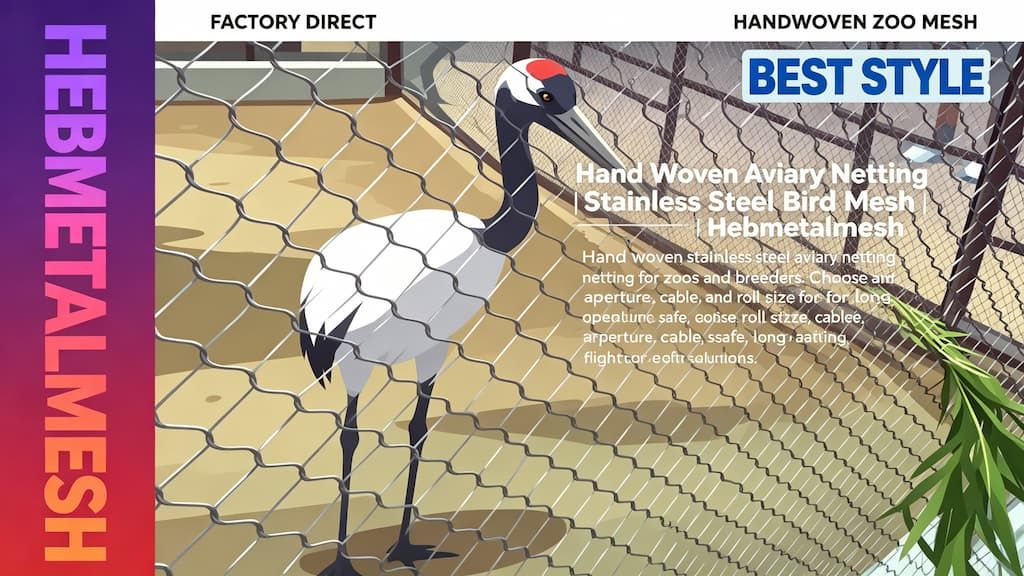
Hand woven zoo mesh is the material most zoo aviaries settle on after trying cheaper options. It gives visitors a nearly invisible view of the birds while giving keepers a barrier that survives beaks, claws, and weather for decades. Unlike welded wire, hand-woven construction lets the panel flex under impact and spring back, so a startled bird hitting the mesh at speed is more likely to bounce off than to be hurt. Unlike plastic netting, stainless steel never degrades in sunlight and never has to be replaced on a five-year cycle. This guide covers what hand woven zoo mesh actually is, which zoo bird aviary applications it serves best, and how to spec aperture, wire diameter, and grade so the build is right the first time.
Planning a Zoo Aviary? Get a Free Quote
Send us the bird species, enclosure size, and climate. We return a hand woven zoo mesh specification and price within 24 hours.
Request My Free Quote →Key Takeaways
- Hand woven zoo mesh combines near-invisible sightlines with real impact strength, which is why zoos use it for bird exhibits.
- Zoo enclosure wire netting must be feather-safe first; every cut edge needs a border cable or a factory finish.
- Aperture is set by the smallest bird to contain and the largest predator to exclude, not by the frame.
- 304 stainless steel covers most inland zoos; 316 is the call for coastal and marine-adjacent exhibits.
- Hand-woven panels absorb impact that would crack a welded junction, so birds collide safely.
- Plastic netting looks cheap until year three, when UV degradation forces a full replacement.
- Factory-cut panels remove field edges, which removes most snag points before the birds ever arrive.
Why Hand Woven Zoo Mesh Wins in Bird Aviaries
A zoo bird aviary is a contradiction: it must be an enclosure that feels like open space. Birds need flight room and clean sightlines, visitors need to see the animals, and keepers need a barrier that nothing gets through and nothing gets injured by. Hand woven zoo mesh is built from twisted stainless cables, which gives it the two properties that make all of that possible at once.
First, the twisted-cable weave is flexible. When a bird hits it at speed, the panel deflects and returns instead of holding rigid and transferring the impact to the bird. Second, the thin strands and open lattice read as almost invisible from a few feet away, so the exhibit feels like a habitat rather than a cage. Those two properties are why hand woven stainless steel zoo mesh shows up in so many flagship bird buildings. The complete stainless steel aviary netting range covers the apertures and finishes zoos specify most often.
Application 1: Large Walk-In Flight Aviaries
The largest zoo bird aviary netting installations are walk-in flight aviaries where people enter the habitat with the birds. These buildings need mesh that spans long unsupported runs, carries roof loads, and keeps every edge smooth at eye level.
For a walk-in flight, the mesh has to be tensioned on a border cable around every panel so there are no loose strand ends inside the visitor path. Aperture is typically chosen mid-range — large enough to feel open, small enough that no bird in the collection can pass through and no local predator can enter. Stainless steel rope mesh aviary panels are the usual spec here because the flexibility of the cable construction absorbs both bird impact and wind loading. The bird aviary enclosure mesh selected for a walk-in flight is effectively the safety system of the whole building, so the panel spec and the frame design are reviewed together.
Application 2: Species Exhibits and Display Aviaries
Display aviaries are the zoo’s showpiece, and the mesh is part of the scenery. Visitors stand inches from the panel, so weave consistency, surface finish, and edge treatment all matter as much as strength.
Stainless steel aviary mesh for zoo displays is usually bright-finished or black-oxide, depending on the design language of the building. The key spec decision is the aperture: too large and small species squeeze through; too small and the panel reads as a wall that hides the birds. Most display aviaries settle in the 1 to 1.5 inch band and let the species list drive the final number. Keepers who want the full layout logic should read our walk-in aviary design guide.
Application 3: Mixed-Species and Free-Flight Buildings
Free-flight buildings hold dozens of species in one volume, which makes the mesh specification harder. The barrier has to contain the smallest bird in the collection and exclude the largest predator in the region, and it has to do both at the same time.
That is why aviary mesh for zoo birds in a free-flight setting usually follows the smallest-species rule: the aperture is set by the tiniest occupant, and everything else — wire diameter, grade, frame — is built up from there. Hand woven mesh for bird enclosures earns its place here because a single panel style can be stretched across the whole volume while still reading as open air.
Application 4: Outdoor Aviaries in Coastal Climates
Coastal zoos face a problem inland facilities never see: salt-laden air attacks fasteners and mesh alike. Galvanized and plated options corrode visibly within two seasons, and even standard stainless shows staining at the fixing points.
The answer is 316 stainless steel throughout — mesh, clips, and hardware — plus factory-finished edges so there are no field cuts where corrosion can start. Hand woven mesh for zoos in marine environments is a higher upfront cost and a far lower lifetime cost, because the panels simply do not degrade, and the same logic holds for stainless steel zoo mesh for aviaries. If the site is within a few miles of the coast, specify 316 from the start. For the full product matrix, our zoo mesh netting page lists every aperture and finish in the range.
Hand Woven vs Welded vs Plastic: The Real Comparison
The wire netting for zoo bird aviary decision usually comes down to three material families, and they behave very differently over a decade.
Hand woven stainless steel. Highest upfront cost, longest life, best optics. Flexible under impact, corrosion-resistant, and repairable by re-tensioning. This is the standard for permanent zoo exhibits.
Welded wire mesh. Cheaper and stiffer, which suits flat, static fencing. But welded junctions crack under repeated impact, and the panels cannot follow a curve. For a bird aviary, a cracked weld is a snag point and eventually a breach.
Plastic netting. Cheapest to buy and the most expensive to own. UV degradation makes it brittle within a few years, birds chew through it, and predators tear it. Some zoos use it for temporary holding; none should use it for a permanent bird exhibit.
Zoo aviary mesh suppliers who work with institutions every day will almost always steer a permanent build toward hand woven stainless, and our welded vs woven mesh wire fences article explains the engineering difference in full.
How to Spec Hand Woven Zoo Mesh Panels
Four numbers define a hand woven zoo mesh panel, and each one answers a different question.
Mesh aperture — the size of the opening. Set by the smallest bird to keep in and the largest predator to keep out. For zoo bird aviary netting, the aperture is the first number decided, because everything else follows it.
Wire diameter — the thickness of the cable. Bigger birds and heavier impact demand thicker wire. A macaw enclosure needs a heavier cable than a finch flight, and the gap between them is significant.
Panel size and edge — how the panel is delivered. Hand woven zoo mesh panels are best ordered factory-cut to the frame bays, with a border cable on every edge. Field cutting creates loose strands, which is exactly the snag point you are trying to avoid.
Grade — the alloy. 304 stainless steel for inland work, 316 stainless steel for coastal and marine-adjacent sites. The alloy choice is made once and never revisited; mesh replacement is the expensive outcome of getting it wrong.
For the full sizing walk-through, our how to choose the right wire rope mesh guide covers aperture and diameter decisions panel by panel.
Feather-Safe Design: The Detail That Protects Birds
Birds injure themselves on enclosure edges far more often than on the mesh face. A loose strand end can cut a foot, snag a primary feather, or catch a wing during a landing. Every serious zoo spec therefore treats the edge as a safety component, not a trimming detail.
The rules are simple. Every panel edge terminates on a border cable. Every penetration — doors, hatches, feeders — is trimmed and clipped on both sides. Factory-cut panels are preferred because the finish is controlled; field cuts are acceptable only when immediately folded and captured. Feather-safe construction is the single cheapest upgrade in a zoo build and the one that prevents the most injuries.
Installation and the Annual Check
Wire netting for bird exhibits performs only as well as its installation. Panels must be tensioned against a frame that was designed for the load, with stainless fasteners everywhere and the lowest 24 inches of mesh reinforced against ground-level predators.
After install, the maintenance load is light: a yearly walk of the perimeter checking tension, ferrules, and fasteners, plus a look at the base line for digging or corrosion. Our maintenance tips for stainless steel wire rope mesh page lists the full annual pass. Two of every three field problems trace back to lost tension or a corroded fastener, both visible long before they become a breach.
FAQs
Hand woven zoo mesh is a stainless steel netting built from twisted cables rather than welded single wires. The cable construction makes it flexible under impact, corrosion-resistant, and visually open, which is why zoos use it for bird aviaries and large exhibits.
Plastic netting degrades in sunlight, grows brittle, and tears under predator pressure within a few years. Stainless steel mesh has the corrosion resistance and high tensile strength to serve a permanent exhibit for decades without replacement.
Set the aperture by the smallest bird in the collection and the largest predator in the area. The opening must be smaller than the smallest thing the barrier has to hold, and that rule overrides everything else.
Yes, when the edges are finished correctly. Every panel edge must terminate on a border cable, and all penetrations must be trimmed and clipped. Factory-finished panels give the cleanest, most feather-safe inside face.
304 stainless steel for inland facilities, 316 stainless steel for coastal or marine-adjacent sites. The grade applies to the mesh and to every fastener and clip in the system.
Yes. Aperture, wire diameter, panel dimensions, edge treatment, and finish can all be specified at the factory, and factory-cut panels eliminate the field edges where most snag and corrosion problems start.
Talk to a Zoo Mesh Specialist
Not sure about aperture or grade for your bird aviary? Our team specs hand woven zoo mesh for zoos and wildlife parks worldwide.
Get Expert Help →