
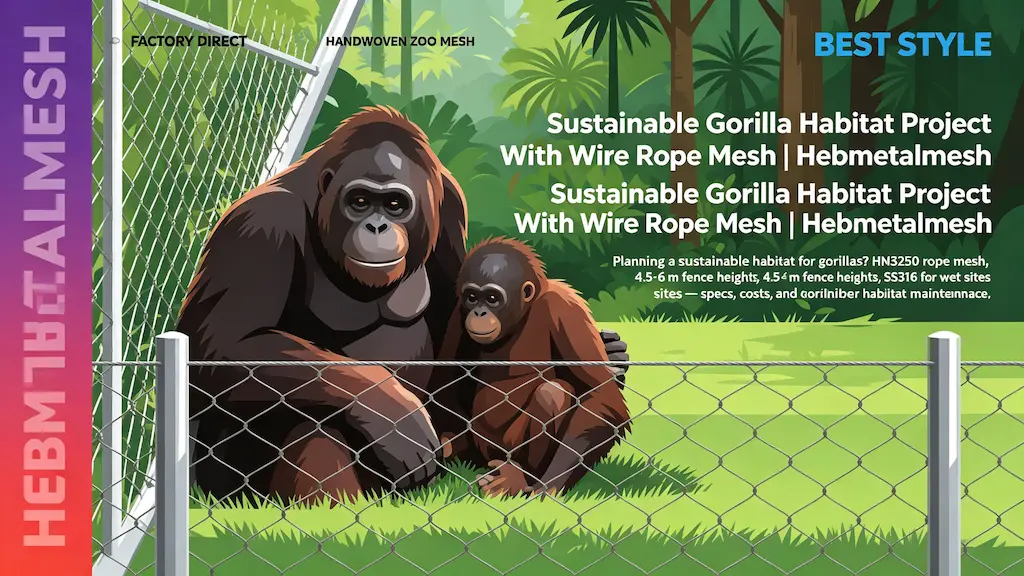
A sustainable habitat for gorillas is not a bigger cage — it is a deliberately engineered landscape in which the barrier does the least visible work. Zoos that plan a gorilla habitat project around hand-woven stainless wire rope mesh get an enclosure that survives a 180 kg silverback gorilla for decades, stays visually open, and costs less per year of service than any wall, glass, or chain-link fence. This guide walks the full project: the gorilla habitat design brief, the mesh specification that carries it (HM3250 as the working default), fence heights and anti-climb details, realistic budgets, and the gorilla habitat maintenance routine that keeps a build sustainable past opening day.
Executive Summary
Every sustainable gorilla habitat project balances four demands that pull in opposite directions: the enclosure must contain an animal with immense strength, it must never offer a grip that lets a juvenile climb out, it must stay visually and acoustically open so gorillas can see their keepers and their surroundings, and it must survive tropical sun, rain, and daily washing for twenty years or more. Hand-woven stainless wire rope mesh answers all four at once: 3.2 mm rope twisted at crossings spreads point loads instead of concentrating them, a 51 mm opening is small enough to deny a fingerhold yet open enough to read as air, and SS304 or SS316 construction removes the corrosion and coating failures that silently end other fences. The reference specification is the gibbon enclosure netting product page product page.
Starting a gorilla enclosure project?
Send your site plan and group size to our engineers for a free barrier specification — rope diameter, aperture, grade, and anchoring layout sized to your troop.
Request a gorilla enclosure spec →Quick Answer:
What makes a gorilla habitat sustainable? A sustainable habitat for gorillas is one whose barrier, landscape, and enrichment serve the troop for 20–30 years with modest upkeep — in practice, a hand-woven stainless rope mesh perimeter (HM3250 as the adult default), SS316 in humid or salt air, full-height panels with no climbable seams, and inspection-based maintenance.
Key Takeaways
- HM3250 is the working gorilla spec: 3.2 mm (1/8 in) wire rope at a 51 mm (2 in × 2 in) mesh aperture — strong enough for adult males, tight enough that no opening offers a finger grip.
- See-through is a welfare feature, not a luxury. Gorillas are visual animals; a transparent barrier lowers stress and gives visitors an honest view, which is what makes the exhibit educational.
- Grade follows climate: SS304 inland, SS316 for humid tropical and coastal sites; the molybdenum addition is cheap insurance against pitting on a barrier meant to last decades.
- Sustainability is a lifecycle calculation: higher first cost buys a longer service life and lower maintenance, which is why wire rope mesh routinely out-bids cheaper fences on total cost of ownership.
Because gorilla conservation decisions are only as good as the data behind them, keepers planning habitat work should review the IUCN Red List status of all four gorilla subspecies (IUCN), all listed as Critically Endangered, before finalizing a project brief.
The Load Case That Decides the Barrier
Design for the strongest animal that will ever test the fence. An adult male silverback gorilla carries 180 kg or more of muscle built for knuckle-walking, branch-breaking, and chest-beating displays; a motivated male can bend soft steel, pry welded joints, and work a loose section for weeks until it gives. The danger is not a charge — it is steady, patient pulling and twisting at crossings, joints, and corners.
The second load case is juvenile climbing. Youngsters treat vertical mesh as playground structure, and a design that contains an adult male but offers a 76 mm opening or a vertical splice seam gives a curious adolescent a ladder. This is why the same gorilla habitat fencing logic used for adults — deny the grip, kill the seam — must be applied at infant scale too.
Third is perception. Gorillas are among the most visually oriented great apes, and gorilla enclosure visibility shapes their behavior more than most keepers expect. A solid wall or dense fence makes a troop feel ambushed and can produce redirected aggression; a mesh they can see through — and that keepers can see through — keeps everyone calmer and makes daily welfare checks possible without entering the space.
Barrier Options Compared
| Criterion | Solid walls / rockwork | Glass / polycarbonate | Galvanized chain link | Welded stainless panel | Hand-woven SS rope mesh (HM3250) |
|---|---|---|---|---|---|
| See-through for gorillas | No | Yes, but glare-prone | Partial | Yes | Yes |
| Response to steady prying | Good | Cracks propagate | Bends permanently | Welds fatigue at joints | Flexible crossings recover |
| Grip / climb surface | Low | Low | Endless handholds | Moderate | None at 51 mm |
| Corrosion life outdoors | N/A | UV and scratch damage | Rusts at knuckles in years | Good, weld-decay risk | 20+ years in SS304/316 |
| Injury risk on impact | High (hard) | High (shatter) | Moderate | Moderate | Low (flexible membrane) |
| Service-life economics | Expensive to rebuild | High replacement cost | Cheap to buy, costly to own | Mid | Best lifecycle cost |
Chain link fails on grip and rust; welded mesh concentrates prying force at its welds; glass gives visibility but no give. Only hand-woven rope mesh delivers visibility, impact tolerance, and a 20-year-plus service life together — which is why it is now the accredited great-ape default.
Specifying Gorilla Wire Rope Mesh
Start with the code, then adjust for the group. Gorilla wire rope mesh in the HM range means hand-woven stainless rope: for a troop of adults, specify HM3250 — 3.2 mm rope at a 51 mm mesh aperture, — the classic 2 in × 2 in × 1/8 in gorilla panel. The 3.2 mm rope carries a documented breaking load of roughly 7 kN per strand in the HM spec sheet, and at 51 mm the opening admits neither an adult thumb nor a juvenile fist — no purchase, no climb. Where infants share the group, HM3238 (38 mm aperture, same rope) closes the opening further. Do not step up to a 76 mm aperture “for more view”: a 76 mm opening can admit a gorilla hand and bring the grip back.
The rope diameter drives strength and stiffness; the aperture drives grip safety; both are engineering numbers that belong in the purchase order as “HM3250, 3.2 mm rope, 51 mm aperture, SS316, black oxide finish.”
Grade and finish. Grade is a climate decision. SS304 (18% chromium, 8% nickel) suits clean inland facilities; SS316 adds molybdenum and lifts corrosion resistance for the humid tropical air, coastal spray, and daily washing of real gorilla facilities. The 10–15% grade premium is the cheapest insurance in the whole gorilla habitat project. Finish is welfare plus presentation: the bright Nature finish disappears against sky and foliage, while the black oxide gorilla enclosure mesh option reads as darker structure against greenery in a naturalistic exhibit. The black oxide finish also cuts glare for animals and visitors.
Why the weave matters more than the wire. Hand-woven rope mesh is a tensioned membrane: each crossing is a flexible joint that spreads a local load to its neighbors, so a pull that would crack a weld merely flexes crossings and springs back. Strands are round and smooth — no flat edge to chew, no coating to flake and be swallowed, nothing sharp to cut a curious hand. Specify stainless steel rope mesh for gorilla enclosure perimeters as continuous full-height panels woven to the site’s exact dimensions, a capability of the gibbon enclosure netting range, which weaves panels up to 9 m × 18 m so a boundary face arrives as one unbroken sheet instead of a patchwork of climbable splices.
Fence Heights and the Anti-Climb Detail
Gorilla enclosure fence height is set by the group’s climbers, not the silverback: mixed troops typically get 4.5–6 m mesh with a 60° inward anti-climb overhang on any reachable face. Inside, keep trees and climbing structures at least two meters off the barrier so no branch becomes a launch point. On island exhibits with a moat, mesh can stop lower because the moat sets the containment line — but the overhang rule still applies at landings and gate posts.
The frame matters as much as the mesh. Lace the top and bottom of each panel to a 6–8 mm stainless edge rope, tensioned at each post through turnbuckles, so the whole face works as one membrane instead of hanging loose between posts. Post spacing of 3–5 m on proper footings holds deflection small when a male leans into a face; every door carries a double-latching keeper system, and all fixings sit outside the animal space. These details belong in the gorilla enclosure construction drawings, not improvised on site.
Habitat, Enrichment, and the Sustainability Case
A barrier is one third of a sustainable habitat for gorillas. The gorilla habitat design brief should spend equal care inside the mesh: varied terrain, planting that gives cover and browse, water for play, and climbing and nesting structure. Sustainable gorilla habitat solutions treat enrichment as structure, not decoration — durable stainless frames, puzzle feeders that survive gorilla hands, rotation plans that keep the space novel. Gorilla habitat enrichment bolted to the mesh must be sized so a juvenile cannot turn it into a ladder to the overhang; post-mounted enrichment should sit outside the climb zone.
Zoo gorilla habitat design also has a public side: see-through exhibits convert visitors into conservation audiences, and that connection funds habitat protection in range countries — the real gorilla habitat sustainability story.
From Brief to Built: Phases and Project Case Study Lessons
A successful gorilla habitat project case study reads like a construction program, not a shopping list: a behavior and welfare brief (group, ages, climate), a fixed specification (mesh code, grade, heights, gates), fabrication to drawing, installation with tension sign-off, then a first year of observation as the design gets its real test.
Lessons from real gorilla enclosure construction programs are consistent across continents: sanctuaries caring for rescued gorillas find that visible, flexible barriers reduce startle responses in new arrivals, and accredited exhibits find that a barrier for a silverback must also work for a keeper at 6 a.m., so service access is drawn in before concrete is poured. Every hand-woven mesh project reports the same follow-up — maintenance shrinks to inspection because the material stops failing. For the build-and-choose side, our gorilla enclosure build guide walks the wire rope mesh options in depth.
Cost, Lifecycle, and Gorilla Habitat Maintenance
Treat the budget as a lifecycle cost, not a sticker price. Planning ranges for gorilla-grade HM3250-class mesh (material only, ex-works) run roughly $22–38 per square meter by grade and panel size — planning figures only, since freight, framing, and site work usually exceed the mesh line item. The comparison a wall cannot win: a 3.2 mm stainless membrane lasting 20–30 years versus a cheaper fence rebuilt twice in the same window. Every year the panel stays up is saved replacement cost — where “sustainable” becomes a line item.
Gorilla habitat maintenance is mostly routine: perimeter walks to check crossings for distortion from pulling, tension checks at turnbuckles, hog-ring and lacing inspection, and cleaning with plain water and a soft brush where algae gathers. Never use carbon steel brushes or wire wool — embedded iron starts surface rust even on 316. SS304 and SS316 need no painting or coating renewal, removing the costliest recurring jobs on any other fence. A habitat checked twice a year and washed as the climate demands is the reality that keeps a gorilla habitat project sustainable for the building’s full life.
Frequently Asked Questions
A sustainable habitat for gorillas is an enclosure designed for a 20–30 year service life: hand-woven stainless rope mesh, climate-matched grade, full-height continuous panels, and an inspection-based maintenance plan.
Build 4.5–6 m for mixed troops and add a 60° inward anti-climb overhang where juveniles can reach; keep climbing structures at least two meters off the barrier so nothing becomes a launch point.
HM3250 — 3.2 mm rope at a 51 mm aperture — is the adult default; choose HM3238 at 38 mm where infants are present. Both deny a finger grip while staying visually open.
Rope mesh has no weld to crack and no chain-link handhold; its flexible crossings spread prying force, round smooth strands prevent chewing damage, and its see-through face keeps the troop calm.
SS304 panels routinely pass twenty years outdoors and SS316 longer; planning material costs run $22–38 per square meter for HM3250-class mesh, with framing and installation extra.
Final Word
Every durable gorilla habitat project was built the same way: a clear behavioral brief, an honest material decision, and a barrier chosen for the decades, not the season. Hand-woven stainless wire rope mesh is that decision — HM3250 for adults, SS316 in wet air, black oxide finish where the design calls for it, panels woven full-height so the enclosure has no seams to climb and no joints to fail.
Ready to spec a gorilla enclosure? Send your site plan and group details to our engineers for a free barrier specification and panel quote.