
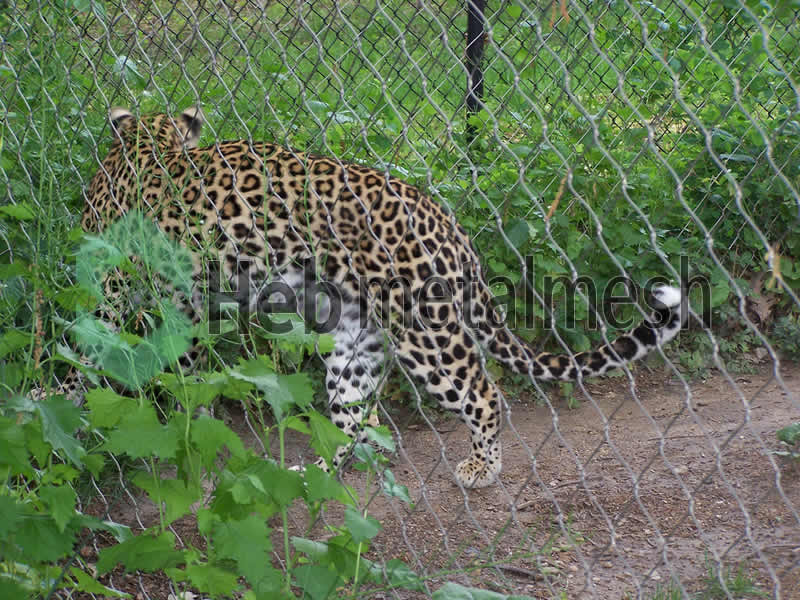
Executive Summary: Jaguar enclosures demand a barrier that withstands 1,250 psi bite force, prevents climbing escape, and lasts decades in outdoor conditions. Hand‑woven stainless steel rope mesh delivers the impact resistance, anti‑climb geometry, and corrosion performance that chain‑link and welded panels cannot match. Specify cable diameter, aperture size, and grade (304 or 316) based on enclosure zone—and meet AZA big‑cat care standards with a single, low‑maintenance material.
Ready to spec your enclosure? Request a quote for jaguar enclosures →
Or browse our Anti-Climb Leopard Cage Netting | Claw-Safe Vertical Barrier to reference →
Key Takeaways
- Jaguars are powerful climbers and jumpers—enclosure mesh must prevent paw and head insertion while eliminating horizontal footholds.
- Hand‑woven rope mesh absorbs impact forces from charges and jumps; welded mesh deforms permanently under the same stress.
- Aperture size and cable diameter vary by zone: public‑facing walls, dens, roofs, and transfer chutes each require different specifications.
- 316 stainless is mandatory for outdoor, tropical, or coastal exhibits; 304 suffices for indoor dens and arid climates.
- Proper tensioning, frame attachment, and quarterly inspections extend mesh life beyond 30 years.
Why Hand‑Woven Rope Mesh for Jaguar Enclosures?
Jaguars are the third‑largest big cat and the Americas’ only pantherine species. They climb, swim, and deliver the strongest bite force of any big cat—up to 1,250 pounds. A jaguar enclosure that fails is not an option. The fencing system must resist impact, prevent climbing, maintain visitor sightlines, and outlast the animal’s 20‑year captive lifespan.
Hand‑woven stainless steel rope mesh solves problems that welded mesh and chain‑link create:
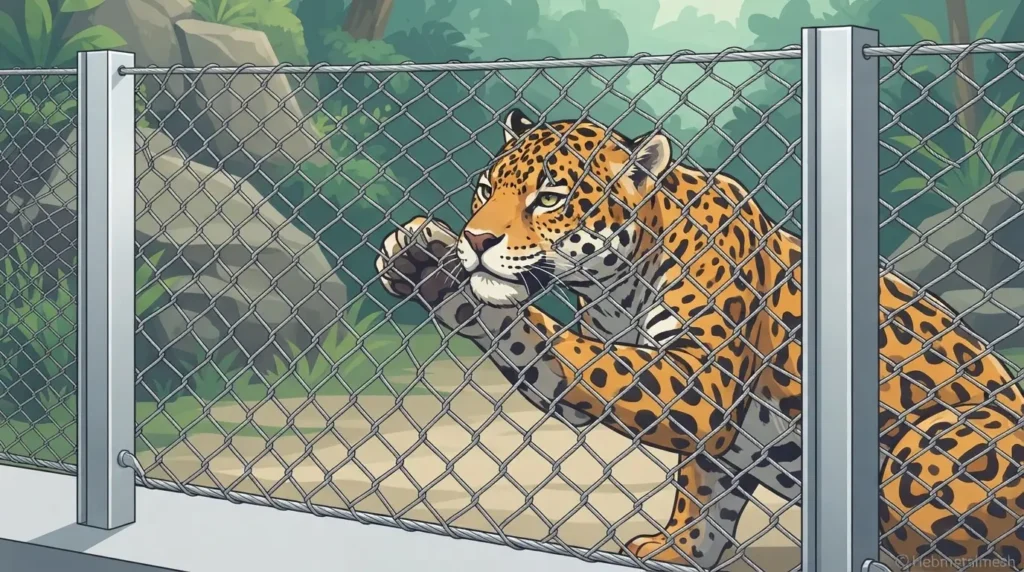
Anti‑climb geometry. Welded mesh has horizontal welds that act as ladder rungs. Jaguars hook claws into these intersections and scale vertical walls. Hand‑woven rope mesh presents a smooth, continuous cable surface with no horizontal purchase points. The diamond or square lattice pattern offers nothing for a claw to grip—a critical feature for a species that climbs trees in the wild and tests every enclosure boundary.
Impact absorption. Jaguars charge fences. They leap from rocks and trees against barrier walls. Welded mesh—rigid and brittle—deforms on impact and stays deformed, creating gaps. Hand‑woven rope mesh flexes under load, absorbs kinetic energy, and returns to its original shape. The cable construction distributes force across multiple strands rather than concentrating stress at weld points.
No sharp edges. Welds create burrs. Cut chain‑link leaves jagged wire ends. Hand‑woven rope mesh has no welds and no exposed cut ends when properly terminated. This protects jaguar paws, noses, and teeth from laceration—a genuine concern for animals that bite and pull on enclosure barriers.
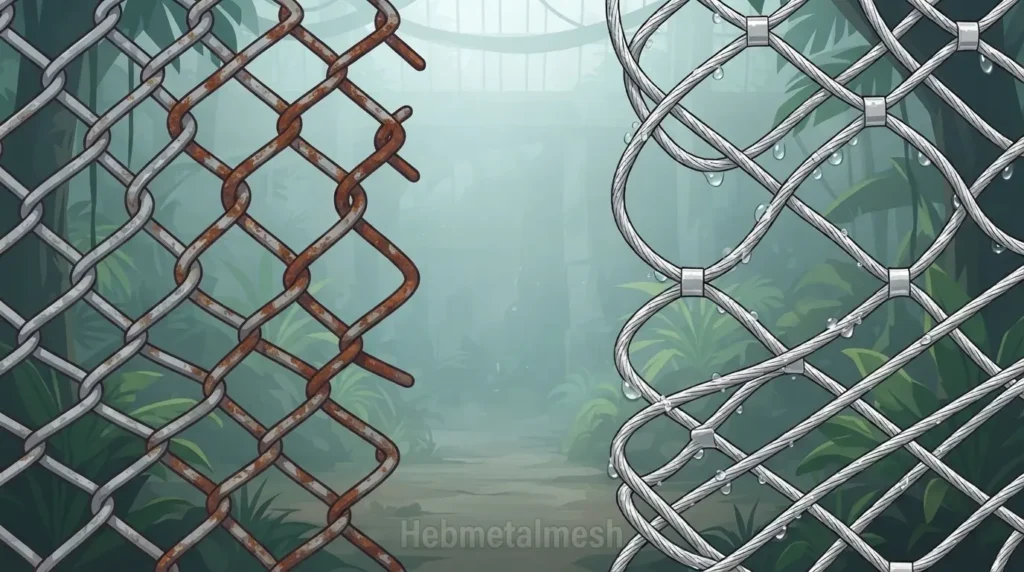
Corrosion resistance that matters. Chain‑link rusts within years. Galvanized coatings fail. Stainless steel rope mesh—304 or 316 grade—resists corrosion for decades. For outdoor jaguar enclosures exposed to rain, humidity, and urine, this is not a luxury; it is a safety requirement.
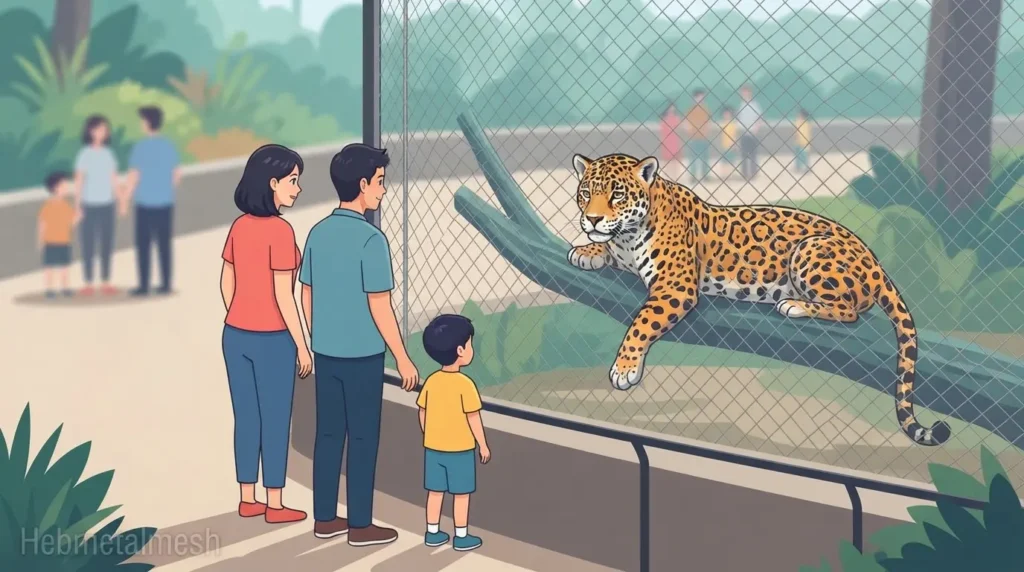
Visibility. Visitors come to see jaguars, not fence posts. Hand‑woven stainless steel netting provides exceptional transparency. The thin cables recede visually, allowing unobstructed viewing while maintaining a secure barrier.
Lifespan. A properly specified hand‑woven stainless steel jaguar enclosure mesh lasts 30+ years with minimal maintenance. Chain‑link requires replacement every 10–15 years. The lifecycle cost of rope mesh is significantly lower.
For a deeper comparison of construction methods, see our guide on welded vs. woven mesh. For a broader view of material options, explore our stainless steel animal enclosure mesh overview.
Jaguar‑Specific Engineering: Cable Diameter & Aperture
Not all mesh is equal. Jaguar enclosures require zone‑specific specifications. A perimeter wall that holds a 160 kg male jaguar demands different engineering than a den partition or a roof cover.
The table below provides baseline recommendations. Final specifications depend on your jaguar’s age, sex, and temperament—and your exhibit’s AZA or EAZA accreditation requirements.
Jaguar Enclosures – Heavy-Duty Stainless Mesh
Life-safety barrier engineered for big-cat containment. Hand-woven 316 stainless cable (2.4 – 3.2 mm) flexes under impact instead of snapping, while the open 75–100 mm aperture delivers crystal-clear public viewing. Specified for zoos, moat edges, and quarantine spaces — corrosion-resistant, cut-to-size, and built to outlast coated alternatives.
Build choice & what it gives you
Key specifications for a secure, transparent big-cat barrier
| Build choice | What it gives you |
|---|---|
| Hand-woven stainless cable | A barrier that flexes instead of snapping and never rusts |
| Small, consistent aperture | Containment sized to the animal, not the roll |
| Flexible, transparent grid | Light and air pass through; keepers see the animals clearly |
| Cut-to-size supply | No field cutting, no sharp offcuts |
Why these specifications matter. Jaguars are strong jumpers and climbers. The AZA recommends jaguar enclosure heights of 10 to 12 feet minimum. An aperture larger than 2″ × 2″ on a vertical wall allows a jaguar to insert a paw, hook claws, and pull itself up. A cable thinner than 3.2 mm risks deformation or breakage under repeated impact and biting.
Hand‑woven vs. ferruled. Hand‑woven mesh is constructed strand‑by‑strand, creating a continuous lattice with no mechanical fasteners at intersections. Ferruled (crimped) mesh uses sleeves to join cables at cross points—these sleeves can loosen over time under jaguar stress. Hand‑woven construction is the superior choice for big‑cat security.
For comparative specifications, review our leopard enclosure netting (which uses a 2″ × 2″ aperture for climbing specialists) and our tiger enclosure mesh (which emphasizes aquatic‑grade corrosion resistance). For larger cats, see our lion enclosure netting for heavy‑impact applications.
How the Mesh Is Built
Big-cat mesh is woven from 2.4 mm – 3.2 mm stainless cable, almost always in 316 for humid houses. Knotted construction is the standard because the barrier must survive impact and testing by a powerful animal. The result is a tensioned, see-through wall rather than a cage of bars.
Specification Table
Jaguar Enclosures – Specification Parameters
Life-safety barrier engineered for big-cat containment. The table below defines the critical choices: cable diameter (2.4 – 3.2 mm) governs impact and bite resistance; aperture (75–100 mm) ensures clear public viewing; SS316 is specified for humid/coastal houses, and knotted construction is the high-impact default. Span is tensioned between posts or a moat to form a true perimeter barrier.
Key specification parameters
Typical ranges and what each choice controls for big-cat enclosures
| Parameter | Typical range | What it controls |
|---|---|---|
| Cable diameter | 2.4 mm – 3.2 mm | Impact and bite resistance |
| Aperture | 75 mm – 100 mm (3″ – 4″) | Clear public-view visibility |
| Span | tensioned between posts or moat | Safe perimeter barrier |
| Material | SS316 recommended | Humid and coastal houses |
| Mesh type | Knotted | High-impact default |
Designing a Secure Jaguar Habitat
A jaguar enclosure is more than a cage—it is a habitat that must balance security, animal welfare, and visitor experience. Effective design integrates multiple layers of containment.
Anti‑climb design. Hand‑woven stainless steel rope mesh has no horizontal welds, but design goes beyond material. Perimeter walls should incorporate a 30° inward overhang at the top to prevent jaguars from hooking claws over the edge and pulling themselves out. Walls should extend at least 12 feet high—the AZA‑recommended minimum.
Overhead cover mesh. Jaguars climb trees in the wild. In captivity, they will attempt to climb enclosure walls and leap from elevated structures. An impenetrable roof at the 12‑foot mark is recommended. Our hand‑woven stainless steel netting can be fabricated to cover any roof span, with zero seams across widths up to 30 feet.
Double‑entry keeper airlock. All keeper access points must feature double‑door systems that prevent simultaneous opening. The mesh in these areas should be 1.5″ × 1.5″ aperture with 3/32″ cable to prevent paw insertion during shifting.
Public‑safety standoff. A physical barrier—dry moat, railing, or vegetation—should separate visitors from the enclosure mesh. The AZA and ZAA recommend barriers at least 3 feet tall and 3 feet away from the primary containment. This prevents visitors from touching the mesh and protects jaguars from thrown objects.
Integration with rockwork, trees, and water features. Jaguars are natural climbers and swimmers. Enclosures should include climbing structures, elevated perches, and water features (pools deeper than 1 meter) to stimulate natural behaviors. Hand‑woven mesh conforms to irregular rock surfaces and tree trunks, eliminating gaps that rigid fencing would leave.
Modular panels. Pre‑fabricated mesh panels simplify installation and allow for future modifications. Panels can be fabricated to custom dimensions and shipped ready for frame attachment.
For additional design considerations, see our zoo netting for animal and visitor safety guide. For similar‑species references, review our snow leopard enclosure fencing page.
Installation, Tensioning & Maintenance
Proper installation is as critical as material selection. A well‑specified mesh installed poorly will fail. A modest mesh installed correctly will perform.
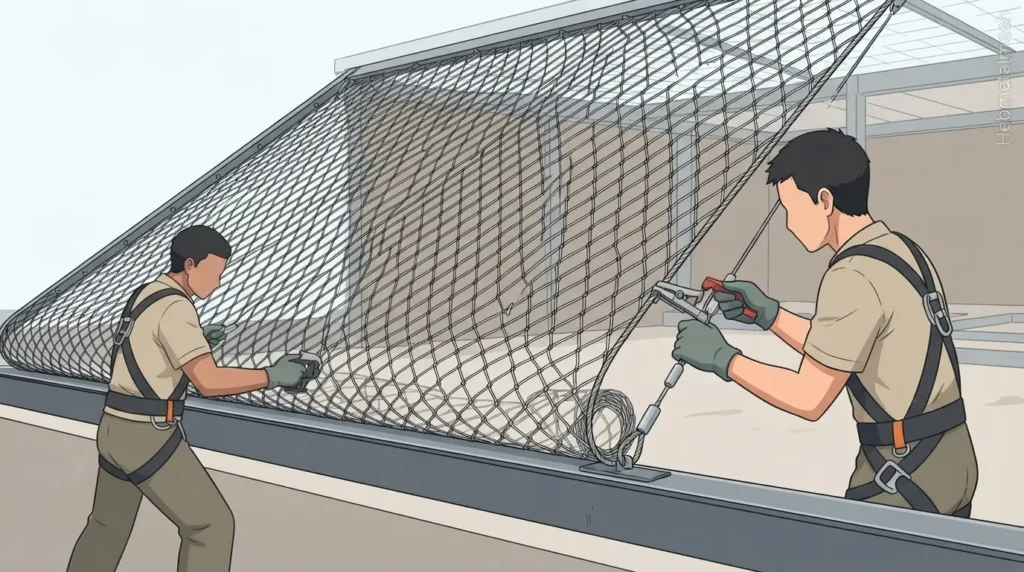
Frame attachment. Mesh must be securely attached to structural frames using grade‑matched hardware. Use stainless steel clamps, turnbuckles, and tensioning devices—never galvanized or carbon steel, which will corrode and compromise the connection. For a detailed walkthrough, see our guide on how to attach wire mesh to metal frames.
Progressive tensioning. Mesh should be tensioned progressively—starting from the center and working outward—to ensure even load distribution. Over‑tensioning stresses cables and connection points; under‑tensioning allows sagging and creates climbing opportunities. Tensioning systems must accommodate thermal expansion and contraction between summer and winter.
Hardware grade matching. All clamps, bolts, and turnbuckles must match the mesh grade (304 or 316). Mixed metals create galvanic corrosion that degrades connections over time.
Quarterly inspection. Inspect mesh for broken strands, loose connections, and signs of corrosion. Pay particular attention to areas where jaguars bite or rub against the mesh—these are failure points. Document all findings.
Cleaning. Clean mesh with mild detergent and water. Avoid harsh chemicals and abrasive tools that can damage the surface oxide layer. Rinse thoroughly after cleaning.
Broken‑strand repair. A single broken strand does not compromise overall integrity—hand‑woven mesh is inherently redundant—but it should be repaired promptly to prevent progression. Use stainless steel wire to splice and secure the broken end. For comprehensive guidance, review our maintenance tips for stainless steel wire rope mesh.
Hebmetalmesh Advantage
Hebmetalmesh is a factory‑direct supplier of hand‑woven stainless steel rope mesh with over 20 years of export experience to zoological institutions across 40+ countries.
Factory direct. No middlemen. No markups. You work directly with the manufacturer.
Custom fabrication. We accept custom specifications for cable diameter, aperture size, panel dimensions, grade (304/316), and finish (natural stainless or black oxide). Panel sizes up to 30′ × 60′ seamless—larger upon request.
304 and 316 inox. We stock both grades and advise on the right choice for your climate and exhibit type.
Hand‑woven. Every panel is hand‑woven by skilled craftsmen—not machine‑welded or crimped. The result is a flexible, durable, and safe barrier.
Big‑cat project experience. We have supplied mesh for jaguar, leopard, tiger, lion, and snow leopard exhibits worldwide. We understand the behavioral and engineering demands of each species.
Export packaging. Mesh is packed for ocean or air freight, with protective wrapping to prevent damage during transit.
Engineering support. Our team provides technical guidance on specifications, installation, and maintenance—before and after purchase.
Frequently Asked Questions
What mesh is used for jaguar enclosures?
Hand‑woven stainless steel rope mesh is the industry standard for jaguar enclosures. We recommend 3.2 mm (1/8″) cable diameter with 2″ × 2″ aperture for perimeter walls, and 3″ × 3″ aperture for overhead cover. The mesh must be hand‑woven—not welded—to prevent horizontal climbing aids and to absorb impact forces.
How thick should cable be for jaguar cages?
Cable diameter for jaguar cages should be at least 3.2 mm (1/8″) for primary perimeter barriers. This thickness resists the 1,250 psi bite force of an adult jaguar and withstands repeated impact from charges and jumps. For dens and transfer chutes, 2.4 mm (3/32″) cable is acceptable.
Can jaguars climb stainless steel rope mesh?
Jaguars are powerful climbers, but hand‑woven stainless steel rope mesh is specifically designed to prevent climbing. The smooth cable surface offers no horizontal purchase points for claws. Unlike welded mesh—which has welds that act as ladder rungs—hand‑woven mesh presents a continuous, claw‑resistant surface.
304 or 316 stainless for outdoor jaguar exhibits?
For outdoor jaguar exhibits, 316 stainless steel is the recommended choice. Its molybdenum content provides superior resistance to chloride‑induced pitting and crevice corrosion—critical for enclosures exposed to rain, humidity, and cleaning chemicals. 304 stainless is suitable for indoor dens and arid inland climates.
How long does jaguar enclosure mesh last?
A properly specified and maintained hand‑woven stainless steel jaguar enclosure mesh lasts 30+ years. 316‑grade mesh in coastal or tropical environments can last even longer—up to 5–10× the lifespan of 304‑grade under saline conditions. Regular inspection and cleaning maximize service life.
Ready to specify jaguar enclosures for your zoo, wildlife park, or sanctuary? Contact Hebmetalmesh for factory‑direct pricing, custom fabrication, and engineering support. We have supplied hand‑woven stainless steel netting for big‑cat exhibits across North America, Europe, Australia, and Asia—and we are ready to help with your project.
Get a sized quote in 24 hours. Send us your jaguar enclosures dimensions for a quote →