
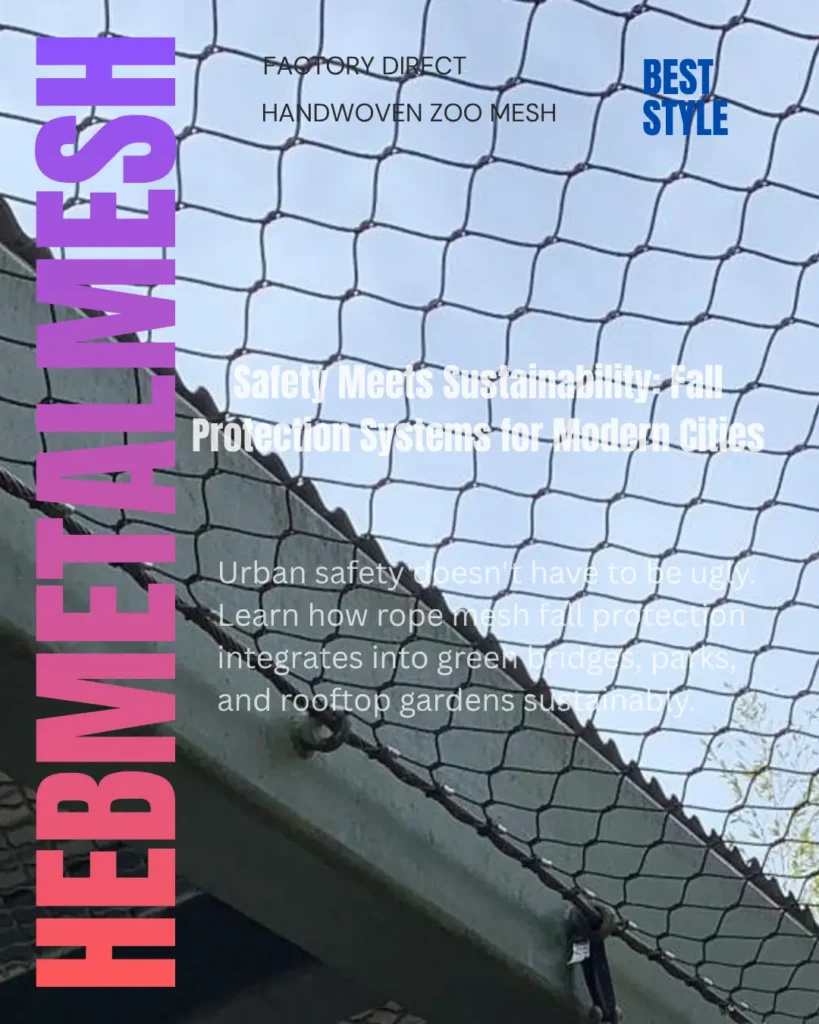
A city that builds upward hands its residents a view and an open edge at the same time. Elevated parks, rooftop gardens, promenades, observation decks and pedestrian bridges all put the public next to a drop, and every one of them is protected by a single line of defence. That is the fact that governs the whole specification. A worker at height is protected by a system — a barrier plus a harness, a lanyard, an anchor point, training and a permit. A member of the public is protected by the barrier alone. Nothing sits behind it to catch what it misses, so edge protection at height has to prevent the fall rather than arrest it.
Executive Summary
Edge protection at height is the permanent barrier between a public place and a drop, and it is specified under a constraint that no worker fall-protection system carries: the protected person has no training, no equipment, no supervisor and no agreement to be protected. Only one duty is available on public ground, which is why prevention and arrest are not interchangeable here. Two numbers carry the design — the opening, set by the smallest head that can be present, and the height, set by the most determined climber — with the load, the continuity of the edge and the fixings following behind them. A public barrier is also a public object, so it has to be visible at night, inspectable from the ground, and free of any surface that must be repainted. The reference specification is the stainless steel rope mesh product page.
Quick Answer:
Edge protection at height is a permanent barrier on the open edge of a public structure — a rooftop garden, an elevated park, a promenade, a viewing platform or a bridge — sized for people who have never been trained to use it. Because no fall-arrest system sits behind it, the barrier must deny the fall completely rather than soften it. Stainless steel rope mesh suits that duty because it is transparent, it absorbs a dynamic load by deflecting across the whole panel, and it carries no coating that has to be renewed.
Key Takeaways
- The public gets prevention, not arrest. A barrier that keeps a body away from the drop is the only protection a member of the public has.
- An undefined population is sized from its extremes — the smallest person for the opening, the most determined for the height, a crowd for the load.
- The edge is a continuous duty. A fine panel with a wide gap beneath it contains nothing.
- The barrier is also public furniture. It must be visible at night, inspectable from the ground, and free of a surface that needs repainting.
- Nobody owns it for the life of the asset, so the record rather than memory is what keeps a thirty-year barrier adequate.
Safety barriers for building occupants are covered by life-safety codes, and the National Fire Protection Association (NFPA) publishes the provisions on guard height, opening limits and assembly occupancy loads that a public edge is measured against.
The Public Edge Has No Second Line of Defence
Worker fall protection is a system of several parts. A roof worker is held by a guardrail, an anchor, a lanyard and a harness, briefed before the shift and checked during it. Remove the harness and the guardrail is suddenly doing a job it was never sized for. That is precisely the position of a visitor standing at the edge of a public park. The trade uses two different words for the two duties, and the distinction matters more here than anywhere else: fall prevention versus fall arrest. Prevention keeps a body away from the drop. Arrest catches a body after it has left the surface and manages the deceleration. Only prevention can be delivered by a permanent barrier with nobody on the far end of it, which is why on public ground the barrier is the entire system rather than one component of it.
The physics is unforgiving. A fall accelerates at 9.8 metres per second squared, so the speed at the ground is the square root of twice the height times gravity. A 1.5 m fall arrives at roughly 5.4 m/s, a 3 m fall at 7.7 m/s and a 10 m fall at about 14 m/s. Kinetic energy rises with the square of that speed, so the gap between a low kerb and a first-floor terrace is not a difference of degree. A public barrier is designed on the assumption that the fall must not happen at all.

Two Numbers Set the Barrier: the Opening and the Height
Because the public is undefined, the barrier is sized from its extremes rather than its average. The opening comes from the smallest head or body that can legitimately be in the space. The height comes from the tallest and most determined person who might climb it. Life-safety practice proxies the opening with a sphere test, where a ball of a stated diameter must not pass, and on a public structure that sphere is a small one because a child’s head is the body part that matters. A nominal aperture size on a hand-woven wire rope mesh also carries a tolerance, and an aperture measured across the flat of the diamond is not the same as one measured across the crossing, so the figure on a quotation is worth pinning down long before it reaches a drawing.
Height is the number most often left short. A private balcony is usually guarded at 1,100 mm, which is a leaning height. A public edge where people congregate, and especially where children play, is often built to 2.4 m and above, because the threat is not a lean but a climb, a push and a crowd. Building the barrier taller costs little. Raising it after the concrete is poured costs a great deal.

Sizing for the Person Who Is Not a Worker
Load is where a public barrier diverges most sharply from a private one. A single adult resting against a barrier presents a modest load. A crowd does not. In dense conditions the force arrives as pressure distributed along the length of the rail, which is why crowd-safety codes treat a public edge as a crowd load barrier rather than as a garden fence. A surge at a festival exit, a bank-holiday queue and a school group at a viewing platform all present the same thing: a lateral force repeated along the barrier for as long as the crowd is standing there. A public crowd barrier is therefore designed for duration as much as for magnitude.
Impact is the second and sharper load. A person running into an edge produces a dynamic load in a fraction of a second, and how the panel answers it is the reason woven metal is used at all. A flexible panel deflects, spreads the force through the crossings and hands it to the perimeter, and that is what energy absorption actually means in practice. A rigid infill has to absorb the same energy in the few millimetres a panel moves before it registers the load. Our rope mesh range covers rope from 1.2 mm to 3.2 mm and apertures from 20 mm to 102 mm, on panels up to 9 m by 18 m, so the panel that answers a given edge can be built to it rather than chosen from a catalogue.
Where a City Puts an Edge
Six situations cover most of the public realm. A rooftop garden or roof terrace puts planting and seating against the parapet, and rooftop edge protection there is usually an infill added to a wall that already exists. An elevated park or promenade inherits a long, curving edge with a view as the product, so an elevated park barrier trades as much width as its structure allows while still being proof against climbing. A pedestrian bridge barrier must carry its own weight on a deck that was never designed for it. An observation deck barrier and a viewing platform edge protection are read from arm’s length, so sightline and the absence of glare become specification items rather than preferences. A walkway edge protection run on a transit concourse, in an atrium or across a mezzanine void is protecting people in a hurry.
The green-space case changes the material question. Where the barrier doubles as a trellis for planting, green space edge protection adds a maintenance dimension the rest of the public realm does not have, and a planted screen behaves very differently from an open one once water and weight are involved. Public edge protection on a planted edge has to be specified for both duties at once, and a public realm barrier rarely has the luxury of separating them.
The Edge, Not the Panel
Almost every report of a failed public barrier describes a gap rather than a broken panel. The panel is over-strength by a wide margin; the failures sit at the base, the top, the post and the corner. A flexible cable netting field that is genuinely climb resistant can still be climbed at a post if the panel is set flat against it, and a barrier whose field opening is well under the sphere rule can still pass a child through the strip beneath the bottom edge if the panel stops short of the ground. Guardrail infill fails at the same four points, which is why codes write the opening rather than the wire.
The fix is to treat the edge as one continuous duty with no seams. Every bay ends at a termination, and a hand-woven panel closed on an edge cable with a swage ferrule can be re-tensioned, while one cut to size and clipped cannot. Corners are where two duties meet: either run the panel around the corner or terminate both bays at a post, but never pull two free edges against each other. Where the barrier crosses a change of level, a stair or a planting bed, the opening rule has to be maintained through the transition and not only along the straight run.
Retrofitting an Edge That Already Exists
Most public edges are not new. A heritage bridge parapet, a mid-century guardrail on a municipal deck and an older balustrade on a listed building all need a current safety rating without a current silhouette. Here the structural question comes first: an infill adds dead load and, more importantly, adds a moment at every fixing, because wind pressure acts through the depth of the panel rather than at the wall. Barrier behaviour under load is a useful reference for how much movement to allow before the fixings rather than the panel become the limit. A parapet mesh retrofit that keeps the panel light and ties it back to an existing structural line usually needs no new foundation at all, and the same logic carries a bridge parapet infill on a modern deck.
The Barrier Nobody Owns for Thirty Years
A public barrier is expected to last a generation, and the team that specified it will not be on site for the handover. That makes the record part of the specification. What matters is not a paint warranty but a documented installed tension, a panel schedule that matches the drawing, and an inspection interval that reflects how hard the edge is used. A public edge is loaded every day by people who leave no trace behind, so a periodic condition assessment counts for more here than on a barrier only a small group ever touches. Barrier maintenance at height carries a constraint no industrial site has: the park is open. Access from below, from a rope or from a platform has to be planned around the site’s opening hours, so terminations, fixings and tensioning points should all be reachable without closing the space.
| Item | What to write | Why |
|---|---|---|
| Opening | Nominal aperture plus tolerance | Sphere test, smallest head |
| Cable | 2.4–3.2 mm rope | Dynamic load, cut resistance |
| Height | 1,100 mm minimum, more on public ground | Climb, crowd, code |
| Alloy | 304 inland, 316 coastal or damp | Salt and chloride pitting |
| Finish | Uncoated, matte | Nothing to renew |
| Fixings | Rated connection, 10–20% allowance | Load path, not accessories |
A corrosion resistant mesh also has to be checked at its contact points, because stainless on a galvanised frame forms a galvanic cell in every damp corner, and a thirty-year edge should be planned as a barrier with a service record rather than as a purchase. Cost drivers run in the same order every time: cable diameter first, then aperture, then panel size, with order volume almost irrelevant. A 3.2 mm rope on a 76 mm aperture weighs roughly 1.5 to 2.0 kg per square metre, and open area runs from about 88 per cent at a 20 mm opening to about 94 per cent at 102 mm, which is what keeps a public barrier from reading as a wall.
FAQ
Yes, usually. A balcony guards against leaning and is commonly built to 1,100 mm. A public edge also has to resist climbing, pushing and crowd pressure, and where children are present it is normally built considerably higher. The extra height costs little at design stage and a great deal afterwards.
It can often be added rather than replaced. A bridge parapet infill or a parapet mesh retrofit leaves the masonry or concrete in place and adds the safety layer in front of it, which keeps the silhouette and avoids adding new foundations.
The weave helps, because the crossings are acute and there is no flat bar to stand on, but the geometry only does half the work. A panel set tight against a post still gives a foothold, so the top, the base and the post line need detailing as carefully as the field.
At least annually, and after any crowd event, storm or reported impact. A public edge is loaded daily by people who leave no record, so the inspection depends on the installed tension being documented at handover in the first place.
Building a public edge, an elevated park or a bridge retrofit? Talk to our specification team and we will size the opening, the rope and the fixings for the population the barrier actually serves.