
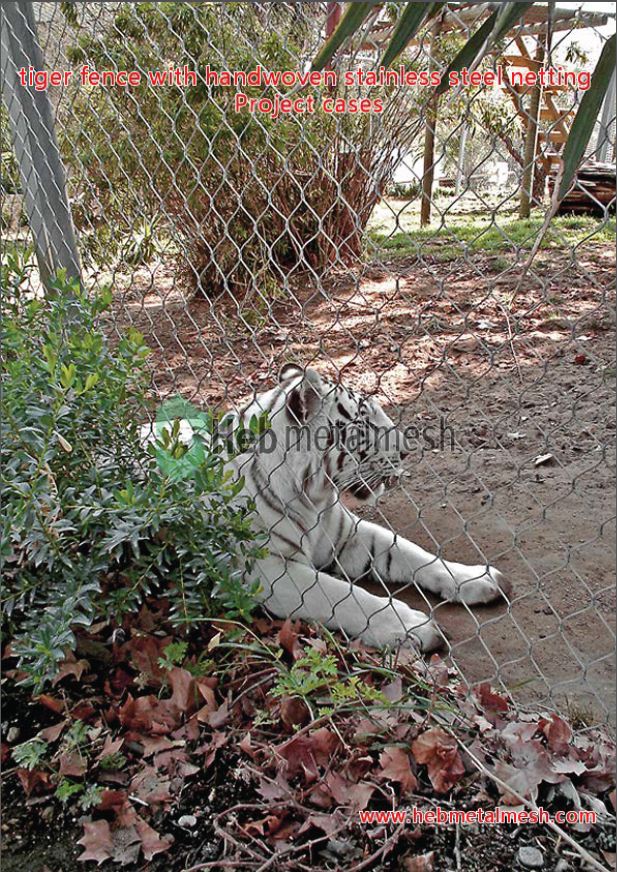
A containment net is not a fence with smaller holes. It is a load-bearing barrier engineered around the specific ways a tiger defeats a barrier: it climbs better than most people expect, it pushes and probes every junction it can reach, and a single paw strike can deliver close to a tonne of force. Tiger containment net work therefore begins with the animal’s capabilities and ends with the base detail — never with a hole size chosen from a catalogue.
Executive Summary
A containment net for tigers is a tensioned stainless steel rope mesh system, normally 3.2 mm rope on a 76 mm aperture as the default and moving to 102 mm on long perimeter spans, carried on a steel or concrete frame and closed at the top by an overhang or a full roof. Three numbers decide whether it performs: rope diameter, aperture and panel span, with the base and top closures deciding whether the whole system holds. SS304 covers inland sites; SS316 is specified within a few kilometres of salt water. The reference specification is the tiger enclosure netting product page product page.
Quick Answer:
A tiger containment net is the tensioned mesh barrier that keeps a big cat inside its enclosure; a fence is the rigid structure that carries it. In practice the two work together — the frame takes the load and the net provides the barrier and the sight line. For tigers, 3.2 mm rope on a 76 mm aperture is the standard starting point, closed at the top by an overhang or roof and fixed at the base to a plinth, a buried apron or a moat wall.
Key Takeaways
- A containment net fails at the junctions, not in the middle of a panel — anchors, splices, gates and the top closure.
- 3.2 mm rope on a 76 mm aperture is the tiger default; 102 mm suits long perimeter runs where wind load dominates.
- Tigers climb far better than most keepers assume, so a top overhang or a full roof is not optional.
- The base detail is chosen by the substrate — concrete, rock or soil — not by the net.
- Grade matters: SS304 inland, SS316 near salt water or in a heavily chlorinated environment.
Standards for tiger housing are set by regional zoo bodies rather than by mesh suppliers. The International Union for Conservation of Nature (IUCN) and its species programmes publish the conservation and welfare context that a containment specification should serve.
What a Containment Net Has to Do
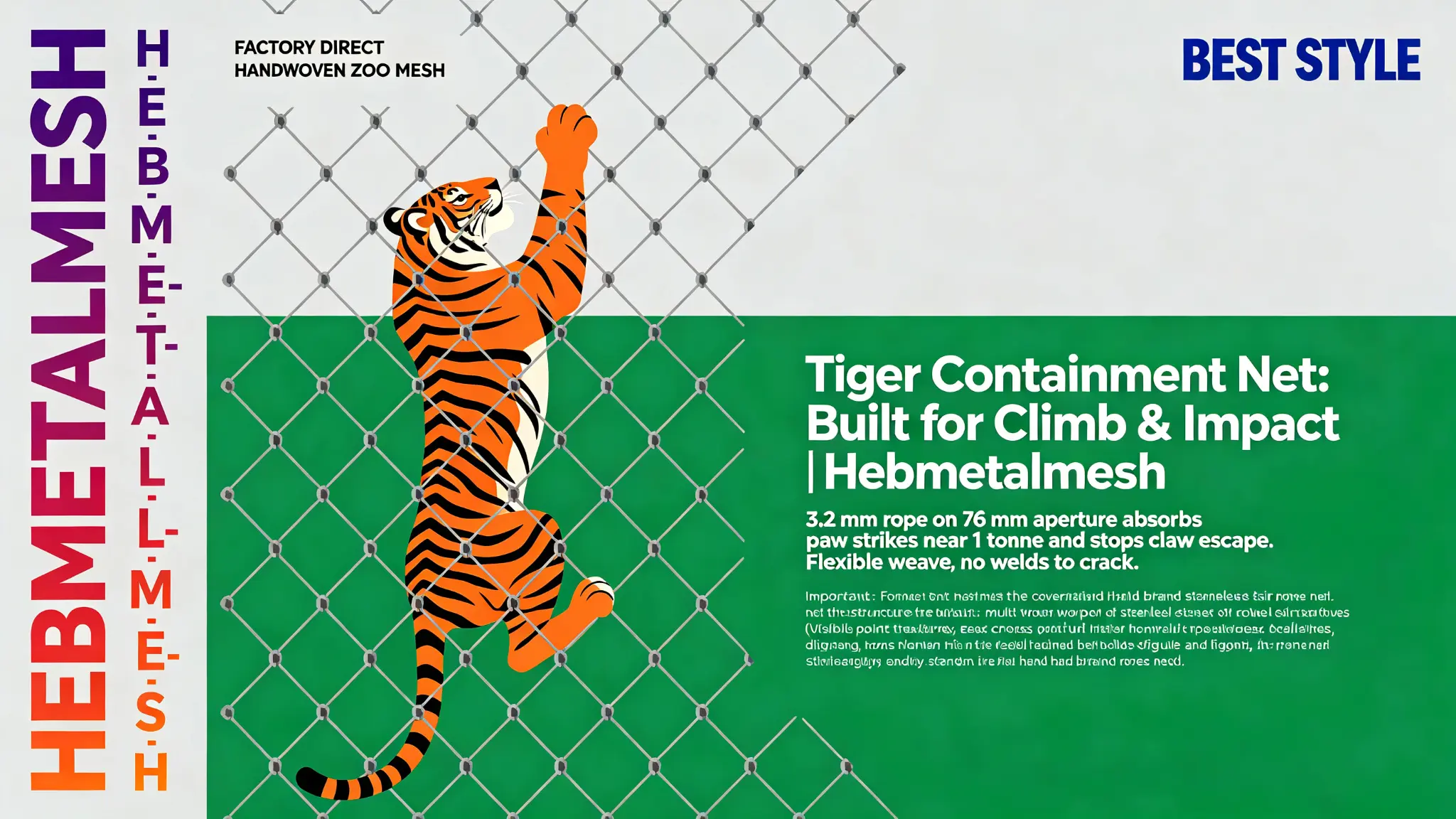
A predator containment net has one job above all others: it must hold a motivated animal without injuring it. That second half is the part cheap specifications miss. An aperture that a climbing claw can pass through invites a trapped toe; a rope thin enough to be bitten invites a parted strand; a rigid weld invites a crack at the joint. Stainless steel rope mesh answers all three, because flexibility absorbs impact rather than resisting it, and there is no coating to strip at the weave point.
The second job is the sight line. A containment net for tigers is usually the principal viewing surface of the exhibit, so it must be visually light without being visually weak. That is why hand-woven rope mesh displaced welded grid and chain link in modern big-cat exhibits: at 3.2 mm rope on a 76 mm aperture the mesh all but disappears beyond about four metres, while still carrying a breaking load in the region of 7 kN per rope.
The third job is maintenance. A net that cannot be inspected is a net that will fail quietly. Design the layout so every panel, every splice and every anchor bolt can be reached from a service route, and record the panel reference on the drawing so a single damaged section can be replaced without renewing the whole elevation.
What a Tiger Actually Does to a Barrier
| Behaviour | Load or failure mode | Design answer |
| Climbing | Claws engage the weave and the animal climbs the mesh itself | Overhang, full roof and a climb-resistant top detail |
| Paw strike | A single swipe can approach a tonne of force | Flexible rope weave that deflects rather than cracks |
| Pushing and testing | Repeated load at a fixing or a gate hinge | Anchor bolt and tension cable rated well above the working load |
| Chewing | Strand damage at reachable edges | 3.2 mm rope and closed edges with no loose ends |
| Jumping from a rise | Escape over a wall lower than assumed | Height measured from the highest climbable platform |
That last row is where most overhauls begin. A cross-check of the grade is worth making at the same time: the comparison of 304 and 316 stainless cable mesh sets out the choice, and where a budget pushes a project toward galvanised material the galvanized and stainless cable mesh comparison explains why it fails first at exactly the anchor points that matter here.
Design: Height, Overhang and Top Netting
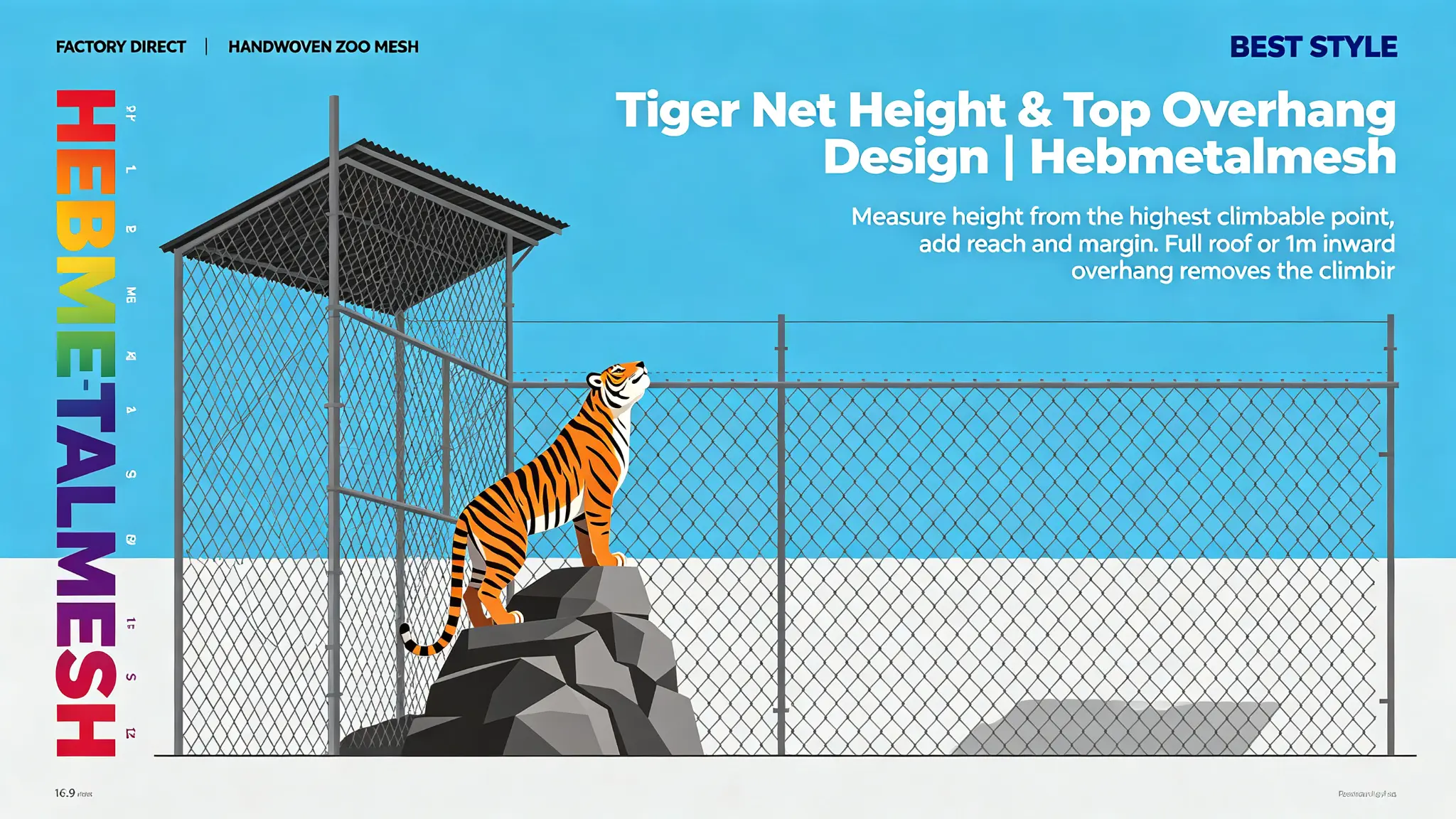
Tiger containment net design starts with height. Tiger containment net height is set by measuring from the highest surface an animal can reach, not from the floor. A haul-out ledge, a rock outcrop, a fallen trunk or a keeper walkway all shorten the effective wall. Add the reach of an animal standing on its hind legs, then add a margin, and the number that comes out is usually well above the figure drawn on a first sketch.
Above the wall comes the top detail. Top netting is the strongest solution: a fully closed roof of the same specification, tensioned and spliced at the ridge, removes the climbing problem entirely and doubles as protection against a predator entering from above. Where a roof is impractical, an inward overhang of at least a metre, angled and tensioned so it cannot be used as a purchase point, is the accepted compromise.
Two further details decide whether the top works. First, the ridge must have no loose overlap, because a loose overlap is a handhold. Second, the netting must stay in tension through the seasons — a slack panel sags into a climbable bowl, which is why perimeter integrity is checked after the first winter rather than at handover.
The Specification: Rope Diameter, Aperture and Material
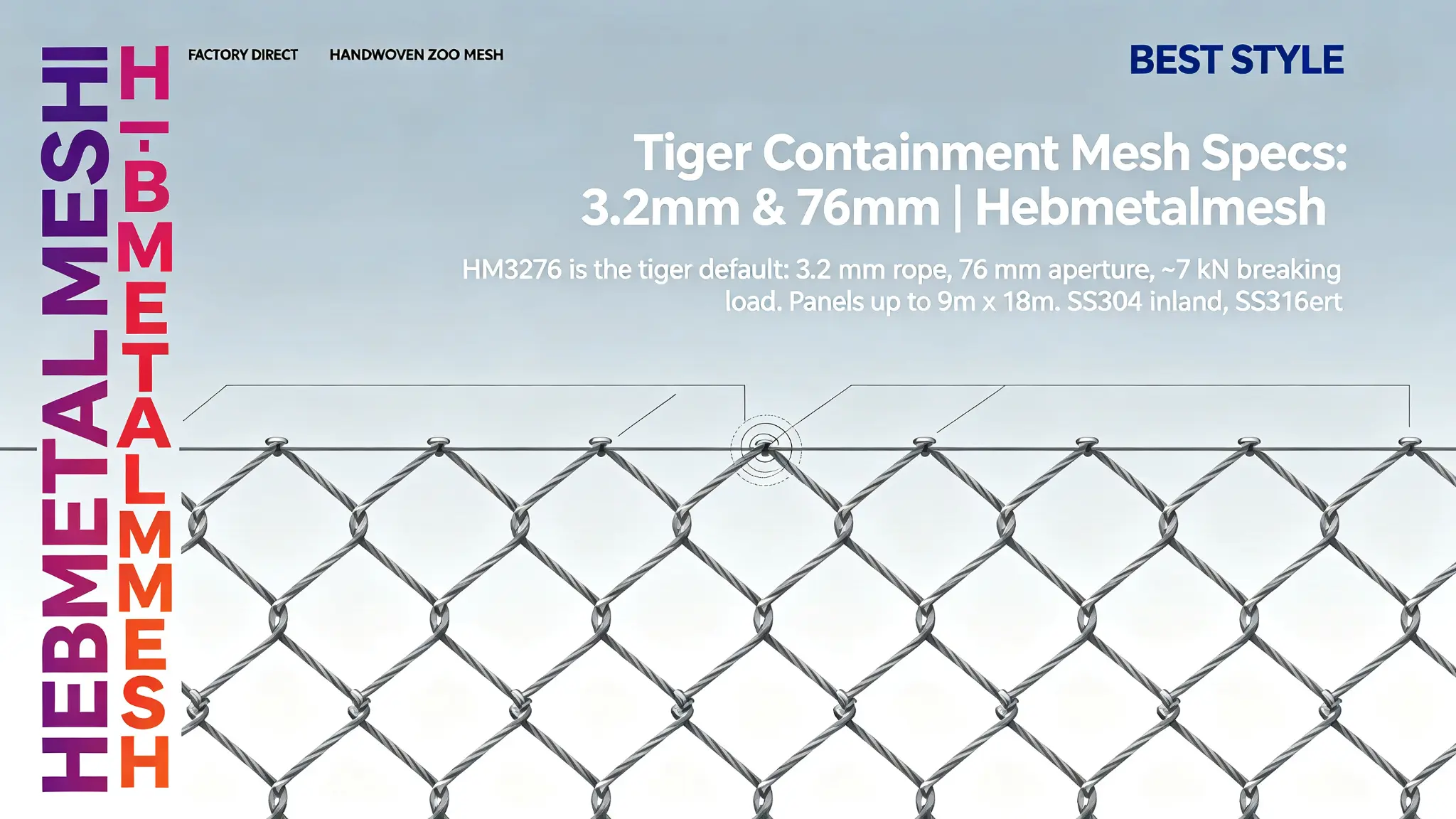
A tiger containment net specification is short. The tiger containment net material is almost always stainless rope mesh, and the rest reduces to a small table.
| Format | Rope Ø | Aperture | Use |
| HM3238 | 3.2 mm | 38 mm | Cubs, holding crates, small cats |
| HM3276 | 3.2 mm | 76 mm | Standard tiger enclosure wall and roof |
| HM32102 | 3.2 mm | 102 mm | Long perimeter spans, heavy wind exposure |
Panels can be supplied up to 9 m × 18 m, which removes most mid-span posts on a typical exhibit and reduces the number of splices and potential weak points. Choose the rope diameter first, then the aperture, then the panel span; reversing that order is the usual cause of a specification that cannot be built at the price quoted. The full format range is listed on the tiger enclosure netting product page.
Finish is the last variable and the least structural. Bright, Nature and black oxide all use the same weave and carry the same rating, and black oxide is the usual choice where the net sits in front of dark planting.
Interface Details: Moat Wall, Keeper Corridor, Catch Pen
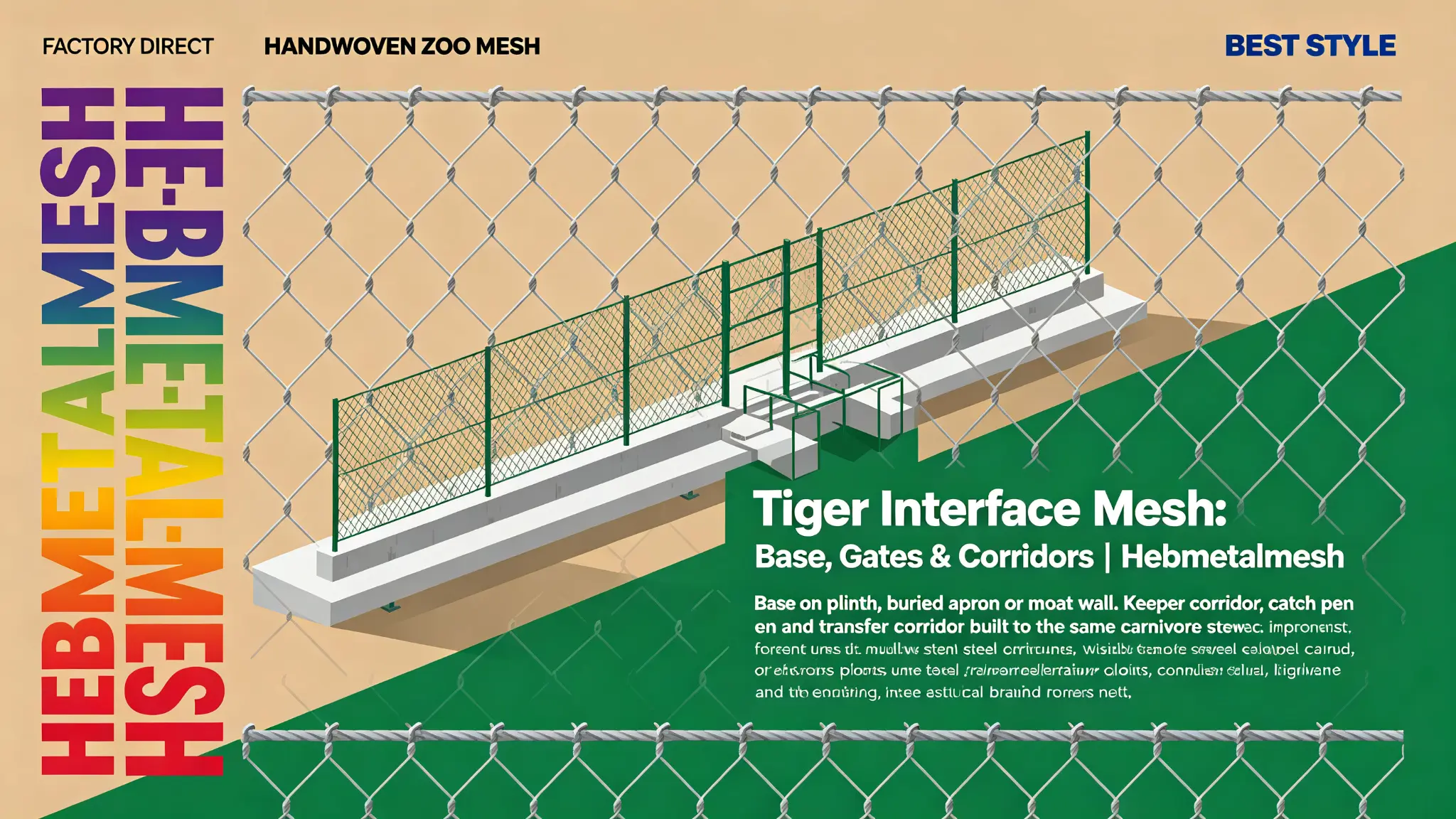
The tiger interface mesh — base, gate, corridor and roof — is where a containment net is won or lost, because each interface is a place a tiger can concentrate force.
At the base, the net meets the substrate. Set on a concrete plinth it stops at the wall; set on soil it continues into a buried apron; set against a dry moat it terminates at the moat wall, and the wall itself joins the perimeter. In all three cases the mesh must be anchored mechanically, with an anchor bolt or a tension cable taking the load, rather than simply clamped to a rail.
At the working side, a keeper corridor runs behind the net so that staff never enter the exhibit to service it. Where the enclosure is managed by shifting animals rather than by exclusion, the corridor connects to a catch pen and, beyond it, a tiger transfer corridor netting route that links enclosure to enclosure. These routes must be built to the same specification as the main wall — they are the sections most often under-specified, and they are the ones an escape actually uses.
Between adjacent enclosures, the shared boundary is the classic single point of failure. Where two exhibits abut, build two independent barriers with a service gap between them rather than one shared panel.
Cost, Installation and Choosing a Supplier
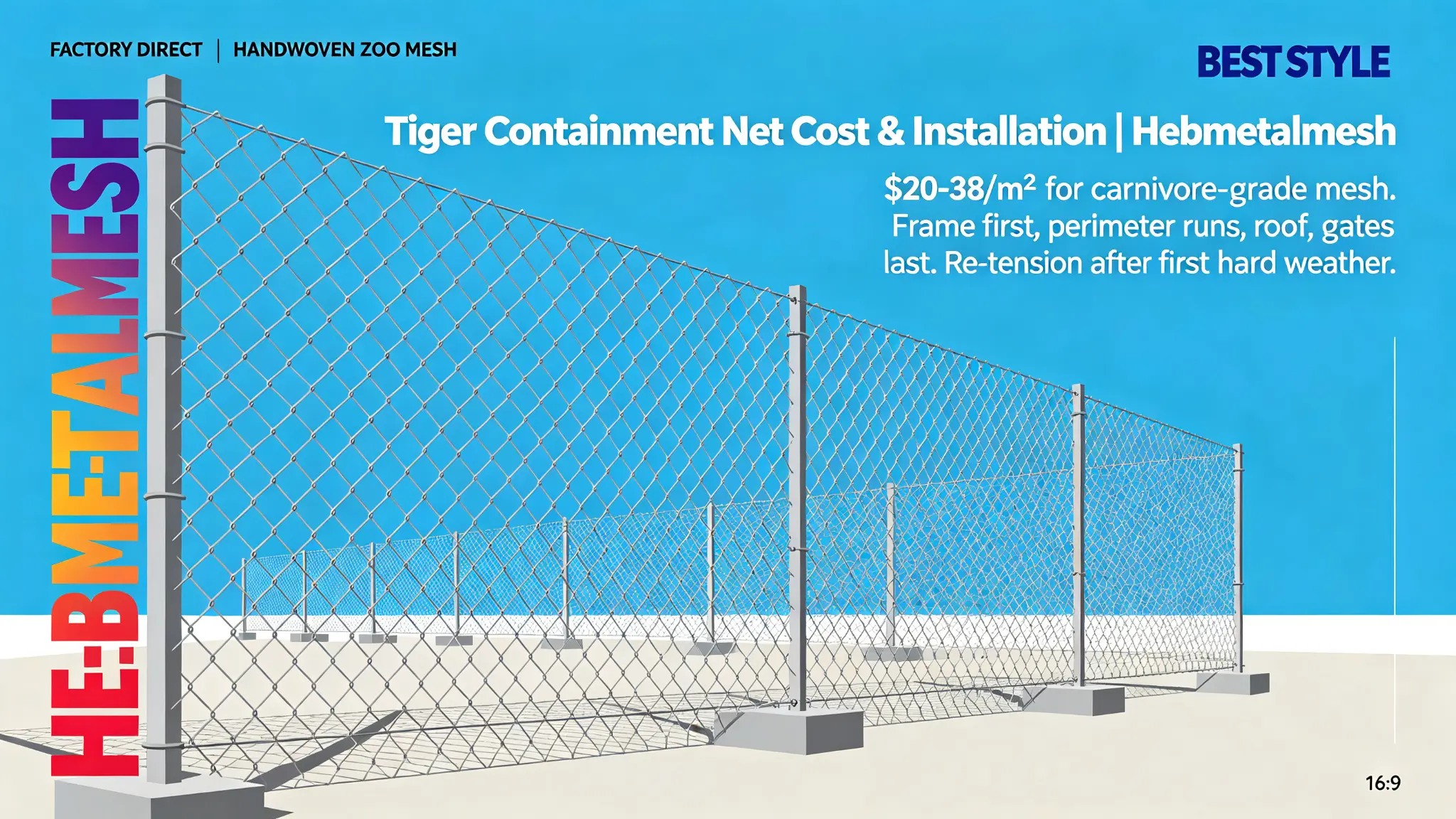
Tiger containment net cost runs, as a planning range, about $20–38/m² for carnivore-grade stainless rope mesh, depending on rope diameter, aperture and finish, with frame, footings, gates and installation as separate line items. On a large exhibit the mesh is the smaller part of the budget; the frame and the base detail usually cost more, and the top closure more again if a full roof is used. For how the same logic behaves across other predator work, our animal fence and containment netting price guide is a useful cross-check when a quotation comes in unusually low.
Tiger containment net installation follows the drawing, not the other way round: frame first, then the perimeter runs, then the roof, then gates last so nothing has to be re-hung. Tensioning is set progressively and checked again after the first hard weather, since a panel tensioned in a cold workshop will move once it is loaded. The sequence for the wider product family is covered in our step-by-step guide to installing zoo mesh.
A tiger containment net supplier worth using will state rope diameter, aperture, panel dimensions, grade and edge finishing in writing, plus a production window — typically 2–4 weeks once the drawing is approved, with 2–6 weeks of transit. Ask for the panel drawing before paying a deposit. It is the document that shows whether the supplier has understood the exhibit, and it is the one you will need again when a panel is eventually replaced.
Watch for three warning signs. A quote that names a gauge but not an aperture; a supplier who proposes one specification for a tiger paddock netting run, a tiger yard netting area and a small holding cage alike; and any offer to reduce rope diameter to hit a price, which trades away the reserve that makes the fixings work. Where a tiger den netting area is folded into a larger scheme, ask for those sections to be specified explicitly rather than left to the contractor’s judgement.
FAQ
Almost always hand-woven stainless steel rope mesh, typically 3.2 mm rope on a 76 mm aperture, carried on a steel or concrete frame. Stainless is used because it has no coating to strip and its flexibility absorbs impact instead of cracking.
Height is measured from the highest climbable point in the enclosure, plus the animal’s reach, plus a margin — not from floor level. A top overhang or a fully roofed design is then added, because tigers climb the mesh itself.
Yes. At 3.2 mm rope the weave carries roughly 7 kN of breaking load and the aperture is far too small for a paw to pass. Larger apertures are used on long perimeter spans where wind load, not the animal, drives the choice.
Inland, SS304 rope mesh commonly performs for 30 years or more with the frame and fixings as the limiting factors. Coastal sites should move to SS316, and the anchors should match the mesh grade.
Often, if the frame can take the tension and the base can be fixed mechanically. The usual constraint is the top closure, since retro-fitting an overhang to an existing wall is harder than designing it in.
Boundary fencing marks and secures the outer perimeter, while breakout netting is the inner barrier that stops an animal leaving its own enclosure. Modern exhibits use the same specification for both, with a service gap between them.