
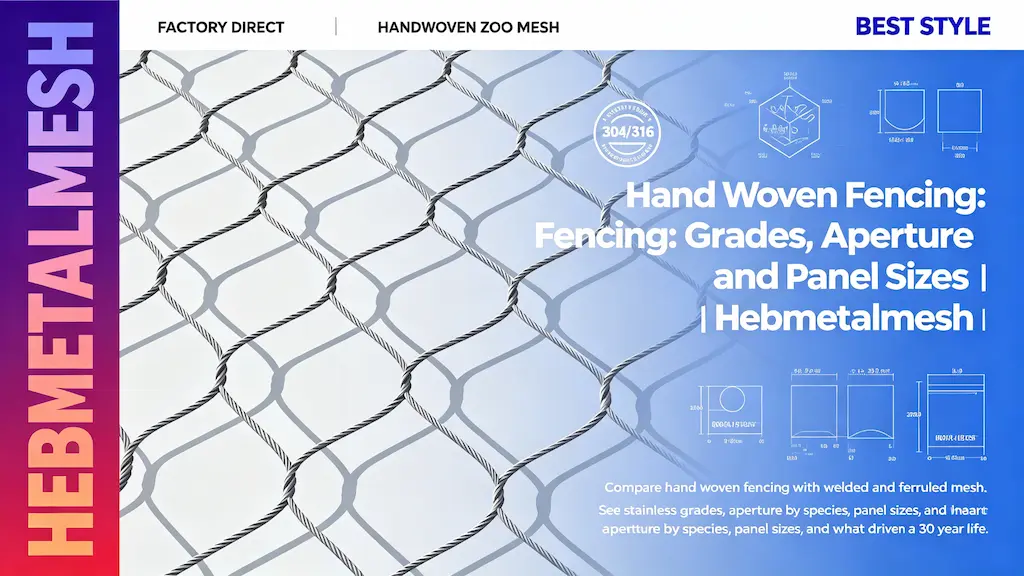
Netting supplier selection is a materials decision before it is a purchasing decision. Most netting failures in a garden or an outdoor run — a bird net that shreds by its third summer, a crop cover that sags across a bed, a wildlife barrier that tears away at the first post — trace back to a material picked off a catalogue line rather than from a specification. This guide sets out how to compare netting materials, how to read a datasheet, and how to run a netting supplier comparison that ends with the right roll on site.
Executive Summary
Send the project type, the span and the exposure before you ask for a price. Material, weave and documentation decide whether netting lasts three summers or twenty-five, and we weave both polymer and stainless products to size. Contact Hebmetalmesh
A supplier who can only quote a price is selling a commodity; one who can state the polymer grade, filament diameter and weave density is selling a specification you can hold them to. The reference specification is the garden netting product page.
Quick Answer:
Netting supplier selection comes down to matching the material to the exposure, then verifying the specification in writing. For a seasonal garden cover, a UV-stabilized polyethylene or polyester net is adequate and inexpensive. For a permanent garden enclosure, a wildlife barrier or any panel that has to carry load, specify stainless steel rope mesh — SS304 inland, SS316 where the site is coastal or washed down — and ask for the polymer grade, filament diameter, weave density and a batch document before placing the order.
Key Takeaways
- Material first, price second. The same square metre of netting costs one dollar or thirty depending on what it is woven from; the cheap version is not a saving if it is replaced twice.
- Exposure decides the grade. Ultraviolet light, salt and mechanical load are the three things that shorten service life, and each maps to a specific line on the datasheet.
- Ask for the numbers. A supplier who cannot state denier, weave density and filament diameter is guessing on your behalf.
- Documentation is part of the product. A mill or batch report turns a verbal promise about netting UV resistance into something you can verify after delivery.
- Buy the panel, not the roll, where shape matters. Custom-cut panels remove both the waste and the weak joints that come from joining standard widths on site.
Where netting is there to keep wildlife out of a growing space rather than to enclose an animal, the World Wide Fund for Nature material on living alongside wildlife is a useful frame — a barrier should resolve a conflict, not relocate it.
What netting supplier selection actually decides
The first decision is not which supplier, it is which material family. Netting is sold under a confusing set of names — garden netting, shade cloth, insect screen, bird net, debris net — but underneath those names there are only four constructions that matter for outdoor work, and they behave very differently.
The second decision is aperture, the size of the opening. Aperture is what the material is for: an insect barrier needs a small opening, a bird barrier a larger one, a wildlife or climbing barrier needs openings small enough that nothing can get a paw or a hoof through. For the plant-protection side of the decision, the garden netting range sets out aperture by crop and pest. The third decision is the supplier, and that is where most projects stop thinking too early. A netting buyer guide is really a guide to three questions: can this supplier state a specification, prove it with a document, and cut the panel to the shape the site actually is. Get those three right and the price conversation becomes straightforward.
Comparing the four netting materials
Getting netting fabric selection right starts with honest exposure data. A coastal site, a windy ridge and a shaded courtyard will not carry the same material for the same number of years, and a supplier who does not ask about exposure is not really specifying anything.
| Material | Typical use | UV behaviour | Load capacity | Service life |
| Polyethylene (PE) | seasonal crop covers, insect barrier | good when stabilized | low | 2–5 years |
| Polyester | shade netting, bird netting | strong | moderate | 5–8 years |
| Nylon (polyamide) | portable, abrasion-heavy nets | poor if untreated | high | 3–6 years |
| Stainless steel rope mesh | permanent enclosures, barriers, screens | unaffected | very high | 25–30 years |
Netting weave selection follows the material. A knotless weave removes the knots that abrade against a post or a frame, and it is the difference between a net that frays at every fixing point and one that does not. For polymer nets, a stabilized yarn matters more than the headline breaking strength, because a strong yarn without a UV stabilizer simply becomes brittle. For stainless mesh, the equivalent of grade selection is the rope construction: a 7×7 rope of 1.2–3.2 mm diameter with an aperture of 20–102 mm covers almost every outdoor application, and the choice is driven by what the barrier has to stop rather than by raw strength alone.
For fixed plant protection in a garden — a bed covered all season, a fruit cage that stays up year after year — netting grade selection is where projects overspend or underspend most often. Our guide to fine mesh garden netting walks through how aperture and material trade off against insect pressure and plant access.
The netting specifications guide: what a datasheet should say
A serious netting specifications guide is short. Six numbers settle most arguments, and any supplier who cannot supply them in writing is asking you to buy on trust.
- Polymer grade — polyethylene, polyester or polyamide, and for polymer nets whether the resin is virgin or reprocessed.
- Denier — the linear density of the yarn. A higher denier is a thicker yarn and a stronger net at the same weave.
- Filament diameter — for stainless rope mesh, the wire diameter per strand, commonly 1.2 mm to 3.2 mm.
- Weave density — how many yarns per unit length. Density, not aperture alone, sets how the net behaves under load.
- Mesh or aperture size — the opening, stated in millimetres, which decides what the net excludes.
- Mass per square metre — the honest figure for freight, handling and frame load.
A datasheet that lists only “heavy duty” or “commercial grade” is a marketing sheet. The test is simple: ask for tensile test values and the mesh count, and see whether the numbers arrive as a document or as adjectives.
Netting UV resistance and netting life expectancy
Sunlight is the single most common cause of premature netting failure, and netting UV resistance is the specification line most often left out of a quotation. An unstabilized polymer net can lose most of its strength within a couple of seasons of full exposure, while the same construction with a properly dosed UV stabilizer holds its properties for years longer. That is why two nets of identical appearance and identical price can differ by a factor of three in netting life expectancy.
Weather is the second driver. Wind does not simply push a net; it works it, and every fixing point becomes a fatigue point where the weave rubs against the frame. A net with a knotless weave and a generous edge has far fewer of those points than a knotted net stapled directly to a rail. Salt is the third: on any coastal site, the choice moves from polymer to stainless steel rope mesh, because a marine atmosphere degrades coatings and stabilizers alike while leaving SS316 largely untouched.
Practically, plan on two to five years for budget polymer netting in full sun, five to eight for well-stabilized polyester, and twenty-five to thirty for stainless steel rope mesh. Stainless costs more per square metre and less per year of service, which is the comparison that matters for a permanent structure. Our overview of stainless steel rope mesh applications shows how the same material performs across very different outdoor projects.
Running a netting supplier comparison
A netting supplier evaluation should be short and repeatable. Set the netting selection criteria before contacting anyone — material family, aperture, panel sizes, documentation, lead time — then score every reply against the same list. Suppliers who answer in adjectives drop out of a netting supplier comparison quickly once the criteria are fixed.
A workable netting supplier checklist looks like this:
- Specification on paper. Can they state the polymer grade, denier, filament diameter and weave density of the product quoted?
- Material certification. For stainless products, can they provide an EN 10204 3.1 mill certificate? A 201-grade substitution is invisible in the weave and shows up only in the paperwork.
- Batch traceability. Can a delivered roll be traced to its batch? It is what makes a claim actionable if a panel fails early.
- Panel capability. Can they cut and edge a panel to the site’s actual shape, or only sell standard rolls?
- Supply chain transparency. Where is the yarn or wire drawn, and where is it woven? A short, known supply chain is easier to audit.
- Lead time and packing. Woven panels typically take two to four weeks, plus two to six weeks for export transit; ask how the rolls are protected for sea freight.
Netting supplier vetting should also include one reference project at a similar exposure — a coastal install, a windy ridge, a heavily loaded frame — and the question of what happened to the netting after a few years. A supplier who can answer that is describing their own product; one who cannot is describing a catalogue. For a school, a municipality or a farm building a netting procurement guide, the six points above translate into a tender sheet, and our guide to mesh enclosures covers what those structures demand from their netting.
A rule of thumb for any netting sourcing guide: if the answer to “what is this made of” is a trade name rather than a material and a number, the specification is being managed by marketing. That is the point where how to choose a netting supplier stops being a preference and becomes a documented decision.
Cost, lead time and ordering
Cost follows material, aperture and panel size, and the spread is wide enough that it is worth quoting two options rather than one. As a planning range rather than a quotation, polymer garden netting sits in the low single figures per square metre, while stainless steel rope mesh — the material used for permanent garden enclosures, animal barriers and architectural screens — runs roughly $20 to $38 per square metre before frames and installation.
Two notes save money on real projects. Custom-cut panels are usually cheaper than standard rolls cut on site, because offcuts are paid for in the roll price and joints in labour. And mixing specifications is legitimate: a coarse panel on long straight runs with a finer panel where something actually presses against the net often costs less than a uniform premium specification and performs better. Where a project weighs grades directly, our comparison of galvanised against stainless mesh and our guide to 304 versus 316 stainless set out where each is the right answer.
Frequently asked questions
It is the process of matching a netting material and aperture to a specific exposure, then choosing a supplier who can state that specification in writing and prove it with documentation. A materials exercise with a purchasing step at the end.
Compare four things: material family, aperture, UV stabilization and load capacity. Exposure drives the result — a seasonal garden cover, a permanent plant cage and a coastal wildlife barrier will each settle on a different material.
The two are used interchangeably in the trade. Netting usually describes a flexible woven product sold in rolls or panels, while mesh more often describes the same construction treated as a structural material. Both are defined by material, aperture and yarn or wire diameter.
It depends on what the net excludes. Insect barriers use openings of a few millimetres; bird barriers typically 20–50 mm; barriers that stop a larger animal 50–76 mm or more. A very fine net also needs more support because of wind load.
Two to five years for budget polymer netting in full sun, five to eight for well-stabilized polyester, and twenty-five to thirty for stainless steel rope mesh. UV exposure, wind and salt are the variables that shorten those figures.
Ask for the specification in writing — polymer grade, denier or wire diameter, weave density and aperture — plus material certification and batch traceability on delivery. If those cannot be provided, the price is the only thing being quoted.
Ordering netting with a specification attached
Send the project type, the span, the exposure and the aperture you think you need. That is enough to recommend a material family, confirm the netting supplier selection logic behind it, and weave panels to the size the site actually is rather than to a standard width.
Request a netting material quotation from Hebmetalmesh and the panels ship cut, edged and documented.
Hebmetalmesh — Shijiazhuang Netting Trading Co., Ltd, No.386 Zhaiying Street, Shijiazhuang, Hebei, China. info@hebmetalmesh.com