
Most guides to this fence type compare wire diameters and prices and stop there. That misses where the risk sits. A wire rope fence is a tensioned line: a few horizontal strands held taut between posts and working in tension rather than bending. The wire is the cheapest element in the system and the last one that matters. What decides whether the fence holds is how the strands are spaced, how the ends and corners are built, how the line is tensioned, and whether that tension survives twenty years of weather.
Executive Summary
Choose a tensioned line fence by its structure, not by its strand. Four decisions settle it, in order. Wire spacing on a fence is set by the smallest animal the line has to stop, and strand count follows from the height. A taut line dumps its load at its ends and corners, so the fence end assembly design — brace post assembly, anchor and the turn at every corner — is what the fence is really built on. The line must be tensioned and then re-tensioned, so fence tensioning devices belong in the specification rather than in a maintenance note. Finally the ground decides whether the line steps, springs or breaks. A supplier quoting per metre without asking about ends, corners or terrain is quoting a different fence. The reference specification is the animal fence mesh product page.
Quick Answer:
Choose it on four things: strand spacing from the smallest animal, strand count from the height, the end and corner assemblies from the pull the line will hold, and the ground it crosses. Settle run length and turns first, because both change the load arriving at the ends.
Key Takeaways
- A line is only as strong as its weakest end assembly; ends, corners and gates are where these fences fail, not mid-span.
- Wire spacing on a fence comes from the smallest animal and strand count from the height — two independent variables.
- Tension loss is normal and permanent; the design question is whether the line can be re-tensioned at all.
- Every fence line change of direction needs a stay or brace, because the load arrives sideways there.
- Ground decides the run: a fence over uneven terrain steps rather than bridges, and a fence crossing a gully changes level with a brace at each step.
Strand, rope and fence fabric are covered by published test methods, and ASTM International writes them — a useful check when a datasheet quotes no test basis.
A Wire Rope Fence Is a Tensioned Line, Not a Panel
The format explains everything that follows. A panel barrier holds its shape in bending: each panel is a stiff sheet and the posts merely hold it up. A tensioned line works the opposite way — a few strands run horizontally and pulled tight, with the posts only holding them at the right heights. Strands carry load in tension, the strongest and cheapest mode a steel wire has, which is why the format covers a long run with light intermediate posts.
Tension is also its weakness. A taut line stores energy, and every kilogram of tension is resisted somewhere — never in mid-run, but at the ends, the corners and every gate. That one fact reorganises every factor worth considering, and it explains why a line fence built onto a light end assembly fails long before its wire does.
Factor One: Wire Spacing and Strand Count
Two numbers set the working part of the fence, and they come from different questions. The wire spacing on a fence — the vertical gap between strands — is set by the smallest animal the line must stop, because that gap is the size of the opening. Strand count comes from the height the line must reach, divided by that spacing.
Treat them as independent. Tightening the spacing for a smaller animal does not raise containment; it only packs more strands into the same height. Adding strands raises height and stiffness but does nothing about a gap a lamb or a dog walks through. A common specification for a boundary demarcation fence carrying stock runs five to seven strands over roughly a metre, but that number is an outcome, not a starting point.
| Question | What it sets | Typical answer |
| Smallest animal to stop | Vertical gap between strands | 100–200 mm |
| Height the line must reach | Number of strands | 5–8 strands |
| Stock pressure on the line | Strand diameter | 2.5–4.0 mm |
| Run length between end assemblies | Post spacing and brace size | 3–6 m |
Factor Two: The End Assembly Carries Everything
If one factor decides whether the fence works, it is this. A tight line pulls its end posts toward each other with a force equal to the total tension it carries, so the end assembly — strainer post, brace or stay, and anchor — resists that pull permanently. That is why the fence end assembly design uses heavier posts set deeper with a diagonal brace, while mid-run posts stay light.
Corners concentrate the same load in two directions. A fence corner assembly design therefore needs a brace each way, or a strainer sized for the resultant. A fence brace post assembly made from a length of wire or a light diagonal bar is a common and expensive mistake, and it is the detail most often left out of a quotation. Gates behave the same way, since a gate post is an end assembly that also gets leaned on. Where the ground refuses a driven or concrete anchor, a rock or screw-in anchor takes over and must be rated for the pull, not chosen for convenience. One rule keeps this simple: treat every change of direction as a full end assembly, never as a bend in the line.
Factor Three: Tensioning, and Tensioning Again
A tensioned line is not set once. Wire rope creeps under sustained load, ground settles around new anchors, and posts and strands move at different rates with temperature. Each shows up as sag, so maintaining wire tension is ordinary maintenance rather than repair.
That makes the tensioning method part of the specification. Fence tensioning devices run from in-line strainers and ratchet tensioners to turnbuckles at the end assemblies, and the choice matters more than it looks: a device operable from the line is worth more over twenty years than one that is cheapest at the counter, because a strainer buried in a corner that needs a spanner and two people will not be adjusted. Set the rule early — that re tensioning a fence line is planned rather than improvised — and the fence line maintenance schedule becomes a one-page job instead of a decision taken each time the line looks slack.
Factor Four: Terrain and Changes of Direction
Ground decides how a line is built, and a wire rope fence follows it rather than bridging it. A fence over uneven terrain steps at each post instead of spanning hollows, because a strand pulled straight across a dip lifts stock and collects debris. Longer gaps are better handled by a spring curve or a stay than by extra tension.
Water changes the rules again. A fence crossing a gully either steps down and up with a stay at each change, or the line is broken and the gap closed another way; a fence water crossing is rarely a good place to run a tensioned line at all. Any fence line change of direction should be built as a fresh end assembly with its own brace, because that is exactly what it is. Where the ground is the dominant constraint rather than the fence type, the site conditions and ground material is the right companion to this page.
Factor Five: Holding Tension Over the Life of the Line
A wire rope fence is judged after ten years, not on the day it is pulled tight. Three things move: strands gain slack as they bed onto the posts, anchors settle a few millimetres under sustained load, and corrosion works wherever a strand is clamped, crossed or cut. The first two appear as sag and are corrected with a tensioner. The third is decided by material and detailing, and it is where tension loss becomes permanent.
A line has few, large, inspectable load points, so a fence line inspection is quick and its interval can be generous — an annual walk of the run, tension checked at each end, a look for a broken strand at a clamp, and a look at the anchor. What inspection cannot do is recover section already gone. Galvanised strand sacrifices its coating first and then rusts at the clamp, exactly where the coating is thinnest. Wherever a galvanised fitting meets a stainless one, galvanic corrosion at that contact is predictable rather than possible, so isolate it at build stage instead of discovering it at year five. Material chosen this way, rather than by purchase price, is what sets the service life of the line.
When a Tensioned Line Beats a Mesh Barrier
Both formats are stainless and both hold boundaries, but they are not substitutes. Choose the line for exclusion at a boundary, where seeing past the fence matters, where the run is long and animals press lightly, and where installed cost and wind load must stay low. A taut line has almost no surface area, so it does not catch wind the way a full barrier does, and it needs far less steel and labour per metre.
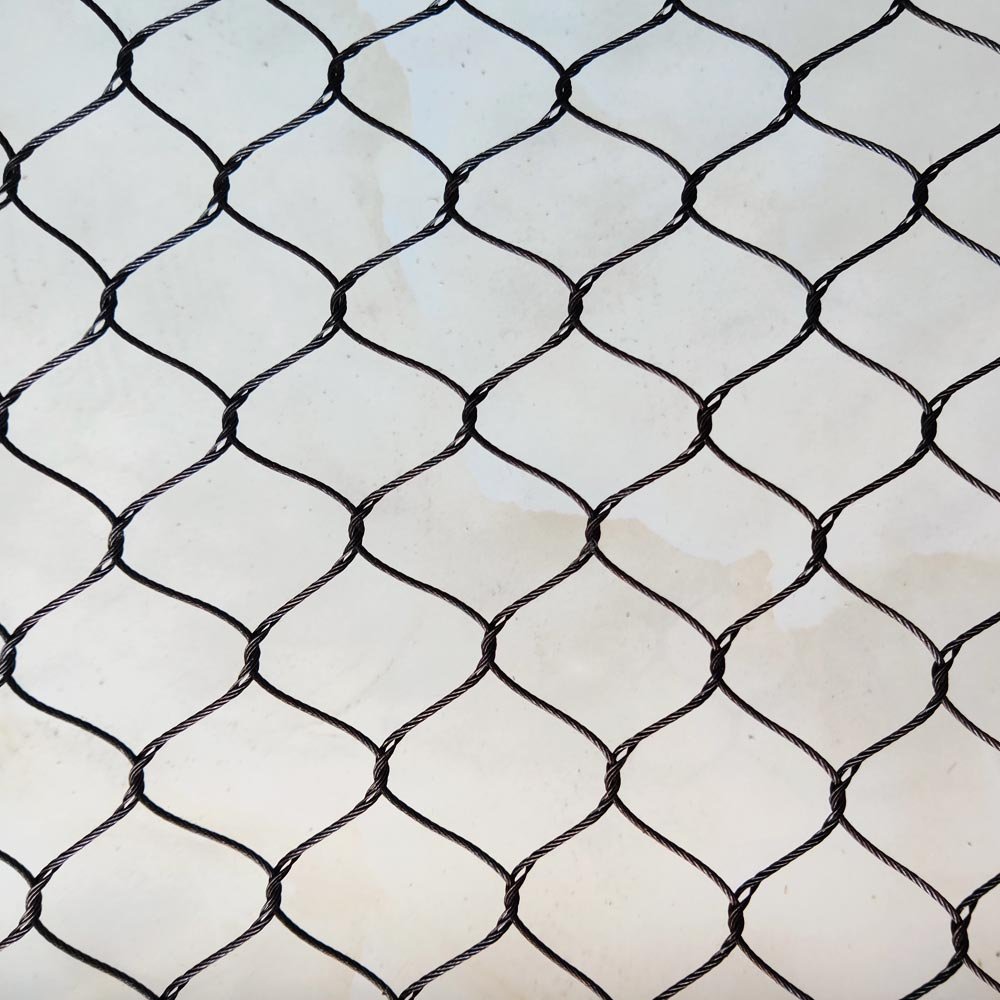
Choose a woven barrier to contain something that climbs, pushes, digs or squeezes. A hand woven rope mesh closes the whole opening rather than drawing lines across it, and it delivers its load through an edge cable around each panel, terminated by a swage ferrule at each end and set out from the cross point where strands intersect. That is why damage behaves differently: in a 7×7 strand one broken wire costs roughly two per cent of that strand’s breaking load, so the panel stays tensioned and the defect stays local, whereas a welded grid opens at the fused intersection where the coating is thinnest. For containment rather than demarcation, the format and failure mode comparison is the better start, and the requirements-first decision framework checks the fence is being chosen for the right reason.
Specifying and Buying a Tensioned Line Fence
Start with the job, not the material: what the line stops, over what length, against what pressure, and how the run is arranged around gates and stock movement. That is a layout question as much as a materials one, and the line arrangement discussion belongs before a tensioned line fence design is drawn.
Then write it as a list rather than a description. A tensioned line fence specification carries the strand count and vertical spacing; strand diameter and grade or coating; post spacing and run length between end assemblies; the type and size of every end, corner and gate assembly; the anchor type at each; the tensioning devices and where they sit; the tension set at handover; how terrain is handled; and the inspection and re-tensioning interval. A tensioned line fence supplier quoting against that list is comparable with the next one; one quoting per metre against nothing is not.
Where runs are long, terrain gentle and animals light, the line is usually the cheapest way to hold a boundary, and tensioned line fence planning is mostly a matter of keeping the ends honest. Where runs are short and broken by gates and turns, bracing dominates and a panel barrier can price better once labour counts. An order written against the strand diameters, spacing options and finishes on the animal fence mesh product page can be quoted directly and compared like for like.
FAQ
How many strands does my fence need? Count from the height and the smallest animal, not a rule of thumb. Divide the required height by the vertical gap the smallest animal cannot pass, then round up. A line holding sheep over a metre is a different fence from one merely demarcating a boundary at the same height.
Should the end posts be concrete-set or driven? Whichever the ground holds, provided the anchor is rated for the pull. Driven posts suit firm soils and go in faster; concrete suits softer ground and corners carrying two directions of load.
Can I re-tension a fence that has been up for years? Usually, if the tensioners are reachable and the anchors have not moved. Take the tension up gradually and watch the end assemblies, because their load rises with every turn. If the anchors have yielded, re-tensioning buys a season rather than a repair.
Does a tensioned line fence work for animals that dig or climb? Poorly. A line draws barriers across a boundary; it does not close the opening. Anything digging under, climbing over or forcing a gap needs a woven mesh spanning the full face.