
The dog goes out at seven. The rabbits arrive at dusk. Somewhere between those two events a neighbor walks past the end of the garden and decides whether the new structure reads as a fence or as a compound.
Most garden barriers answer one of those three. A pet run holds the dog and looks like a run. A vegetable cage keeps the rabbits off the kale and looks like a cage.
A security fence keeps people out and looks like a fence. Nobody minds, because each one does a single job and can be shaped around it.
A fence cage is the attempt to answer all three with one structure. That is a harder brief than it sounds. The three users want different things from the same square meter of mesh, and the compromise lands on whoever builds it.
Executive Summary
A fence cage can serve three duties at once: it holds a pet inside, it keeps wildlife outside, and it stays open enough that the garden does not become a compound. The three duties agree more often than buyers expect, because all of them want a closed perimeter and a rigid frame. They also collide in three specific places, and those collisions are where most builds go wrong.
This article maps the agreements first, then the conflicts of height, aperture and sightline. It covers the access question of gate count, the boundary question of who the structure belongs to, and the legal question of permission. It closes on the cases where one cage is the wrong answer and two structures cost less over ten years.
Quick Answer
A fence cage works as a single barrier when the pet is smaller than the wildlife you are excluding and the garden is wide enough to keep the cage off the boundary. Where either condition fails, split the duties across two structures.
Key Takeaways
- A fence cage is judged on three duties, and the sightline is usually the hardest.
- Height follows the animal that jumps highest, not the pet you had in mind.
- Aperture follows the smallest animal that must not get through, and that drives the sightline.
- Two gates turn a cage into something a household can live with.
- When the pet and the wildlife are close to the same size, one cage cannot serve both.
Three Jobs, One Structure
Start with what the structure has to do rather than what it has to look like. The first job is containment inward: a pet stays on the property. The second is exclusion outward: deer, rabbits, foxes and birds stay off the beds.
The third job is visual, and buyers rarely name it out loud. That is why it causes the most trouble later. A structure that keeps pets in and wildlife out is doing two jobs with one skin, and the skin is the thing everyone has to look at.
| Duty | What it demands | What it costs the other two |
| Keep a pet in | Height above the pet’s jump, strength at the gate, no gap at the base | Sightline, because a tall cage reads as a compound |
| Keep wildlife out | Aperture under the smallest animal’s shoulder, closed perimeter | Sightline again, plus airflow across the beds |
| Keep the view open | Wide aperture, thin gauge, dark finish | Strength at both of the above, because open mesh is weak mesh |
Where the Three Duties Agree
The duties overlap more than the table suggests. All three want a closed perimeter with no gap at the base, because a gap defeats containment and exclusion equally.
All three want a rigid frame too, since a sagging panel looks bad, leaks animals and reads as neglected. That frame is the part woven mesh built for animal enclosures hangs from.
All three want stainless as well. A galvanized barrier that rusts at the cut ends fails its security job and its visual job at once, which is the reasoning behind pet containment mesh sized for a yard rather than for a farm.
Where the Duties Fight
Three conflicts do most of the damage, and each one has a standard resolution. Each is a decision about which duty gets the last word.
Height: The First Real Conflict
Height for a dog and a deer are not the same number. A dog that clears a meter is unusual. A deer clears two meters without gathering itself, and a rabbit needs almost no height at all because it goes under rather than over.
Set the cage to the pet and the deer walks in over the top rail.
The resolution is a stepped perimeter. Run the tall section along the side the wildlife uses and drop to pet height on the other three. A stepped cage usually looks more deliberate than a uniform box.
Aperture: The Second Conflict
An aperture that stops a rabbit is around 50 mm or less. That is a fine mesh, and fine mesh is the enemy of the view.
Open it to 75 mm and the rabbit is still out but the sightline improves sharply. Open it past 100 mm and you have built a barrier for deer and people that a rabbit walks through.
Species pressure differs, and so does the mesh that answers each one. Garden barrier selection by animal works through the aperture for each before the sightline question comes up.
Pick the aperture from the smallest animal on the exclusion list and accept what it does to the view. If the result is too solid, the answer is a darker finish rather than a wider hole.
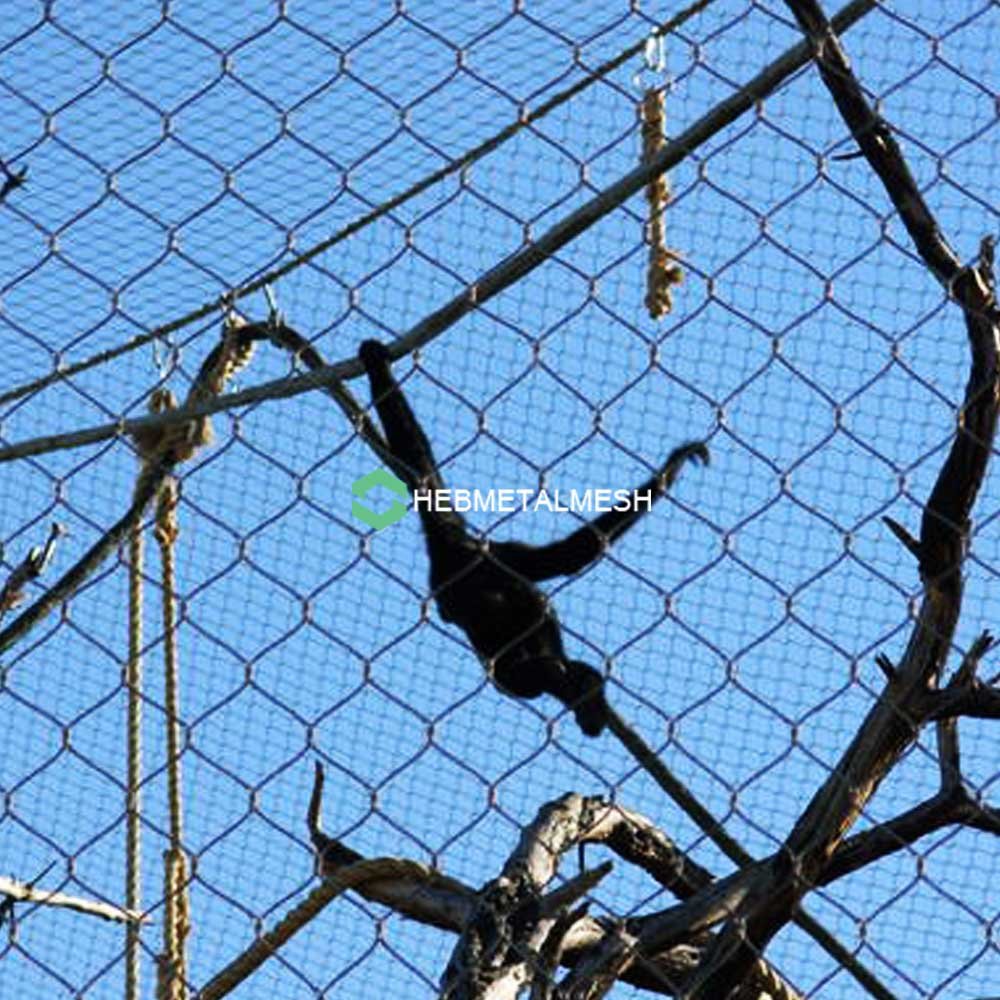
A black or dark bronze mesh at 50 mm reads as a shadow at four meters, while bright stainless at the same aperture reads as a grid. Panels from the animal enclosure mesh range come in both finishes for exactly this reason.
Tension and the Perimeter
Every panel carries load, and a panel that loses tension loses its aperture. Loose mesh sags, the openings distort, and the effective hole size grows past the number you specified. This is a specification conflict between duties: containment wants high tension, and the visual duty wants a panel that does not pucker at the corners.
Set tension at the frame rather than at the mesh. A rigid post, a footing that does not move and a cable along the top rail hold the panel flat. Tensioning hardware at the panel edge only takes up slack the frame should never have allowed.
The Sightline Test
Stand where you will actually look at the cage, not where the drawings put the elevation. Most people check the view from the patio and stop there.
Check it from four places before the panels arrive:
- The kitchen window, at the height you actually stand.
- The patio, where guests will see it.
- The gate, where you pass twice a day.
- The upstairs landing, which looks down on the roof line rather than through the mesh.
The view through a fence cage is different from all four, and the worst one decides whether the structure survives family review.
Run the test in daylight and again at dusk. Bright stainless disappears against a bright sky and turns into a visible grid against a dark hedge. A dark finish does the opposite, which is why the same panel can look invisible from one side of a garden and obvious from the other.
Where the cage sits within four meters of a window, gauge matters as much as aperture. A 1.5 mm rope at 50 mm is 88 percent open by area, and a 2.5 mm rope at the same aperture is 82 percent. That difference is invisible on a spec sheet and obvious through a window.
The point of see through mesh at eye level is not transparency. It is the absence of a pattern the eye keeps trying to resolve.
Gates, Corners and Daily Use
Access is where a good cage becomes an annoying one. Gate count on a garden cage is usually settled at two, and the reason is practical rather than generous.
One gate serves the house side and the daily route. The second serves the working side, so a wheelbarrow, a mower or a bag of compost does not have to travel through the pet’s space.
A second gate at the top of the garden earns its cost within a season. It turns a dead-end run into a through route. Position it where the ground is level and where a wheel can pass, not where the drawing leaves a convenient gap.
Five details decide whether the gates keep working:
- A gate frame independent of the panel, so gate traffic does not load the mesh.
- A latch that a child cannot open and a dog cannot nose open.
- A hard stop at the hinge side, so the gate cannot swing past square.
- Ground clearance under the gate of 50 mm or less, or the gap becomes the weak point.
- The same aperture in the gate as in the panel, because a gate is a hole with hinges.
The Boundary Question
A shared boundary with a neighbor changes the project from a garden job into a property job. The structure stands on a line two households have an interest in, and mesh makes that interest visible in a way a hedge never did. Settle the line before the footings go in.
Planning permission for a garden cage depends on height, distance from the boundary and whether the site is domestic. Most jurisdictions allow a domestic barrier below a stated height without an application, and most treat a structure that encloses volume differently from a flat fence. Check the local rule first, because the trigger height is often lower than buyers assume.
Where the cage must sit close to the line, a freestanding structure set back from the boundary avoids most of the argument. It also keeps the mesh out of the neighbor’s sightline, which matters more than the legal position. If a boundary structure is unavoidable, barrier fencing built as a security element is easier to justify than a garden cage that happens to sit on the line.
When One Cage Is the Wrong Answer
Knowing when one cage cannot do all three jobs is the most valuable judgment in the project. One cage three jobs works when the duties overlap, and fails when the pet and the wildlife are close to the same size, because the same aperture cannot hold one in and keep the other out with any margin.
A terrier and a fox are near enough the same problem, and no single panel solves both.
It also fails on a small yard with one cage asked to cover everything. Consolidating barriers into one structure needs enough perimeter to give each duty its own run of fence. On a plot where the cage has to touch three boundaries, the stepped perimeter has nowhere to step.
The honest test is simple. If you can describe the cage in one sentence that names the pet, the wildlife and the sightline, build one. If any of the three needs a qualifier, build two.
Combining pet run and garden barrier into a single build is a real saving, but it is a saving on the frame rather than on the mesh, and the frame is the cheap part.
Where the answer is two structures, treat them as one project. Shared footings, a common finish and one gate strategy cost less than two builds a year apart. The layouts in residential and commercial barrier options show how far a shared line can be pushed.
IUCN work on species and habitat conservation is a useful reminder that the wildlife side of the brief is not a nuisance to be blocked. A cage that excludes a rabbit from a raised bed does something different from a cage that cuts a hedgehog’s route across a garden.
FAQ
Not always. A cage under about 1.8 m on firm ground can use driven posts with a gravel collar. Anything taller, or any post carrying a gate, needs a concrete footing set below the local frost line.
Around 50 mm. A 50 mm aperture at 1.5 mm rope is roughly 88 percent open by area, which reads as a haze rather than a grid. Going wider improves the view and starts letting young rabbits through.
Yes, if you step the height. Run two meters along the side the deer use and drop to 1.2 m elsewhere. A uniform height set for the dog will not stop a deer.
Two, in most gardens. One on the house side for daily use and one at the far end so the cage is a through route rather than a dead end.
Stainless rope mesh does not rust at a cut, because the alloy runs through the section rather than sitting on the surface as a coating. Galvanized mesh is the material that fails at cut ends.