
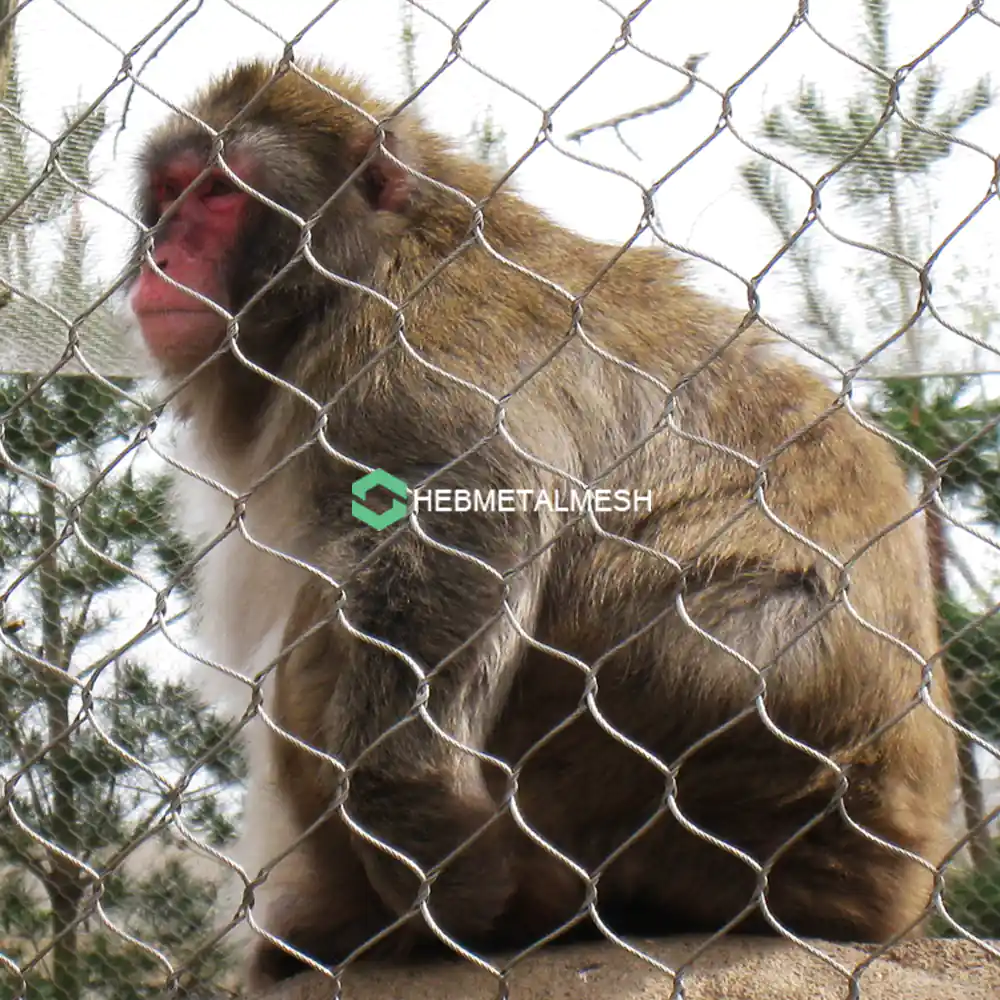
Ask for a 50 mm aperture and you will get one. It will measure 50 mm in the workshop, with the panel flat on a table and nothing pulling on it.
Put that panel on a frame, tension it, then let a winter gale or a 90 kg animal lean into it, and the number changes. A woven panel carries load by changing shape. That is the property that makes it useful in a wildlife enclosure, and the same property that makes its geometry uncertain.
This is the part of flexible mesh that catalogue pages skip. Flexibility is not a bonus feature bolted onto a fixed product. It is a structural behavior with consequences for the one dimension an animal enclosure is judged on.
Executive Summary
Flexible mesh under load holds its specified aperture only at rest. Under wind, animal pressure or its own pre-tension the panel deflects, and the weave distorts unevenly across the bay, so the opening at mid-span is not the opening at the corner. The catalogue figure and the working figure are two different numbers, and only one of them contains an animal.
This article treats that as a design problem rather than a defect. It covers the three loads that change panel geometry, where the change concentrates, and how span, rope diameter and pre-tension each move the result. It closes on the cases where a rigid panel is the better answer, because flexibility is a trade rather than an upgrade, and every trade has a price written somewhere.
Quick Answer
A flexible mesh panel carries load by deflecting, so its aperture is largest where the panel moves most, which is usually mid-span. Specify against that loaded dimension rather than the catalogue figure, or the enclosure only complies when nothing is pushing on it.
Key Takeaways
- A woven panel resists load by changing shape, so geometry and load are one problem, not two.
- Mid-span moves first, which means the widest opening sits where an animal is most likely to test it.
- A thicker rope holds aperture better than a thin one, because it strains less at the same load.
- Pre-tension buys geometry now and gives some of it back as the rope creeps.
- Corners carry the highest stress and the least movement, so they fail by concentration.
- Where aperture has to be exact, a rigid welded panel is the honest choice.
What Flexible Actually Means
A rigid panel carries load through its members and passes it to a frame. A woven panel does something different. It changes shape until the geometry itself resists, which is why a wire rope net spans further than its weight suggests.
That behavior is the whole point of the material in a wildlife setting. It absorbs a bird strike instead of stopping it dead, wraps a curved corner without a fabricated frame, and takes a shove from a primate and returns. Panels from the animal enclosure mesh range are chosen for that compliance, not for their stiffness.
Every one of those advantages costs geometric certainty. A rigid panel that stays flat keeps its aperture. A compliant panel that does its job is, by definition, not staying flat.
That is the trade flexible mesh netting makes everywhere it is used, and it is worth naming before a specification is written.
The Panel at Rest and the Panel in Service
Two numbers matter, and most specifications state only one. The first is the aperture at rest, which a catalogue lists and a caliper reads in the workshop. The second is the aperture under load, which is what an animal actually meets.
The gap between them is not small. On a wide bay in an exposed site, a 50 mm panel can open past 55 mm at mid-span under design wind, before anything leans on it. For a species contained by a 50 mm opening, five millimeters is the entire margin.
Three Loads That Change the Geometry
Wind is the one everyone thinks of, and it rarely governs. Animal pressure is more local and more damaging. The third load is the panel’s own tension, which the installer controls and which quietly leaves.
| Load case | What moves | What it does to the aperture |
| Wind on an exposed bay | The whole panel sags downwind | Opens at mid-span, tightens at the windward edge |
| Animal pushing at eye level | Local deformation around the contact patch | Opens around the push, closes a bay either side |
| Pre-tension at installation | Uniform strain across the weave | Closes everywhere, then relaxes as the rope creeps |
| Snow or debris on a roof panel | Downward catenary | Opens across the crown, closes at the supports |
Wind and the Catenary
Wind pushes a panel into a curve, and a curve is a longer path than a straight line. The extra length comes out of the weave as elongation, so the apertures along the middle of the bay stretch in the direction of the span.
The deflection of a mesh panel under wind therefore matters twice. It moves the boundary, and it changes the containment dimension at the same time. A panel that sags 200 mm has also opened its weave by a measurable amount, and both effects arrive together.
Animal Pressure
Animal pressure on a panel is a small load in a small area, and that is what makes it awkward. A big cat pushing at eye level does not load the whole bay. It loads a patch, and the weave around that patch distorts sharply.
This is where nominal versus actual aperture stops being academic. The animal tests the exact spot the mesh has been pushed, and that spot is where the opening is widest. A panel that passes a static inspection can fail the first time something leans on it.
Its Own Tension
Pre-tension is the installer’s main tool and the least understood. Pulling a panel tight closes the apertures and stiffens the bay, which is why a well-tensioned panel behaves better than a slack one.
Then the rope creeps. Under sustained load, wire rope relaxes slowly, and the relaxation concentrates at the terminations.
Part of that movement is the elastic stretch of wire rope, which returns when the load comes off. The rest is creep, which does not.
Tension loss over time is not a defect in the material. It is normal behavior for a pre-tensioned rope system, and it means the aperture set at handover is not the aperture you have in year three.
Where the Geometry Goes
Distortion is not uniform across a panel, and knowing where it concentrates is most of the design work. The middle of a bay moves. The corners do not.
That is the point where custom woven mesh panels stop being a catalogue item and become a calculation.
Panel geometry at a corner is set by the frame and the fitting, not by the weave. A corner is restrained in two directions, so it barely deflects, which tempts people to treat it as the safe part of the panel. It is the safe part for aperture and the worst part for stress.
Sag Between Cables
The span between support cables sets almost everything downstream. Halve the span and deflection falls steeply, because deflection in a tensioned member scales with span raised to the fourth power against tension. The aperture benefit follows the same curve.
That is the most effective lever on loaded geometry and the most expensive, because more cables mean more anchors and more frame. A designer who wants a tight aperture cheaply is asking for something the physics does not offer. Sizing the grid before ordering panels is the same discipline that governs predator exclusion netting design, where the perimeter sets what the panel has to do.
Corners, Bridles and the Load Path
A corner pull is the fitting most likely to fail and the one most often specified by habit. It takes the panel load in one direction and hands it to a single anchor, concentrating stress in the weave right where the panel can least redistribute it.
A bridle splits that corner load into two directions and shortens the effective span at the edge. It costs one extra fitting and a few minutes per corner, and it removes the failure mode that shows up first on an inspection.
The load path from panel to post runs through every component in series. The weakest item sets the capacity of the whole chain, which is why a heavy cable terminated into a light bracket performs like a light bracket.
Specifying So the Loaded Panel Still Works
Write the specification for flexible mesh under load rather than at rest, and the numbers start to behave. Five moves do most of the work, in rough order of value for money:
- Shorten the span by adding a cable, which reduces deflection fastest.
- Increase rope diameter, because a thicker rope strains less at the same load.
- State a pre-tension figure and check it with a meter at handover.
- Bridle the corners so the edge can share its load.
- Reduce the nominal aperture to leave room for aperture drift.
That last move is the counterintuitive one. Buyers assume a flexible panel needs a wider aperture to stay open visually, then discover the loaded opening is wider than the specified one. Sizing down at the catalogue stage and letting the load open it back up lands nearer the intended result.
A tolerance stack makes the arithmetic visible. Each item below adds to the worst case rather than averaging out:
- Weave tolerance from the loom.
- Rope diameter tolerance within the standard.
- Tension setting tolerance at installation.
- Deflection under the design load.
- Creep over the service life.
Add them and the design aperture is rarely the number on the drawing. Subtract them and you have the smallest opening the panel will ever present, which is the figure that matters for anything trying to get out through the tightest part. AZA standards for zoo and aquarium enclosures treat containment this way, as a performance requirement rather than a material list.
Maintenance Is a Geometry Task
Re-tensioning a flexible panel is not cosmetic upkeep. It restores the geometry the enclosure was designed around, and skipping it widens the containment dimension year by year.
Put it on a schedule rather than on a feeling. A panel set to a stated tension at handover should be checked at twelve months, because most creep happens early, then annually after that. A tension meter costs less than a replacement animal and settles the argument about whether the mesh has gone slack or always looked like that.
The same inspection should look at the anchors, not just the mesh. Running a fence line across rough ground shows how much of the total performance sits in the frame and the ground, and a perfectly tensioned panel on a moving anchor will not stay tensioned.
When Flexibility Is the Wrong Property
Flexibility is a trade, and some enclosures cannot pay for it. Where containment depends on an exact opening, a rigid welded panel holds geometry in a way a woven one never will, because its aperture does not change when the load does.
Small bird containment is the clearest case, and so is any exclusion detail where a few millimeters decide whether something fits through. In those applications the right answer is often a rigid panel for the critical dimension and a flexible one everywhere the geometry is forgiving.
The range of rope mesh constructions covers both behaviors, and the choice between them is a choice about which risk you would rather carry: a boundary that moves, or a boundary that cracks at a fixing point.
FAQ
Yes, slowly. Pre-tensioned rope creeps under sustained load, so a panel set tight at handover relaxes over the first year or two. The aperture opens with it, which is why the tension check belongs on a schedule.
Yes. At the same load a thicker rope carries lower stress, so it strains less and the weave distorts less. The counterintuitive result is that the stiffer panel is the one that looks less flexible in the catalogue.
On a wide exposed bay it can move a 50 mm aperture past 55 mm at mid-span. The exact figure depends on span, tension and exposure, and it is worth calculating rather than assuming.
No. Over-tensioning loads the frame and the corner fittings beyond their design case and accelerates creep at the terminations. Set the stated figure and check it with a meter.
When containment depends on an exact opening, such as small bird or fine exclusion work. A rigid welded panel holds its opening when loaded; a woven one holds it only at rest.