
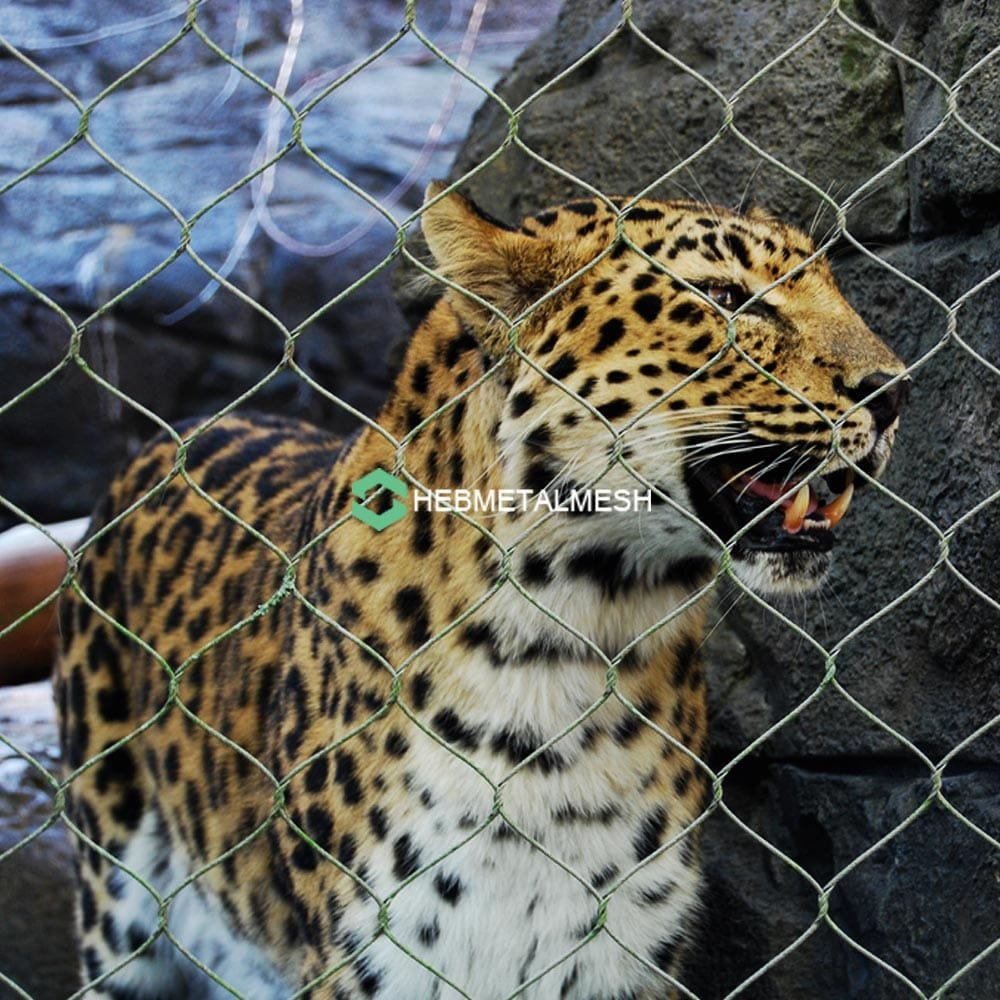
Most fencing failures in a zoo or wildlife park are not material failures. They are setting failures — a barrier specified for one kind of facility and installed at another. A hand-woven stainless panel that is exactly right around a leopard at an urban zoo can be the wrong answer at a drive-through park, not because the animal changed but because everything around the animal changed: how close the public gets, whether vehicles enter the range, how long the perimeter runs, and who reaches a breach first. Wildlife park fencing is a two-variable problem — what the animal can do, and what the facility is asking the barrier to do around it. Settle the facility first and much of the specification decides itself.
Executive Summary
Four things separate one facility type from another, and all four change the barrier: how close the public gets, whether vehicles enter the animal’s space, how long the perimeter runs, and how quickly a keeper can reach a breach. An urban zoo exhibit is short, viewed from behind a second line and inspected daily. A safari or drive-through park is kilometres long, crossed by visitor vehicles and inspected from a moving cab. A sanctuary or rescue centre is frequently the highest escape risk on its own site, because the animals are unsettled, the staff are few and the budget is thin. The animal’s own numbers — barrier height, mesh aperture and cable diameter — travel between all of them unchanged, which is precisely why operators get caught: one species chart is reused at three sites that need three different answers. Classify the facility, then apply the animal’s numbers inside it.
The reference specification is the animal fence mesh product page.
Quick Answer:
Wildlife park fencing is selected in two passes. First classify the facility — urban zoo exhibit, safari or drive-through park, sanctuary or rescue centre, or a conservation breeding unit — because the facility fixes the visitor interface, the standoff distance and the perimeter length. Then apply the species numbers: barrier height from the animal’s climbing and jumping capability, mesh aperture from the smallest part of the smallest resident, and cable diameter from the heaviest beak, horn or hand in the collection. The institution decides how the barrier is arranged; the animal decides how strong it has to be.
Key Takeaways
- The facility sets the layout; the animal sets the strength. Height, aperture and cable come from the species. Standoff, sightline, perimeter and inspection route come from the institution.
- A public exhibit needs two barriers. Primary containment at the animal, plus a separate visitor line. A range park substitutes distance for the second wall.
- Perimeter length is the hidden cost driver. Price scales with area, so a drive-through range and a 400 m² exhibit look nothing alike economically even on identical mesh.
- Sanctuaries carry the highest escape risk. Unsettled animals, transient populations and thin staffing make inspection discipline worth more than an extra half millimetre of cable.
- Grade and format travel. SS304 inland, SS316 where salt or strong cleaning chemicals are present, with a mill certificate for anything cited in a welfare licence.
The facility standards behind those points are published by the World Association of Zoos and Aquariums, whose members operate across all four models described below.
Why the Facility, Not the Animal, Decides Your Fencing
Two institutions can hold the same species and need different barriers. Species charts read as though the animal were the only variable, and they are half right: the animal sets the load and the opening, but the institution sets the geometry. Put a pair of gibbons in a 300 m² exhibit viewed from a footpath and the barrier must defeat a brachiating reach at head height while still leaving the animals visible. Put the same pair on a forested island in a range park and the job shifts — the water gap now does most of the containment and the fence becomes a boundary rather than an exhibit wall. Neither fence is better. They answer different briefs, and the panel that satisfies one will embarrass you at the other.
The Four Settings and What Each One Changes
Every collection in this family sits in one of four operating models, and each model fixes its own set of design variables. Zoo and safari park fencing differ far less in the mesh than in what surrounds the mesh.
| Setting | Public interface | Typical perimeter | Second line | Inspection |
| Urban zoo exhibit | Close, from a path | 100–600 m | Visitor barrier plus standoff | Daily visual, annual detailed |
| Safari / drive-through park | Vehicles inside the range | 2–20 km | Distance and vehicle rules | Daily from a cab, monthly on foot |
| Sanctuary / rescue centre | Limited, booked visits | 200 m–2 km | Often none | Twice daily, logged |
| Breeding / reintroduction unit | Staff only | 50–400 m | Quarantine and night housing | Daily, with movement records |
Inside a Zoo: Two Barriers and a Sightline to Protect
An urban zoo exhibit is the most constrained setting on the list. The footprint is small, the public is close, and the animal is on show for most of the day, so the barrier has to be strong and visually quiet at the same time. The primary containment zoo staff rely on is usually a tensioned stainless mesh panel on a rigid frame, because it delivers a high breaking load with an open area that keeps the animal in view — the whole point of the exhibit.
Geometry matters more here than gauge. Even a 1.5 m enclosure standoff changes how a barrier is braced, how a keeper works inside it and how a rescue is staged, and it is usually the cheapest safety feature on the contract. The animal viewing barrier is the second line and answers a different question: it stops a hand, a dropped item or a determined child, and it is allowed to be light because it was never meant to hold an animal. Operators who merge the two lines end up with one overbuilt fence and no separation, which is the arrangement that fails worst.
Licensing follows the same logic. A zoo license fencing requirement is rarely written as a product specification; it is a performance standard — an escape cannot occur, the public cannot make contact, the animal cannot be seen being stressed.
Inside a Safari or Drive-Through Park: Distance Instead of a Second Wall
Safari park fencing is not an exhibit wall with the visitors moved out. It is a boundary system for animals that live at a scale, where the design currency is distance rather than height. A lion in a 4,000 m² enclosure has to be contained by engineering; the same lion on a 40-hectare range is contained mostly by geography, and the fence is there to define the edge and survive occasional contact rather than daily pressure.
Drive through safari fencing has to survive forces an exhibit never sees. Vehicles approach the line, animals congregate along it, and the barrier absorbs pushing, rubbing and the occasional impact from a large body at speed. That is a specification about anchor plates and post spacing as much as about mesh, because a line that deflects more than intended across two kilometres has already failed somewhere invisible.
A free range wildlife park complicates matters by mixing species across one continuous boundary. Large mammal range fencing is sized from the herd rather than the individual — group loading on a shared line is not the single-animal case, and a design that holds one rhino will not necessarily hold twelve moving together. Hoofstock range fencing works at the opposite extreme: loads are lower, but the run is longer, abrasion is constant, and the economics turn entirely on roll or panel format and the number of posts consumed per kilometre. Where predators share or adjoin the range, a predator proof perimeter has to hold at its weakest point rather than its average, and that weakest point is almost always a gate, a corner or a service crossing.
Inside a Sanctuary or Rescue Centre: The Highest Escape Risk on Site
Wildlife sanctuary fencing is usually the most heavily loaded barrier on the smallest budget in the sector. Three factors combine: animals arrive unsettled, often after injury or long transport; the population changes constantly, so no specification can be tuned to a fixed collection; and staffing is thin, so inspection happens less often than the risk warrants.
Animal sanctuary fencing also copes with a shifting census. A site holding primates, parrots and hoofstock at once cannot take one aperture and one cable and expect both ends of that range to work; the honest answer is usually two specifications across different compounds rather than one compromise everywhere. Animal rescue fencing adds a harder constraint, because it must hold an animal nobody has assessed yet — a species that turns out to climb, dig or work fixings in a way the intake form did not predict.
That is why animal escape response matters more than any single number on these sites. A written procedure — who calls whom, which gate is pre-agreed as the re-entry point, what the public is told, and how quickly a panel can be opened without tools — buys more safety than a heavier gauge, and it costs nothing but an afternoon.
What Does Not Change: Mesh Format, Grade, Cost and Inspection
Whatever the setting, the panel comes from the same short list. Hand-woven rope mesh is chosen where a high breaking load and long service life matter, because each strand is a rope of 49 wires rather than a fused intersection: damage stays local, the panel holds tension, and one broken wire costs a small fraction of the strand’s capacity instead of opening the grid. Welded mesh is cheaper on the day and fails at the weld, which is also where its coating is thinnest. Compare the formats on cost per square metre and you will pick the wrong one; compare them over service life and the position reverses. The format comparison sets that out, and the zoo enclosure barrier review covers where mesh sits against glass and moats.
Alloy and exposure follow the site, not the species. SS304 covers inland installations; SS316 is the specification where salt spray, coastal air or aggressive cleaning chemicals are present, and mixing galvanised fittings with a stainless panel invites galvanic corrosion at exactly the joint an inspector will examine. Tension loss is normal and should be planned for: a mesh line relaxes over its first seasons and needs re-tensioning on a stated interval, which is why perimeter inspection deserves a schedule and a log rather than an informal glance.
Cost still runs in a fixed order — cable diameter first, aperture second, panel size third, order volume last — so a lighter cable over a tight aperture is the cheapest way to cut a quotation without cutting safety. Fixings, edge cable, tensioners, anchor plates and frames typically add 10 to 20 percent, and more on a range park because there is more line to anchor. The panel sizes and grades behind those figures are drawn from the animal fence mesh range used across all four settings. An open-air enclosure design note covers how the hardware is laid out, and the specification walk-through shows the sequence to follow while the brief is still a plan.
Briefing a Supplier for Any Setting
Give the supplier the facility model before the species. State whether the barrier is an exhibit wall or a range boundary, how long the run is, whether vehicles or the public enter the animal’s space, and who inspects it and how often. Then give the animal numbers: the tallest resident’s climbing and jumping capability, the smallest resident’s smallest part, and the heaviest beak, horn or hand in the collection. Ask for the aperture and cable to be justified rather than stated, request panels or rolls cut to size with a take-off by area, and require the fixing allowance in the same document as the mesh. A supplier who cannot answer a facility question is selling you a material.
FAQ
The animal sets the minimum; the facility sets how much margin you add. A climbing species on a public exhibit needs additional height and an overhang, while the same species behind a moat may need very little.
It is necessary where the barrier must last decades with minimal maintenance, and it is usually cheaper over that term than galvanised mesh needing recoating. Grade is a site question: SS304 inland, SS316 for coastal or chemically washed areas.
A public exhibit daily for the visible line and in detail annually. A sanctuary holding unsettled animals should log twice-daily checks, and a range boundary should be driven daily and walked monthly, with attention at gates, corners and service crossings.
Because cost scales with cable diameter across the whole run, and a heavier line than the animal justifies only moves money away from the standoff, the second barrier and the inspection routine.