

Executive Summary
Leopards are the only wild cats known to haul their kills into trees. That single habit tells you what a flat enclosure misses. A leopard needs height, and height needs structure, and structure needs mesh that can carry a climbing cat without stretching out of shape.
Most enclosure budgets go into the perimeter. The climbing layer gets whatever is left. That order is backwards. A perimeter keeps the cat in. A climbing layer keeps the cat behaving like a leopard.
This guide covers the build: what the structure has to carry, how to size leopard climbing structure mesh, where anchors go, how much platform deflection is acceptable, and how to retrofit an existing habitat without tearing it apart. It closes with the checks that catch a weak build before a cat finds it.
Building a climbing layer into a big cat enclosure?
Send the structure layout and the heaviest cat in the collection. We return aperture, cable diameter, anchor spacing, and a deflection figure for each platform.
Why a Flat Habitat Fails a Leopard
A leopard that cannot get off the ground spends its day pacing a boundary. Keepers see it as a restless animal. It is usually an under-built one.
Wild leopards use height for three jobs. They cache kills above scavengers. They rest on limbs with a clear line of sight. They ambush from above rather than chase across open ground. Take the height away and all three behaviors disappear.
That is why leopard habitat vertical space deserves its own budget line, separate from the perimeter fence. It is not decoration bolted onto a wall. Platforms, limbs, and overhead runs are the part of the enclosure that produces natural behavior.
What the Climbing Layer Has to Carry
A climbing structure takes loads a perimeter never sees. The cat lands on it, launches from it, and shakes it while climbing.
Three load cases matter:
- Landing impact — a cat dropping from a platform onto mesh below
- Launch load — the push-off from a jump, concentrated at the feet
- Sustained climb — an animal hanging and shifting weight on a vertical panel
Landing governs. A 150-pound leopard dropping six feet can put four to six times its body weight into a small area of mesh in a fraction of a second. Design the anchors for that number, not for the animal standing still.
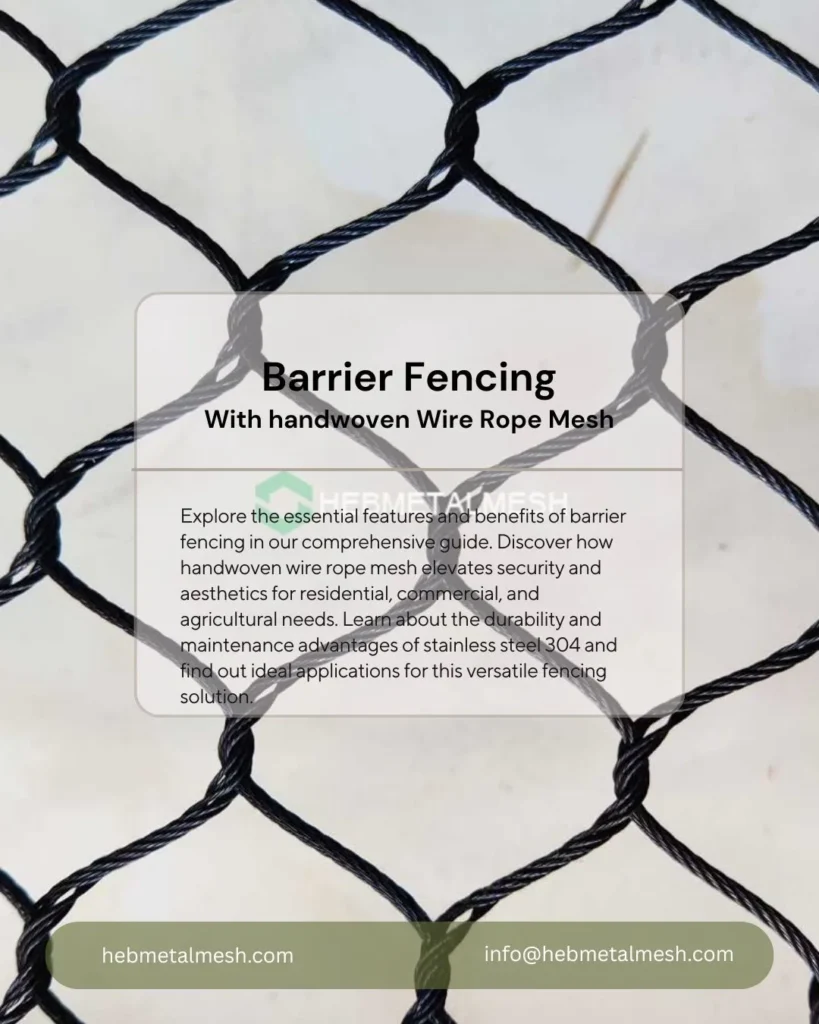
Climbing mesh for big cats has to do one thing a perimeter panel never does: recover. A handwoven wire rope mesh absorbs the hit and returns to shape because each ferrule mesh joint moves. A rigid welded panel takes the hit and keeps the dent. For an arboreal big cat enclosure, that recovery decides whether the structure lasts or gets rebuilt.
Aperture and Cable for Climbing Structures
Aperture size on a climbing surface needs to be tighter than on a perimeter panel. A claw or a toe can pass through an opening that a head cannot, and a caught claw on a moving cat is how legs break.
Sizing leopard climbing structure mesh starts here, not with the cable. Our leopard enclosure mesh range covers the apertures below, and platform panels are cut to the same spec.
Use this as a starting range, then confirm it against the largest cat in the collection:
| Climbing element | Aperture | Cable diameter | Anchor spacing |
| Vertical climbing wall | 2″ x 2″ (50 mm) | 1/8″ | 4 ft grid |
| Horizontal platform | 2″ x 2″ to 3″ x 3″ | 1/8″ | 5 ft grid |
| Overhead run | 3″ x 3″ (75 mm) | 1/8″ | 8 – 10 ft between frames |
| Tree-substitute column | 2″ x 2″ | 3/32″ – 1/8″ | 4 ft |
| Keeper-side safety panel | 2″ x 2″ | 1/8″ | 5 ft grid |
Two adjustments apply to almost every build. Go to 1/8″ cable wherever a cat lands, even if the rest of the structure runs 3/32″. And never widen the aperture on a climbing surface just to save weight. The cat does not care about weight. It cares where its foot goes.
A leopard climbing platform mesh at 2″ x 2″ with 1/8″ cable covers most adult animals. The same panel works as leopard platform netting on vertical walls, so one spec can serve the whole structure. Keepers working with younger or smaller cats sometimes drop to a tighter opening, which costs more per square foot and removes the claw risk entirely.
Anchors and Climbing Load
The mesh is rarely the weak point. The anchor is. A climbing cat puts torque on a fixing that a perimeter panel never generates, and leopard climbing load arrives as a shock rather than a steady push.
Three rules keep anchors honest:
- Tie every anchor back to structure, not to cladding or fascia.
- Space fixings on a 4 ft grid on vertical surfaces, tighter at platform edges.
- Use a leopard climbing net anchor rated well above the calculated landing load, then inspect it after the first month.
Stainless steel 304 hardware suits most indoor and covered structures. Move to 316 where the enclosure sits near salt water or gets hosed with harsh cleaners.
A useful check at handover: load one platform with sandbags to the design figure and watch the anchors, not the mesh. If the frame flexes, the mesh will follow it and lose tension within a season.
Platform Deflection and Mesh Tensioning
Mesh platform deflection decides how a landing feels to the cat. A stiff platform stops the animal short. A slack one turns into a trampoline that never settles.
Aim for less than an inch of deflection at design load across a 5 ft span. That keeps the surface predictable under a running cat and stops the mesh from sagging into a bowl over time.
Big cat net tensioning is a two-pass job. Pull to hand tension first and check the aperture is square at every frame. Then come back and pull to final tension, working from the middle of the panel outward so the load spreads evenly.
Uneven tension shows up first at corners, where the aperture pulls out of square. That is where a claw catches.
Overhead Runs and Cross-Habitat Links
The best climbing structures connect two places. A leopard overhead mesh run from a night house to an outdoor platform gives the animal a route instead of a room.
Three details make an overhead run work:
- Height clearance. Keep at least 8 ft of clear space below the run, so keepers and visitors pass without ducking.
- Continuous surface. Join panels so the cat never meets a gap or a lip it can catch a claw on.
- A second exit. A run with one door is a trap. Give the cat a way out at both ends.
Junction detail matters more here than anywhere else in the build. A gap where a run meets a building face defeats the aperture spec, and the fence gap sealing guide covers the joints that carry load.
Leopard enclosure height requirements are set by the cat, not the visitor. Plan 8 to 12 ft of usable climb above the floor, and keep the run itself clear of anything a cat can hook a limb over.
Retrofitting an Existing Habitat
Most climbing layers go into habitats that already exist. A leopard habitat renovation is cheaper than a new build, and it carries one hard constraint: the perimeter stays.
Work in this order. Survey the structure and find the real load paths first. Then add leopard enrichment structures that hang from existing frames rather than from new footings. Finish with the mesh, because the mesh is the part that has to fit what you built.
Custom panels usually beat standard rolls on a retrofit. Bends, offsets, and odd spans are normal in an existing building, and our guide to custom-made enclosure mesh covers how far a panel can be shaped before it needs its own frame.
Species Notes
Snow leopards. The high-altitude subspecies wants bigger vertical jumps and colder-weather hardware. Our notes on the snow leopard high-altitude habitat cover the differences in structure and spacing.
Clouded leopards. Smaller and more arboreal than their lowland relatives. A leopard tree structure enclosure built for clouded leopards needs tighter aperture and more horizontal branches, not taller walls.
Mixed big cat buildings. Where leopards share a structure with larger cats, the heavier animal sets the cable and the lighter one sets the aperture. The predator enclosure mesh guide covers the high-impact end of that range.
Installation Sequence
Leopard climbing mesh installation follows a fixed order. Skipping a step usually shows up as a slack platform within a year.
- Survey the host structure and confirm anchor capacity before ordering mesh.
- Set primary anchors and load-test a sample fixing.
- Erect the frame or platform, then brace it against the run.
- Hang mesh from the top edge and work down both sides.
- Tension in two passes and check aperture square at every frame.
- Load-test each platform to the design figure.
- Walk the route with a keeper and a cat in view before opening it.
For the fixing pattern itself, attaching wire mesh to metal frames shows the sequence that keeps tension even across a panel.
Maintenance That Protects the Cat
Climbing structures fail at the points that move. Inspect those first.
- Check anchors monthly for the first quarter, then quarterly.
- Look for broken ferrules at platform corners, where load concentrates.
- Re-tension after the first winter and every third year after that.
- Replace damaged panels whole, never as patches, because a patch creates a stiff spot in a flexible field.
- Watch for polished spots on the mesh, which mark where a cat lands repeatedly.
That last one is free information. A polished patch tells you the real traffic pattern in the structure, and where the next anchor should go.
Why This Matters Beyond the Build
Leopards have lost most of their historic range, and the animals in human care now carry weight for the species. Good enclosure design supports that role.
The climbing layer is where captive behavior looks most like wild behavior. A cat that caches a piece of meat on a platform is running the same program it would run in the Sabi Sands. Keepers who can point to that behavior have something stronger than a design claim.
Panthera’s leopard conservation program tracks the wild picture, including the fact that leopards now occupy a fraction of their former range. Facilities that get the vertical dimension right are showing visitors what that animal actually is. Animal welfare and wildlife conservation meet at the same point: an enclosure that lets the cat behave.
Key Takeaways
- Leopards cache kills in trees, so height is a behavioral requirement, not a design flourish.
- Landing impact governs the structure. Design anchors for four to six times body weight.
- Climbing surfaces need a tighter aperture than perimeter panels to protect claws and toes.
- Keep platform deflection under an inch at design load across a 5 ft span.
- Tension in two passes and check aperture square at every frame.
- An overhead run needs clear space below, a continuous surface, and an exit at both ends.
Get the climbing layer specified before the frame goes up.
Send your platform layout and the heaviest cat you house. We will return aperture, cable diameter, anchor grid, and a deflection figure you can test against.