
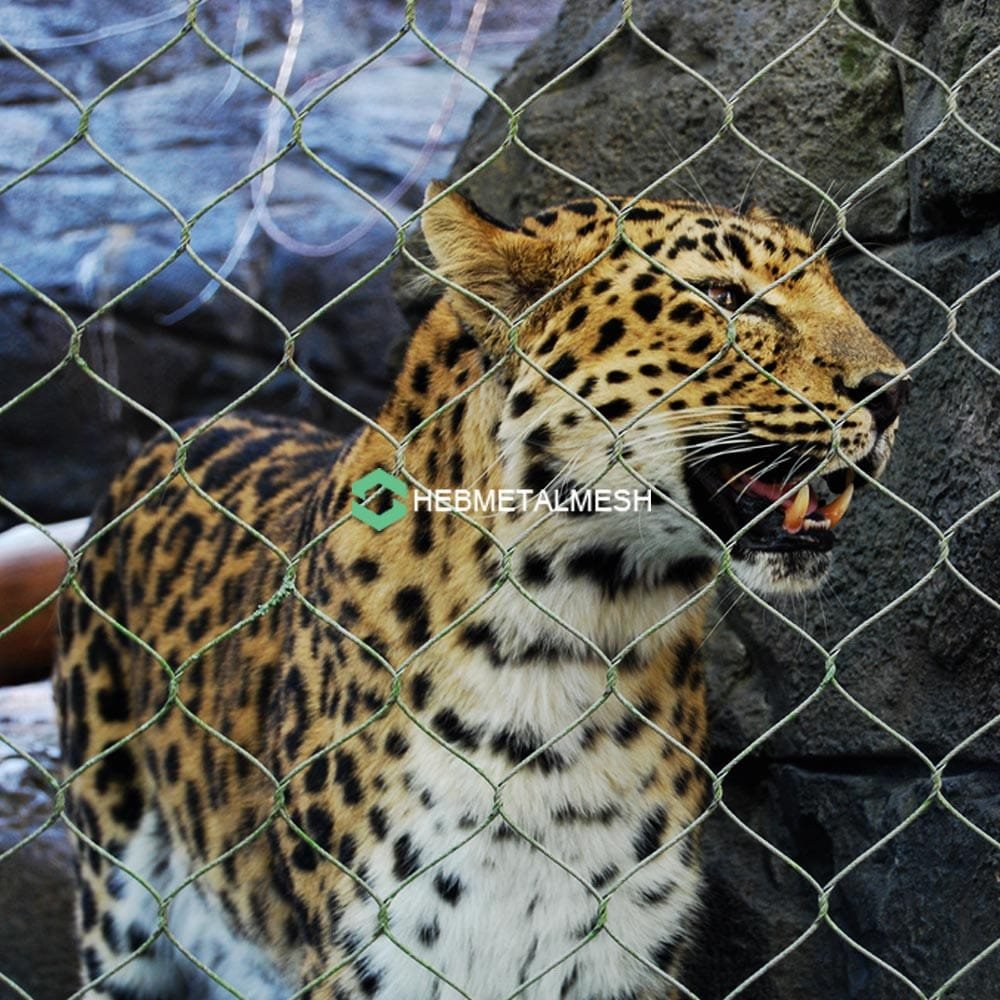
A wildlife net does not fail on the day it tears. It fails years earlier, in a ferrule nobody looked at, on a cut end that was never capped, at an anchor that worked loose in the second winter.
That is why the lifespan figures on a quotation tell you so little. Thirty years is a claim about a material in a laboratory, tested under conditions no enclosure reproduces. A net in a wildlife park lives in rain, sun, animal weight, and a maintenance budget that gets cut in a bad year.
The gap between those two numbers is what this guide is about. Not how long a good net can last, but what actually ends the average one, and how early the warning shows — often years before anything looks wrong.
Executive Summary
Five things set a wildlife netting lifespan: corrosion, abrasion, UV exposure, tension loss and impact damage. Material grade decides the ceiling, but installation and inspection decide whether a facility ever reaches it. The failure that takes a barrier out of service is rarely the mesh itself — it is a ferrule that slipped, an anchor that corroded, or a panel that sagged until an animal learned to work it. A well-specified stainless net in a temperate zoo runs fifteen to twenty-five years, with re-tensioning around year five and a condition survey every six months. Plan against the year the first repair becomes a recurring cost, not against the warranty figure. The two are rarely the same number, and the gap is where budgets go wrong.
Need a barrier that outlasts its fittings?
Send the enclosure type, the species, and the exposure. We return the alloy, cable diameter and anchor schedule that match the life you need, plus the inspection points to watch.
Quick Answer
A stainless steel wildlife net in a temperate zoo typically lasts fifteen to twenty-five years, not the thirty years often quoted. The mesh usually outlives its fittings, so ferrule and anchor condition set the practical lifespan. Inspect every six months and re-tension at around year five.
Key Takeaways
- The quoted thirty-year figure describes a material, not an installed net.
- Fittings fail before mesh does: ferrules, thimbles, anchors and tensioners.
- Corrosion starts at cut ends and welds, where the alloy’s protection is broken.
- A sagging panel is a tension problem, and animals find it before staff do.
- Re-tension around year five. Expect the first real repairs after year eight.
- Plan replacement from a condition survey, not from a calendar date.
Why a Quoted Lifespan Means Nothing on Its Own
A wildlife netting lifespan is not a property of the panel alone. A wire rope mesh panel is a material and a build. The material has a corrosion rate you can estimate. The build has an installation quality you cannot, until it has been through a few seasons.
Suppliers quote the material. Facilities live with the build.
Two panels of the same cable diameter and the same aperture size can differ by a decade in service. One panel went up in two passes onto a frame braced first. The other went up tight in one go onto a frame that was still moving. Nothing on the invoice records that difference, and it decides everything.
Our animal enclosure mesh range is specified by exposure and load rather than by a single headline life figure, because the figure is the output, not the input.
Five Failure Modes That Set the Real Number
Most wildlife netting failure modes fall into five groups. Knowing which one is working on your barrier tells you what to inspect and when.
- Corrosion. Starts at cut ends, welds and ferrule contact points, where the alloy’s passive layer is broken and cannot rebuild.
- Abrasion. Concentrated at anchors, where the panel moves against a fixing every time the structure flexes.
- UV exposure. Rope mesh UV degradation is slower than in synthetic netting, but stabilisers in coatings and accessories still age.
- Tension loss. Panels relax over years as fittings settle and frames move. A slack panel loads its neighbours.
- Impact damage. A single strike rarely ends a net. Repeated strikes at the same point do.
The first four are gradual and visible if you look. The fifth arrives without warning, which is why the inspection routine matters more than the specification.
Corrosion Begins at the Ferrule
Ferrule corrosion in zoo mesh is the most common cause of premature retirement, and it is almost always hidden. The ferrule is a pressed sleeve, and the wire inside it is in a crevice where moisture sits and oxygen is scarce.
That is the worst possible environment for stainless. A crevice keeps the surface from repassivating, so corrosion runs inside the fitting while the visible wire still looks clean.
Stainless steel netting corrosion life is therefore not one number. It is the life of the wire face, which is long, and the life of the terminations, which is shorter. A condemned panel usually still has serviceable mesh. The ends do not.
This is why ferrule mesh should be specified with the termination method named, not left to the installer. Swaged ends, thimbles and tensioners all behave differently in a wet enclosure.
Choosing the Grade for the Exposure
Stainless steel 304 covers most inland zoo buildings. It is the default for a reason: it handles rain, animal waste and wash-down without drama.
A stainless steel grade for coastal zoo sites needs a harder look. Salt spray defeats 304 at cut ends long before it marks the wire face, and a coastal facility that specifies 304 to save money usually replaces terminations first and panels second.
Wildlife net anchor corrosion follows the same logic. An anchor plate in a splash zone or a coastal yard is a crevice with a bolt through it. Specify the plate and the fixing in the same grade as the mesh, or accept that the steel around the net becomes the weak point. The cage mesh for zoos and wildlife parks range covers the grade and termination combinations that match each exposure class.
Abrasion and Tension Loss
Mesh abrasion at anchor points is mechanical, not chemical, and it shows up as a polished flat on the wire where it passes a fixing. Cold-drawn wire carries much of its strength in a work hardening skin, and abrasion wears that skin away. The wire loses section, then cracks.
The fix is not a heavier cable. It is a better detail: a thimble, a bush, or a slightly larger radius at the contact point. A heavier cable abrades just as fast if the detail is wrong.
Netting tension loss over time is the other slow failure. Panels relax as frames settle and as fittings seat under load. A panel that was correct at handover can be visibly slack by year four.
Slack is not cosmetic. A slack panel moves more, abrades faster at its anchors, and gives an animal something to test.
Diagnosing a Sagging Panel
Netting panel sag diagnosis starts with a measurement, not an opinion. Run a straight edge across the panel and measure the deepest point of the curve against the frame line.
- Under 2 inches on a 10 ft span: normal settlement, monitor at the next inspection.
- 2 to 4 inches: re-tension at the next scheduled window.
- Over 4 inches: re-tension now, and check the frame for movement before you do.
If a panel sags again within a year of re-tensioning, the problem is the frame, not the net. The maintaining zoo fences notes cover the structural checks that come before any re-tensioning work.
Reading Condition at Inspection
Bring a form and a torch. Most of what matters is inside the lower three feet of the panel, where splash, waste and animal contact concentrate.
| What you see | Likely cause | Action |
| Polished flat on wire at an anchor | Abrasion, wrong contact detail | Re-detail with a thimble or bush |
| Rust bleed at a ferrule | Crevice corrosion inside the fitting | Replace the termination, inspect neighbours |
| Slack panel with intact wire | Tension loss or frame movement | Measure sag, check frame, re-tension |
| Broken wire at a low point | Impact or animal working the mesh | Repair, then review the barrier detail |
| Discolored patch on the wire face | Surface contamination, not corrosion | Clean and re-inspect next cycle |
Aperture size belongs on the same form. Measure a diagonal at three points per panel, because a stretched opening is wider than the drawing says and an animal welfare problem before it is a maintenance one. Facilities working to accreditation standards keep those records on site, and the AZA accreditation process expects them to be current.
Patch, Repair, or Replace
Wildlife net repair vs replace is a judgement call, but it does not have to be a difficult one. Three questions settle most cases.
- Is the damaged area under 10 percent of the panel and away from a termination? Patch it.
- Is the damage at a ferrule or an anchor? Replace the termination, not the panel.
- Is the panel more than fifteen years old with corrosion at multiple ends? Replace the panel.
Zoo netting patch repair works as a permanent fix when the wire and the aperture match, and when you lace the patch rather than tie it. A tied patch creates hard points that abrade the surrounding mesh. A patch is only as good as the wire it is made from, and the animal fence mesh specification lists the grades a repair has to match.
What a Warranty Covers and What It Does Not
Enclosure netting warranty expectations deserve a reading before purchase, not after a failure. Most warranties cover the wire against manufacturing defect. Very few cover installation, frame movement, or corrosion at a termination.
That is not a trick. A manufacturer cannot warrant a detail they did not build. But it means the warranty is a weak proxy for lifespan, and a facility that plans around it will be surprised.
Ask two questions instead. What is excluded, and what evidence is required for a claim? A warranty that requires an unbroken inspection log is telling you something useful about how the product should be maintained.
Planning Replacement Before You Need It
Mesh life cycle cost zoo budgeting is usually done at replacement, when there is no room to move. Done at purchase, it changes what you buy. A wildlife net replacement schedule built from the inspection log gives capital planning a date it can work with, instead of a surprise.
The enclosure fencing cost factors that matter over twenty years are not the price per square foot. They are the number of re-tensions, the number of termination replacements, and whether the panel can be replaced without rebuilding the frame.
A slightly higher grade with better terminations often costs less over the life of the building, because the expensive events are the interventions, not the material. That is the same arithmetic a wildlife conservation budget runs on, and the same reason a premature failure costs more than the barrier did.
The Inspection Cadence
Zoo mesh inspection frequency should follow exposure, not the calendar alone. Twice a year suits most temperate facilities. Coastal, splash-zone and high-traffic panels need quarterly checks for the first two years.
Run the walk in the same order every time, and log what you find:
- Lower three feet of every panel, gloved hand along the wire.
- Every ferrule, looking for rust bleed and slippage marks.
- Every anchor plate, checking for elongated bolt holes.
- Sag measurement on each panel against the frame line.
- Aperture diagonal at three points per panel.
The stainless steel rope mesh for zoo fencing guidance sets out the material behavior behind those checks.
A wildlife netting lifespan is extended by what you find on those walks, not by what you bought. A barrier you inspect gets replaced on schedule. A barrier you do not gets replaced in an emergency, usually after an animal has already found the gap.
Get the lifecycle numbers before you order.
Send the enclosure type, species and exposure class. We will return the alloy, termination method and anchor schedule, plus the inspection points that fail first on that build.