
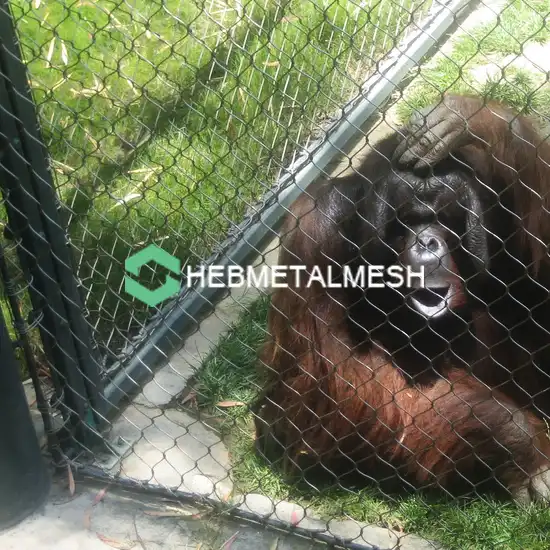
Why Gorillas Need Specialized Silverback-Strength Netting
Gorillas present the single most demanding containment challenge in modern zoological design. An adult male silverback can weigh 400+ pounds and possesses 10x the strength of a human — capable of bending, prying, and even shattering weaker metal alloys. Combined with exceptional intelligence, problem-solving skills, and manual dexterity, gorillas are the ultimate test of any enclosure system.
- Silverback Impact Force: A charging silverback generates thousands of pounds of kinetic energy. Our handwoven cable structure distributes impact load across the entire panel — not a single weld point — preventing catastrophic failure. The mesh flexes under impact and immediately rebounds, protecting both the barrier and the animal.
- Intelligence & Dexterity: Gorillas possess opposable thumbs and will actively test enclosure barriers — attempting to untwist, pry apart, or dismantle any accessible component. Our ferrule-secured, knotless weave eliminates exposed wire ends, grip points, and easily manipulated connections. The smooth surface prevents fingers from gaining purchase on the mesh.
- No Single Point of Failure: Welded mesh has hundreds of brittle weld points — each a potential failure point under concentrated gorilla force. Our handwoven ferrule construction creates a “no weak point” system where load is distributed across thousands of cable intersections. Even under extreme concentrated force, the barrier maintains its integrity.
- 20+ Year Corrosion Resistance: Gorilla habitats are exposed to acidic waste, cleaning agents, and extreme weather. Our SS304 stainless steel is inherently resistant to rust, pitting, and degradation — eliminating the costly 5-10 year replacement cycles of galvanized or coated alternatives.
Specifications of Handwoven netting in Gibbon fence & mesh
We accept customized rope diameter, material and mesh size. The wire rope is smooth, protecting the fur from being damaged.
We provide the regular specifications for your reference.
📋 Product Specifications Overview
Selecting the right mesh for your gorilla enclosure requires understanding the unique containment challenges these magnificent primates present. An adult male silverback can weigh 400+ pounds with 10x the strength of a human — capable of bending, prying, and shattering weaker metal alloys. Combined with exceptional intelligence, opposable thumbs, and manual dexterity, gorillas will actively test and dismantle any accessible barrier components. We strongly recommend a 2″ x 2″ aperture to prevent finger insertion and grip purchase, combined with a 1/8″ (3.2mm) wire diameter for maximum tensile strength. Our hand-woven ferrule-secured SS304/316 construction eliminates single points of failure, distributing load across thousands of cable intersections. Below are our standard stock specifications — custom sizes are always available to fit your exact enclosure design.
📋 Product Specifications Overview
| Item ID | Mesh Details | Material |
|---|---|---|
| HM2038 | 1.5″ × 1.5″ × 5/64″ | SS304 / 316 |
| HM2050 | 2″ × 2″ × 5/64″ | SS304 / 316 |
| HM2438 | 1.5″ × 1.5″ × 3/32″ | SS304 / 316 |
| HM2450 | 2″ × 2″ × 3/32″ | SS304 / 316 |
| HM2476 | 3″ × 3″ × 3/32″ | SS304 / 316 |
| HM2410 | 4″ × 4″ × 3/32″ | SS304 / 316 |
| HM3250 | 2″ × 2″ × 1/8″ | SS304 / 316 |
| HM3276 | 3″ × 3″ × 1/8″ | SS304 / 316 |
| HM3210 | 4″ × 4″ × 1/8″ | SS304 / 316 |
BestSeller: Gorilla Fence & Enclosure mesh |Heavy-Duty SS Netting | 2″ x 1/8″ | 30ft x 60ft Rolls
Build the ultimate containment solution with our premium Handwoven Stainless Steel Mesh, engineered specifically for gorilla enclosures, primate habitats, and high-security animal fencing. This commercial-grade 304 Stainless Steel netting offers superior durability, safety, and longevity for demanding zoo and wildlife park applications.
Product Specifications:
- Material: Premium Type 304 Stainless Steel – Excellent corrosion resistance & strength.
- Mesh Size: 2 inches x 2 inches (2″ x 2″) – Optimal for safety, visibility, and animal well-being.
- Wire Diameter / Thickness: 1/8 inch – Extremely robust and vandal-resistant.
- Roll Dimensions: 30 feet wide x 60 feet long – Large panels for efficient installation.
- Standard Colors: Nature (silvery metallic) or Black Oxide finish for reduced glare and aesthetic blending.
- Price: $6,050.00 per roll – Invest in permanent, low-maintenance security.
Why Choose Our Stainless Steel Enclosure Mesh?
1. Maximum Security & Animal Safety:
Our 1/8″ thick stainless steel wire is handwoven into a rigid, non-flexing grid that withstands immense force. The 2″ x 2″ mesh pattern prevents finger and toe entanglement, ensuring the highest standard of animal safety for gorillas, large primates, and other powerful animals.
2. Built for a Lifetime:
304 Stainless Steel is inherently resistant to rust, corrosion, and weathering. It outperforms and outlasts galvanized or powder-coated steels, providing a permanent fencing solution with near-zero maintenance, even in harsh outdoor environments.
3. Perfect for Professional Applications:
- Zoo Exhibits & Primate Enclosures
- Wildlife Sanctuary Perimeter Fencing
- Aviary Roofing & Sidewalls
- Heavy-Duty Animal Barriers & Dividers
- High-Security Perimeter Mesh
4. Customization & Support:
Need a specific size? Custom rolls and panels are available. Our team at HEBNETALMESH can work with your project specifications to deliver the exact fencing solution you require.
Order Your Professional Enclosure Solution Today!
Don’t compromise on safety or durability. This 30ft x 60ft stainless steel mesh roll is the industry choice for a reason. Its strength, safety-focused design, and corrosion-resistant properties make it the intelligent, long-term investment for any serious animal care facility or security project.
Visit our product page to learn more, discuss customization, or place your order:
https://hebmetalmesh.com/store/30-x-60-rolls-handwoven-stainless-steel-mesh-2-x-2-holes-nature-or-black-oxide-fence-with-mesh/
HEBNETALMESH – Engineering Confidence in Every Mesh.
Understanding Gorilla Fence Requirements: Safety, Welfare & Durability
Designing a containment system for Gorilla gorilla or Gorilla beringei requires understanding the three critical pressures that define gorilla enclosure design:
1. Immense Physical Strength
A healthy adult gorilla can exert forces capable of bending, prying, and shattering weaker metal alloys. Gorilla strength necessitates a barrier with exceptional tensile strength and superior impact resistance. Our 1/8″ (3.2mm) wire diameter provides the industrial-grade strength required, while the handwoven structure distributes impact load across the entire panel.
2. Intelligence and Dexterity
Gorillas are highly intelligent primates exhibiting complex tool-use and problem-solving skills. They possess powerful hands and opposable thumbs, allowing remarkable dexterity. Our 2″ x 2″ aperture is specifically sized to prevent finger insertion — eliminating the grip points gorillas would otherwise exploit to pull, twist, or dismantle the barrier.
3. Environmental Factors
Zoo enclosures are exposed to a relentless cycle of environmental stressors: moisture, temperature fluctuations, UV radiation, and corrosive elements from animal waste and cleaning agents. Our SS304 stainless steel demonstrates uncompromising resistance to corrosion, ensuring a 50+ year service life without degradation.
4. Animal Welfare
Modern zoo standards prioritize naturalistic, enriching environments. A gorilla barrier must not feel like a cage. Our Black Oxide finish virtually eliminates glare, creating an “invisible” barrier that provides unobstructed views while maintaining maximum security — enhancing both visitor experience and gorilla welfare.

The Industry Standard: Handwoven Stainless Steel Cable Mesh
The consensus among leading zoo designers and architects globally has settled on a single superior material: handwoven stainless steel cable mesh. This material represents a paradigm shift in wildlife enclosure design, providing an engineered barrier that meets all safety protocols while simultaneously maximizing aesthetic naturalism and animal welfare.
What is Handwoven Stainless Steel Zoo Mesh?
Handwoven stainless steel mesh, often referred to as ferrule-type or cable-type netting, is a highly specialized architectural material. The process begins with sourcing high-tensile, corrosion-resistant stainless steel cables (typically SS304 or SS316). These cables are then meticulously woven together by skilled craftsmen in a distinct diamond or square pattern.
Crucially, at every cross-junction where two cables meet, a seamless, high-strength ferrule (a metal collar) is hydraulically pressed onto the cables. This handwoven, ferrule-secured construction is what differentiates it from inferior welded or knotted products. The finished product is a highly flexible, three-dimensional netting system—an elegant, resilient skin that can be tensioned across massive structural openings, creating the definitive gorilla enclosure mesh.
Key Benefits for Gorilla Enclosures
The inherent properties of this woven cable structure make it uniquely suited to the containment challenges presented by great apes.
Unmatched Strength & Security
The handwoven structure creates a “no weak point” system. When a gorilla impacts the mesh, the load is not borne by a single weld or anchor; instead, the entire panel—the cables and the thousands of ferrules—acts as one massive, shock-absorbing fabric. This distributed load capacity means the fence maintains its integrity under extreme, concentrated force. The tensile strength of a properly tensioned gorilla fence exceeds that of virtually any rigid system.
Superior Flexibility & Impact Absorption
Unlike rigid steel bars or brittle welded wire, the stainless steel cable mesh exhibits extraordinary elasticity. This flexibility allows the mesh to “give” under impact, acting as a massive, industrial-strength hammock. This impact absorption is twofold: it prevents catastrophic failure of the containment system by dissipating kinetic energy, and it protects the gorilla from injury by cushioning the impact, making it ideal primate enclosure netting.
Excellent Visibility
The thin-diameter cables and open mesh aperture create a barrier that is visually unobtrusive. When correctly installed and tensioned, the material is nearly invisible from a short distance, especially when viewed through a camera lens. This superior visibility enhances the naturalistic aesthetic of the gorilla habitat fencing, improving the visitor experience and providing a clearer, more stimulating environment for the gorillas themselves.
Total Weather & Corrosion Resistance
Utilizing only high-grade Stainless Steel 304 (SS304) ensures the stainless steel zoo mesh is inherently resistant to rust, pitting, and general environmental degradation. This material choice guarantees a maintenance-free, multi-decade service life, standing up to cleaning agents, acidic animal waste, heavy rain, snow, and intense UV exposure without compromising its structural integrity.
Safety for Animals
The smooth, polished surface of the stainless steel cables, combined with the lack of sharp edges or rigid projections, makes this material the safest option for large, powerful animals. The woven structure prevents any part of the gorilla from getting snagged, scraped, or trapped, contributing significantly to optimal animal welfare standards.
Choosing the Right Gorilla Fence Specifications
Selecting the correct technical specifications is paramount to ensuring both long-term security and optimal cost-efficiency for your gorilla fence project. The choices regarding mesh aperture, cable diameter, and material grade must be carefully calibrated to the specific occupants and structural design.
Mesh Size Analysis: 2″ x 2″ vs. 3″ x 3″
The mesh aperture is the most critical factor in gorilla enclosure design:
2″ x 2″ Mesh — The Premium Security Choice
For institutions housing adult male silverbacks or highly manipulative gorillas, the 2″ x 2″ gorilla enclosure mesh prevents fingers from gaining purchase on the cables. The smaller opening physically restricts finger insertion, making manipulation of the net virtually impossible. This is the ideal choice for high-tension areas where the utmost level of security is non-negotiable.
3″ x 3″ Mesh — The Balanced Solution
The 3″ x 3″ aperture offers a highly popular, balanced, and cost-effective solution. This size provides sufficient structural integrity for larger gorilla habitat fencing structures while maximizing light and visitor visibility. For larger enclosures where the primary goal is a strong perimeter fence, the 3″ x 3″ mesh often provides the perfect balance of security, visibility, and value.
Cable Diameter: Why 1/8″ (3.2mm) is Standard
The cable diameter is the main determinant of the net’s ultimate tensile strength. For heavy-duty applications like a gorilla fence, Hebmetalmesh recommends cable diameters 1/8″ (3.2mm).
This range strikes the optimal balance required: it provides industrial-grade strength and resistance to shear forces and impact, yet retains the necessary flexibility to allow for efficient installation and superior shock absorption. While thicker cables offer more ultimate strength, they become significantly heavier, less flexible, and more visually intrusive, which detracts from the naturalistic habitat goal. The 1/8″ (3.2mm) standard is proven in the field to withstand the incredible power of great apes while maintaining visual elegance.
Material: SS304 vs. Other Grades
Material composition is crucial for long-term viability. Stainless Steel Grade 304 (SS304) is the industry standard for primate enclosure netting.
SS304 is a chromium-nickel alloy that offers excellent corrosion resistance, high tensile strength, and good forming properties, making it perfect for the handweaving process. It is suitable for 99% of all inland zoo environments.
For projects located in extreme coastal or highly polluted industrial areas where salt spray or highly corrosive chemicals are a factor, Stainless Steel Grade 316 (SS316) may be briefly considered. SS316 incorporates molybdenum, providing an enhanced level of resistance to chloride corrosion (pitting). However, due to its higher cost and the fact that SS304 provides more than adequate protection in most global locations, SS304 remains the highly recommended, cost-effective, and robust choice for any professional gorilla enclosure mesh.
Color Options: Natural vs. Black Oxide
The finished aesthetic of the stainless steel zoo mesh plays a major role in achieving the desired “barrier-less” look.
Natural Stainless
The Natural finish maintains the bright, polished look of stainless steel. When properly tensioned, this finish reflects the ambient light and often blends with the sky or bright backgrounds. This finish maximizes the invisibility effect and is highly durable.
Black Oxide
The Black Oxide finish involves a specialized chemical treatment that darkens the stainless steel. This non-reflective, matte-black surface is designed to completely disappear against dark backgrounds, shadow, or foliage within the enclosure. The result is a profoundly immersive visual experience for the visitor, creating the perception of a completely open habitat, which is often the preferred choice for modern, award-winning zoo designs. This process maintains the full tensile strength of the cable without adding any coating that could chip or peel.
Hebmetalmesh Gorilla Fence Panels: Custom-Built for Your Project
At Hebmetalmesh, we understand that a gorilla fence is not a stock commodity; it is a custom-engineered structural fabric integral to a multi-million-dollar habitat. Our manufacturing process, overseen by Shijiazhuang Netting Trading Co., Ltd., is specifically optimized to produce the large, high-quality panels required for professional zoological projects.
Our Standard Large Panels: 30′ x 60′
One of our key competitive advantages is the ability to fabricate ultra-large panels, routinely reaching sizes up to 30′ x 60′ (approximately 9m x 18m). The benefit of these standard large panels is substantial. By providing massive, custom-fabricated sections, we drastically reduce the number of field seams and connections required on site.
Fewer seams mean:
- Enhanced Security: Every connection point is a potential (though minimal) weakness. Minimizing these points increases the overall, long-term integrity of the primate enclosure netting.
- Faster Installation: Large panels are quicker to hoist, tension, and secure than numerous smaller sections, leading to significant savings in labor and project timeline.
- Superior Aesthetics: A seamless, single-panel run of mesh creates a cleaner, more visually impactful barrier, further enhancing the “invisible” effect of the gorilla enclosure mesh.
The Power of Customization
Recognizing that gorilla habitat fencing projects are inherently unique, we specialize in total customization. We thrive on complex architectural demands. Every order is cut, woven, and finished to exact specifications. Whether your design calls for complex, three-dimensional shapes, tapered sections to fit curved architectural elements, or cut-outs to accommodate trees, rocks, or other habitat features, our factory can handle it.
We offer full collaboration with your engineering and design teams. Our specialists can advise on optimal mesh direction, panel segmentation, and provide custom attachment hardware, including specialized tensioning cables, edge ropes, and mounting plates, all made from corresponding high-grade stainless steel. We do not simply sell mesh; we provide a custom-engineered gorilla fence system, manufactured precisely to fit your unique vision.

Case Study: Installing a Gorilla Fence System
While the installation process varies based on structural design, the deployment of a Hebmetalmesh stainless steel zoo mesh system follows a predictable, high-precision methodology designed to ensure optimal tension, security, and aesthetics.
Step 1: Planning & Design Consultation
The process begins long before manufacturing. Our engineers work with your architects to review the enclosure drawings. This phase includes:
- Load Calculation: Determining the tension and load requirements for the structural support system (e.g., steel posts, overhead cables).
- Panel Mapping: Optimizing the size and shape of each gorilla fence panel to minimize seams, maximize material use, and simplify on-site installation logistics.
- Hardware Specification: Defining custom or standard tensioning hardware and fittings, ensuring all components are compatible and rated for the required load.
Step 2: Panel Fabrication & Quality Control
In our ISO-certified facility, the SS304 cables are cut and handwoven. The ferrules are hydraulically pressed, a process subject to rigorous quality control checks for consistency and integrity at every junction. Each custom panel of primate enclosure netting is tagged, cataloged, and inspected to ensure it perfectly matches the approved shop drawings and meets our uncompromising standards for material quality and weave consistency.
Step 3: On-Site Preparation & Anchor Point Installation
The structural framework is prepared on site. This involves installing and certifying the perimeter posts, support cables, and anchor points. These anchor points must be rated to handle the significant, sustained tension required to properly secure the mesh. Correct anchor installation is crucial to the final security of the gorilla enclosure mesh.
Step 4: Panel Hoisting & Tensioning
Panels are delivered, hoisted into position, and temporarily secured. The most critical phase is tensioning. Using specialized stainless steel perimeter cables and tensioners, the gorilla fence is systematically pulled taut along all axes. This tensioning process is what activates the net’s full load-sharing capacity, transforming the flexible mesh into a strong, resilient, and visually smooth barrier. Precision tensioning eliminates any sag or waviness, which is vital for both security and aesthetics.
Step 5: Final Inspection and Habitat Finishing
Once tensioning is complete, the entire barrier is subjected to a final security and visual inspection. The perimeter cables and attachment hardware are locked down. After final approval, the remainder of the habitat (foliage, rockwork, and animal features) can be installed, often right up against the mesh, creating the fully immersive and highly secured gorilla cage fence environment.

Hebmetalmesh: Your Trusted Partner in Wildlife Conservation
Shijiazhuang Netting Trading Co., Ltd., through our globally recognized brand Hebmetalmesh, is not merely a supplier; we are a dedicated manufacturing partner committed to supporting the critical missions of wildlife parks and zoological institutions worldwide. Our expertise lies exclusively in stainless steel woven cable applications, ensuring unparalleled focus and technical knowledge in the realm of specialized stainless steel zoo mesh.
We pride ourselves on our technical authority, dedication to quality, and ability to deliver custom, large-scale gorilla fence systems on time and within budget. When you choose Hebmetalmesh, you gain access to decades of engineering experience applied directly to the unique challenges of great ape containment.
Hebmetalmesh Key Differentiators — Why the World’s Leading Zoos Trust Us
| Differentiator | Description |
|---|---|
| Factory Direct Pricing | As the direct manufacturer, we eliminate intermediary costs, ensuring optimal value for the highest quality product. No markups — just factory-direct pricing for professional-grade gorilla enclosure mesh. |
| Over 20 Years of Experience | Deep, specialized expertise in high-tensile woven mesh applications for zoological and architectural projects globally. Our team has engineered gorilla habitat fencing for zoos across 40+ countries. |
| ISO Certified Quality | Our manufacturing processes adhere to stringent international quality management standards (ISO 9001), ensuring product reliability, consistency, and traceability from raw material to finished gorilla cage mesh panel. |
| Project Support from Design to Delivery | Comprehensive technical consultation, load calculation, custom drawing support, and logistics management for complex projects. We partner with your engineering team to deliver a turnkey gorilla fence system that meets every specification. |
FAQs: Gorilla Enclosure Netting Questions Answered
Q1: Why is 2″ x 2″ mesh recommended for gorilla enclosures?
A: Gorillas have opposable thumbs and extraordinary manual dexterity. A 3″ or 4″ aperture would allow fingers to penetrate and gain leverage to pull, twist, or pry the mesh. The 2″ x 2″ aperture is specifically sized to prevent finger insertion — eliminating the grip points gorillas would otherwise exploit. This is the #1 safety distinction between gorilla fencing and other primate fencing.
Q2: What makes stainless steel mesh stronger than welded wire for gorillas?
A: Welded wire has hundreds of brittle weld points — each a potential failure point under concentrated gorilla force. Our handwoven ferrule construction eliminates single points of failure. When a gorilla impacts the mesh, the load is distributed across thousands of cable intersections, not a single weld. This “no weak point” system maintains integrity even under extreme concentrated force.
Q3: Can gorillas damage stainless steel mesh?
A: Our 1/8″ (3.2mm) stainless steel wire has a tensile strength exceeding 650 MPa. While gorillas will repeatedly test the barrier, the work-hardened surface resists bending and deformation. The handwoven cable structure absorbs impact energy, flexing on contact and immediately rebounding — preventing the permanent damage that occurs with rigid welded panels.
Q4: What is the lifespan of stainless steel gorilla mesh?
A: When properly installed and tensioned, our SS304 stainless steel mesh has an expected service life exceeding 50 years. The corrosion resistance of the material means structural degradation is negligible over multiple decades — a one-time investment that eliminates recurring replacement costs.
Q5: What is the Black Oxide finish and why is it recommended for gorilla habitats?
A: Black Oxide is a thermally bonded coating that provides a non-reflective matte finish. It virtually eliminates glare, making the barrier disappear against natural backgrounds — creating an immersive, “barrier-less” viewing experience that enhances both visitor experience and gorilla welfare. This is the preferred choice for award-winning modern zoo designs.
Build a Safer, More Beautiful Gorilla Habitat
The safety of your staff, the public, and, most importantly, the welfare of the gorillas in your care hinge upon the integrity of your containment system. Settling for conventional or under-engineered fencing is a risk no professional facility should take. The design of modern gorilla habitat fencing demands a material that is technically superior, aesthetically transparent, and proven durable in the face of immense power.
Hebmetalmesh’s handwoven stainless steel cable mesh is the safe, durable, and aesthetically superior choice. By eliminating single points of failure, offering unparalleled impact absorption, and providing decades of corrosion-free performance, our gorilla fence system allows architects and planners to focus on creating enriching, naturalistic habitats without compromising security.
Take the next step toward engineering the ultimate gorilla enclosure. Contact our technical sales team for a project-specific consultation, request a detailed quote, or download our comprehensive stainless steel zoo mesh specification sheet to review technical data, load ratings, and customization options. Partner with the industry leader in high-security, high-visibility primate containment.
Various solutions for kinds of gibbon fence system
The following are the common protection schemes and specifications for different kinds of gorilla and gibbon cage protection.
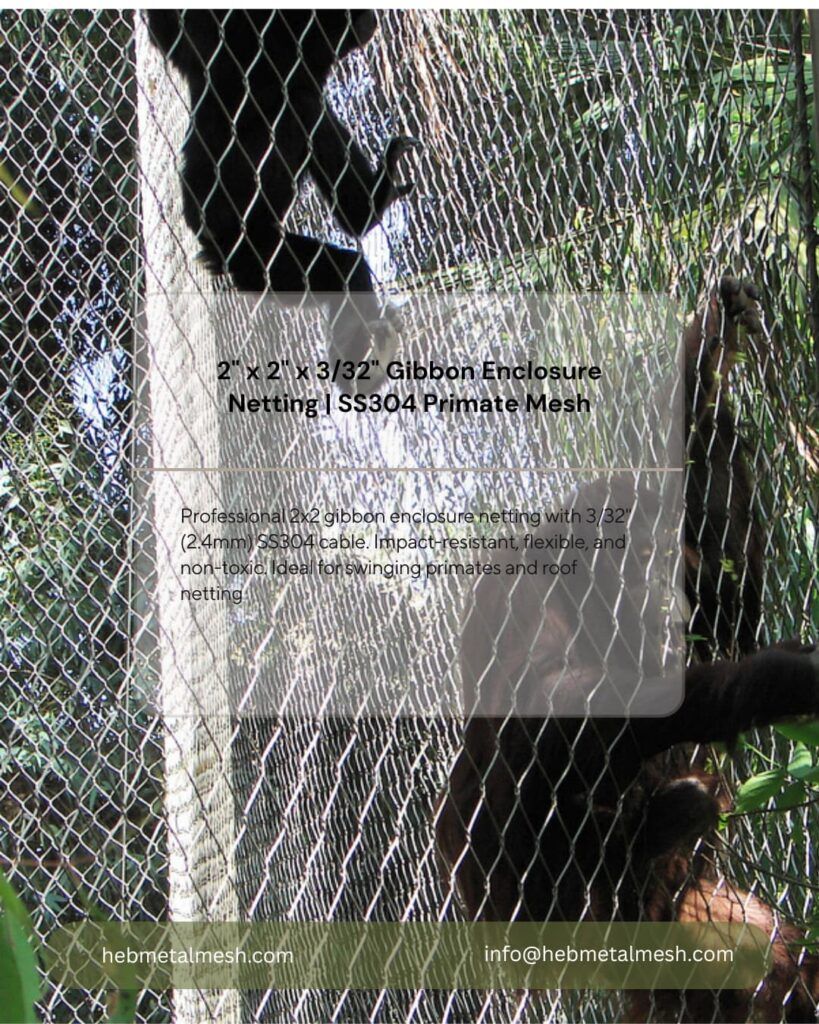
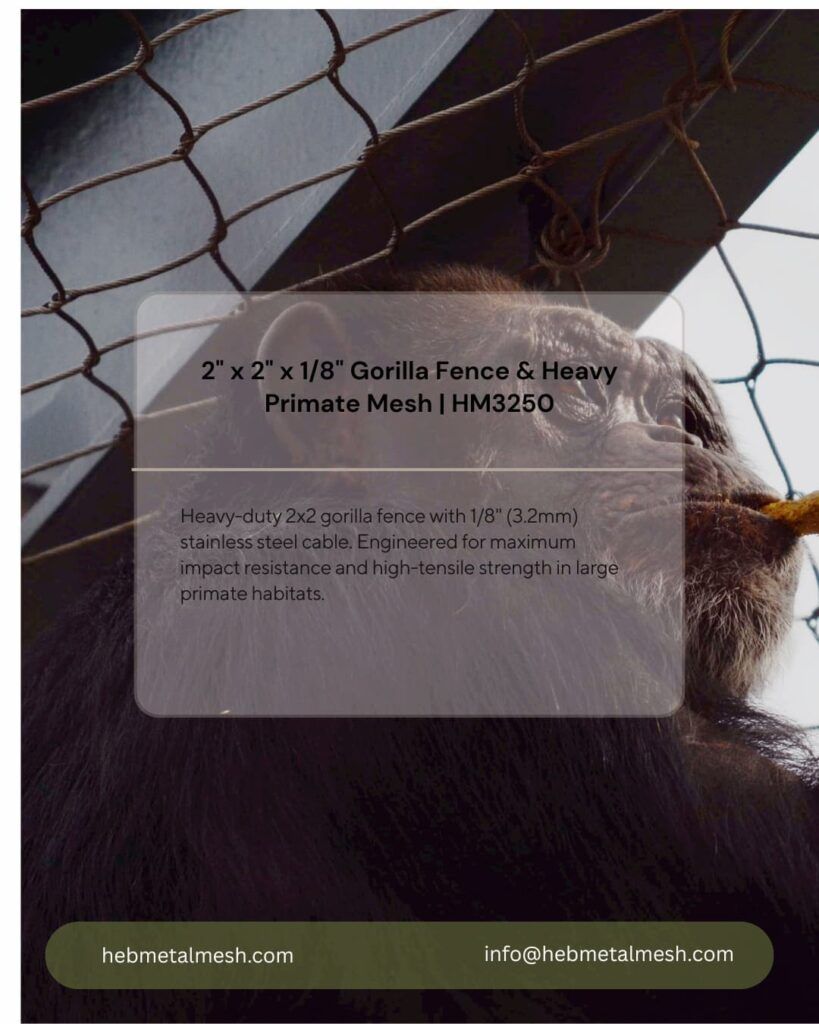
In general, the size of the gorilla determines the size of the mesh aperture. The degree of the gorilla’s damage determines the wire rope diameter, and the specific specification needs to be selected according to the actual gorilla cage exhibit.
In addition, we also have the following stainless steel rope mesh product specifications suitable for application for gorilla enclosure fence protection.
Explore our complete range of primate and big cat enclosure netting solutions: Animal enclosue mesh, Monkey Enclosure Mesh · Lion Enclosure Mesh · Tiger Cage Netting