
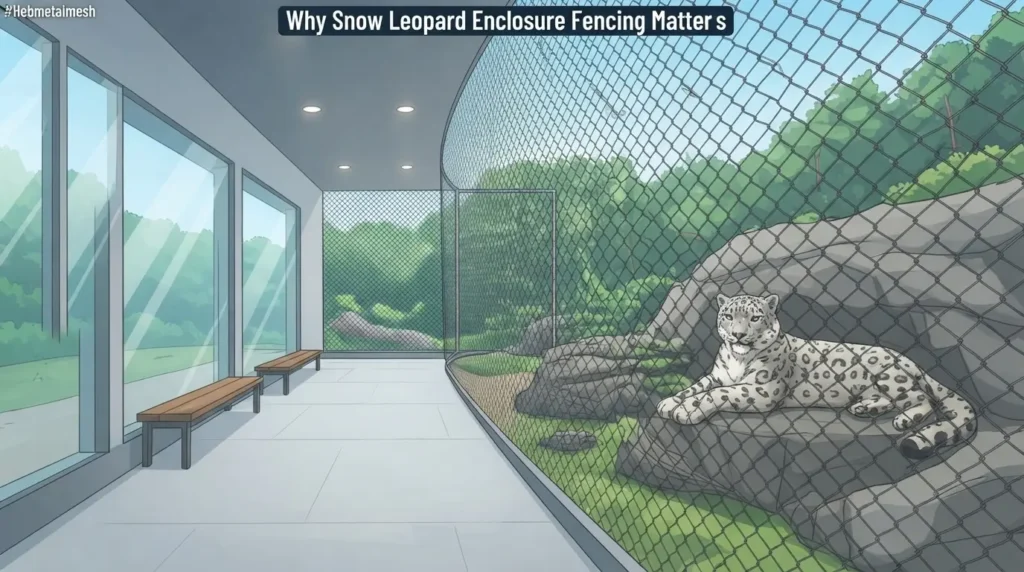
Most snow leopard exhibit budgets get built backwards. Someone pins a number on the mesh, adds rockwork and a holding building, then watches the total land 40 percent over at tender. The barrier was never the problem. The assumption behind it was.
Wire rope mesh for a big cat does not carry one price. The same hundred square meters can cost three times more or three times less depending on cable diameter, aperture, alloy, edge treatment and how the panels ship. A buyer who prices “stainless mesh” as a single line item hands the supplier every decision that sets the price.
This snow leopard exhibit cost breakdown works from the numbers outward. It splits the budget into the lines that carry real money, shows what actually drives the mesh figure, and flags the costs that surface two winters after opening. No supplier catalog does this, because the catalog wants you to buy the row.
Executive Summary
The barrier package usually eats 12 to 20 percent of a snow leopard exhibit budget, and the mesh inside that package runs 20 to 35 percent of the barrier line.
Material price swings far more than most buyers expect. A 2 inch aperture in 1/8 inch cable costs roughly 2.5 times a light 3/64 inch panel. The 316 alloy adds another 15 to 30 percent over 304.
Installation labor, freight and edge detailing together often match the mesh material cost. Budget 2.2 to 3 times the free-on-board mesh price to reach an installed figure, then add a separate lifecycle allowance for re-tensioning and inspection. Teams that price the whole barrier as one number almost always underfund the frame and overpay for the mesh.
Need a barrier number you can defend in a budget meeting?
Send the exhibit footprint, barrier height and species brief. We return a line-by-line mesh and framing estimate with aperture, cable diameter, alloy, edge cable and delivered cost, usually inside one working day.
Quick Answer
A snow leopard exhibit barrier typically costs 2.2 to 3 times the mesh material price once framing, edge cable, hardware and installation are included. Mesh material for big-cat grade panels runs about $25 to $70 per square meter, and cable diameter moves that figure more than aperture does.
Key Takeaways
- The barrier package is 12 to 20 percent of exhibit budget, but it drives the schedule.
- Cable diameter changes mesh price faster than aperture size does.
- Installed cost runs 2.2 to 3 times the free-on-board mesh quote.
- Freight on handwoven panels is billed by volume, not weight, and surprises first-time buyers.
- 316 stainless pays back in coastal and humid sites, not everywhere.
- Lifecycle cost, not purchase price, separates a cheap barrier from an expensive one.
What a Snow Leopard Exhibit Budget Actually Covers
Snow leopards climb, jump and work edges, and that habit sets the shape of every line in the budget. A barrier that holds them needs height, a roof or an overhang, and panels tensioned hard enough that a paw cannot find slack. Teams that design from behavior first, the way a natural snow leopard enclosure gets planned, usually settle layout and cost in the same pass.
The table below shows where a mid-size project’s zoo exhibit barrier budget actually lands, and the leopard enclosure fence netting line is smaller than most teams guess. Treat the shares as planning ranges, because rockwork scope swings them hard.
| Cost line | Typical share | What moves it |
|---|---|---|
| Rockwork and climbing structures | 25 – 40% | Cast concrete versus shotcrete, ledge count, height |
| Holding and off-exhibit building | 15 – 25% | Shift doors, quarantine bay, climate control |
| Barrier mesh and framing | 12 – 20% | Cable diameter, aperture, panel count, post grid |
| Design fees, permitting, contingency | 10 – 15% | Geotech, structural review, wildlife authority sign-off |
| Life support, drainage, snow handling | 5 – 10% | Pool, misting, roof drainage, drift control |
| Interpretation, AV, signage | 5 – 8% | Screen count, graphic production, interactives |
Notice the ranking. The mesh is not the expensive part, yet it decides when the exhibit opens. Late barrier decisions delay rockwork anchor setting, and snow leopard exhibit construction cost climbs fastest during exactly that gap.
Where the barrier money actually goes
Inside that 12 to 20 percent, the split is stubbornly consistent across projects. Handwoven mesh material lands at 20 to 35 percent, posts and structural framing at 25 to 35 percent, installation labor at 25 to 35 percent, and foundations plus hardware take the rest. The panels carry the smallest share and the longest lead time.
Value engineering a zoo exhibit starts here, not at the mesh. The biggest single lever on the barrier line is the post grid. A wider post spacing cuts steel and foundations, but it raises panel tension and cable diameter, so the saving moves rather than disappears.
One line should stay off the value-engineering table. The snow leopard carries a vulnerable listing on the IUCN Red List, and a barrier failure at a breeding institution costs far more than the steel it saved.
What Drives the Mesh Line
Two buyers can request the same wall area and receive quotes that differ by a factor of three. Both quotes are honest, because the big cat mesh price factors behind them describe different products. No snow leopard exhibit cost breakdown survives a comparison that ignores that.
| Aperture | Cable diameter | Cost index | Where it fits |
|---|---|---|---|
| 2 in (50 mm) | 3/64 in (1.2 mm) | 1.0 | Small birds only, never a big cat |
| 2 in (50 mm) | 1/8 in (3.2 mm) | 2.6 | Side walls at public viewing height |
| 3 in (76 mm) | 1/8 in (3.2 mm) | 2.1 | Large panels, fewer ferrules, better sightlines |
| 3 in (76 mm) | 5/32 in (4.0 mm) | 3.2 | Climb zones, roof spans, keeper doors |
| 4 in (100 mm) | 5/32 in (4.0 mm) | 2.8 | High roof netting, off-exhibit yards |
The index uses light 2 inch mesh as its base of 1.0. Read it as relative cost per square meter of zoo netting, not a price list.
Why two quotes differ by 300 percent
Five variables do most of the damage:
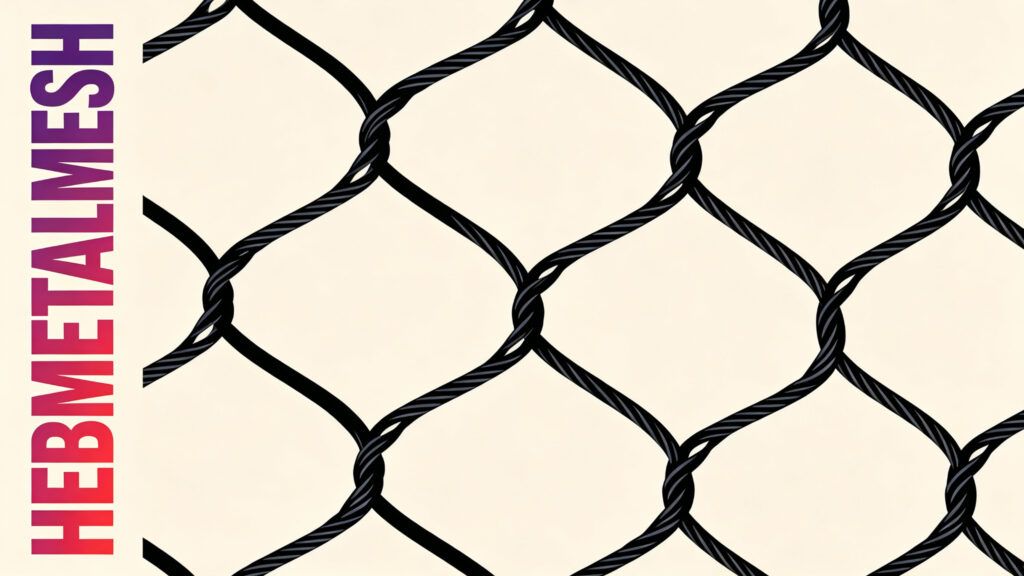
- Cable diameter. Doubling diameter roughly quadruples steel per meter of rope, and it changes the ferrule size with it.
- Aperture size. A tighter aperture packs more rope into the same area, so 2 inch mesh uses more material than 3 inch mesh at equal cable.
- Alloy. 316 stainless resists chlorides and salt air. 304 stainless handles inland sites at a lower price.
- Edge treatment. Swaged ferrules on every boundary edge, plus a perimeter edge cable, add labor the mesh-only price never shows.
- Panel versus roll. Custom panels arrive ready to hang and cost more per square meter. Rolls cost less but demand field tensioning skill.
If a quote lists only aperture, cable and price, it is not a comparable quote yet. The impact-resistant fencing specification for snow leopard walls covers the four numbers that make two quotes comparable.
Frame, edge cable and the parts nobody prices
Posts, top rail, corner bracing and the perimeter edge cable carry the load that a tensioned panel transfers. Under-specify them and the panel sags between supports, which reads as a mesh fault and gets charged back to the mesh supplier.
Budget the frame at roughly the same order as the mesh, sometimes more when spans are long or when the design hangs mesh from a curved beam. This is the line that most often gets trimmed first and rebuilt last. Lock the leopard enclosure netting specification before anyone welds the post grid.
Installation Labor and Site Access
Zoo mesh installation labor cost tracks access, not area. A flat 200 square meter wall beside a service road installs faster than 80 square meters wrapped around artificial rock.
What drives the labor figure:
- Working height and whether a lift can reach the fixing line
- Rockwork sequencing, since mesh hung before rockwork gets damaged by it
- Number of discrete panels and corner returns
- Tensioning method, hand tensioner versus calibrated rig
- Public protection, barriers and night-shift restrictions
Sequence rockwork first, mesh second, and keep a 1.5 meter working margin along the fixing line. That single decision usually saves more than any negotiation on mesh price.
Freight, Duty and the Landed Cost Trap
Handwoven panels ship as volume, not mass, so mesh freight cost per container rarely tracks the invoice value. A crate of 1/8 inch mesh weighs little for its size, and ocean freight prices against cubic meters. Buyers who budget from weight consistently come up short.
Then duty lands on the declared value, which includes the mesh, the ferrules, the edge cable and the crating. On a coastal or cross-border project, rope mesh freight and import duty can add 8 to 15 percent to the delivered figure.
Ask for a delivered stainless steel mesh quote with the Incoterm named. Free-on-board numbers look better and cost more by the time the container clears.
Lifecycle Cost: The Number Most Budgets Miss
A snow leopard exhibit lifecycle cost runs well past the handover date. Handwoven stainless mesh holds up for decades, but zoo mesh maintenance cost never falls to zero. Two allowances belong in the budget from day one:
- Inspection. Twice a year, looking for broken wires, slipped ferrules and slack at anchor points.
- Re-tensioning. Once in the first two years as panels settle, then rarely.
Grade choice drives this line. 316 stainless costs more up front and cuts corrosion risk in humid or coastal air, where chlorides attack 304 at weld and ferrule points. Inland dry sites rarely justify the premium.
A barrier failure at a breeding institution is a conservation and reputational event, not a maintenance ticket. Price the inspection program into the project from the start.
Five Ways to Cut Cost Without Cutting Safety
Value engineering a zoo exhibit works when it targets waste instead of strength.
- Standardize panel sizes. One repeated panel size cuts fabrication setup, crating volume and site errors.
- Drop to 3 inch aperture on tall walls. Sightlines improve and material per square meter falls, while 1/8 inch cable keeps breaking strength where it belongs.
- Buy rolls for simple rectangles. Field tensioning suits straight runs, so reserve custom panels for curves and corners.
- Reuse sound posts on upgrades. A chain link to rope mesh upgrade cost drops sharply when existing steel passes a load check.
- Hold 304 where the site allows it. Spend the 316 premium only on coastal, humid or wash-down zones.
Run each option past the structural engineer before it enters the budget. A saving that adds a midspan post often nets to zero.
For a like-for-like read on what your quote should contain, this guide to how zoo netting pricing is built walks through the same cost lines from the supplier side.
Where Snow Leopard Exhibit Budgets Usually Overrun
A snow leopard exhibit cost overrun almost always traces back to one of five places:
- Roof area underestimated. Big cats need overhead containment, and roof area often exceeds wall area.
- Rockwork clashing with anchor lines. Fixing points land inside sculpted rock, and the fix costs steel and labor.
- Keeper door and shift gate left out. These are fabricated items with their own lead time.
- Snow load ignored. Roof mesh and posts sized for summer loads fail inspection after one heavy winter.
- Contingency spent on scope creep. Interpretation upgrades quietly eat the barrier reserve.
Most of these trace back to a barrier scope drawn after the budget was set. Draw the barrier first, price it second, and let rockwork follow the fixing grid.
If you want the wider picture on how each line behaves across projects, the cost factors behind zoo enclosure fencing are worth reading before you fix a number.
FAQ
Big-cat grade mesh typically runs $25 to $70 per square meter in material, before freight and installation. Cable diameter and alloy set the position inside that range, and aperture shifts it further.
Three inch aperture is cheaper per square meter at the same cable diameter, because it uses less rope. It also gives cleaner sightlines. Keep 2 inch mesh where a paw or a cub could reach a gap.
Often yes, if the posts pass a load check against the new panel tension and wind load. Reusing sound steel is the fastest way to cut a chain link to rope mesh upgrade cost.
In coastal, humid or heavy wash-down sites, yes. Inland dry climates rarely show a payback, and 304 performs well there for decades.
At design freeze, before posts are fabricated. Changes after framing is welded cost both the panel and the steel, and they reset the delivery clock.
Allow 6 to 10 weeks for custom panels plus 3 to 5 weeks of ocean freight on most routes. Standard rolls ship faster, so confirm the mesh delivery lead time against your rockwork schedule.
Ready to turn a rough budget into a real number?
Send the wall and roof areas, barrier height and site location. We return a full snow leopard exhibit cost breakdown covering mesh, framing, edge cable, hardware and delivered freight, with the alloy recommendation spelled out.