
Executive Summary
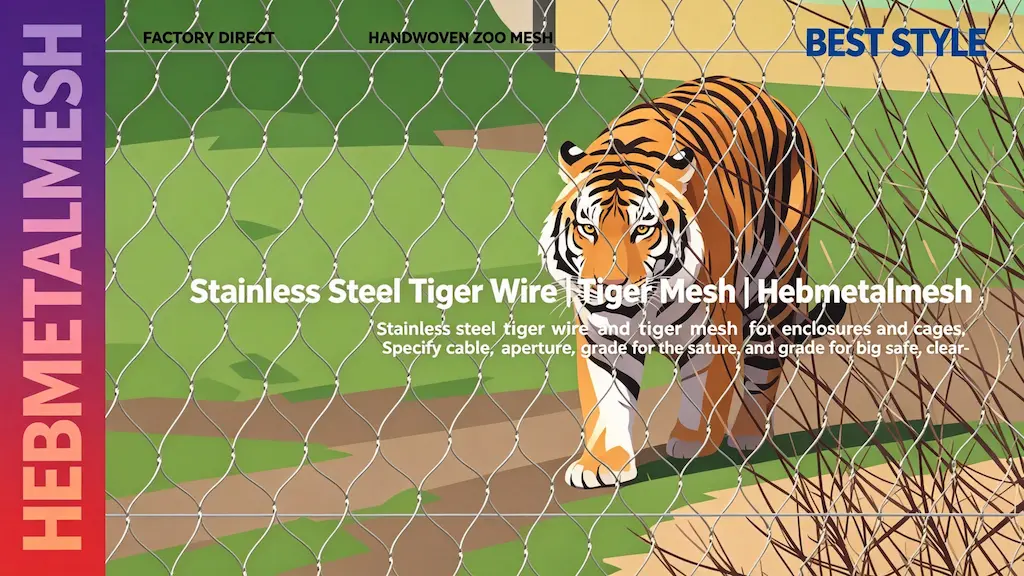
The correct tiger containment mesh is a tensioned stainless steel rope mesh envelope built from 3.2 mm cable at a 76–102 mm mesh aperture, terminated on border cables at every edge, and paired with a closed top or a moat-side overhang. A tiger does not defeat a barrier by climbing it the way a leopard does — it defeats one by mass, by a forepaw swipe delivered with several hundred kilograms behind it, and by a bite measured at roughly 1,050 PSI. That is why tiger exhibits almost never fail in the middle of a panel: they fail at the top edge, at the fixings, and at the pool coping. This guide gives the specification that answers all three, covering tiger enclosure mesh size and cable grade, wet-zone and moat detailing, keeper safety hardware, tiger enclosure mesh installation, inspection and cost. The reference specification is the tiger enclosure netting product page.
Specifying a Tiger Exhibit? Get a Free Barrier Schedule
Send us your cat’s weight and subspecies, exhibit dimensions, moat or pool details and your climate. We return a cable grade, aperture, panel layout and fixing schedule within 24 hours.
Request My Free Quote →Quick Answer: What Mesh Does a Tiger Exhibit Need?
A tiger exhibit needs 3.2 mm stainless steel tiger mesh — 304 grade as standard, 316 stainless steel wherever the mesh meets a pool, a waterfall or a coastal climate — at a 76–102 mm aperture, with every edge terminated on a border cable and the whole envelope tensioned drum-tight. The wire diameter absorbs the swipe and the bite; the aperture keeps a paw and a muzzle inside; the tension removes the slack that turns mesh into a climbing frame. Add a double-door vestibule, a lock-out den and a tensioning hardware set in matching stainless, then re-tension at 30 days. That is the tiger barrier mesh for zoos specification that stays in service for 20–30+ years.
Key Takeaways
- 3.2 mm cable at a 76–102 mm aperture is the tiger standard — 2.0 mm is a bird and small-mammal grade, not a big cat containment grade.
- Tigers are strength-and-water animals: design for mass, paw impact and wet zones, not for climbing.
- 316 stainless is the correct choice wherever the mesh touches chlorinated or recirculated water; 304 is correct everywhere else.
- Every failure we see is a fixing, a top edge or a coping detail — never the mesh field itself.
- Moats reduce the required barrier height but add a wet-zone corrosion duty that must be specified from the start.
Tiger habitat and handling guidance in this article aligns with the conservation position published by IUCN, the International Union for Conservation of Nature, which lists Panthera tigris as Endangered.
Why Tigers Break Barriers Differently From Other Big Cats
A tiger enclosure design starts from a different animal than a leopard or lion exhibit does. Three capabilities drive the specification:
- Mass. An adult male Amur or Bengal tiger reaches 200–300 kg. Every horizontal run of mesh has to be tensioned to carry that weight hanging, swaying and pushing, not just standing against it.
- Forepaw impact. A tiger rears on its hind legs and swipes with the full weight of its shoulders behind the blow. That is an impact load, not a steady load, and it is absorbed by cable thickness and panel tension together.
- Bite and chew. At roughly 1,050 PSI, a tiger that decides to work a cable will deform anything softer than 3 mm stainless. Chew damage is concentrated at edges, corners and any loose strand a cat can draw into its mouth.
What tigers do not do is climb for a living. Our leopard barrier specification is built around a cat that goes up; this one is built around a cat that goes through and down. The practical consequence is that tiger barriers carry larger apertures and heavier cable than leopard barriers, and put more engineering into the base, the water line and the top edge.
Tiger Enclosure Mesh Size and Strength
Two numbers define tiger enclosure mesh strength: the aperture and the cable.
| Enclosure Element | Mesh Aperture | Wire Diameter | Grade |
| Exhibit walls and roof | 76–102 mm (3″–4″) | 3.2 mm | 304 or 316 |
| Holding dens and night houses | 76 mm (3″) | 3.2 mm | 304 |
| Moat-side lower band and pool edge | 51–76 mm (2″–3″) | 3.2 mm | 316 |
| Visitor-side secondary barrier | 76 mm (3″) | 2.4–3.2 mm | 304 |
| Transfer chutes and lock-outs | 76 mm (3″) | 3.2 mm | 304 |
A 3.2 mm strand carries a minimum breaking load of about 7.6 kN, roughly 770 kgf, which is the number that matters when a 250 kg cat hangs off a roof panel at the end of a wet afternoon. Codes in the standard range run from HM2076 (2.0 mm / 76 mm, for light duty and small cats) up through HM3276 (3.2 mm / 76 mm) and HM32102 (3.2 mm / 102 mm) for the big open spans on tiger exhibits.
The mesh aperture is a welfare and safety decision, not a strength decision. At 76 mm a tiger cannot push a paw through far enough to hook clothing or a neighbouring animal; at 102 mm you gain sightline openness on outer runs but lose that margin, so 102 mm belongs on the outer face of a double barrier or in the roof, never on a primary containment line a keeper walks past. Framed that way, paw-proof mesh for tigers is a function of cable thickness and aperture together, and the aperture you choose is the one that keeps four legs and a muzzle on the right side of the line.
Material: 304 or 316 Stainless for a Wet Exhibit
| Feature | SS304 Rope Mesh | SS316 Rope Mesh | Welded Wire | Chain Link |
| Best application | Dry exhibit walls, dens | Pools, moats, waterfalls, coastal sites | Not recommended | Not recommended |
| Chloride resistance | Good | Excellent (molybdenum-alloyed) | Poor at welds | Poor |
| Impact behaviour | Flexes and returns | Flexes and returns | Cracks at joints | Stretches permanently |
| Chew and bite resistance | No welds, no cut ends | No welds, no cut ends | Welds crack | Selvage tears |
304 carries 18% chromium and 8% nickel and handles rain, hosing and disinfection for 20–30+ years. 316 stainless steel adds molybdenum for chloride resistance — name it whenever the mesh sits within splash range of a recirculated pool, because the most common corrosion site on a tiger exhibit is the band at the water line, not the wall above it. Both grades come in Nature and Black Oxide; Black Oxide cuts glare and softens the visual line of a tiger exhibit netting envelope on its public face.
Rope construction, not welded construction, is the rest of the decision: no weld to crack under a hanging cat, no cut end to snag a claw. Full grade and code lists sit on the tiger cage netting page, and the platform is shared with the lion enclosure range and the general animal fence mesh specification.
Barrier Configurations: Wall, Moat and Roof
Most exhibits pair a tiger enclosure barrier mesh wall with a water moat, which changes the job the mesh has to do.
- Full mesh envelope. Mesh walls to 4–5 m with a roofed or overhung top — the most predictable option, and our recommendation wherever the exhibit holds more than one cat.
- Moat plus overhang. A wet or dry moat in front of a 2.5–3 m wall, with an inward-sloping mesh overhang on top. Tiger moat barrier mesh works because a tiger judges the gap, not the height — the overhang removes the take-off.
- Mesh over glass. Cable mesh on the outer line, laminated glass at the viewing point. The mesh carries the impact duty; the glass carries the viewing duty.
Moats shorten the wall but add a corrosion and cleaning duty below the water line, and they change escape prevention altogether: a dry moat must still be lined or overhung, because a tiger that falls in and climbs out on the visitor side has escaped just as effectively.
Keeper Safety and Tiger Protection
Tiger protection netting protects in both directions. For the people working the exhibit:
- Double-door vestibules. Two interlocked doors with at least 1.2 m of separation, so a cat cannot follow a keeper through.
- Lock-out dens. An indoor den that can be closed and secured so the outdoor exhibit can be serviced, hosed and inspected with the cat inside.
- Transfer chutes. Mesh-lined, 76 mm aperture, 3.2 mm cable — a chute lets a tiger shift between areas without direct handling.
- Sightlines. The open grid lets a keeper read posture and position instantly, which is a safety feature, not an aesthetic one.
For the animal, the same open grid gives ventilation, daylight and an unobstructed view out. Tiger cage mesh in the holding areas is where a cat spends its longest uninterrupted hours, which is exactly why the den specification matches the exhibit specification rather than being value-engineered down.
Tiger Enclosure Mesh Installation
A tiger enclosure mesh installation runs in five steps:
- Frame for impact, not just for weight. Steel posts at 3–4 m centres with corner gussets, and roof structure sized for a hanging, swaying cat rather than a static load.
- Terminate every edge on a border cable. Walls, roof, chutes and den doors all end on a clamped border cable — never on a bare strand a cat can draw into its mouth.
- Tension from the top down. Each bay is pulled drum-tight working downward, so no slack pocket survives anywhere a paw can hook.
- Detail the water line before filling. Fit the 316 band at the pool coping first; retrofitting a corroded water-line band means draining the exhibit.
- Re-tension at 30 days. Rope mesh stretches 2–4% on first load. The re-tension pass is part of the installation, not a maintenance extra.
Use stainless tensioning hardware throughout. A plated or galvanised clamp in a chlorinated splash zone will corrode, loosen and hand a 250 kg cat its exit — the cheapest component in the schedule is the one that fails first.
Inspection and Maintenance
Inspection is monthly and focused: walk the perimeter and roof for loose clamps, deformed ferrules and chewed strands, with particular attention to the water-line band, den frames and corner clamps; re-tension twice a year; photograph anything that changes so you have a trend rather than an anecdote. The mesh needs no painting, coating or rust treatment — animal-enclosure-grade stainless, detailed on the general animal enclosure mesh page, does not degrade. The job is keeping the hardware tight, the top closed and the water line sound.
Cost
Tiger-grade mesh — 3.2 mm rope at a 76–102 mm aperture — indicatively runs 20–38 per m² before structure and freight, with 316 panels at the top of that band and panels up to 9 m × 18 m reducing the seams a cat can work. Compare cost per year of service: stainless still holding at year 25 beats any alternative re-clad twice, without a second shutdown. Our animal fence and containment netting price guide itemises the line costs, including the fixing and tensioning hardware budgets most often forget.
FAQ
3.2 mm 304 or 316 stainless steel rope mesh at a 76–102 mm aperture, terminated on border cables, tensioned drum-tight, with a closed or overhung top.
76 mm is the tiger standard on primary containment lines; 102 mm is acceptable in the roof or on the outer face of a double barrier. Below 76 mm you lose nothing structurally and gain margin.
No. At roughly 1,050 PSI a tiger can deform thin or plated fittings, but 3.2 mm solid stainless cable with no welds and no loose ends resists both bite and claw.
Far less, and that is the design difference. Design a tiger barrier for mass, paw impact and water; design a leopard barrier for climbing.
304 for dry walls and dens; 316 stainless steel for any panel within splash range of a chlorinated or recirculated pool, a waterfall, or on a coastal site.
Yes, or a substantial inward overhang. Tigers jump roughly 3 m vertically from a standing start and will test any top edge they can reach.
Interlocked double-door vestibules, indoor lock-out dens, mesh-lined transfer chutes, and clear sightlines through the open grid.
Yes — as a custom tiger enclosure mesh supplier we cut panels up to 9 m × 18 m, splice to your roof geometry, supply matching 304/316 clamps and tensioning hardware, and ship a fixing schedule with the panels.
Tiger-proof fencing comes down to four decisions: 3.2 mm cable, a 76 mm aperture, 316 wherever water touches it, and clamp discipline at every edge and corner. Contact us with your cat’s weight, exhibit drawings and pool details, and we will return an aperture, cable grade, panel layout and fixing schedule for a tiger containment mesh envelope that holds for decades.