

A kudu bull puts its muzzle through a fence to reach a branch, lifts its head, and stops. One spiral horn has hooked over the wire above the gap. The more it pulls, the tighter the hook sets.
That is not a strength failure. The panel held. The animal is caught because the gap was the wrong size in a way nobody measures.
Horned species break the normal aperture logic. For most animals, a smaller opening is safer and a larger one is more dangerous. For a horned antelope, both ends of that range are safe and the middle is the trap. A gap too small to admit the muzzle is fine. A gap wide enough for the whole head and both horns is also fine. The gap in between takes the muzzle and catches the horn.
This guide covers where that range sits, the two numbers that define it, the fittings that catch animals even on a good aperture, and what to change on an enclosure already built.
Executive Summary
Horned hoofstock fencing fails in a narrow band of aperture sizes. A gap that admits the muzzle but not the horn lets the animal put its head in and then hooks a horn over the wire above. Fine mesh below about 2 inches avoids it because nothing enters. Very open mesh avoids it because nothing catches.
The dangerous zone sits between roughly 4 and 8 inches, which is unfortunately where a lot of general-purpose zoo mesh lands. That single fact explains most horn entrapment incidents.
The fix is not a stronger panel. It is a split specification: close the aperture at head height, keep the open mesh above it, and remove every fitting a horn can hook. Measure the animals you actually have, because horn span grows every year.
Specifying for horned species?
Send the species list, the horn spans you have measured and the head-height band on your drawing. We return a split specification: aperture at head height, open mesh above, and the fittings to avoid.
Quick Answer
For horned hoofstock, the safest mesh aperture at head height is 2 inches or less, because the muzzle cannot get purchase. Apertures between roughly 4 and 8 inches are the dangerous range: the muzzle enters, the horn hooks the wire above, and the animal cannot withdraw. Above head height, use open mesh and remove every fitting a horn can catch.
Key Takeaways
- Both ends of the aperture range are safe; the middle is the trap.
- Horn span, not body size, is the number that sets the risk.
- The critical band is head height, roughly 0.9 to 1.8 m for medium antelope.
- Welded mesh cuts and hooks; smooth cable slides.
- Fittings catch more animals than panels do.
- Horns grow every year, so a fence that was safe at handover may not be safe at year five.
- Dehorning is a management choice, not a substitute for a correct aperture.

Why the Middle Aperture Is the Trap
Mesh aperture for horned animals is usually specified from body size, which is the wrong input. A kudu bull and a zebra mare are similar weights, and the zebra needs nothing special. The kudu needs a decision that has nothing to do with mass, and it belongs in the enclosure fencing brief before any panel is ordered.
The mechanism is simple. An animal reaches through a gap for food or a neighbor. Its muzzle is narrow and enters easily. Its head is wider and stops partway. Its horns sit above and behind, much wider than either.
Now the animal lifts or turns. A horn passes over the wire above the gap and hooks it. When the animal pulls back, the horn cannot reverse the path it took, because the wire is now inside the curve. That is horn entrapment in mesh fencing, and it happens in seconds.
Two configurations avoid it. If the aperture is under about 2 inches, the muzzle never gets far enough in to start the sequence. If the aperture is very open, there is no wire close enough above the gap for a horn to hook.
Everything in between is a hazard that scales with how hard the animal tries.
Measuring the Two Numbers
Aperture size for horned antelope comes from two measurements, and both are taken on the animals in front of you rather than from a book. The panel is the easy part, because a ferrule mesh panel can be cut to whatever aperture you name.
Horn span. The widest distance across both horns, tip to tip, measured above the horn boss on the widest adult male. Not the average. The widest animal sets the requirement.
Horn reach above the head. How far the highest point of the horn sits above the skull when the head is level. That number sets how much clear space a horn needs above a gap.
The relationship between horn span versus mesh aperture is what decides the specification. If the span is far wider than any aperture in the panel, the animal can get its head in and not its horns out. If the span is narrower than the aperture, both pass and there is no trap.
| Species | Horn span, adult bull | Horn shape | Risk at 4 in mesh | Working detail |
|---|---|---|---|---|
| Greater kudu | 600–800 mm | Deep spiral | High | 2 in at head height |
| Sable antelope | 500–700 mm | Long backward sweep | High | 2 in, no wire near horn line |
| Bongo | 400–550 mm | Sweeps close to neck | Moderate | 2 in; less overhang risk |
| Ibex | 500–700 mm | Ridged scimitar | High | 2 in; ridges grip cable |
| Eland | 400–600 mm | Straight with a twist | High | 2 in or solid to 1.6 m |
Treat the spans as planning ranges for mature bulls. A well-fed bull can exceed them, and a young bull introduced in year three will grow into the top of the range. Where a fence for elk handles antlers with a bottom cable and a wide span, kudu and sable need the opposite approach at head height.
That is also why kudu fence mesh, sable antelope enclosure mesh and bongo enclosure mesh should not be one line item in a tender, and why a containment design for a horned herd starts with the species list. Same continent, same body mass, three different horn geometries and three different answers.

Where Animals Actually Catch
Head entrapment in hoofstock enclosures happens at a short list of places, and almost none of them is the middle of a panel. Walk an enclosure that has had an incident and the same details keep appearing.
The frame edge. The first aperture next to a post or a top rail is often a partial opening, larger or smaller than the field. A horn finds it.
Gate stiles. Hinge and latch stiles carry brackets, plates and bolts. Every one is a hook.
Corners. Two panels meeting at an angle create a wedge. An animal that pushes into it cannot reverse out.
The mesh-to-solid transition. Where a solid lower panel meets mesh above, the junction line is a horizontal edge at exactly horn height.
Feeders and water points. Openings cut for access are sized for the bucket, not the animal.
Roof junctions. An animal that rears can hook a horn on the roof mesh line, which is worse because it cannot take weight off the horn.
Edges Catch More Than Apertures
Every horn catch point on mesh panel framing is an edge, a bracket or a transition, never the middle of the field. This is why a panel can be correctly specified and still catch animals, and why fittings matter as much as the mesh.
Horned antelope are a conservation priority across much of Africa and Asia. The IUCN Red List tracks the species most often held in captivity, and it is a useful starting point when you are writing a species list into an enclosure brief.
Cable, Welded Mesh and the Lower Zone
Wire rope mesh and welded mesh behave differently once a horn is in contact, and the difference is not strength.
Welded mesh presents rigid intersections and cut wire ends. A horn sliding across it catches on a weld nub or a cut end, and the animal’s own movement drives it harder into the snag. Welded panels also deform locally, which opens an aperture just enough to admit a muzzle that could not have entered before.
A smooth cable panel with swage ferrule terminations has no cut ends in the field and no rigid intersections. Cable diameter matters less here than surface finish. A horn slides along a round cable instead of catching on it. That is the whole advantage, and it is why the same aperture performs differently in the two materials.
Where the geometry is difficult, a solid panel for horned animals solves it outright. Take the solid section to about 1.6 m, above the reach of most medium antelope at a fence line, and run open mesh above it.
A hoofstock enclosure designed around movement still needs the lower zone solid or fine, because that is where the head goes when an animal grazes along the fence line.

Horns Grow, Fences Do Not
Horn growth and fence aperture is the part of this problem that arrives two years after handover, when everyone has stopped thinking about the specification.
A young bull’s horns lengthen and spread every year until maturity, and some species keep adding mass long after the span settles. An enclosure specified for a two-year-old at 300 mm span can be a trap for the same animal at six years and 700 mm.
Two responses. Specify for the adult, not the one you unload next month. Then write an inspection interval that re-measures the widest bull each year against the aperture at head height.
The same logic applies to deer enclosure mesh chosen for antler clearance, where the seasonal change is faster and the risk window is shorter but just as real.
When an Animal Is Caught
Releasing Without Injury
Head entrapment hoofstock incidents are rare, memorable, and usually handled badly in the first two minutes. When you find an antelope head stuck in fence mesh it is a two-person job, and the instinct to pull the animal free is the instinct that breaks its neck.
- Stop the animal moving. Two people, one at the head, one controlling the body.
- Assess whether the horn is hooked over a wire or through an aperture. The release differs.
- Cut the wire, never the horn. A horn cannot be replaced and a cable can.
- Support the head before the wire is cut, so the animal does not drop its own weight onto the freed horn.
- Call the vet before you release, not after. A sedative makes the last step safe for everyone.
- Photograph the catch point before you repair it. That photograph is the specification change.
The repair is the important part. A caught animal tells you exactly which detail failed, and the same detail exists on every other enclosure built to that drawing.

What to Put in the Specification
A hoofstock mesh specification that accounts for horns has six lines, and most drawings carry two.
- Aperture at head height, stated as a maximum, not a nominal.
- The height band that counts as head height for each species on the list.
- Aperture above the band, which can be much more open.
- Material and finish, with smooth cable preferred over welded at the critical band, and the perimeter cable and tension wire anchored outside it.
- A list of prohibited fittings in the band: brackets, bolts, cut ends, plates.
- The re-measurement interval and who owns it.
Horned species enclosure design is mostly naming the band, then treating everything inside it as a different specification. Once that split is drawn, the rest of the enclosure can use ordinary mesh and details.
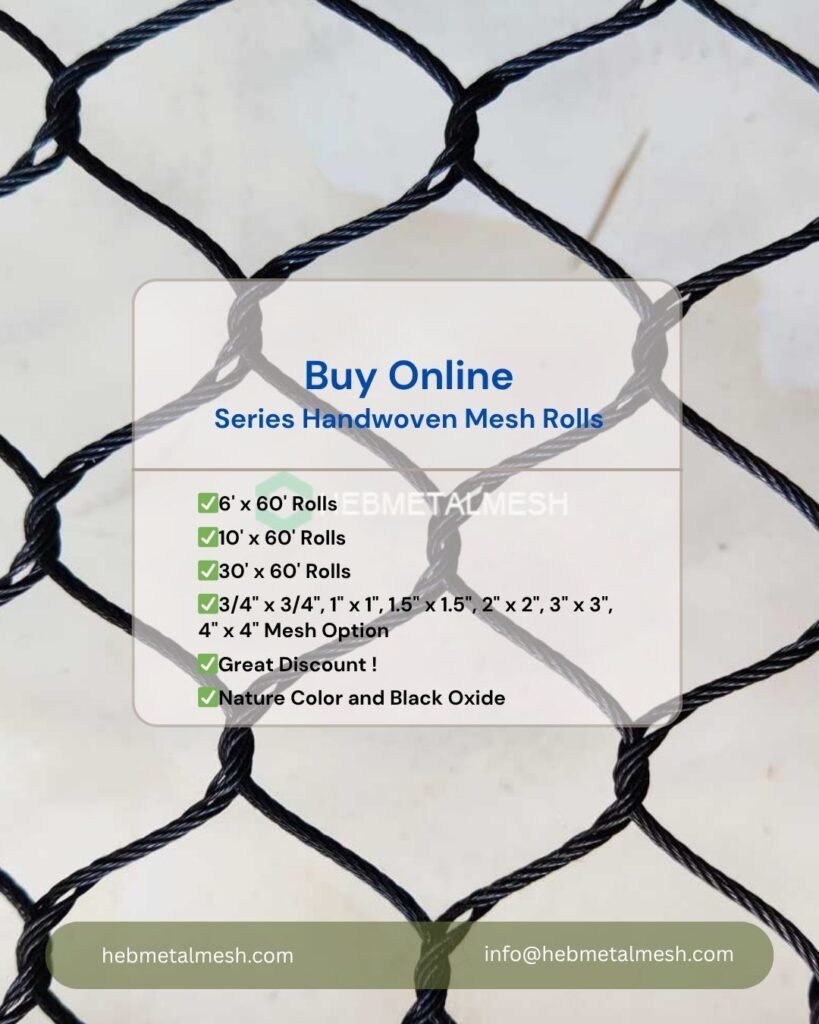
Panels built for the lower band are usually a small fraction of the total area, which is why this fix is cheaper than it sounds. Horned hoofstock fencing is mostly one band done properly. A knotted animal fence mesh in grade 304 handles the upper zone, and the fine panel does the work where the head actually goes.
FAQ
At head height, yes, because the muzzle cannot get enough purchase to start the hooking sequence. Above head height the aperture matters much less, and a wider mesh is fine.
Roughly 4 to 8 inches. It admits the muzzle, stops the head, and leaves a wire close enough above the gap for a horn to hook over. That range covers a lot of general-purpose zoo mesh.
You can above the head band, and it is often right for visibility and cost. At head height it lets the animal push its head through into whatever is on the other side, which is a different problem.
It is a management decision, and for display collections it is usually not acceptable. Dehorning versus mesh design is not really a choice: the fence has to work for the animal you intend to keep.
Annually, against the widest adult male, and again whenever a new animal is introduced. Horns grow, and a specification written for a juvenile is a specification that expires.
Draw the band before you draw the panel.
Send your species list and measured horn spans. We will return the aperture at head height, the open mesh above it, and the fittings to keep out of the band, with panel sizes cut to your elevations.