
Avian Netting Buyer’s Guide 2026 — Stainless Steel vs. Plastic | 30+ Year Lifespan

Executive Summary

Choosing the right avian netting is the single most critical decision for your birds’ safety and your facility’s long-term budget. Plastic nets fail within 3–7 years under UV exposure. Galvanized wire rusts and can leach toxinsStainless steel avian netting delivers 30–50 years of predator-proof, rust-free performance — making it the only professional-grade solution for US zoos, sanctuaries, agricultural operations, and commercial bird parks. This guide covers material selection, mesh size specifications, installation best practices, and maintenance — so you can make an informed, cost-effective decision that protects your birds and your investment. Whether you’re wondering how to install avian netting over a large aviary or what is the best avian netting for outdoor parrot enclosures, this comprehensive resource has you covered.

Key Takeaways

  • Stainless steel outlasts all other materials — 30+ years vs. 3–7 years for plastic or galvanized alternatives
  • Mesh size must match your bird species — 1″ for small birds, 1.5″–2″ for parrots and macaws
  • 304 grade works for most environments; 316 grade is mandatory for coastal locations
  • Handwoven construction prevents feather damage — smooth, knotless surfaces eliminate abrasion injuries
  • Black oxide finish offers near-invisible aesthetics for enhanced visitor experiences
  • UV-stabilised polypropylene is a key material spec for outdoor durability in non-permanent applications
  • Routine maintenance — quarterly tension calibration and visual inspections — extends functional lifespan by up to 40%
⚡ Stop replacing plastic netting every 3 years.
Switch to handwoven stainless steel avian netting that outlasts your birds — 30+ years of predator‑proof performance.
📋 Get your free custom quote + mesh sizing guide — no obligation, just expert advice.

What Is Avian Netting and Why Do You Need It?

Defining Avian Netting — Physical Bird Barriers Explained

Avian netting is a specialized physical barrier designed to contain birds within an enclosure or exclude them from protected areas. Unlike traditional fencing or solid walls, avian netting provides a lightweight, highly visible (or nearly invisible) barrier that birds cannot penetrate while allowing airflow, light, and visibility.

Before diving into material selection, it’s worth understanding the fundamentals — our guide on what is bird netting explains the core principles of physical exclusion and how modern netting systems work.

At its core, avian netting serves two primary functions:

  1. Containment — keeping birds safely inside their designated enclosure
  2. Exclusion — keeping wild birds out of protected crops, buildings, or sensitive areas

The mesh aperture — the size of the opening between strands — determines which bird species are effectively contained or excluded. This is why understanding how to choose avian netting mesh size for small birds versus large raptors is essential for any successful installation.

Primary Applications: Aviaries, Agriculture, and Building Protection

Avian netting finds application across three major sectors in the American market:

Aviaries and Zoos
For professional aviary managers, zoo curators, and bird sanctuary owners, the enclosure is the single most critical element of bird welfareAviary netting isn’t just about keeping birds in — it’s about keeping predators out, preventing injuries, and creating an environment where birds can thrive. Major US zoos and wildlife parks rely on stainless steel bird-proof mesh for permanent installations that protect species ranging from tiny finches to massive eagles.

Agriculture and Crop Protection
Farmers and orchard owners use avian netting to protect fruit trees, vineyards, and berry crops from bird damage. The consequence of selecting inadequate netting can be severe: crop loss, damaged produce, and the long-term operational cost of constant replacement.

Building and Infrastructure Protection
Commercial property managers and facility operators install bird exclusion netting to prevent roosting, nesting, and damage from pigeons, starlings, and other urban birds. This application demands durable, weather-resistant materials that maintain structural integrity for decades.

For large-scale aviaries and commercial bird parks, heavy duty aviary netting serves as the essential component ensuring both containment and predator protection.

Avian Netting vs. Other Bird Deterrents — Why Netting Wins

When comparing avian netting to other bird control methods, the advantages become clear:

🤖 AI OVERVIEW Key Insights from the Data
  • Cost over 30 years: Avian netting pays for itself compared to replacing plastic/chemicals every 2–5 seasons.
  • Safety first: Falconry & netting are the only high‑effectiveness options that are non‑toxic and bird‑safe.
  • Beware “cheap” fixes: Spikes & chemicals carry injury/toxicity risks — netting is the only permanent, humane barrier.
  • Active vs. passive: Falconry requires daily management; netting works 24/7 with zero recurring labor.
Table 1 — Comparative analysis of avian control methods by effectiveness, lifespan, safety, and application.
MethodEffectivenessDurabilityBird SafetyBest Use Case
Avian Netting Excellent30–50 years High (non-toxic)Permanent enclosures
Ultrasonic Deterrents Poor2–5 years ModerateTemporary scaring
Spikes Moderate5–10 years Low (injury risk)Ledges only
Chemical Repellents VariableSeasonal Low (toxicity)Short-term only
Falconry ExcellentOngoing cost HighActive management

Avian netting wins because it provides a complete, permanent, and humane solution. Unlike chemical deterrents that require reapplication or sonic devices that birds quickly habituate to, a properly installed physical barrier works 24/7 without ongoing intervention.

How to Choose the Right Avian Netting for Your Application

Mesh Size Matters — Matching Aperture to Target Bird Species

Selecting the correct mesh aperture is arguably the most critical technical decision in any avian netting project. Too large, and small birds escape or become trapped. Too small, and you’re paying for material you don’t need while potentially reducing visibility.

🤖 AI OVERVIEW Mesh Selection Rules — What the Specs Actually Mean
  • Match aperture to species size — 1″ mesh for finches/budgies prevents escape; 1.5″–2″ for macaws/raptors balances visibility with security.
  • Wire gauge equals beak resistance — parrots need 1/16″–5/64″; macaws and large cockatoos require a minimum 2.0mm (5/64″) gauge to withstand powerful chewing.
  • Predators demand custom specs — eagles and hawks need 2″ mesh (or custom sizes) with 5/64″+ wire, plus reinforced edges for true predator‑proofing.
  • Agriculture is a different game — crop protection calls for ultra‑fine ½″–¾″ (13–19mm) mesh to exclude small songbirds like sparrows and starlings without blocking light.
Table 2 — Recommended mesh sizing and wire gauge by bird species and application type.
Bird CategoryRecommended Mesh SizeWire DiameterKey Consideration
Songbirds, Finches, Budgies1″ × 1″ (25mm × 25mm)1/16″ (1.6mm)Small aperture prevents escape
Parrots, Cockatoos, African Greys1″–1.5″ × 1″–1.5″1/16″–5/64″Beak strength requires heavier gauge
Macaws, Large Parrots1.5″–2″ × 1.5″–2″5/64″ (2.0mm)Maximum strength for powerful beaks
Raptors, Eagles, Hawks2″ × 2″ or custom5/64″+Predator‑proof heavy‑duty construction
Crop Protection (small birds)½″–¾″ (13mm–19mm)VariablePrevents entry of sparrows and starlings

For mixed-species enclosures, consider zoning different mesh sizes within the same enclosureKnotless netting designs reduce abrasion and extend service life.

Pro Tip: How to prevent birds from getting tangled in aviary netting starts with selecting apertures smaller than 5mm where entanglement risk is highest, and ensuring proper tension to eliminate sagging pockets.

Material Selection — Polypropylene, Nylon, or Stainless Steel?

Builders and designers often face a confusing array of options — primarily polyethylene (HDPE) netting, galvanized wire mesh, or stainless steel. Here’s how they compare:

🤖 AI OVERVIEW Material Intelligence — What the Data Tells You
  • Stainless steel (304/316) is the clear winner — 30–50 year lifespan, zero UV degradation, zero rust, and completely non‑toxic with smooth edges. The only true “install once, forget it” material.
  • HDPE is a compromise — 10–15 years sounds decent, but it’s chewable (hazardous for parrots) and only moderately weather‑resistant. Fine for temporary budgets, not for permanent bird welfare.
  • Never spec galvanized wire for birds — rusts within 5–10 years, and zinc leaching is a real toxicity risk if birds chew it. “Short‑term only” is the generous reading.
  • Nylon is a false economy — 3–7 years with poor UV/corrosion resistance. Only suitable for indoor or truly temporary setups where replacement is expected.
Table 3 — Material comparison by lifespan, environmental resistance, safety, and ideal application.
MaterialLifespanUV ResistanceCorrosion ResistanceSafetyBest Application
Stainless Steel (304/316)30–50 yearsExcellentExcellentNon‑toxic, smooth edgesPermanent installations
UV‑Stabilized Polyethylene (HDPE)10–15 yearsGoodModerateSafe but chewableBudget‑conscious projects
Galvanized Wire5–10 yearsModeratePoor — rustsCan leach toxins if chewedShort‑term only — not recommended
Nylon3–7 yearsPoorPoorModerateTemporary applications

Stainless steel is the only professional-grade solution that meets the demands of modern zoological and commercial applications. With over 30 years of manufacturing experience, leading suppliers like Hebmetalmesh specialize exclusively in high-quality 304 and 316 stainless steel avian netting.

304 grade works for most environments across the continental US. 316 grade is mandatory for coastal locations — Florida, California, Gulf Coast, and anywhere with salt spray exposure.

For buyers ready to move from specification to procurement, Hebmetalmesh offers a full range of handwoven stainless steel bird netting fence and aviary mesh products designed for permanent, predator-proof installations.

Knotless vs. Knotted Construction — What’s the Difference?

The construction method significantly impacts performance, safety, and longevity:

Knotless Netting

  • Smooth surfaces eliminate abrasion injuries to birds — no rough knots to catch feathers or skin
  • Reduced friction between strands extends lifespan
  • Easier handling and installation
  • Preferred for bird parks and sanctuaries where animal welfare is paramount

Knotted Netting

  • Higher break strength — suitable for heavy-duty applications involving large predators
  • Traditional construction with proven performance
  • Better for raptor enclosures and high-security applications

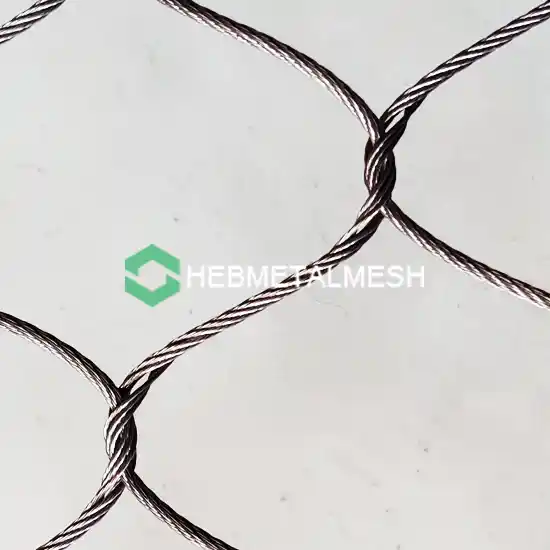
Hebmetalmesh’s handwoven stainless steel netting features a unique “inter-knotted” construction where stainless steel wire rope is crossed twice with a single knot. This premium wire fabric is characterized by exceptional strength and flexibility.

UV Stabilisation and Weather Resistance — Why They’re Non-Negotiable

For outdoor installations, UV stability is non-negotiable. Here’s why:

  • Stainless steel is naturally UV-stable — no degradation from sunlight exposure
  • Industrial-grade stainless steel withstands extreme temperatures from -250°F to +270°F
  • High wind zones — nets are tested to withstand hurricane-force conditions
  • Handwoven stainless steel netting withstands extreme weather, including heavy rain, snow, and even hurricanes

Hebmetalmesh offers a Black Oxide finish that makes the mesh virtually invisible, providing an unobstructed view of your birds while maintaining necessary strength and security. This walk-in aviary enclosure design enhances the immersive experience for visitors without compromising safety.

Sizing and Coverage — Calculating How Much Netting You Need

How much avian netting do I need for a 10×10 metre aviary? This common question requires careful calculation:

Basic Formula:

  • Measure length, width, and height of your enclosure
  • Calculate total surface area: 2 × (L×H) + 2 × (W×H) + (L×W) for roof
  • Add 10–15% for overlap, tensioning, and trimming

Example — 10m × 10m × 4m aviary:

  • Walls: 2 × (10×4) + 2 × (10×4) = 160 m²
  • Roof: 10 × 10 = 100 m²
  • Total: 260 m² + 15% contingency = ~300 m²

Custom sizing is essential for complex projects. Leading manufacturers like Hebmetalmesh provide flexible roll sizes, custom-cut to perfectly match your specific frame dimensions at no extra cost. This eliminates the limitations of fixed-size panels, ensuring a seamless and easier installation process.

Custom-sized stainless steel peacock enclosure netting installed in a luxury private aviary

Step-by-Step Avian Netting Installation Guide

Tools and Materials You’ll Need Before You Start

Before beginning any avian netting installation, gather:

  • Netting — correctly sized for your species and application
  • Mounting hardware — stainless steel zip ties, hog rings, or custom fasteners
  • Support cables — galvanized or stainless steel tension cables
  • Corner posts and frame — steel, timber, or existing structure
  • Tensioning tools — come-alongs, ratchet straps, or cable tensioners
  • Safety equipment — harnesses, gloves, eye protection
  • Measuring tools — tape measure, laser level, chalk line
  • Cutting tools — wire cutters, tin snips, or angle grinder

Measuring and Planning Your Netting Layout

Proper installation starts with accurate assessment:

  • Conduct 3D terrain mapping for irregular landscapes
  • Account for support structures — trees, buildings, pylons, and existing framework
  • Plan for thermal expansion — include expansion joints in temperate zones
  • Consider predator access points — ground sealing is critical

Common installation mistakes to avoid:

  • Using incorrect mesh size for target species
  • Insufficient tension leading to sagging
  • Inadequate predator-proof ground sealing
  • Ignoring thermal expansion joints

Installing the Mounting System — Fixings, Poles, and Frames

The mounting system is the backbone of any avian netting installation:

Main fixings should be placed every 10 metres and at every corner or direction change. For large spans, use tension cables and pylon systems.

Choosing fixings:

  • Stainless steel — maximum corrosion resistance, recommended for all permanent installations
  • Galvanized steel — suitable for interior or temporary applications
  • Custom hardware — often required for complex architectural integration

Running and Tensioning the Support Wire

Support wires create the framework that carries the avian netting:

  1. Run primary support cables along the top perimeter
  2. Install intermediate support lines for large spans
  3. Set corner posts with proper bracing
  4. Tension cables using come-alongs or mechanical tensioners
  5. Verify all anchor points are secure

For large enclosures, steel cable rigging with tensioned netting allows adaptation to curved or sloping spaces.

Attaching and Securing the Netting

Netting installation steps:

  1. Unroll and lay net flat for handling
  2. Attach corners using appropriate fasteners (zip ties, hog rings, or custom hardware)
  3. Ensure netting is taut — sagging creates predator entry points
  4. Secure edges with reinforced selvedge cord
  5. Conduct tension calibration and final inspection

Knotless netting is significantly easier to handle during installation — no snags, no tangles, and minimal friction.

For detailed instructions on securing your netting to various frame types, refer to our comprehensive guide on how to attach wire mesh to metal frames — covering tools, tensioning, and hardware selection.

Trimming, Tensioning, and Final Inspection

After attachment:

  1. Trim excess netting — leave 6–12 inches of overlap at all edges
  2. Final tensioning — netting should be drum-tight with no sagging
  3. Inspect all connections — verify every fastener is secure
  4. Check ground seal — ensure predators cannot dig under
  5. Document installation — photograph and record for maintenance reference
A close-up, high-definition photograph of handwoven stainless steel wire rope mesh tensioned seamlessly across a dark geometric structural steel frame, highlighting the metallic texture, flexible weave pattern, and high visual transparency.

Maintenance, Repair, and Longevity

Routine Inspections — What to Look For

How long does avian netting last outdoors? With stainless steel, the answer is decades — but routine inspection extends that lifespan even further:

Quarterly inspections:

  • Tension calibration — check for sagging or loosening
  • Visual inspection for damage or wear
  • Check all fasteners, hardware, and edge terminations for loosening or corrosion
  • Look for signs of predator attempts (chew marks, bent strands)
  • Verify ground seal integrity

Preventative maintenance can extend functional lifespan by up to 40%.

Repairing Tears and Damage in the Field

Even the best avian netting can sustain damage from extreme weather, falling branches, or animal impact:

  • Modular repair systems allow targeted patching without full dismantling
  • Premium nets become cost-effective within 7 years due to reduced replacement costs
  • Stainless steel repairs are straightforward — splice in new sections using the same material

For knotless netting, repairs are simpler because there are no knots to recreate — just weave in replacement strands.

Seasonal Storage and Reuse Best Practices

Can avian netting be reused season after season? Yes — provided it’s stored correctly:

  1. Inspect for damage before storage
  2. Clean off debris — dirt and organic matter can trap moisture
  3. Dry completely before rolling to prevent mold
  4. Store in cool, dry place away from direct sunlight
  5. Avoid folding in the same crease lines repeatedly

HDPE and nylon netting require careful storage; stainless steel is far more forgiving.

When to Replace Your Avian Netting

Signs it’s time for replacement:

  • Visible rust (galvanized or non-stainless materials)
  • Brittle strands (plastic and nylon degradation)
  • Multiple repairs in same area
  • Loss of tension that cannot be corrected
  • Changed species requirements — new birds may need different mesh size

Stainless steel avian netting from quality manufacturers typically provides 30+ years of service, making replacement a once-in-a-career decision for most facility managers.

Close-up of black oxide finished stainless steel bird wire mesh showcasing the hand-woven diamond pattern against a soft-focus landscape for architectural facade and balustrade use.

Regulatory and Ethical Considerations for European and American Buyers

Wildlife Protection Laws and Entanglement Prevention

Beyond mere containment, modern zoo mesh serves as a vital tool for animal enrichment — encouraging natural behaviors while maintaining the highest safety standards.

American and European purchasers must comply with:

  • Migratory Bird Treaty Act (US) — protects native bird species
  • Endangered Species Act — applies to threatened and endangered birds
  • EU Birds Directive — protects all wild bird species in Europe
  • Local wildlife regulations — varying by state and municipality

How to keep birds from getting trapped in avian netting is both an ethical obligation and a regulatory requirement:

  • Select mesh apertures smaller than 5mm where entanglement risk exists
  • Use knotless or wildlife-friendly netting designs
  • Install with proper tension to eliminate sagging pockets
  • Conduct regular inspections to identify hazards
  • Consider black oxide finish for near-invisible aesthetics

For zoological facilities and commercial aviaries in the United States, compliance with AZA animal care and welfare standards is often a prerequisite for accreditation. These standards specify minimum requirements for enclosure design, predator protection, and species-appropriate housing — all of which directly inform avian netting selection and installation.

Mesh Size Regulations for Wildlife-Friendly Netting

Regulatory bodies increasingly specify minimum mesh aperture requirements for wildlife-friendly avian netting:

  • Small bird exclusion: apertures must be small enough to prevent head entanglement
  • Predator protection: apertures must be small enough to prevent predator access
  • Visibility requirements: some jurisdictions mandate highly visible netting to prevent bird strikes

Wildlife-friendly netting is an emerging standard that prioritizes bird safety alongside containment effectiveness.

Disposal and Environmental Compliance

End-of-life considerations:

  • Stainless steel is 100% recyclable — no environmental contamination
  • HDPE and nylon are plastic waste — check local recycling options
  • Galvanized wire contains zinc — may require specialized disposal
  • Responsible manufacturers employ sustainable practices including eco-friendly materials and energy-efficient production

Summary

Selecting the right avian netting is an investment in your birds’ safety, your facility’s longevity, and your operational budget. Stainless steel outperforms all alternatives — delivering 30+ years of predator-proof protection with virtually no maintenance. Whether you’re protecting a commercial aviary, a fruit orchard, or an urban building, matching mesh size to your target species, selecting the appropriate material grade, and following proper installation practices are the keys to success.

For zoos and wildlife parks housing exotic birds, our aviary netting provides a safe, rust‑proof barrier that keeps winged residents secure without obstructing visitor views.

For permanent, professional installations, stainless steel avian netting remains the gold standard. With over 30 years of manufacturing experience, suppliers like Hebmetalmesh stand ready to help you design the perfect netting solution for your specific needs. From how to install avian netting over a large aviary to what is the best avian netting for outdoor parrot enclosures, the answers all point in one direction: handwoven stainless steel.

Remember: As a trusted zoo mesh manufacturer, we engineer our stainless steel netting to withstand the immense force, clawing, and impact of large predators like lions and tigers. The cheapest option today is rarely the most cost-effective over 30 years. Invest in avian netting that protects your birds, your visitors, and your bottom line for decades to come.

Frequently Asked Questions (FAQ)

Q1: What mesh size avian netting stops sparrows and starlings?

For sparrows, starlings, and similar small birds, a mesh aperture of 28mm or smaller is recommended. For comprehensive protection against most songbirds, ½-inch to ¾-inch (approximately 13mm to 19mm) mesh is the industry standard. Always match mesh size to the smallest bird species you need to exclude.

Q2: How long does avian netting last outdoors?

Lifespan depends entirely on material quality and UV exposure. Lightweight netting (6–8 g/m²) may degrade after a single season. Mid-weight HDPE netting with UV stabilisers typically lasts two to three years. Premium-grade stainless steel avian netting from quality manufacturers delivers 30–50 years of service.

Q3: Can avian netting be reused season after season?

Yes — provided it is stored correctly. High-quality woven nylon or polypropylene netting is designed for repeated use. Stainless steel netting is inherently reusable across decades. To maximise reusability, inspect for damage before storage, clean off debris, and store in a cool, dry place away from direct sunlight.

Q4: Is knotless avian netting stronger than knotted netting?

“Stronger” depends on what you’re measuring. Knotted netting typically offers higher break strength, making it suitable for heavy-duty applications involving larger birds or predators. Knotless netting, however, is more abrasion-resistant because it eliminates friction points where knots would rub. It is also lighter, easier to handle, and less likely to damage birds — making it the preferred choice for many commercial and ethical applications.

Q5: How do I keep birds from getting trapped in avian netting?

Preventing bird entanglement starts with selecting the right mesh size — apertures smaller than 5mm significantly reduce the risk of trapping. Additionally, always install netting with proper tension to eliminate sagging pockets where birds could become caught. Use knotless or wildlife-friendly netting designs wherever possible, and conduct regular inspections to identify and repair any loose sections before they become hazards.

✅ Ready to future‑proof your aviary or crop protection?
Our engineers will design a stainless steel netting solution tailored to your exact site specs — 304/316 grades, black oxide finish, any size.
📬 Request your no‑obligation quote now — same‑day response, nationwide shipping.
print
Shopping Cart
Home
Shop
Message
Cart