
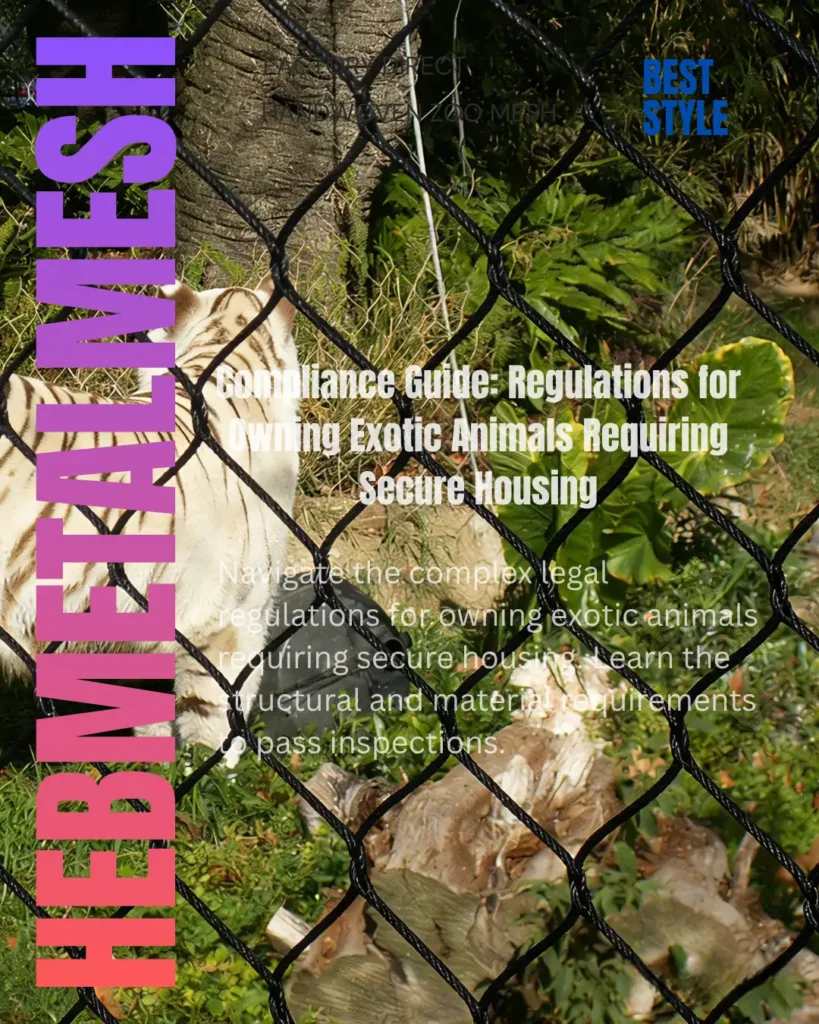
Navigating the strict legal regulations for owning exotic animals requiring secure housing demands a rock-solid understanding of structural compliance codes. Regulatory bodies like the USDA, AZA, and global wildlife authorities mandate perimeter barriers that are fully unbreachable under extreme physical stress. To comfortably pass rigorous inspections and mitigate liability risks, property owners must move past outdated, rust-prone fencing. Upgrading to fully certified, high-tensile handwoven stainless steel wire rope systems ensures absolute compliance and structural safety.
Key Takeaways
- Regulatory standards strictly define perimeter heights, mesh gauge minimums, and dig-proofing depth profiles.
- Material failure due to rust or environmental corrosion can result in immediate permit revocation and major fines.
- Handwoven stainless steel wire rope provides the verified tensile performance metrics required by commercial insurance underwritings.
- Documented tensile certifications accelerate structural permit approvals from local and federal wildlife bodies.
1. The Global Legal Landscape of Large Carnivore Keeping
Navigating the legal framework of large carnivore housing requires a deep understanding of international, federal, and municipal statutory laws. Operating a commercial zoo, conservation sanctuary, or research facility requires more than just biological expertise; it demands strict adherence to rigorous engineering codes. Failing to meet these legal minimums can result in immediate asset seizure, heavy civil fines, and criminal negligence charges.
The legal landscape is managed through a tiered regulatory system:
International Frameworks (CITES and WAZA)
At the global level, the Convention on International Trade in Endangered Species of Wild Fauna and Flora (CITES) tightly regulates the cross-border movement of apex predators like the tiger (Panthera tigris). Once an animal clears import customs, the World Association of Zoos and Aquariums (WAZA) sets the baseline expectations for humane containment. WAZA frameworks state that modern boundaries must blend structural security with advanced animal welfare, directly pushing facilities away from old-fashioned, high-stress iron cages.
Federal Enforcement (USDA and APHIS)
In the United States, federal oversight is governed by the Animal Welfare Act (AWA), enforced directly by the United States Department of Agriculture (USDA) and the Animal and Plant Health Inspection Service (APHIS). Under APHIS Title 9, Code of Federal Regulations (9 CFR), large dangerous carnivores are classified as “Class I Dangerous Wildlife.”
Federal mandates demand that containment structures must withstand the maximum physical forces the animal can generate, meaning that structural plans must explicitly account for peak weight, leaping height, and impact velocity.
Regional, State, and Municipal Codes
While federal codes establish the baseline, regional laws—such as state departments of fish and wildlife or municipal zoning boards—often introduce even stricter rules:
- Mandatory Minimum Heights: Most state jurisdictions require perimeter walls to be at least 16 feet (4.8 meters) tall for big cats.
- Integrated Jump Overhangs: Enclosures must feature an inward-facing top angle overhang of at least 3 feet (0.9 meters) tilted at a 45-degree angle, or a completely sealed overhead canopy.
- Sub-Grade Dig Barriers: To prevent tunneling escapes, regulations require a concrete subterranean curtain wall or an inward-extending mesh L-footer extending at least 3 to 5 feet underground.
To ensure your facility easily meets these layered compliance demands, project architects must integrate strict regional rules directly into their initial blueprints. Reviewing our comprehensive operational playbook on the Regulations for Owning Exotic Animals Requiring Secure Housing helps clarify these multi-jurisdictional codes before breaking ground.
Once your layout satisfies these legal constraints, engineers can choose compliant materials from the main hebmetalmesh zoo mesh product catalog to ensure the physical infrastructure matches or exceeds every statutory requirement.
2. Decoding Material Requirements: What Inspectors Look For
When a USDA or state wildlife inspector arrives for an unannounced facility audit, they do not just glance at the beauty of the habitat. They perform an intensive, hands-on physical inspection of the perimeter boundary, specifically searching for micro-vulnerabilities, structural fatigue, and material deflection risks. Knowing what inspectors focus on is critical to maintaining your operating license.
The Failure of Standard Chain-Link Fencing
Standard commercial chain-link fencing is the most common material flagged and failed during professional safety inspections. While it is cheap and readily available, its structural design features severe vulnerabilities when used for Class I wildlife:
- Weak Tie-Wires: Chain-link fabrics are attached to their pipe frames using manual aluminum or light-steel tie-wires. A 500-pound tiger can easily slide its claws behind the fabric and pull inward. The resulting leverage quickly snaps or uncurls the soft tie-wires, detaching the mesh from the post and creating an instant escape route.
- Easy Structural Deformation: Chain-link uses an un-knotted, simple over-and-under weave pattern. When an animal strikes or leans against this fabric, the diamond loops easily distort and stretch out of alignment. This permanent deformation creates sag zones that lower the fence’s effective height and compromise its structural integrity.
- The Sharp Cut-Wire Hazard: If a chain-link wire breaks under tension, the loose end unravels rapidly, leaving a sharp, jagged steel edge that can cause severe facial lacerations or eye injuries to the animal.
The Compliance Advantages of Continuous Handwoven Steel
To pass rigorous compliance checks without issue, engineering plans should replace traditional fencing with high-tensile, handwoven stainless steel wire rope mesh.
| Inspection Checklist | Handwoven Stainless Wire Mesh | Standard Commercial Chain-Link |
|---|---|---|
| Attachment Security | Continuous cable perimeter wrap; no loose ties | Individual aluminum ties; prone to snapping |
| Weave Integrity | Interlocking hand-knotted mesh; completely un-rippable | Loose over-under loop layout; unravels if broken |
Handwoven wire rope fabric delivers an un-rippable boundary that satisfies modern safety audits:
- Monolithic Structural Fabric: The mesh uses interlocking diamond knots woven from multi-strand stainless steel cables. If an animal impacts the barrier, the contiguous web transfers the kinetic load across the entire surface area, completely eliminating localized deformation.
- Continuous Cable Border Integration: Instead of relying on brittle individual tie-wires, handwoven mesh sheets attach to their structural support frames using a continuous stainless steel boundary cable. This system permanently seals the edge, preventing the animal from gaining claw leverage or pulling the mesh away from the post.
- Zero-Unraveling Security: Because the interlocking nodes are knotted under high tension, a single broken wire cannot cause the system to unravel. The surrounding grid locks firmly in place, keeping the boundary perfectly secure until the next scheduled maintenance review.
To secure an inspection-ready setup, procurement officers must select the correct gauge and wire layout. Facility designers can evaluate certified break-load charts, node connections, and thickness matrices by reviewing the specialized hebmetalmesh tiger enclosure mesh directory.
From there, project estimators can source compliant materials directly through the commercial hebmetalmesh store to ensure the facility passes its final inspection on the first visit.
3. Overcoming the Top Compliance Failures
State and federal inspectors consistently flag a predictable set of engineering oversights during annual wildlife facility audits. To maintain a valid operational license and ensure absolute containment security, facility engineers must proactively design against these three common failure points.
Inadequate Enclosure Tops
Tigers are exceptional vertical climbers capable of using minimal claw leverage to scale sheer boundaries. A common compliance failure is installing weak, non-load-bearing netting across the roof perimeter. When a 500-pound animal leaps vertically into a substandard mesh ceiling, the impact can easily snap the wire lines.
Furthermore, overhead spans must withstand heavy environmental loads, such as accumulating snow and ice. Specifying a heavy-duty, load-bearing wire rope canopy ensures that the overhead barrier maintains its structural shape under both environmental weight and direct physical impact.
Substandard Anchor Pointing
A containment mesh is only as dependable as its perimeter structural frame integration. Many field contractors install high-tensile fabric but secure it to the structural steel posts using light-gauge individual tie-wires, standard commercial staples, or low-strength clamps.
During an inspection, auditors will apply targeted pressure to these connection boundaries. If the tie-wires stretch, unwind, or snap under concentrated leverage, the fence fails the safety audit. Secure configurations require the mesh to be interwoven directly onto a heavy stainless steel border cable or threaded continuously through structural pipe frames, creating a uniform, un-peelable edge connection.
Corrosion Degradation
Standard galvanized carbon steel fences look sound when first installed, but environmental humidity, acid rain, and animal waste quickly attack the zinc layer. Once rust compromises the steel core, the fence line loses its baseline tensile capacity.
During an unannounced inspection, auditors frequently perform physical push-tests and mechanical leverage checks on the lower rows of the mesh. If the wires are brittle from hidden oxidation, they will fracture under pressure, resulting in an immediate code violation and a forced shutdown of the exhibit.
To prevent these systemic failures, engineering teams must evaluate physical material performance parameters before finalizing construction documents. Reviewing the certified tensile thresholds and structural load maximums listed on the hebmetalmesh tiger enclosure mesh specification index provides the data required to build an un-flagglable, inspection-ready barrier.
4. Managing Civil Liability and Insurance Underwriting
Operating a commercial zoo or wildlife sanctuary involves managing substantial financial and legal risks. Because Class I dangerous carnivores possess immense destructive potential, insurance underwriters evaluate these facilities through a strict actuarial lens. If an facility cannot prove its containment boundaries are practically unbreachable, it will face skyrocketing annual liability premiums or a complete denial of coverage.
| Actuarial Risk Variable | Handwoven Stainless Wire Rope Mesh | Standard Galvanized Chain-Link |
|---|---|---|
| Underwriting Risk Rating | Elite / Minimum Risk Profile | High Risk / Premium Surcharges Apply |
| Structural Failure Probability | Near Zero; interlocking 3D elastic web | High; loose wires prone to unraveling |
When insurance underwriters review a facility’s risk profile, they calculate the mathematical probability of a structural failure. Standard chain-link or rigid welded wire panels carry inherent structural risks due to brittle welds, loose tie-wires, and rapid rust degradation. Because these materials are prone to localized failures, underwriters apply significant premium surcharges to protect against potential catastrophic civil claims.
Specifying premium architectural handwoven stainless steel wire rope mesh fundamentally alters this underwriting equation. Because this material utilizes high-tensile, marine-grade stainless steel cables linked by interlocking handwoven nodes, it delivers an un-rippable boundary that cannot unravel or warp out of shape. The elastic behavior of the mesh web allows it to safely absorb multi-ton dynamic impacts, lowering structural failure probabilities to near zero.
When an facility presents certified metallurgical test data and independent load-cell verification sheets from a specialized manufacturer, underwriters can comfortably place the facility into their lowest risk tier. The resulting drop in annual insurance premiums allows commercial operators to quickly recover their initial material investment while securing complete long-term peace of mind.
To tie these liability advantages into a complete project estimate, procurement officers should evaluate direct factory options. Navigating to the commercial hebmetalmesh store allows project managers to source certified, code-compliant wire fabrics directly.
From there, estimators can view full width availability on the master hebmetalmesh stainless steel rope mesh product to ensure the selected dimensions minimize field seams and keep construction aligned with the best practices outlined in our comprehensive guide on Best Practices for Designing a Secure Tiger Habitat.
5. Case Studies: Real-World Failures and Compliance Successes
Analyzing historical data highlights the clear differences between standard commercial materials and specialized containment design. Across the zoological industry, the transition from outdated, rigid frameworks to flexible wire rope systems has reshaped how regulatory agencies evaluate animal safety.
Case Study 1: The Commercial Chain-Link Breach (Failure)
In a notable municipal animal park incident, a facility used heavy-duty, commercial-grade galvanized chain-link fencing for a temporary tiger holding zone. While the fabric thickness met local height rules, the mesh was attached to the posts using standard individual aluminum tie-wires.
During an intense storm, a startled adult male tiger repeatedly charged the lower boundary wall. The dynamic impact forces easily sheared the individual tie-wires, detaching the chain-link fabric from its framework. The tiger slipped through the resulting gap, leading to an immediate emergency breach, severe regulatory fines, and a temporary revocation of the facility’s USDA operating license.
This failure proved that a boundary material is only as secure as its connection points, demonstrating why inspectors consistently flag individual tie-wire configurations during field audits.
Case Study 2: The High-Velocity Leap Test (Success)
Conversely, a major progressive wildlife sanctuary in the Pacific Northwest utilized monolithic sheets of handwoven stainless steel wire rope mesh to build a large, multi-level tiger habitat. The design featured integrated climbing platforms positioned near a 16-foot vertical wall, covered by a full, high-tensile woven mesh canopy.
During a routine veterinary introduction, a newly arrived tiger panicked and launched a full-speed leap from an elevated platform directly into the overhead canopy. Instead of snapping or tearing, the handwoven mesh deflected elastically, safely absorbing the dynamic energy and gently easing the animal back to the ground without injury.
When state inspectors reviewed the impact zone the following day, the interlocking hand-knotted nodes showed zero permanent deformation, and the continuous edge-cable attachment remained perfectly intact. The facility passed its structural compliance audit with a perfect score.
| Operational Outcome | Standard Chain-Link Layout | Handwoven Stainless Wire Fabric |
|---|---|---|
| Dynamic Impact Behavior | Tie-wires shear; fabric pulls away from frame | 3D elastic deflection buffers and controls energy |
| Post-Impact Inspection | Immediate failure; permanent material sagging | Zero structural distortion; system returns to form |
To integrate these field-tested outcomes into your current design phase, project managers should align their structural specifications with certified industrial metrics. Engineering teams can cross-reference break loads and custom weave types within the hebmetalmesh tiger enclosure mesh directory to select code-compliant options.
From there, procurement agents can source identical, inspection-ready wire fabrics directly from the hebmetalmesh zoo mesh store to protect their facility against unexpected structural failures.
By basing material choices on documented safety data rather than low upfront costs, contractors can deliver a high-welfare facility that meets strict conservation criteria. For teams preparing for final regulatory site reviews, cross-reference your structural layouts with our comprehensive manual on Best Practices for Designing a Secure Tiger Habitat to ensure every square foot of your containment boundary passes code inspection.
Pass Your Structural Containment Inspections with Flying Colors
Don’t risk costly fines, structural write-offs, or permit revocations. Equip your facilities with fully certified, ultra-durable handwoven stainless steel mesh solutions.
Secure Your Facility TodayFrequently Asked Questions (FAQ)
A: Under USDA and APHIS Title 9 compliance codes, Class I dangerous wildlife structures must be built to withstand the peak dynamic forces an apex predator can generate. Most regional and state fish and wildlife jurisdictions dictate a mandatory minimum height of 16 feet (4.8 meters) for tiger enclosures. This vertical standard must be paired with either a fully enclosed load-bearing ceiling canopy or an inward-facing top jump overhang tilted at a 45-degree angle extending at least 3 feet inward.
A: Standard chain-link fencing relies on loose over-and-under wire loops that easily distort, causing permanent structural sagging that lowers the fence’s effective height. Additionally, chain-link is secured to posts using individual aluminum or light-steel tie-wires. A 500-pound tiger can easily slip its claws behind the mesh and pull, snapping these weak ties and peeling the fence from its frame. Handwoven stainless steel wire fabrics avoid this vulnerability by using a continuous border cable integration that creates an un-peelable, uniform connection.
A: Tigers are incredibly agile climbers. A common compliance pitfall is utilizing lightweight, non-load-bearing netting across overhead spans. When an excited animal leaps vertically or when heavy winter snow and ice accumulate, these weak structures fail, tear, or sag. Specifying heavy-duty, multi-strand wire rope mesh for overhead canopies ensures the facility passes structural push-tests and heavy load-bearing checks during unannounced audits. To evaluate certified breaking strengths and loop dimensions for overhead spans, browse the main hebmetalmesh zoo mesh series products.
A: Yes. Insurance underwriters evaluate large carnivore facilities through a strict actuarial lens based on failure probabilities. Because brittle welded grids and loose chain-link fences carry high risks of corrosion and localized failures, they trigger expensive insurance premium surcharges. Replacing these materials with high-tensile, handwoven stainless steel wire rope mesh drops structural failure probabilities to near zero. Presenting certified factory load testing data allows commercial operators to shift into the lowest risk underwriting tiers, drastically lowering annual premiums.
A: Inspectors actively look for micro-fissures and hidden rust scaling along lower fence rows. Standard galvanized carbon steel wire degrades rapidly when exposed to environmental humidity and acidic animal urine, causing it to fail unexpected physical push-tests. Specifying Grade 304 or Grade 316 stainless steel guarantees long-term compliance. Grade 316 incorporates a 2% addition of Molybdenum, which creates a self-healing passive oxide layer that permanently stops chemical pitting and corrosion. Facility designers can map out these exact metallurgical dimensions and order custom sizes by visiting the commercial hebmetalmesh store.