
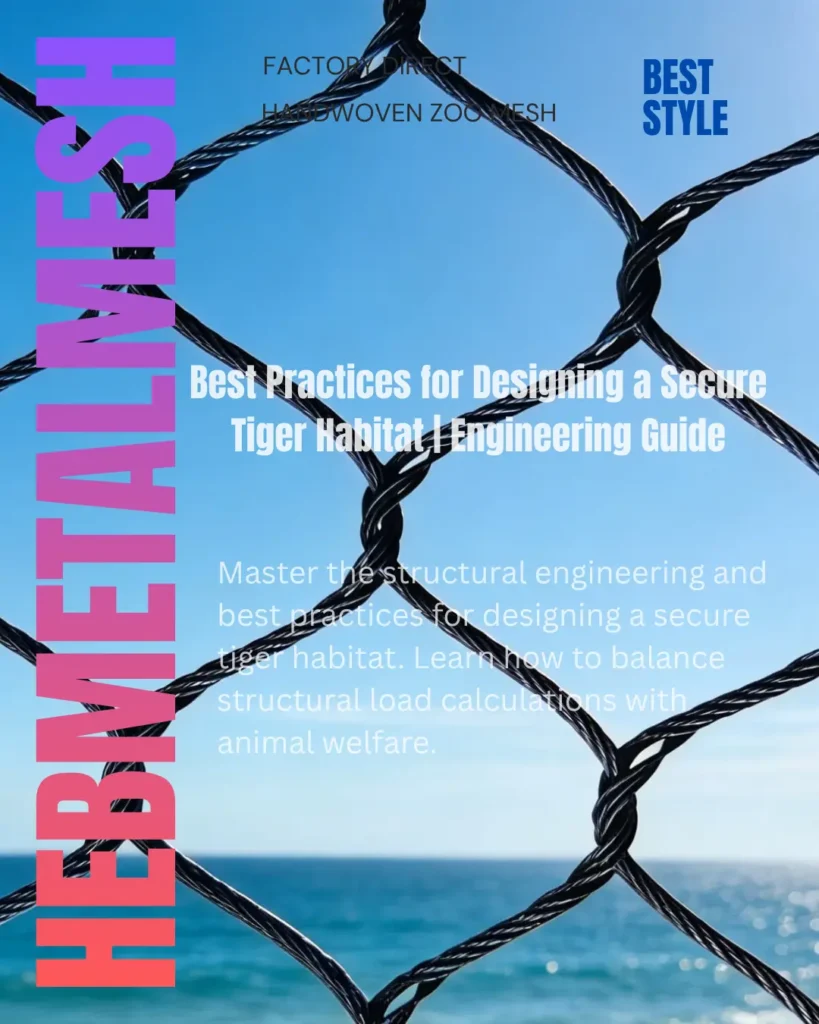
Adhering to best practices for designing a secure tiger habitat requires a dual focus on biomechanical containment and stress-reducing design. Engineering metrics dictate a barrier capable of withstanding dynamic kinetic impacts exceeding 15,000N while simultaneously remaining light-permeable. By replacing rigid containment barriers with high-tensile, 3D-deforming stainless steel rope netting, structural engineers can build expansive, multi-level enclosures that completely mitigate stereotypical pacing behaviors while guaranteeing absolute public safety.
Key Takeaways
- Enclosures must safely absorb dynamic, three-dimensional kinetic loads rather than relying on rigid resistance.
- Enrichment features like vertical climbing structures require integrated, load-bearing ceiling barriers.
- Aperture scaling must strictly prevent paw entrapment and claw leverage points.
- Unobstructed sightlines drop animal stress markers significantly, lowering liability risks.
1. The Physics of Containment: Mass vs. Velocity
When engineering containment boundaries for large carnivores, relying on static load calculations is one of the most dangerous mistakes an architectural team can make. A static load rating—the measure of how much dead weight a material can support while resting completely still—tells you almost nothing about how a perimeter wall will behave when a real-world crisis unfolds.
To establish true best practices for designing a secure tiger habitat, structural calculations must shift away from static mass and focus entirely on dynamic kinetic energy vectors.
An adult male Amur or Bengal tiger (Panthera tigris) can weigh upwards of 500 pounds (227 kg). However, their threat vector is not defined by their weight; it is defined by their explosive velocity. From a dead stop, a tiger can launch its massive frame horizontally or vertically at speeds hitting 16 m/s (around 35 mph).
When that animal leaps into a boundary wall, the impact forces are dynamic, instantaneous, and multi-directional. The ultimate kinetic energy (E_k) transferred to your perimeter fence is modeled by the classic physics equation:
Because velocity (v) is squared, even a minor increase in a tiger’s momentum causes an exponential spike in impact energy. A 227kg tiger striking a barrier at full speed generates a catastrophic spike of over 29,000 Joules of kinetic energy.
If your design team specifies rigid iron fences or low-tensile chain links based strictly on static dead-weight capacity, those panels will suffer instant plastic deformation or weld failure under dynamic shear stress. To safely absorb these dynamic vectors, the perimeter structure must possess extreme three-dimensional elasticity.
Before finalize structural load models, engineering teams should evaluate certified physical data sheets. Reviewing the raw tensile strengths listed on the hebmetalmesh product directory provides the baseline mechanical metrics required to build load-absorbing, flexible boundaries that cleanly withstand multi-ton dynamic impacts.
2. The Biomechanical Needs of the Species
An unyielding containment wall ignores the complex biological reality of the animal inside. Tigers are not flat, ground-dwelling creatures; they are incredibly agile, semi-aquatic apex predators with highly evolved vertical climbing and swimming capabilities. Designing a world-class habitat requires integrating these natural behaviors without creating architectural escape vectors.
Vertical Rock Faces and Elevated Platforms
To promote muscle tone and prevent psychological pacing, modern habitats feature high vertical rock formations, deadfall trees, and elevated resting platforms. Tigers naturally seek high ground to survey their territory.
However, every foot of elevation granted to the animal effectively shortens your vertical perimeter fence line. If a tiger is sitting on a 12-foot-high rock ledge, a standard 16-foot perimeter wall suddenly becomes a simple 4-foot hurdle. To counteract this biomechanical leverage, best practices mandate:
- Enclosure boundaries must incorporate comprehensive, outward-curved top overhangs or, ideally, full high-tensile overhead mesh canopies.
- Perimeter walls must be clear of any natural “step-up” structures that allow the animal to gain upward momentum near the boundary edges.
Deep-Water Features and Humidity Corrosiveness
Tigers routinely use deep pools, streams, and waterfalls for thermoregulation and behavioral enrichment. While water elements look spectacular, they create intense micro-climates characterized by high localized humidity and chemical clean-off runoffs.
Standard carbon steel grids, chain links, and poorly galvanized iron bars will quickly corrode at the water-to-air interface line, creating hidden structural rust scaling that can fail unexpectedly. If you are sourcing components for these wet, high-abuse zones, it is vital to know exactly where to buy heavy duty tiger cages for zoos that use marine-grade, handwoven stainless wire fabrics.
Specifying 316-grade stainless steel mesh guarantees complete immunity to moisture oxidation and heavy organic animal waste corrosion. This material resilience allows designers to route flexible boundaries directly through water features, over climbing zones, and across complex vertical rockwork without introducing structural seams, blind spots, or weak escape vectors at the roof perimeter.
3. Eliminating the Cage Mentality: The “Invisible Barrier”
The transition toward naturalistic habitat design is not merely an aesthetic choice to please zoo visitors—it is a critical requirement for the neurological and physical health of the animal. Modern zoological medicine and veterinary behaviorists have established a direct, undeniable correlation between the visual density of a containment barrier and the stress markers exhibited by large carnivores.
When an animal is surrounded by dense, opaque barriers like thick iron bars or heavy concrete walls, it triggers a psychological phenomenon known as “confinement claustrophobia.” The constant visual reminder of a hard boundary disrupts the animal’s natural territorial instincts. This visual confinement often leads to stereotypical pacing patterns, elevated cortisol levels, and heightened aggression along the perimeter lines.
To eliminate the “cage mentality,” architectural layouts must prioritize materials with low visual density that act as an invisible barrier. When evaluating light transmission metrics, the differences between traditional and modern materials are stark:
- Heavy Steel Bars: Depending on the thickness of the bar and the gap sizing required for safety, vertical iron bar configurations typically block 40% to 55% of natural light transmission. This high structural density casts harsh, artificial shadows across the exhibit space, restricting airflow and reinforcing a high-stress environment.
- Woven Stainless Steel Wire Mesh: Utilizing premium handwoven stainless steel mesh nets provides an open aperture design that achieves a spectacular light and air transmission metric exceeding 85% to 92%.
By allowing light, wind, and natural environmental scents to pass seamlessly through the boundary, the perimeter fence visually dissolves into the surrounding topography. The tiger perceives an open landscape rather than a restrictive wall, which dramatically reduces pacing triggers.
For engineers aiming to merge this psychological relief with uncompromised structural data, reviewing a dedicated factory inventory is the next logical step. You can examine the light-permeable aperture configurations and break-load data on the hebmetalmesh tiger enclosure fence netting mesh specification index to see how clear sightlines coexist with bulletproof apex-predator containment.
4. Specifying Material Safety Gauges
Achieving maximum visibility does not mean sacrificing structural thickness. To safely absorb the immense kinetic energy of a charging big cat, architects must understand the internal metallurgy and structural wire gauges of the containment medium.
When detailing flexible boundaries, standard single-strand wire (like that found in commercial chain links) must be banned from the blueprints. Instead, next-generation habitats rely on multi-strand stainless steel wire rope structures.
The Anatomy of 7×7 and 7×19 Wire Configurations
The terminology “7×7” or “7×19” describes the internal manufacturing geometry of the high-tensile steel rope.
7×7 Configuration
7×19 Configuration
- The 7×7 Structure: Composed of 7 structural strands, with each strand containing 7 individual wires twisted together around a core. This configuration provides excellent tensile strength and high stiffness, making it ideal for flat vertical walls where lateral deflection needs to be tightly managed.
- The 7×19 Structure: Composed of 7 structural strands, with each strand tightly weaving 19 individual micro-wires. Because it contains a significantly higher concentration of thin wires, the 7×19 configuration delivers elite flexibility without sacrificing a single pound of absolute breaking strength. It is capable of twisting, bending, and undulating tightly around complex organic frames, tree tunnels, and irregular overhead canopies.
Shock Absorption and the Eradication of Claw Penetration
Why do these knotted, twisted stainless steel cables outperform traditional rigid panels when a tiger strikes or climbs the fence? It comes down to material behavior under stress.
When an animal launches its weight into a rigid mesh panel, the impact force concentrates heavily onto the exact steel wires making physical contact. If the material cannot deform elastically, those wires snap or bend permanently out of alignment. Furthermore, rigid welded grids often provide uniform horizontal lines that allow an animal to slide its claws underneath the wires, using the mesh as a ladder. This leverage increases claw penetration, leads to torn paw pads, and inflicts structural damage on the joints.
| Safety Variable | Knotted/Twisted Wire Cable Mesh | Traditional Rigid Welded Mesh |
|---|---|---|
| Shock Absorption | High 3D elastic deflection; buffers kinetic impact safely | Zero deflection; transfers peak force back to the animal |
| Claw Penetration | Flexible diamond loops close under load, denying footholds | Rigid horizontal wires provide consistent ladder leverage |
Handwoven wire rope mesh features flexible diamond loops that actively shifting when pressed. When a tiger attempts to climb or strike a knotted cable boundary, the flexible lines shift subtly under the paw, denying the animal the rigid leverage point required to climb or pull. The twisted cable configuration naturally redistributes the shear stress diagonally across hundreds of intersecting wire knots.
To map these safety metrics into a complete structural blueprint, designers must match wire gauges with specialized engineering principles. If you are preparing your final construction specifications, ensure you integrate the core physical rules detailed in our technical guide on tiger cage design and choosing the right material to guarantee your habitat passes rigorous state and insurance safety audits.
5. Load Distribution Across Irregular Frames
The days of designing rigid, box-like enclosures with flat square walls are officially over. Modern zoological architecture embraces organic, undulating geometries that reflect natural landscapes. However, wrapping a perimeter boundary around uneven topography, living trees, and massive rock formations introduces massive structural engineering challenges.
When a containment barrier follows an irregular or curved frame, traditional rigid materials like welded panels or iron fencing fail completely. Forcing a rigid steel sheet to bend or contour creates intense internal structural stresses along the metal’s matrix. This warping compromises the material’s baseline breaking strength and leaves it highly vulnerable to unexpected failures under impact.
To safely execute these complex, organic layouts, architectural teams utilize flexible high-tensile mesh fabrics as a structural skin.
The Engineering of Three-Dimensional Tensioning
Handwoven stainless steel wire rope mesh behaves like a highly durable, high-strength fabric. Because the twisted steel cables are woven into an interlocking diamond web, the mesh can stretch, drape, and contour three-dimensionally across irregular steel hoops, structural arches, and natural anchors.
When a tiger charges or leaps into a curved, tensioned mesh boundary, the localized impact energy does not bottleneck at a single corner or anchor point. Instead, the organic geometry of the tensioned fabric uses its curved surface area to distribute the dynamic force across the entire multi-directional web. The stress flows smoothly down the continuous wire lines to your primary perimeter foundation posts, keeping the barrier completely secure.
Integrating Natural Topography Without Creating Seams
Utilizing flexible wire fabrics allows engineers to build habitats directly through complex environments:
- Tree Integration: Mesh canopies can wrap seamlessly around mature trees without cutting into the bark, allowing branches to grow naturally while maintaining a escape-proof seal.
- Rock and Grade Contouring: The mesh can be tailored to match the exact rising and falling lines of natural rock outcroppings and steep slopes, completely eliminating the need for extensive, costly grading and heavy concrete retaining walls.
To make this seamless integration work, contractors need access to large, custom-dimensioned mesh sheets woven to their exact project dimensions. Eliminating small, spliced field panels prevents hidden weak links from forming along your curved boundaries.
Engineering teams can evaluate full breaking strengths, custom roll sizes, and geometric tension tolerances by browsing the commercial hebmetalmesh store. Accessing direct factory fabrication metrics ensures that your irregular-framed designs remain structurally unbreachable.
Furthermore, moving past rigid grids to organic, woven steel fabrics allows you to comfortably meet the strict material guidelines enforced by wildlife agencies. If you are verifying your habitat configurations against state, federal, or international conservation codes, explore our deep-dive operational guide detailing the Regulations for Owning Exotic Animals Requiring Secure Housing to ensure your design comfortably passes every physical compliance inspection.
🔗 Want the full specs? See our Tiger Fence & Enclosure Guide — mesh sizes, SS304/316 cable options, and installation for zoo & sanctuary enclosures.
Bring Next-Gen Structural Integrity to Your Habitat Designs
Ready to spec world-class safety into your architectural blueprints? Download full engineering specifications and request custom-dimensioned mesh samples today.
Browse the Commercial StoreFrequently Asked Questions (FAQ)
A: A static load rating only measures the dead weight a material can support while completely at rest. However, a 500-pound tiger launching itself at a perimeter wall generates massive dynamic kinetic energy—often exceeding 29,000 Joules. Rigid materials specified using static calculations will easily snap or suffer permanent plastic deformation under these sudden, high-velocity shear forces. To ensure absolute safety, barriers must be engineered based on dynamic impact vectors and possess the elastic capacity to absorb and distribute sudden physical forces.
A: Tigers are highly territorial predators. When surrounded by dense, high-visibility boundaries like thick iron bars or concrete walls, they often experience confinement claustrophobia. This psychological stress directly triggers negative, stereotypical pacing behaviors along the fence line. Utilizing high-tensile boundaries with excellent light transmission (above 85%) creates an “invisible barrier” effect. This visually dissolves the perimeter into the surrounding landscape, allowing natural light and airflow to pass through, which significantly lowers animal stress markers. To review open-aperture styles that balance this psychological relief with bulletproof security, explore the hebmetalmesh tiger enclosure fence netting mesh technical catalog.
A: Multi-strand stainless steel wire rope configurations—specifically 7×7 and 7×19 structures—deliver the ultimate blend of elasticity and multi-ton breaking strength. The 7×7 configuration offers excellent structural stiffness for flat vertical perimeters, while the ultra-flexible 7×19 configuration twists easily around organic tree tunnels and irregular overhead canopies. Both options utilize interlocking handwoven knots rather than brittle welds, allowing the mesh fabric to deflect under impact and safely absorb intense kinetic payloads.
A: Integrating vertical rock faces, climbing trees, and elevated resting platforms is vital for a tiger’s physical fitness. However, every foot of elevation you give the animal effectively lowers your vertical fence line. If a tiger can leap from a 12-foot rock platform, standard vertical walls become easy escape vectors. Best practices dictate that multi-level habitats must incorporate integrated, high-tensile overhead mesh canopies or deep, outward-curved top overhangs to completely seal the environment. You can check out full thickness ratings and baseline tensile capacities for these large-scale spans on the main hebmetalmesh product directory.
A: Yes. Unlike rigid metal panels that distort or require heavy concrete retaining walls on slopes, handwoven stainless steel mesh functions like a high-strength architectural fabric. It contours seamlessly over uneven topography, rock formations, and around living trees without creating structural weak points or blind spots. Additionally, specifying premium 316-grade stainless steel ensures the barrier is completely immune to the intense humidity and corrosive elements found near tiger pools and streams.
To cross-reference your specific topography load calculations with factory manufacturing limits or to purchase custom-dimensioned rolls directly, access the commercial platform at the hebmetalmesh store.
Furthermore, ensuring your custom-contoured habitat complies with all regional wildlife mandates is essential for passing your final operational audit. Review the structural safety standards enforced by conservation bodies in our complete compliance guide on Regulations for Owning Exotic Animals Requiring Secure Housing.