
A containment structure contractor is not a fencing contractor with a larger order book. The company that builds an enclosure for a lion or a gorilla is selling a built work: a structure assembled on site, over a frame fabricated by another trade, using a panel that somebody else wove. The mill certificate that travels with the mesh covers the mesh. Nothing on an ordinary purchase order covers the assembly. This is a guide to qualifying the builder rather than the material: what to ask for, what to write down, and what has to be proven before an animal goes in.
Executive Summary
Containment fails at the joints, the fixings and the interfaces, and those are the parts no material certificate reaches. The maker warrants the panel, and the panel is rarely what fails. That asymmetry is why enclosure contractor selection carries more weight on a large-animal project than the choice of alloy. The question that qualifies a firm is not whether it has built a fence, but whether it has built a barrier against a load case that somebody wrote down and signed. The evidence that answers it is an enclosure contractor track record a zoo can verify and enclosure contractor references it can stand in front of, dated and still in service. The paperwork that protects the buyer is a containment structure contract naming the design responsibility, fixing the works package enclosure boundary, attaching the contractor insurance certificate and the performance bond, and holding a retention against the last defects. The event that proves the finished structure is a containment trial before occupation, not a walk round on the final afternoon. The reference specification is the stainless steel animal enclosure mesh product page.
Briefing builders on a containment project? Send the species and counts, the barrier length and height, the ground conditions and the handover date, and we will return the panel schedule, aperture and cable figures, edge cable and fixing allowance as one specification document.
Request a specificationQuick Answer:
A containment structure contractor is qualified on evidence rather than claims: a visitable reference installation of comparable scale, a written load case, an installed tension figure, and an as built containment record handed over at completion. Prequalification examines the company, the contract decides who owns the design, and witness testing followed by a containment trial decides whether the structure is fit to hold an animal.
Key Takeaways
- The panel is a product and the barrier is a built work, and only the second one contains an animal.
- The load case, not the fence height, is what separates an enclosure contractor from a fencing contractor.
- Design responsibility has to be named in writing, because an unnamed load case belongs to nobody.
- A performance bond and a defects liability period are what make the last five percent of a project happen.
- Containment is proven by a trial before occupation, and by nothing else.
Accreditation bodies treat containment as a continuing obligation rather than a one-off delivery, and the reference material on how a barrier is assessed and recorded is maintained by AZA.
A Containment Structure Is a Built Work, Not a Product
The distinction decides the whole procurement method. A product is made in a factory, measured against a drawing and shipped with a certificate. A built work is made on a site, in weather, to tolerances that move, by people who will not be there in ten years. The stainless steel rope mesh arrives as a product; the barrier has no factory behind it to blame.
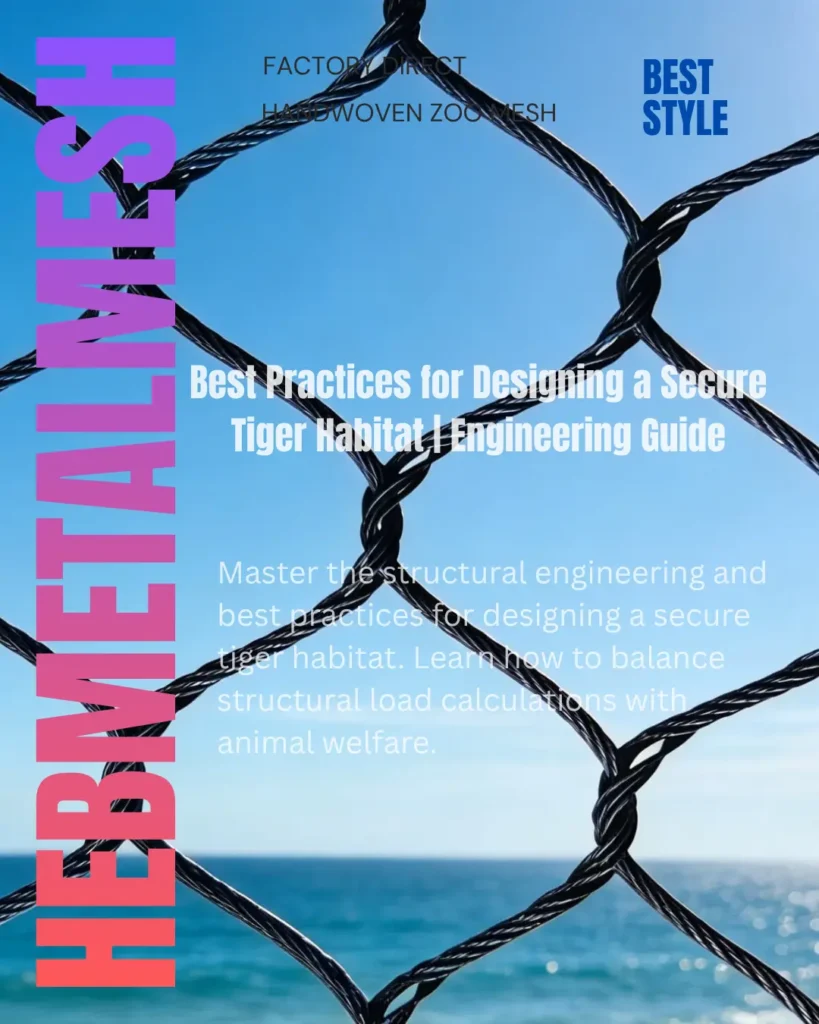
The mechanism matters here. A woven panel carries load in tension only, so it delivers its whole strength at its perimeter, and its perimeter is a top rail, an edge cable or a post set by another trade. The panel tolerates local damage; the connection that holds it has no such reserve. That is why a support structure is part of the containment argument rather than an accessory to it, and why we link our notes on the lion mesh support structure.
Three separate purchase orders produce three warranties and two gaps. One order produces a single firm to hold accountable.
Enclosure Contractor Selection Starts With the Load Case
Before price, before programme, ask for the load case. A containment barrier is designed against a stated load: an animal of a stated mass leaning its shoulder into the lower metre, a charge, a repeated push at a known point. Without that number a builder is guessing, and the guess will be the cheapest one that reads plausibly.
Four figures turn the brief into something a builder can price. Species and body mass set the load. The deflection allowed at the point of contact sets how much the barrier may move before failure is declared. Aperture is set by the smallest body that must not pass, which in a breeding group is a juvenile rather than the adult standing in front of you. Cable diameter is set by the strongest contact the animal makes, and it is an independent variable from aperture.
A general fencing contractor works from height and post spacing, because a boundary fence resists wind. A containment barrier resists an animal, and the two rules do not transfer.
How to Vet an Enclosure Contractor: Prequalification
Enclosure contractor prequalification is a document exercise, and it is worth doing properly because choosing an enclosure contractor on lowest price selects the firm least able to carry the interfaces.
Ask for a capability statement with named personnel rather than a brochure, a method statement written for containment installation specifically, and the name of the site supervisor who will actually be on the job.
Then test the track record. An enclosure contractor track record is only meaningful if it is dated: ask for two installations of comparable scale that are five years old and still in service, and go and look at them. A gallery of handover-day photographs proves nothing, because every barrier looks correct on the day it is finished. Enclosure contractor references should include the curator who now has to inspect the panel, not only the project manager who signed it off.
Compare that paper trail with the different evidence set a mesh maker must supply, which we set out in our guide to mesh factory qualification.
Design Responsibility: Who Owns the Drawing
Design responsibility is the clause that decides who pays when the barrier is wrong. In a design and build enclosure contract the builder takes the load case and turns it into steel. That is a perfectly good arrangement, provided the load case is written down and issued with the enquiry. If it is not, the contract transfers an undefined obligation, and a competent builder will price the cheapest defensible reading of it.
Whatever the arrangement, insist on a setting out drawing. The builder surveys the frame as built, not as drawn, because posts lean and bays are not square, and then issues the panel sizes, the edge details and the fixing schedule. That drawing is the document the whole job is measured against.
Ask where the drawing register is kept, how revisions are numbered and who signs them off. A revision that exists only in an email is a defect waiting for its first anniversary.

The Containment Structure Contract: Scope, Bond and Retention
A containment structure contract should state the works package enclosure in a way that can be priced and checked. Name the mesh, the frame, the footings, the anchors, the gate leaves, the edge treatment, the tensioning, the testing and the making good after testing. Then list what is excluded, because the exclusions are where two bids stop being comparable.
Insurance is not a formality on this kind of work. A contractor insurance certificate should cover public liability at a level that reflects a zoo’s visitor numbers, and contractor’s all-risk where the works disturb ground or operate near a live collection. A performance bond, typically ten percent of contract value, is what pays for the second attempt if the first builder stops. A retention held through the defects liability period is what closes the snag list.
The mesh is the one component in the package that arrives with mill evidence, and the one whose maker can prove what was melted: the stainless steel animal enclosure mesh range carries that documentation. Everything around it is built on site, which is exactly why the contract, not the certificate, is what protects the enclosure.
Proving the Structure Contains Before Animals Go In
A completed barrier is not a proven barrier. Four stages convert one into the other, and each ends with a signature.
| Stage | What it proves | Who signs |
| Installed tension check | The tension on the drawing actually exists in the steel | Builder and installer |
| Witness testing enclosure | The frame, anchors and terminations carry the design load | Structural engineer |
| Containment trial before occupation | No gap exceeds the aperture, leaves close, latches hold | Builder, curator, keeper |
| Staged occupation enclosure | The animal accepts part of the volume before all of it | Curator |
A load test on completion is the stage most often skipped on small projects and most often regretted on large ones, because it is the only moment when a hidden anchor can be loaded before an animal loads it. The containment trial matters as much: walk the perimeter with a tape and test every opening at the groundline, at the latch and at the corner post. Then stage the occupation, so a defect found on day one is found with the animal in a shift yard.
Run an escape risk assessment at each stage rather than a single one at the end, and write the animal introduction protocol into the handover pack.
What the Builder Must Understand About the Material
A hand woven mesh panel behaves as a textile, and a site team that has only fitted rigid grids will get it wrong in predictable ways. A welded grid loses a full intersection when a weld shears. A woven panel loses one wire, which costs roughly two percent of that strand’s breaking load, and the rest of the panel stays at tension. That difference is why local damage on a woven barrier is a repair and on a welded one is a section replacement.
The panel is a membrane, so it delivers its strength at its edge cable and at each swage ferrule termination. Those are the components the installer must protect, and the reason re-tensioning access has to be designed in. Deflection is the mechanism rather than a fault: a flexible barrier absorbs impact by moving, which means the supports are sized for travel, not only for load. Where a stainless panel meets a galvanised frame the two metals form a galvanic corrosion cell, so isolation washers at every fixing are a specification line, not a nicety. Fixings, tensioners and anchor plates add ten to twenty percent to a mesh-only rate, and the fabricated panel itself is covered in our note on the modular panel system.
Handing Over a Containment Asset, Not a Job
The handover pack is what a zoo is left with for the next twenty-five years, and it should read as an as built containment record rather than a delivery note. It contains the panel schedule as installed, the tension values recorded at each bay, the alloy grade and finish, the aperture with its tolerance, the heat numbers behind the wire, and photographs of the anchor and termination details before they were covered.
Order spare panels with the first delivery, while the loom is already set up. Agree in writing that the same specification can be reordered within ten years, which is a paperwork question that a builder can answer and a certificate cannot.
Then book the first re-tensioning visit for the season after handover, because a woven panel beds in. That visit is also the start of the inspection record, and it is the same file a barrier condition assessment will be built from years later, so it pays to get the format right once. The stage sequence that leads to it is set out in our guide to mesh lead time.
FAQ
A fencing contractor builds a boundary to resist wind, and works from height and post spacing. A containment structure contractor builds a barrier to resist an animal, and works from a load case, a permitted deflection and an installed tension figure. The trades overlap; the engineering does not.
Run a prequalification check on documents and evidence: a named supervisor, a method statement for containment work, an insurance certificate, a bonding capacity, and at least two reference installations of similar scale that are several years old and still in service.
Whoever the contract says. If design responsibility sits with the builder through a design and build enclosure contract, the builder owns the load case and the failure. If the buyer issued the design, the buyer owns it, which is why the load case must be issued in writing with the enquiry.
An as built containment record: panel schedule, recorded tensions, alloy and finish, aperture and tolerance, wire heat numbers, photographs of concealed anchors and terminations, spare panels, and a booked first-season re-tensioning visit.