
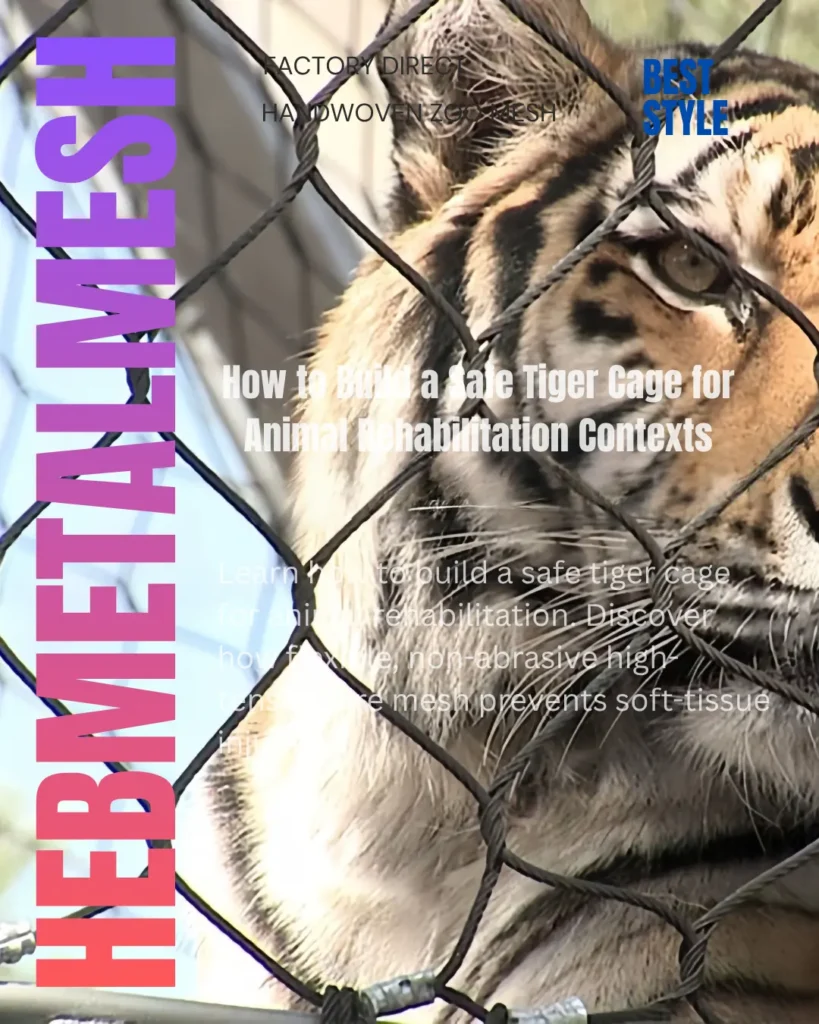
Discovering how to build a safe tiger cage for animal rehabilitation requires a fundamental shift away from punitive, hard-surface confinement. Injured, stressed, or rescued big cats are highly prone to self-trauma, broken teeth, and nose-rubbing against rigid steel bars. Utilizing flexible, non-abrasive handwoven stainless steel rope netting provides an incredibly forgiving, high-tensile perimeter. This advanced setup successfully absorbs panicked impacts while protecting delicate claws, coats, and dental health throughout the animal’s recovery cycle.
Key Takeaways
- Rehabilitation habitats must prioritize soft-surface interfaces to prevent self-mutilation and panic injuries.
- Smooth, knotless, or hand-twisted stainless steel wire structures protect big cat fur and paw pads from deep abrasions.
- Flexible barriers dramatically reduce impact-related skeletal trauma in highly stressed, rescued wildlife.
- Modular, high-tensile mesh systems adapt beautifully to fast-rolling assembly parameters in remote environments.
1. The Psychology of Rescued Apex Predators
When drafting containment strategies for sanctuaries, rescue centers, and rehabilitation facilities, engineers must discard the design assumptions used for standard zoological exhibits. There is a profound behavioral and psychological gap between zoo-bred tigers (Panthera tigris) and wild-caught or abused rescues. Understanding this psychology is the first critical milestone when mastering how to build a safe tiger cage for animal rehabilitation.
Zoo-bred apex predators are conditioned to human presence, machinery noises, and artificial boundaries from birth. In contrast, rescued tigers—often seized from illegal backyard menageries, roadside attractions, or the black-market pet trade—frequently suffer from severe, deeply ingrained psychological trauma.
When these animals arrive at a legitimate rehabilitation facility, the transition triggers extreme fight-or-flight responses. Behavioral experts note several high-risk patterns unique to rescued carnivores:
- Frantic Wall-Charging: Startled by novel stimuli, a traumatized rescue will frequently launch a full-speed horizontal charge directly into perimeter walls, indifferent to its own safety.
- Persistent Fence Pacing: Chronic stress manifests as endless pacing along boundary lines, putting continuous, localized friction and mechanical wear on the lower sections of the barrier.
- Aggressive Escape Attempts: Rescued animals will actively search for micro-vulnerabilities, trying to force their jaws into gaps or use their weight to pull down seams.
Because of these erratic behaviors, temporary or light-gauge holding structures represent an immediate safety breach. To secure your sanctuary against these extreme stress vectors, the perimeter framework must be built using specialized materials. Reviewing the certified gauge ratings and structural load maximums listed on the hebmetalmesh product directory provides the foundation data necessary to design an enclosure capable of safely managing unpredictable behavioral spikes.
2. Preventing Self-Trauma: The Danger of Rigid Enclosures
The primary goal of an animal sanctuary is rehabilitation, yet traditional rigid enclosure designs often inflict severe physical trauma on stressed rescues. When a terrified, 500-pound tiger encounters unyielding resistance, its natural instinct is to push through, chew, or fight the barrier, leading to self-inflicted injuries.
The Clinical Hazards of Rigid Barriers
Traditional materials like vertical iron bars, concrete walls, and heavy-gauge rigid welded wire panels pose severe clinical risks to large carnivores:
- Fractured Canines: When a rescue aggressively bites at rigid iron bars or unyielding welded wire grids out of frustration or fear, the hard steel easily fractures their vital canine teeth. This leads to deep nerve exposure, severe infections, and the need for complex, painful veterinary dental surgeries.
- Nose-Rubbing Infections: Pacing animals continuously rub their snouts along rigid, high-friction vertical lines. This repetitive rubbing strips away skin and protective hair, causing open, bloody facial lacerations that are highly susceptible to opportunistic bacterial infections.
- Joint and Musculoskeletal Trauma: If a tiger charges a rigid wall, the unyielding surface bounces the massive kinetic energy payload back into the animal’s skeletal frame, frequently causing dislocated shoulders, spinal trauma, and torn ligaments.
The Physics of Deceleration: Elastic Deflection vs. Rigid Resistance
To eliminate these severe medical risks, modern sanctuary architecture relies on the physics of three-dimensional elastic deflection.
When an animal impacts a handwoven stainless steel wire rope mesh net, the flexible fabric stretches and deforms dynamically under the load. Instead of stopping the animal instantly, the mesh safely decelerates its momentum over a few crucial inches—acting like an engineered catch net—before snapping back to its original shape.
This elastic buffer minimizes impact forces on the animal’s skeletal system and prevents their teeth from catching on rigid edges. To learn more about implementing these safety features into your structural layouts, review our specialized manual on Best Practices for Designing a Secure Tiger Habitat.
Furthermore, ensuring your material selections align with advanced veterinary parameters is essential for passing global welfare audits. If you are refining your architectural layouts, review the specific physical performance charts on the hebmetalmesh tiger enclosure fence netting mesh directory to choose an aperture and wire thickness that completely eliminates snout traps, claw catching, and teeth snapping.
3. Designing a Stress-Minimized Medical Separation Space
Within a rescue or rehabilitation infrastructure, the medical separation space is the most high-intensity zone. Stressed, injured, or newly quarantined apex predators must be monitored, treated, and moved between holding areas without facing additional physical risks. Integrating transfer tunnels, shift gates, and medical quarantine zones requires a complete departure from rough, industrial metal fabrications.
Rescued big cats are prone to panic when confined in tight spaces like transfer chutes or squeeze cages. If these structures feature rough zinc galvanization scales, jagged weld beads, or sharp wire ends, a thrashing animal will suffer immediate skin tears and deep lacerations.
To eliminate these hazards, facilities specify high-tensile, handwoven stainless steel wire rope mesh for internal separation partitions, shift tunnels, and overhead containment caps. The smooth, hand-knotted intersections of the woven cables feature no sharp burrs, ensuring that even if an agitated tiger presses its face or paws firmly against the barrier, it cannot slice its skin.
| Sanitation Variable | Smooth SS304 Woven Mesh | Rough Galvanized Welded Wire |
|---|---|---|
| Surface Micro-Porosity | Near Zero; perfectly smooth chemical barrier | High; zinc scaling traps bacteria and organic matter |
| Chemical Washdown Tolerance | Withstands high-pressure steam & aggressive oxidizers | Corrodes under heavy chemical sanitizers |
Furthermore, medical containment requires strict biochemical management. Stressed or sick rescues often shed high volumes of viral and bacterial pathogens. Traditional galvanized fencing possesses a rough surface texture with microscopic pits and zinc scaling that trap blood, feces, urine, and biological waste. These contaminants resist standard spraying, turning the fence line into a breeding ground for cross-contamination.
Utilizing premium Grade 304 or 316 stainless steel wire fabrics provides an ultra-smooth, non-porous finish. This allows veterinary teams to use high-pressure steam, bleach, and harsh chemical oxidizers to maintain an aseptic, easily sanitized quarantine environment without risking structural rust or material breakdown.
San sanctuary engineers can review full chemical-resistance sheets and technical layout designs by exploring the hebmetalmesh tiger enclosure fence netting mesh directory. Selecting these veterinary-grade materials allows facilities to balance clean medical protocols with uncompromised physical security.
4. Cost-Effective Deployment Strategies for Sanctuaries
Non-profit animal sanctuaries and wildlife rescues operate under intense financial scrutiny. Unlike commercial zoos backed by corporate sponsorships or municipal tax bases, sanctuaries survive on limited private donations and conservation grants. In this economic environment, optimizing every dollar requires looking past the initial purchase price and focusing heavily on long-term asset lifecycles.
Many facilities fall into the trap of purchasing cheap, low-grade galvanized chain-link fencing or basic welded wire grids to save money during initial construction. This choice quickly backfires, leading to a constant cycle of maintenance expenses:
- Recurring Patch-Welding Labor: Stressed rescues constantly strain, pull, and test weak boundaries. Within 3 to 5 years, broken welds and stretched links force maintenance crews to perform ongoing patch-welding, bleeding away precious operational funds.
- Frequent Full Replacements: Once deep rust compromises the structural integrity of carbon steel fencing, patch-welding can no longer guarantee safety. The facility is forced to completely tear down and replace entire perimeter sections, paying for new materials and labor all over again.
- Operational Downtime: Replacing a compromised perimeter wall requires tranquilizing the animals or shifting them into cramped holding spaces, disrupting the facility’s routine and stressing the rescues.
Investing in a 30-to-50-year maintenance-free material like handwoven stainless steel mesh completely rewrites this math. Because premium stainless steel wire rope resists corrosion, UV degradation, and physical impact fatigue, it requires zero structural maintenance after installation.
Sanctuary directors can review pricing, roll specifications, and volume options on the commercial hebmetalmesh store to align their long-term budgets with durable solutions. Eliminating recurring patch repairs allows non-profit managers to redirect their valuable capital away from fence upkeep and straight into animal nutrition, enrichment, and hands-on veterinary care.
To see how these durable materials perform when applied by commercial development teams, review our comprehensive contractor playbook detailing the top companies that build large animal containment structures. This resource helps estimators connect long-term material value with safe, professional construction practices.
5. Optimizing Visibility for Continuous Veterinary Monitoring
The final pillar of rehabilitative design is veterinary monitoring. Traumatized rescues require continuous visual evaluation to spot early signs of illness, tracking-gait abnormalities, or wound healing progress without forcing staff to constantly enter their space.
Traditional thick iron bars cast deep, artificial shadows that hide an animal’s subtle movements, while high-glare galvanized fencing makes it difficult to monitor tracking via remote camera systems. Utilizing handwoven stainless steel wire fabrics achieves an open aperture design with over 90% clear light transmission.
This uncompromised visibility gives veterinary teams a crystal-clear view of the animals from safe observation points, ensuring accurate health tracking while giving the animals the open, stress-free environment they need to fully recover. To verify full mesh sizing criteria and examine how these clear lines are manufactured, look through the main hebmetalmesh product catalog to lock down the ideal layout specifications for your facility.
🔗 Want the full specs? See our Stainless Steel Tiger Mesh — mesh sizes, SS304/316 cable options, and installation for zoo & sanctuary enclosures.
Humane Containment Solutions for Sanctuaries Worldwide
Protect your rescued big cats from self-trauma with our ultra-smooth, high-tensile handwoven wire mesh. Contact us for specialized non-profit pricing packages.
Order Custom Mesh SamplesFrequently Asked Questions (FAQ)
A: Unlike zoo-bred tigers that are accustomed to human presence, rescued tigers often suffer from deep psychological trauma due to past abuse or confinement. When introduced to a new environment, they frequently exhibit intense flight-or-flight responses, such as frantic wall-charging, aggressive chewing, and persistent fence pacing. This unpredictable behavior requires a highly secure containment layout that avoids rigid, low-tensile materials. To learn how to safely manage these extreme stress vectors, review our detailed guide on how to build a safe tiger cage.
A: When a panicked, 500-pound tiger charges or bites an unyielding rigid surface, the barrier bounces the peak kinetic impact force directly back into the animal. This frequently results in broken canine teeth, severe nose-rubbing lacerations, and serious joint or spinal trauma. Flexible handwoven wire rope mesh utilizes three-dimensional elastic deflection to safely buffer and decelerate the animal’s momentum like an engineered safety net, completely preventing self-trauma. To review full flexibility specifications and material metrics, view the hebmetalmesh product catalog.
A: Quarantine and medical spaces require strict sanitation protocols to prevent pathogen cross-contamination. Traditional galvanized wire features a rough, porous surface with microscopic pits that trap feces, blood, and urine, resisting standard washdowns. Grade 304 stainless steel offers an ultra-smooth, non-porous finish with zero sharp wire burrs. This allows veterinary teams to continuously sanitize the environment using high-pressure steam and aggressive chemical oxidizers without causing structural rust or scratching the animal’s skin. You can view custom quarantine mesh options within the hebmetalmesh tiger enclosure fence netting mesh directory.
A: While low-grade galvanized chain-link or welded grids have a cheaper upfront cost, they trap sanctuaries in an expensive cycle of recurring maintenance. Stressed animals quickly break welds and stretch links, forcing crews to perform constant patch-welding before the entire rusted structure eventually requires a costly, full replacement. Investing once in a 30-to-50-year maintenance-free material like handwoven stainless steel mesh completely eliminates these recurring labor and material expenses, allowing directors to channel valuable donor capital straight into animal care. Sanctuaries can explore direct-from-factory pricing and custom roll sizes at the commercial hebmetalmesh store.
A: Rehabilitating rescued big cats requires continuous, non-intrusive observation to track wound healing, behavioral changes, and gait alignment. Heavy iron bars cast deep, artificial shadows that obscure these details, while high-glare fencing disrupts remote camera tracking. Handwoven stainless steel wire netting delivers a seamless diamond pattern that provides over 90% clear light transmission. This uncompromised visibility allows veterinary staff to maintain flawless observation from a safe distance. Discover how to incorporate these high-visibility metrics into your civil blueprints by reviewing our technical manual on Best Practices for Designing a Secure Tiger Habitat.
For sanctuary operators navigating the complex intersection of animal welfare and civil liability, matching your material choices with verified construction partners is critical. Review our industry breakdown of the top companies that build large animal containment structures to ensure your facility comfortably passes every state and federal regulatory audit.