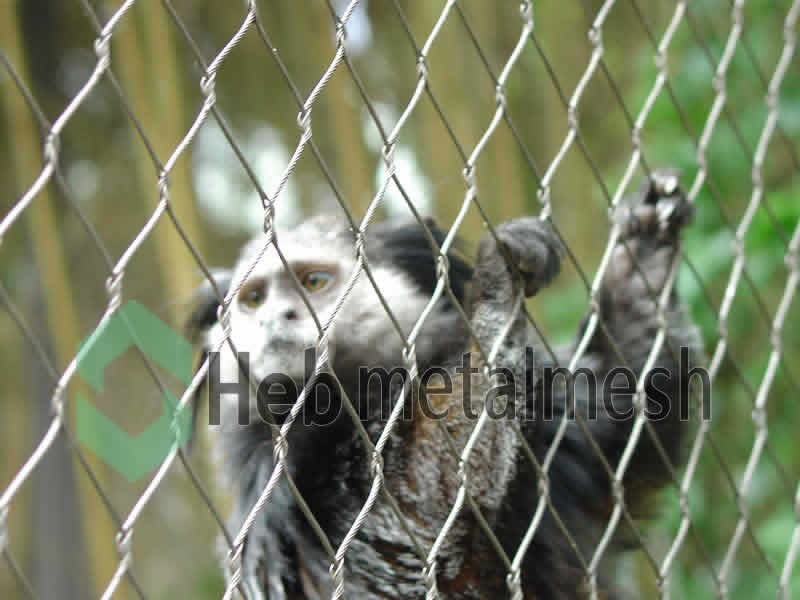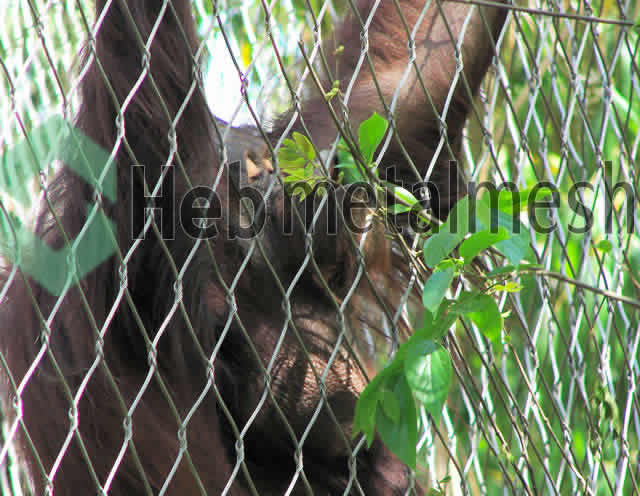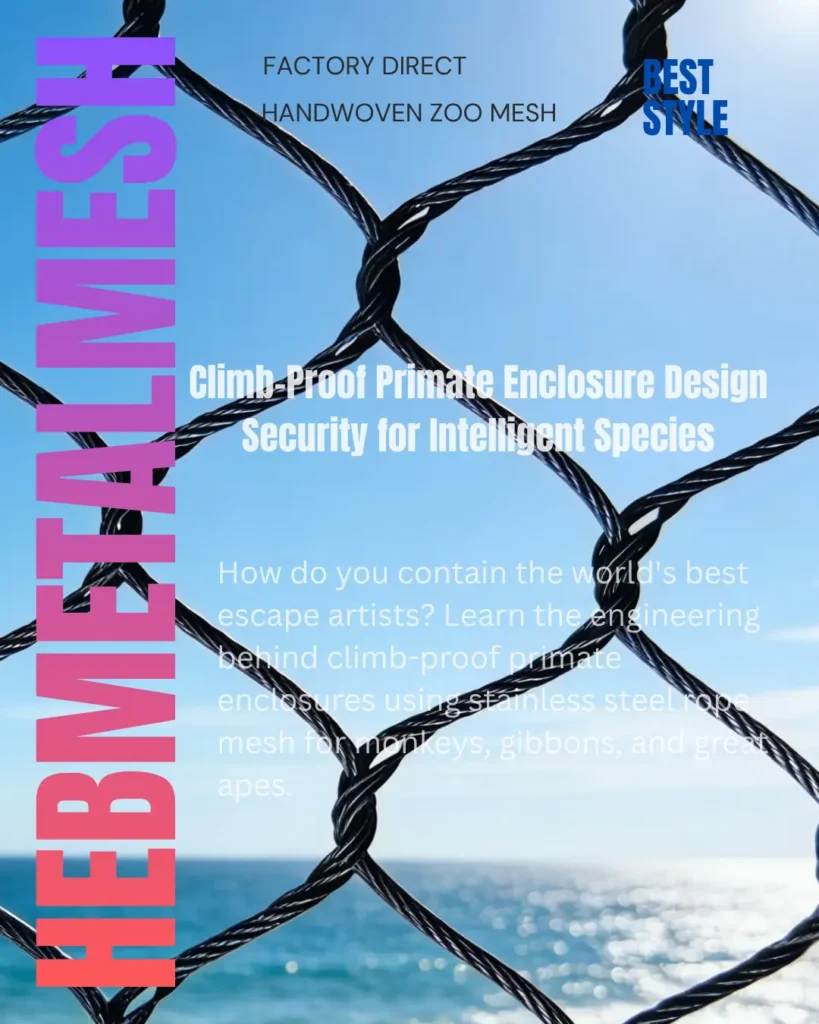
How do you make a primate enclosure climb-proof? Modern primate containment relies on non-linear surface tension and aperture restriction. By using hand-woven stainless steel rope mesh, designers eliminate the rigid “ladder effects” found in traditional bars or chain-link. The flexible nature of the mesh provides no stable foothold, while the smooth 316-grade steel resists gripping, ensuring that even the most intelligent primates—from marmosets to chimpanzees—remain securely and safely contained.
I. Introduction: The Primate Problem
If you’re managing a primate habitat, you aren’t just fighting gravity and physics—you’re fighting intelligence.
A tiger might try to power through a fence, and a bird might try to fly over it, but a primate? A primate looks at a fence and asks, “Where is the weak point?” They don’t just see a barrier; they see a puzzle waiting to be solved. Whether it’s a mischievous capuchin or a 400-pound silverback, primates possess a unique combination of high-cognitive problem-solving and extreme grip strength that makes them the ultimate escape artists of the animal kingdom.
The Challenge: Intelligence Meets Power
The engineering challenge is twofold. First, you have the grip strength: a chimpanzee, pound for pound, is significantly stronger than a human athlete, capable of generating immense leverage on any fixed point. Second, you have the dexterity: their ability to manipulate wires, untwist ties, and pick at welds is unparalleled. If there is a loose nut, a sharp edge, or a repeatable pattern they can exploit, they will find it.
The Shift: Enrichment-Based Security
For years, the solution was simply “more steel.” We built heavy, oppressive cages that kept them in but crushed their spirit. Today, the industry is shifting. We are moving toward enrichment-based security. The goal is to create a perimeter that is so secure it allows the interior of the habitat to be more natural. By using flexible, high-tensile materials like stainless steel rope mesh, we provide a safety net that allows primates to climb, jump, and display natural behaviors without the risk of a breach.
II. Why Traditional Fencing is a Primate “Ladder”
To understand why modern zoos are moving away from traditional materials, we have to look at the “failure modes” of old-school fencing. In many ways, traditional materials like chain-link and iron bars actually invite the very escapes they are meant to prevent.
The Chain-Link Trap: The Perfect Staircase
Chain-link is perhaps the most common fencing on the planet, and for primates, it is also the most helpful. The fixed, interlocking “knuckles” and the uniform diamond pattern of chain-link provide a predictable, stable staircase.
- The Grip Factor: The wire is thin enough for small fingers to wrap around completely, allowing for a “power grip” that makes climbing effortless.
- The Maintenance Nightmare: Primates love to find the “pigtails” at the top or bottom and untwist them. Once one wire is loose, the structural integrity of the entire panel begins to unravel.
The Bar Problem: Lateral Bypass and Weld Fatigue
Vertical bars seem secure, but they fail the “Intelligence Test.”
- Lack of Multi-Directional Security: While bars prevent direct forward movement, they offer no resistance to lateral (sideways) movement. Intelligent species can “shimmy” up bars using friction or find leverage points at the horizontal cross-beams.
- Weld Points: Every bar is held in place by a weld. Primates are masters of finding the “vibration frequency” of a cage. By repeatedly shaking or jumping against a rigid bar, they can create stress fractures in the welds over time. Once a single bar pops, the gap is often wide enough for a limb—or an entire animal—to pass through.
The Rigid Failure: Exploiting Vibration
This is the hidden danger of “stiff” metal. Rigid structures don’t dissipate energy; they store it. When a primate repeatedly slams against a rigid fence, that energy has nowhere to go but into the joints and fasteners.
Eventually, the metal becomes “fatigued” and snaps. This is why a flexible, hand-woven mesh is superior. Because the monkeys netting mesh is not rigid, it absorbs the kinetic energy of a jump or a pull and spreads it across the entire surface area. There are no welds to snap and no rigid “rungs” to climb. You aren’t giving them a ladder; you’re giving them a surface that refuses to be conquered.
III. The Engineering of “No-Grip” Mesh
If traditional fencing is a ladder, then stainless steel rope mesh is a “glitch” in a primate’s climbing strategy. At hebmetalmesh, we’ve engineered our products to exploit the sensory and physical preferences of primates, turning their own biology against their escape attempts.
Variable Apertures: The Precision of the Diamond
The “aperture” (the size of the diamond opening) is your first line of defense. A hole that is too large allows for a “foothold,” while a hole that is too small for the species can lead to caught fingers. We match the diamond size to the specific anatomy of the animal. For smaller, more delicate species, it is vital to use restricted openings.
- Expert Tip: Check our specific monkeys netting mesh specs to find the exact aperture-to-wire-diameter ratio that prevents “finger-wrap” leverage.
The Elasticity Factor: Stability is the Enemy
Primates are masters of movement, but they require a stable base to generate power. Traditional bars provide that stability. Rope mesh, however, possesses an inherent elasticity. When a 50lb monkey jumps onto the mesh, the surface “gives” and sways slightly.
This swaying motion is psychologically discouraging. Most primates prefer a firm, predictable substrate for climbing. When the surface moves under their weight, it disrupts their center of gravity and makes them feel insecure, naturally reducing their desire to scale the perimeter.
316 Stainless Smoothness: Denying the Friction Grip
Traditional iron or galvanized steel develops a microscopic “tooth” or texture as it rusts. This texture provides the friction necessary for a primate’s skin or fur to “stick” to the surface.
Our 316-grade stainless steel is polished to a level that minimizes friction. When treated with our signature Black Oxide finish, the surface becomes even smoother. Without that “micro-grip” provided by rust or rough coatings, a primate’s hands and feet have to work significantly harder to maintain a vertical position.
IV. Species-Specific Design (The “Expert” Section)
Not all primates play by the same rules. A gibbon’s movement is entirely different from a gorilla’s brute force. To build a truly “climb-proof” enclosure, you must design for the specific locomotion of the resident.
The Brachiators (Gibbons): The Sky is the Limit
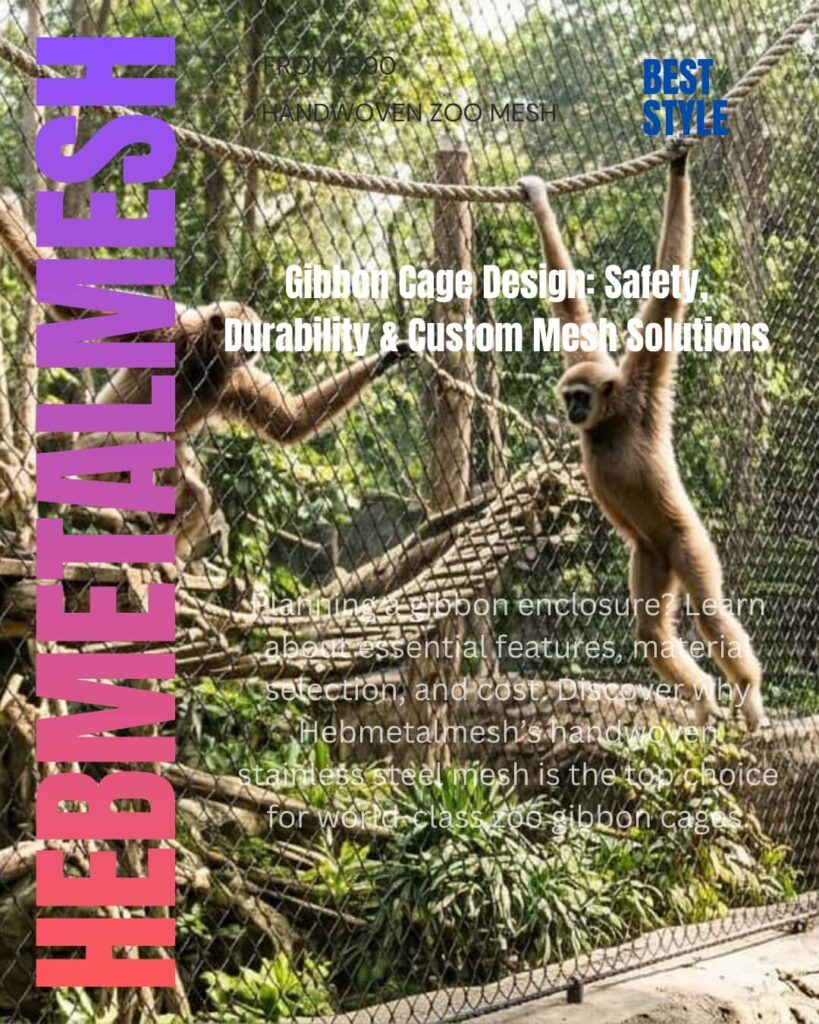
Gibbons are the masters of “brachiation”—swinging through the air with long, powerful arms. For these species, the enclosure isn’t just a wall; it’s a three-dimensional playground.
- The Focus: High-ceiling tension. You need a mesh that can handle the high-velocity “impact and release” cycle of a swinging ape.
- The Solution: We recommend a high-tension lacing system that turns the roof into a functional part of the habitat. For a deeper look at these soaring habitats, see our guide on gibbon enclosure fence netting.
The Powerhouses (Great Apes): Managing the E_k
Chimpanzees, Orangutans, and Gorillas don’t just climb; they “test.” They will throw their entire body weight ($m$) at high velocity (v) against the barrier. As we discussed in Post 1, the Kinetic Energy involved is staggering.
- The Spec: We utilize a 3.2mm cable thickness for these heavy hitters. The rope mesh acts as a shock absorber, dissipating that energy across thousands of hand-woven knots. This prevents the “bowing” or snapping commonly seen in welded wire when hit by a 200lb ape.
The Small & Nimble: Avoiding the Entrapment Trap
For Lemurs, Marmosets, and Squirrel Monkeys, the danger isn’t escaping by force—it’s getting stuck.
- The Focus: Micro-apertures. If a small primate can get its head or a limb through a hole but can’t pull it back, the result is often fatal.
- The Strategy: We utilize high-density weaves with apertures as small as 25mm x 25mm. This keeps their nimble fingers busy on the inside of the mesh while ensuring they can’t get enough “poke-through” to reach the structural cables or lacing on the outside.
V. Installation Tactics: The “Overhang” and “Inward Curve”
Even with the world’s best mesh, the geometry of your enclosure is what ultimately seals the deal. Because hebmetalmesh is a flexible fabric rather than a series of rigid panels, it allows for architectural maneuvers that are impossible with standard fencing.
Geometric Security: The 45-Degree Advantage
The most effective way to stop a vertical climber is to change the angle of the “wall.” In primate design, we often utilize the mesh’s flexibility to create a 45-degree inward-curving overhang or a complete “coved” ceiling. When a primate reaches an inward curve, their center of gravity shifts. They are forced to move from a vertical climb to an inverted “hanging” position. For many species, this transition is a major psychological and physical deterrent. Because our mesh can be tensioned into these organic shapes, you can create a seamless transition from wall to ceiling without the sharp corners or structural gaps that occur when trying to angle rigid bars.
Integrated Enrichment: Security that Works Double Duty
One of the biggest “Aha!” moments for keepers is realizing the mesh can actually be the playground. In a traditional cage, you have to be careful about where you bolt hammocks or ropes—if you put them too close to the fence, you’re just giving the animal a boost over the top. With high-tensile stainless steel mesh, you can:
- Anchor Directly: Small enrichment items can often be laced directly into the mesh (provided the structural frame is rated for the load).
- Create Tunnels: Use the mesh to build overhead “chutes” or transit tunnels between habitats.
- Maximize Space: Because the mesh is climb-proof, you can utilize every square inch of the enclosure for climbing branches and platforms without fearing that a nearby branch will become an escape ramp.
VI. Conclusion: Safety for the Animal, Peace for the Keeper
Building a primate enclosure shouldn’t feel like building a prison; it should feel like building a fortress that looks like a forest. By moving away from the “ladder” of traditional fencing and embracing the “invisible” security of 316-grade stainless steel rope mesh, you are solving three problems at once.
The True ROI of Primate Mesh
- Zero Escapes: You eliminate the weld failures and untwisted wires that lead to 2:00 AM emergency calls.
- Animal Welfare: You remove the risk of “Zinc Poisoning” from galvanized wire and the broken teeth or trapped fingers associated with rigid bars. Happy, healthy primates are more active and engaging for visitors.
- Near-Zero Maintenance: While other facilities are repainting rusted bars or patching chain-link holes, your hebmetalmesh installation will remain structurally sound and visually clear for 30+ years.
Investing in high-grade mesh isn’t just about containment—it’s about the peace of mind that comes from knowing your most intelligent residents have finally met their match.
Ready to Outsmart the Escape Artists?
Get the technical specs for our 316-grade stainless steel primate mesh. Trusted by world-class zoos and sanctuaries.
Custom Apertures | Hand-Woven Quality | Global Delivery
Frequently Asked Questions: Primate Enclosure Engineering
No. While many primates have incredible jaw strength, 316-grade stainless steel has a surface hardness that far exceeds dental enamel. Unlike plastic-coated wires or soft galvanized steel, the rope mesh cannot be frayed or “chewed through.” Furthermore, the hand-woven knots are designed to be smooth, ensuring the animal doesn’t break a tooth if they attempt to bite the barrier.
Aperture selection depends on the “finger-wrap” and head size of the species.
For Small Primates (Marmosets/Lemurs): We recommend a 25mm x 25mm or 38mm x 38mm aperture to prevent limb entrapment.
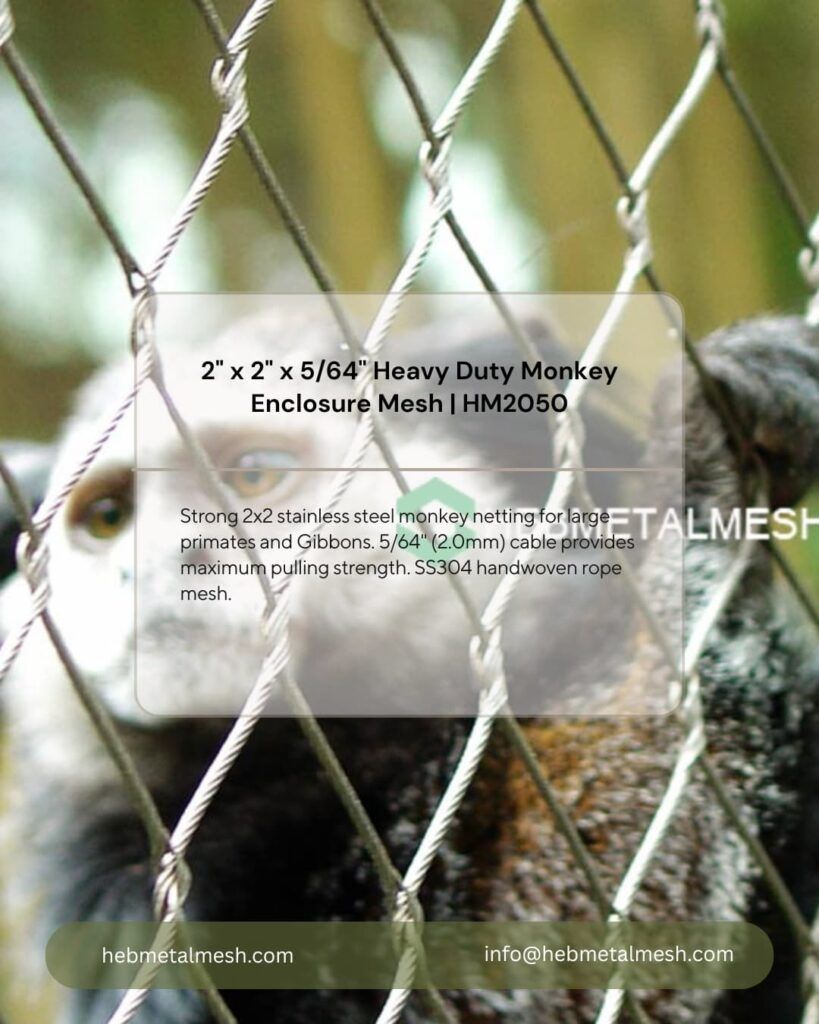
For Large Primates (Gibbons/Chimps): A 50mm x 50mm or 60mm x 60mm aperture is standard.You can view specific dimensions on our monkeys netting mesh product page.
Actually, it’s the opposite. Traditional welded wire often has sharp “burrs” or jagged edges at the weld points. Our mesh is hand-woven, meaning every intersection is smooth and rounded. The flexibility of the mesh also acts as a shock absorber, reducing the impact on joints and ligaments when an animal jumps against the perimeter.
For species that forage or dig, we recommend an “L-shaped” floor buffer. The stainless steel mesh is extended 30-50cm underground and bent inward toward the habitat. This ensures that if an animal attempts to dig at the fence line, they simply encounter more mesh, preventing them from undermining the structural perimeter.
For the visitor experience, yes. Natural stainless steel can create a “glint” or reflection that reminds the primate (and the visitor) that a barrier exists. The Black Oxide finish absorbs light, making the mesh nearly invisible. This reduces the “caged” feel and has been shown to lower stress levels in intelligent species by providing a more open, naturalistic visual field.