
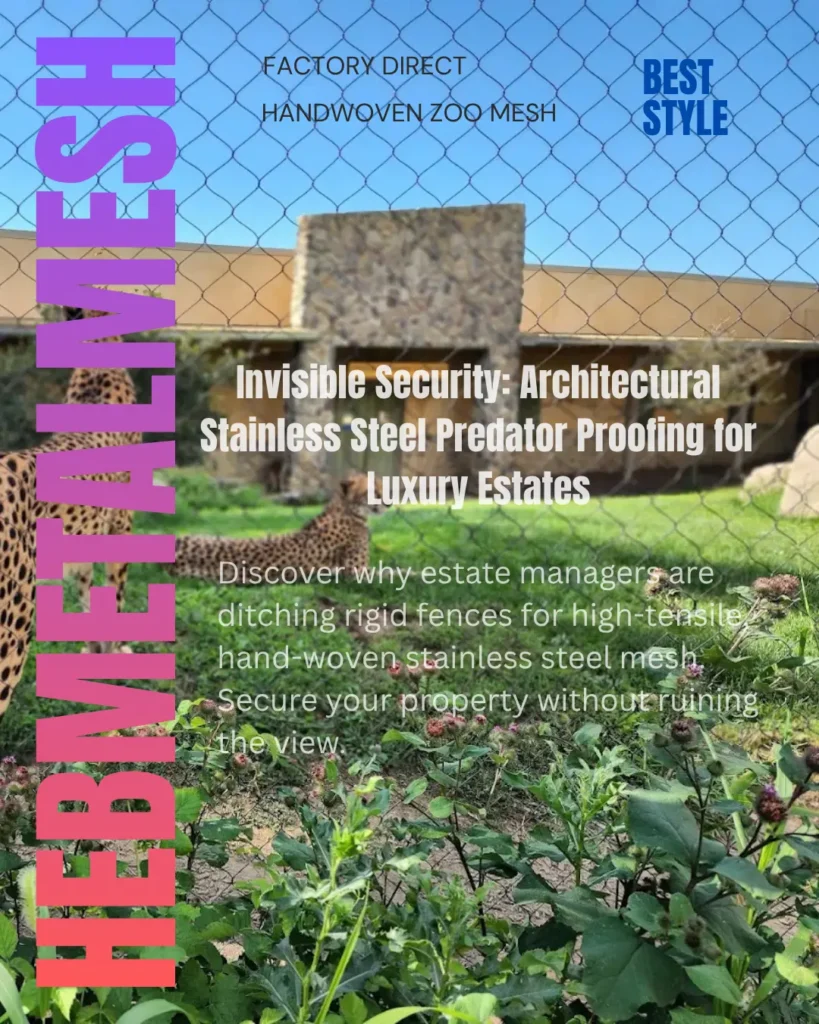
A leopard is the one big cat that spends a working part of its life in a box: not a display barrier, but a cage that gets wheeled to a door, docked against it and lifted onto a trailer. Every other specification on this site describes a surface that stands still; this one describes an object that moves, so it has to be light enough to lift, small enough that the animal is never more than an arm’s length from the mesh, and clean enough to hose out each morning.
Executive Summary
A leopard handling cage is specified by mass rather than by span, and by what happens at contact rather than under load. The animal is always close to every surface, so claw abrasion and paw reach set the aperture, while washdown and urine at the floor line decide the grade. A leopard is also solitary, so its accommodation is a suite of units — a leopard night cage, a display, a shift cage, a leopard transfer crate and a crush cage — each asking something different of the same mesh. The reference specification is the Leopard Enclosure Netting product page.
Building a holding cage, shift cage or transfer crate for a big cat? Send the species, the units you need, the mass limit for anything that moves and how a keeper gets the animal in and out. We will return the aperture, cable, alloy and door schedule.
Quick Answer:
Quick Answer: A leopard handling cage is built from a frame and mesh panels, and the mesh is chosen for three things an exhibit never has to weigh: mass, close-range contact and washdown. For a leopard use a 40 to 50 mm aperture with a 2.0 to 2.4 mm cable for the walls, stepping up to 2.4 to 3.2 mm in the bottom zone. A hand-woven stainless steel rope mesh is the lightest cat-proof surface per square metre, it can be patched after a wire breaks, and it resists the chloride in a daily disinfectant better than a coated fabric.
Key Takeaways
- A cage moves, so cage weight is a specification line rather than an afterthought, and the mesh surface is the heaviest item in the unit.
- The leopard is always within reach of the mesh, which turns the aperture into a reach-through number instead of a climb-out number.
- A leopard is solitary, so leopard solitary housing means a suite of units rather than one room, and the doors between them carry the risk.
- The inside of a cage is a wet, chloride-bearing volume, which makes the frame contact the corrosion site that is planned last and found first.
- Every cage is a set of doors. A sliding door cage and a guillotine leaf are the parts an escape actually tests.
For the container rules an air carrier applies to anything that flies, the Live Animals Regulations published by IATA are the document a transfer crate is built against.
The Unit That Moves
Start with the number no exhibit specification contains. A hand-woven panel at 3.2 mm rope and a 76 mm aperture weighs 1.5 to 2.0 kg per square metre; the same family at 2.0 mm and 38 mm is about 0.9 to 1.2 kg. A cage 3 m by 2 m by 2 m carries roughly 30 square metres of surface, so the mesh alone is 30 to 60 kg. Rope mesh is the only cat-proof surface two people can still handle.
Cage weight therefore leads the specification. A welded panel of the same aperture is heavier for the same strength, and a solid sheet is out because the animal must be observed. The codes carrying the small apertures a leopard needs sit in the light half of the range — HM2038 at 2.0 mm and 38 mm, HM2438 at 2.4 mm and 38 mm. Buying a finished cage rather than building one is a different purchase, and heavy duty tiger cages covers that route.
Arm’s Length From the Mesh
Inside a cage there is no moat, no standoff and no distance: the mesh is half a metre to a metre from the animal wherever it lies. Nothing in a cage fails on span. Things fail because a leopard leaned on one spot for four years, because a forelimb came through and took a strand with it, and because the urine line at the back wall was never on an inspection route.
That makes the aperture a reach-through measurement rather than a containment measurement. A leopard is the smallest of the four big cats, an adult running 30 to 80 kg, and its forearm is far thinner than its shoulder. A 50 mm aperture stops that forearm at the shoulder; a 76 mm opening lets it in to the elbow, and an elbow inside a cage is a lever.
A claw does not cut a rope; it works the same wire at the same cross point until the wire fatigues. A hand-woven panel survives that, because one broken wire costs roughly two percent of that strand’s breaking load and the mesh stays tensioned, where a welded grid has nothing to fall back on. The grade and anti-climb half of this subject sits in the Leopard Enclosure Barrier Mesh guide, and the general case for mesh for cages in a fixed installation is set out separately.
A Suite, Not a Room
A leopard does not share. It is solitary in the wild and largely solitary in a collection, so its accommodation is a series of separate units rather than one room with a group loose in it. That is the structural difference between a leopard building and a lion or gorilla building — a gorilla exhibit fence is loaded by a social group at once, while a leopard unit is loaded by one animal at a time — and it is why leopard solitary housing is a design question rather than a management preference.
Each unit does a different job with the same material. A leopard night cage is small, indoors and wet at the floor, so it is specified for cleanability rather than span. A shift cage docks against a door, so mass and rigidity matter above everything. A leopard transfer crate leaves the site and is handled by strangers, so it gets lifting points, a solid floor and a container standard. A crush cage, whose side moves inward to hold the animal for an injection, must never have moving mesh, because a panel that slides under load opens at a corner. A squeeze crate is sized from the animal’s length with a clear operating face on the keeper’s side. A catch box does the low-technology job at the door of the unit being emptied, and a lockdown cage is where the animal waits while a person works in the compartment it has left.
Doors Are Where a Cage Fails
A cage with a perfect mesh and a lazy door is an open hole with a specification. A sliding door cage closes in one straight movement along a track, but the track is a gap and the leaf must overlap its post rather than meet it. A guillotine leaf drops, removing the track but adding a counterweight and a moment in which the opening is neither open nor closed. A hinged leaf is the simplest and the least suited to a solitary cat, because the operating arc is the escape arc.
Three rules apply whatever the type. The leaf must meet its post at no wider a clearance than the aperture, and it must close onto a threshold detail rather than hovering over the floor, because the strip beneath a gate is the classic route out of a small cage. The latch must work with two movements from the safe side, which means a cage lock a keeper can operate while carrying something. Add a darting panel — one aperture-sized mesh section in a solid side — so a dart can be passed and a paw cannot.
Two Cats, One Mesh Line
Where a solitary species is held in a suite the units are adjacent, and adjacent units share a mesh line. A leopard can reach a foreleg through a single panel and rake the animal on the other side. It can also bite, and a bite through mesh is worse than a claw through it, because the jaw closes on the wire. So adjacent cage separation is a drawing item, not a nicety.
Two arrangements work. Set a separation panel back from the first so the two skins are held apart by more than a foreleg — a mesh gap between panels of 100 to 150 mm denies a paw and still lets air move. Or run an opaque panel through the shared bay, because a leopard that cannot see the other animal marks less and tests the mesh less.
Washdown, Urine and Chloride
The inside of a cage is a wet, chloride-bearing, occasionally acidic volume. Waste sits at the floor line, the panel is hosed daily, and the disinfectant is usually a hypochlorite. Chloride is precisely what attacks the cheaper austenitic grade, so a cage washed every morning is a grade-316 job even when the site is nowhere near salt water.
The contact that follows is galvanic corrosion. A stainless panel bolted to a galvanised frame, or fixed with a plated mild-steel bolt, forms a cell at every touching point, and the corrosion shows up as rust staining at exactly the height a keeper looks at. Isolate the contact and hold one alloy across the unit. A cage floor mesh laid with a fall to a drain does more for service life than any coating, and terminating each panel on an edge cable with a swage ferrule at either end means a damaged panel can be replaced without cutting the rest out.
Lifting, Rolling and Shipping a Cage
An in-house shift cage is best built as a cage on castors with a low centre of gravity, so one person can move it without tipping. A unit that is lifted at all wants four marked cage lifting points, rated and placed above the centre of gravity. Anything leaving the site wants fork pockets as well, and two people is the practical limit for a stack of frames and panels; beyond that it needs a crane and a lifting plan, so design the frame for the point loads rather than stiffening it afterwards.
Put the mass on the drawing while it is still a drawing. A shift crate that only travels between buildings and a transfer crate that crosses a border are the same object asked two different questions.
The Numbers and the Brief
The working set for a leopard unit is small. Aperture 40 to 50 mm for adults, 38 mm where a cub must stay in. Cable diameter 2.0 to 2.4 mm for the walls, rising to 2.4 to 3.2 mm in the bottom zone. An aperture tolerance stated on the schedule, because a hand-woven edge is a run of rope and the finished opening has a range rather than a value. And a re-tensioning interval, because cable tensioning is a maintenance item and a unit that cannot be re-tensioned gets replaced instead.
The brief that makes a quotation honest is eight lines: the units in the suite with their sizes; the smallest body that must not pass; the aperture and the cable as two separate numbers; the alloy by what the volume holds; the panel or roll format with a take-off; the door schedule with leaf sizes, motions and latch faces; the mass limit for anything that moves; and the inspection interval. Ferrules, tensioning hardware and anchors add 10 to 20 percent to a mesh-only figure, and cost drivers run cable diameter, then aperture, then panel size.
Frequently Asked Questions
Because the brief changes once the object moves and the animal is close to every surface. An enclosure is specified around span and load; a cage around mass, contact and cleaning.
You can, and you will get a lower first cost and a heavier unit. The trade is that the loaded crossing is the weak point and a broken weld cannot be repaired on site.
A leopard can be shifted through one door, but every shift is a moment when the animal faces an opening and the keeper is on the wrong side of it.
Have the alloy grade, the aperture and the cable diameter written on the order, and check the delivered panel before it is fixed. Measure the aperture across the flat of the diamond.
Where to Go From Here
Write the suite before you write the mesh. List the units, put a mass limit on the ones that move, and let the aperture and the cable fall out of the smallest body that must not pass. The cages a leopard lives between are the part of the building that gets handled. The reference document is the Leopard Enclosure Netting product page.
Specify the cage and the way it moves. Send the species, the units in the suite, the smallest animal that must not pass and the mass limit for anything lifted, and we will return the aperture, cable, alloy and door schedule. Start the conversation.