
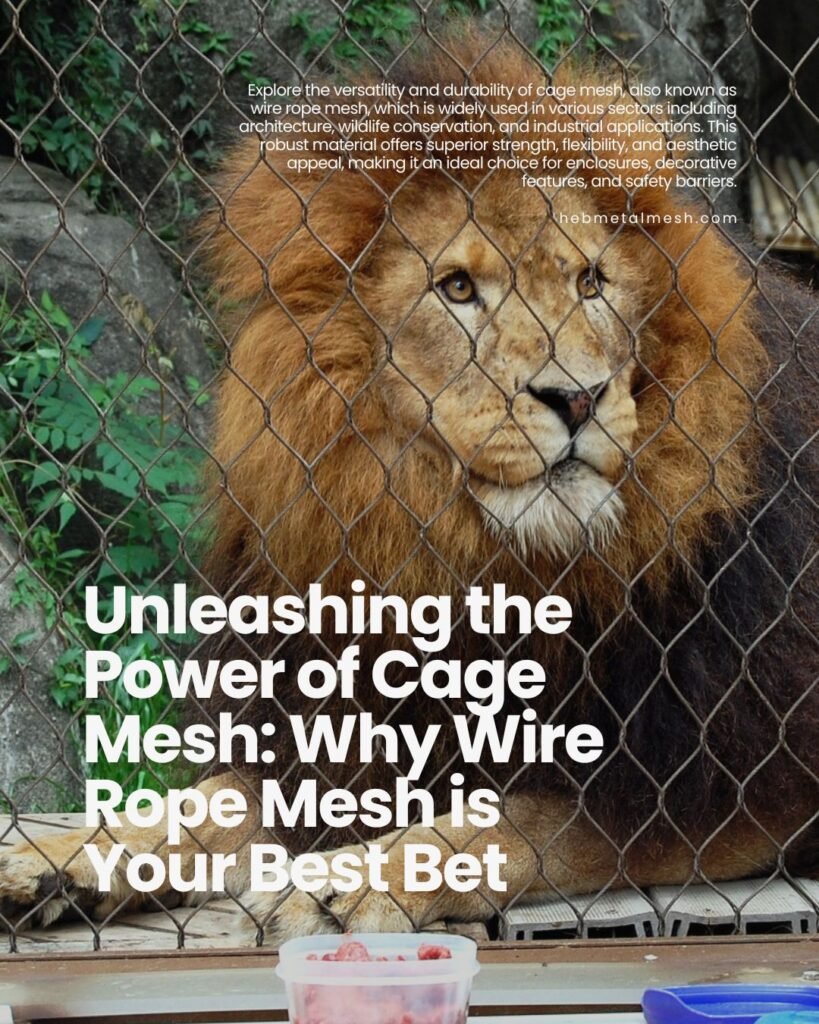
The bird arrives in a box at nine at night with a fractured coracoid and a wing that will not fold. Eight weeks later, if everything goes right, it leaves through a hatch and does not come back.
Between those two nights, the cage has one job that matters more than containment. It must not add a second injury. A cage that holds a bird perfectly and wears a patch of feathers off its carpal joint has cost that bird a month, and sometimes its release.
Most rehab enclosures get built by people who are excellent at animal care and new to mesh specification. The result is a cage that holds, works, and quietly damages the animal inside it.
This article is about the specification that stops that, and about the door the animal finally walks out of.
Executive Summary
A rehabilitation enclosure carries a load no exhibit carries: a patient with an unknown release date and a low tolerance for stress. Every mesh decision either shortens that date or pushes it back.
Three numbers settle most of it. Aperture sets what the animal can reach through. Wire finish sets how much feather and skin it loses on contact. Clear height sets whether a bird builds flight condition or only hovers in place.
None of the three appears on a typical purchase order, and all three are cheap to fix at the drawing stage and expensive to fix after the cage is standing. What follows covers aperture by species group, the wire that causes abrasion, the release panel, predator exclusion and the turnover routine between patients.
Quick Answer
A wildlife rehabilitation enclosure mesh usually runs 25 mm aperture on 1.5 to 2.0 mm stainless steel wire for small birds and mammals, and 38 mm on 2.4 mm for a raptor flight. Give a raptor flight at least 6 m of length and 2.4 m of clear height, and put the release on a removable panel rather than a door. Those three decisions cover abrasion, flight conditioning and the day the animal leaves.
Key Takeaways
- A cage that holds perfectly can still cost a patient a month.
- Aperture decides what an animal reaches. Wire finish decides what it loses.
- Abrasion at the carpal joint is the most common mesh-caused setback.
- A raptor needs length and clear height, not a larger box.
- The release wants a panel, not a door, so nothing snags on the way out.
- Predator exclusion at a rehab pen is a welfare issue first.

A Rehab Cage Is Not a Small Zoo Enclosure
A zoo enclosure is designed around an animal that lives there. A rehab cage is designed around an animal that is leaving, and the difference changes the mesh.
Three things follow. The cage turns over, so it has to survive more cleaning cycles per year than any exhibit on site. The patient arrives stressed and often juvenile, so it probes gaps that a settled animal ignores. And the staff work inside it constantly, which means every fixing has to tolerate a person leaning on it with a net.
That combination pushes a rehab build toward small panels, short spans and a detail a single keeper can service. The animal fence mesh range covers the light rope sizes these cages use, and the sizes matter more than the grade for most rehab work.
The Three Things That Set a Release Date
Release decisions come down to three clinical judgments, and the mesh affects all three.
- Feather condition. A bird with worn primaries or a bare carpal patch cannot fly quietly, cannot thermoregulate, and does not go. Mesh contact is one of the few causes a builder can eliminate.
- Flight condition. A bird needs straight-line distance to rebuild pectoral muscle. A cage that only allows hovering produces a bird that hovers, and a hovering bird is not releasable.
- Stress and habituation. A patient that panics at every approach burns condition. Visibility and a calm approach route matter as much as the wire.
Pre release cage design usually optimizes the third and neglects the first two, because stress is visible and feather wear is slow. The wear shows up at the pre-release exam, three weeks after the damage started.
Aperture and Wire: Matching the Animal You Intend to Release
Mesh aperture for juvenile birds is the number that gets guessed most often, and the guess is usually too wide.
A 25 mm aperture holds a blackbird, a squirrel and a juvenile rabbit, and it keeps a hand from reaching through to grab. A 19 mm opening suits finches, small passerines and any patient small enough to push a head through a 25 mm gap. A raptor flight cage mesh wants 38 mm on 2.4 mm rope, which refuses a head and lets a wing pass without catching.
Wire rope diameter follows the animal, not the aperture. A 1.5 mm wire in a small passerine cage carries the tensile strength for a 1.5 m span and gives a light, forgiving surface. A 2.4 mm wire in a raptor flight carries a heavier bird striking the panel on a bad approach.
A catch up cage for mammals takes the same logic with one addition. Mammals climb the mesh rather than fly at it, so the panel takes a sustained pull at the top edge, and the top rail becomes the part that has to hold. The rope mesh sizes used in holding pens cover that case, and the top rail detail matters more than the weave.

Feather Damage: The Failure That Delays a Release
Feather damage from aviary mesh has a small number of causes, and almost all of them sit at the wire surface rather than in the weave.
A drawn wire with a burr or a weld spatter line acts like a file. A bird that launches from a perch and clips the panel loses barbs on every attempt, and a bird that paces along the mesh wears the same patch daily. Galvanized hardware cloth is the worst offender, because the zinc coating roughens as it weathers.
The injury risk in a netting panel comes down to three surfaces: the wire, the cut end and the fixing. A hand-woven panel removes the cut end from the field entirely, which is why it suits a flight cage better than a welded roll.
Placement matters as much as the wire. A perch set 300 mm from the mesh invites a wing to clip on takeoff. A perch set 900 mm back gives the bird a clean arc, and that single dimension prevents more abrasion than any upgrade in wire quality.
Three Cages, Three Jobs
A rehab program needs three enclosure types, and they are not interchangeable. Building one cage to do all three jobs produces a cage that does none of them well.
| Parameter | Holding cage | Flight cage | Soft release pen |
| Aperture | 19–25 mm | 25–38 mm | 25 mm |
| Wire | 1.5–2.0 mm | 2.0–2.4 mm | 2.0 mm |
| Minimum length | 1.2 m | 6 m | 3 m |
| Clear height | 0.9 m | 2.4 m | 2.0 m |
| Opening | Sliding door | Release hatch | Removable panel |
| Main risk | Feather abrasion | Poor flight condition | Re-entry injury |
| Inspection | Daily | Daily | Twice daily |
Rehabilitation flight cage mesh is the one line in that table people try to save money on, and it is the line that decides release rates. A short flight cage produces a bird that is medically clear and behaviorally unfit, which is the most expensive outcome a rehab center can have.
Deflection belongs in the same conversation. A note on rope netting deflection explains how a flexible panel takes a strike, and a raptor that hits a panel at speed needs that give rather than a rigid surface.
Release work also sits inside a wider conservation framework rather than a purely clinical one. The IUCN SSC Conservation Translocation Specialist Group publishes the guidelines that most release programs write their protocols against, and those protocols set what a cage has to produce.
The Release Door and the Panel That Opens
The release door detail is where good cages lose birds. A hinged gate swings, catches a wing on the frame, and gives a nervous animal a moving object to avoid.
Soft release aviary mesh works better with a panel that lifts out. Two bolts, a top rail that clears the opening, and a gap wide enough for the animal to walk or fly through without touching metal. A keeper removes the panel from outside, steps back, and lets the animal decide.
Release pen netting on a soft release pen also needs a re-entry route. Most soft releases keep the pen open for two to four weeks so a bird can return to feed. That means the opening stays passable in both directions, and a one-way door defeats the purpose.
The mesh that opens for release should be the same weave as the wall, not a lighter panel bolted in at the end. A different aperture at the opening changes the light and the airflow, and a bird reads that change as a hazard.
An eagle release enclosure shows the pattern at the large end of the scale, where the opening has to pass a bird with a two-meter wingspan and still close cleanly for the next patient.
Predators, Observation and the Blind
Predator proofing a rehab pen is not the same problem as predator proofing an exhibit. A rehab patient cannot always escape a threat inside its own cage, and a nocturnal visit can undo eight weeks of conditioning in one night.
Three details carry most of the risk. The roof, because a great horned owl takes birds through open tops. The ground line, because a fox digs at a corner rather than a straight run. And the gap at the door frame, which is the one place a panel rarely meets its post cleanly.
Observation works against all of that, and an observation blind for a rehab enclosure lets staff watch without triggering a flight response. A solid panel 1.2 m high at one end, with a viewing slot at eye level, costs less than a camera and does more for habituation.
Wildlife rehabilitation standards in most regions treat stress and predator exposure as welfare measures, not housekeeping. A wildlife rehabilitation enclosure mesh that fails either test is not fit for a releasable animal, whatever its aperture.
Turnover Between Patients
Rehab enclosure turnover between patients is the operational cost nobody budgets for. A cage that takes two people a day to strip and rebuild will be used less often than it should, and a program short of cages starts releasing animals early.
Design for the turnaround. Panels that unbolt, fixings a single keeper can reach from the ground, and a floor that drains to one point all cut hours off the job. A stainless steel rope mesh with corrosion resistance through the section survives the disinfectant cycle that a coated mesh cannot.
That is where a wildlife rescue center mesh specification earns its place. Write down the aperture, the wire, the panel size, the fixing type and the cleaning method on one page, and the next wildlife rehabilitation enclosure mesh matches the last one. A review of common aviary enclosure failures shows how often the mismatch, rather than the material, causes the problem.
Cages built to a written schedule also age in step. When one panel fails at year twelve, the spare fits, because the weave and the fixing never drifted.
FAQ
Use 19 to 25 mm aperture on 1.5 mm stainless steel wire for finches and small passerines, and 25 mm on 2.0 mm for a blackbird or a thrush. The tighter aperture stops a head from passing and keeps a hand out. Bare wire matters as much as the size, because a coated mesh roughens and abrades feathers.
Aim for at least 6 m of length, 2.4 m of clear height and 3 m of width for a medium raptor. Length is the dimension that builds flight condition, and height is the one that prevents a bird from striking the roof on takeoff. Bigger helps, but length before width before height.
The usual cause is a perch set too close to the panel, not the wire itself. Move perches 900 mm back from the mesh and the wear often stops within a molt. If it continues, check for a burr on the wire or a rough weld at a fixing.
A removable panel works better than a hinged door. A door swings into the flight path and gives a nervous animal something to avoid, while a panel lifts out and leaves a clean opening. Bolt it rather than hinging it, and remove it from outside the cage.
Strip and disinfect between patients, and spot clean daily within a stay. Build the cage so one person can strip it in under an hour, or the schedule will slip under intake pressure. Panels that unbolt and fixings at ground level do more for hygiene than any cleaning product.