
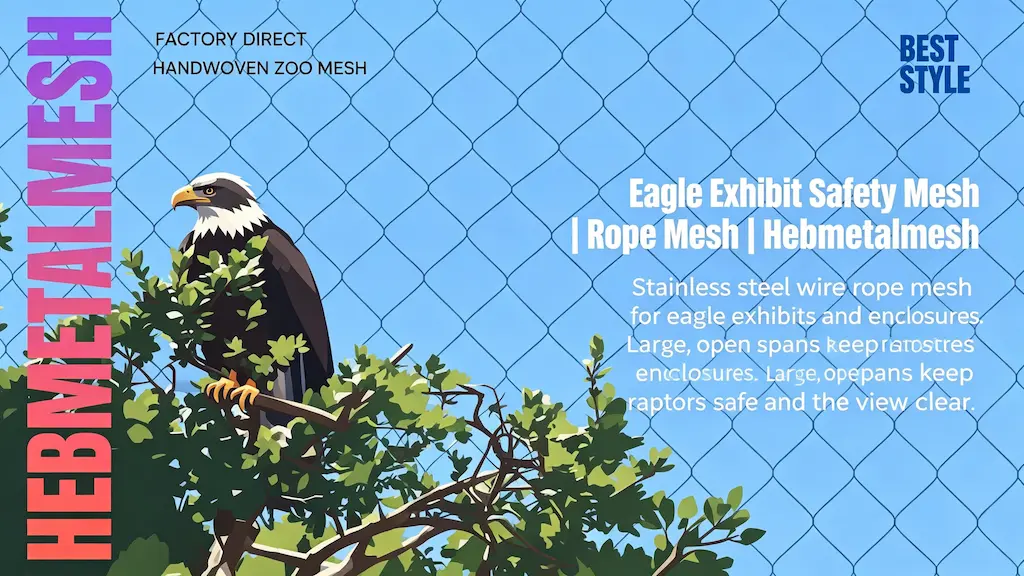
Eagle release enclosure design runs the opposite way to every other enclosure on a zoo or sanctuary site. A display aviary is built for a bird that will live inside it for decades; a rehabilitation enclosure is built for a bird that is supposed to leave, so its volume, openings, finish and feeding detail are judged by whether the bird is fit to go. That moves the whole mesh specification. Containment is the easy half, because an eagle does not climb, dig or squeeze. The hard half is that the bird flies into the mesh before it ever walks out through it, and that the last opening it uses should be one no keeper ever uses.
Executive Summary
An eagle release enclosure is specified backwards, from the release rather than from the bird on admission. A rehabilitating eagle passes through a sequence of handovers — admission, treatment, conditioning, assessment, release and post-release support — and each asks something different of the same panels, so the mesh is chosen for what the bird must be able to do at the end rather than for what it must not do at the start. Four decisions carry the specification through that sequence: a hatch wide enough for the bird and operable from outside, an aperture sized to deny a foot rather than to stop a body, a cable diameter written for a contact that arrives at speed, and a finish with nothing on it that can catch a feather. A raptor enclosure mesh built for a raptor release programme also has to be visible, because the bird’s first failure is collision and not escape — an eagle habitat mesh it cannot see is one it flies into. The reference specification is the eagle enclosure netting range product page.
Specifying a release or rehabilitation enclosure? Send the species, the programme stage you are building for, the size of the bird and the openings you need, and we will return a panel schedule with rope diameter, aperture, grade, edge treatment and the fixing allowance as a line item.
Request a specificationQuick Answer:
An eagle release enclosure is a zoo grade enclosure mesh structure with one requirement no other enclosure has: the mesh has to survive being flown into, and the bird has to leave through an opening a person never walks through. The aperture is therefore set by the foot rather than by the body, since no practical opening admits an eagle; the cable is set by impact rather than by a lean; and the release is a hatch, chute or removable panel operated from outside.
Key Takeaways
- An eagle release enclosure is specified backwards, from the day the bird leaves.
- The escape limit disappears on an eagle, so aperture becomes a foot-and-entrapment decision.
- Impact energy rises with the square of speed, so a flight volume loads a wire differently from a hospital cage.
- The release is an opening, not a door: keeper free feeding and an outside-operated hatch stop a released bird associating people with food.
- A rope panel is nearly invisible at 90% open area, which is why mesh visibility to birds is a specification line rather than an afterthought.
Eagle life history drives all of it, and the accounts of Haliaeetus and Aquila — their development, their flight and their conservation status — are maintained by the IUCN and its specialist groups.
A Release Enclosure Is a Sequence, Not a Building
A facility that holds eagles usually holds them for six different reasons, and the six map onto the stages of one programme rather than onto six building types. The facility-type guide works through the settings; this page works through the order they happen in. An eagle arrives injured or grounded, is treated in the smallest volume a handler can work in, is moved into something large enough to fly in, is assessed against eagle release criteria, and then leaves. After that the same enclosure often stays standing as a feeding point while the bird learns to hunt.
The consequence is that one panel serves jobs pulling in opposite directions. The hospital aviary wants short spans, close control and a surface a handler can see through at arm’s length. The flight volume wants long spans, high impact tolerance and a surface the bird can see at the far end. One alloy family and one cable family will do both; one panel size will not.
The Stages a Bird Passes Through
| Stage | What the bird is doing | What the mesh has to do |
| Admission and triage | Down, injured, cannot fly | Hold a grounded bird with no gap it can wedge a wing into |
| Treatment | Handled daily | Give a handler sight and access at arm’s length |
| Conditioning | Flying, turning, landing | Absorb a contact at speed and stay tensioned |
| Release assessment | Being judged against the criteria | Be inspectable from outside, so the bird is not handled to be judged |
| Release | Leaving | Open from outside, without a person entering the volume |
| Post-release support | Returning to a feeding point, then leaving for good | Stay serviceable with no routine handling |
Every stage defines a good panel differently, and the sequence is why pre release conditioning space is built far larger than the eagle admission quarantine it replaced. A bird that never gets the middle of that table built for it does not reach the bottom of it.
The Mesh Is the Last Surface the Bird Touches
Before a raptor is released it has been in contact with mesh for weeks, and the feathers that contact decides whether it can hunt. A feather condition raptor assessment is not a formality: a bird that has abraded or broken its primaries against a hard, proud surface cannot generate the flight it needs, and the facility has just added a moult cycle to the programme. The panel’s finish is a release variable.
Three properties decide it. A hand woven wire mesh has no fused lump at the crossing, where a welded grid presents a hard intersection at exactly the height a bird grips. A stainless steel rope mesh edge can be terminated in a smooth line on an edge cable rather than left as a cut end, and a cut rope end carries a burr on one face. And a talon contact mesh has to be judged as a grip rather than as a push: an eagle lands on a perch, not on the panel, but when it misses it closes a foot on whatever is there.
The Bird Has to See What It Is About to Hit
A collision risk aviary is one where the panel is invisible and the bird is not yet competent in a confined volume. A rope mesh is roughly 90% open area, and visual weight is only the rope diameter divided by the aperture pitch, so a 2.0 mm rope at a 38 mm aperture reads at about 5% and a 3.2 mm rope at 76 mm at about 4% — in both cases a bird at speed sees air.
That is the mesh visibility to birds problem in practice, and it has three answers. A bright round wire returns a line of light whenever the sun sits in its plane, so a dark or matte finish belongs on a flight volume rather than on a hospital cage. The panel that crosses the flight line matters more than the walls, so treat it differently. And a flexible cable netting field can be broken up deliberately — a marking line, a denser panel at the far end, a lighter cover over the top — because a surface a bird can see is one it learns in a week.
The Opening a Keeper Never Uses
Every other enclosure on the site has a door, and the door is for the keeper. A release enclosure has an opening that is for the bird, and the release hatch mesh detail is where the whole page turns. The hatch has to be wider than the bird with its wings folded and long enough that a bird walking out never brushes the frame, and it has to open from outside the volume and be able to be left open, because a release is a period rather than a moment.
The feeding side follows the same rule. A feeding port design that lets a handler place food from outside, and keeper free feeding through a chute rather than a door, removes the largest imprinting risk in a rehabilitation programme: a bird that learns a person at an opening means food returns to openings, buildings and roads. Both details obey the aperture rule that governs the panel, with a gap no wider than the mesh opening at the leaf and at the groundline.
Two Numbers, Both Set by the Foot
Aperture inverts the usual logic. On a small-mammal or primate enclosure the aperture stops a body passing through; on an eagle there is no practical opening that admits the bird, so the escape limit disappears and the whole decision becomes a foot decision. An aperture has to be small enough that a foot cannot pass through and be caught on withdrawal, and small enough that a bird cannot hook a hallux over the wire. A 50–76 mm opening is generous for a large raptor’s reach and still denies a clean pass; 20–38 mm removes the question.
Cable diameter comes from the contact, and in a flight volume the contact is an impact. Kinetic energy rises with the square of speed, so a bird arriving at speed loads a wire with several times the energy of the same bird leaning on it: a large raptor volume runs at 2.4–3.2 mm rope (HM3276, HM2076), a treatment cage at 1.6–2.0 mm (HM1625, HM2038). Grade follows the inside of the building rather than the climate outside it, so a 304 stainless steel mesh suits an inland hospital volume and 316 earns its molybdenum in a coastal one. The envelope is on the containment specification page.
Release Criteria and What the Panel Becomes Afterwards
The release readiness assessment is the gate, and none of it is a mesh decision — which is why the mesh has to be out of the way while it happens. Body condition, plumage, flight and behaviour are scored from outside the volume, so the bird is not handled in the week before it goes.
The panel’s own eagle release criteria are simpler: sound tension, intact terminations, no local wear, no burrs, and a hatch that still opens freely. Record them, because a bird may move between facilities and the next centre will want the panel specification rather than the story. After release the enclosure usually does a second job as a hack site — a feeding point a young bird returns to, and then stops returning to. A corrosion resistant mesh that is still sound in 25–30 years for the birds that come after is not over-specified; it is the point. What the flight volume itself has to be is on the eagle aviary page, and how a raptor volume is bought is on the raptor netting page.
What Goes Into the Order
Write the brief from the programme rather than from the site plan: the species and birds expected, with sexes, ages and whether any is non-releasable; the stage each volume is built for; the clear span and height of the flight volume with its roof load case; the aperture, with the foot it has to deny; the cable diameter, written for impact; the alloy and finish, including whether a dark finish is needed so the bird can see the panel; the hatch, port and observation details, each with its opening size and the face it is operated from; and delivery, access and lifting.
Cost drivers run diameter first, then aperture, then panel size, with order volume a distant last. Fixings, edge cable, tensioners, ferrules and anchor plates add 10–20% to a mesh-only rate, with cutting waste another 5–10%. Two lines belong on any woven schedule: aperture tolerance, because a woven edge is a run of rope rather than a cut line, and isolation at every frame contact, because a stainless panel bolted to a galvanised frame is a galvanic cell. The envelope of sizes and grades is on the eagle enclosure netting specification.
Frequently Asked Questions
Between 20 mm and 76 mm, and the deciding factor is the foot rather than the body — no practical opening admits an eagle, so the aperture only has to deny a clean pass to a foot. A finer mesh also reads better to a bird, which matters in a flight volume.
Not by pushing through it, and an eagle does not climb or dig, so escape is not the governing risk. The governing risks are collision with an invisible panel and feather damage from a hard or proud surface.
Through a port or chute operated from outside the volume, so no person appears at an opening with food. A feeding port design and keeper free feeding routine remove the association that turns a released bird into a bird that returns to buildings.
Same alloy family, different duty. It needs a visible, forgiving surface for the flight line and an opening that lets the bird out without letting a keeper in.
Send the species, the stage you are building for and the openings you need, and we will return the panel schedule, the aperture logic and the fixing allowance as one document — contact Hebmetalmesh.