
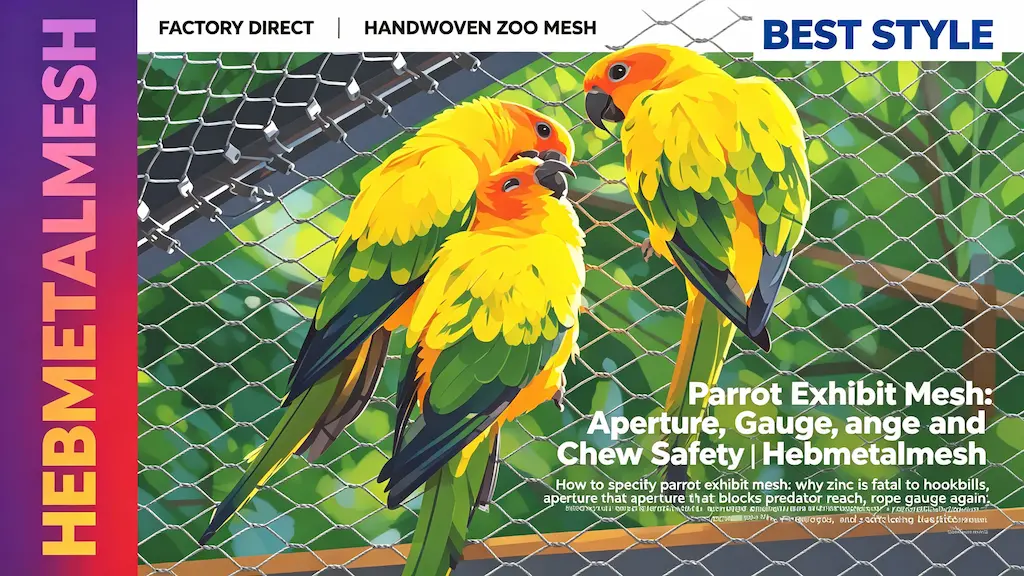
Parrot proofing a room is two jobs with one name. The first is making the room safe for the bird — the cables, the blind cords, the soft-metal coatings, the houseplants — and none of that is a netting job. The second is making the room safe from the bird, and that one is. A parrot is the only animal on a mesh order book routinely kept loose inside a dwelling. Outdoors a panel is a fence; indoors it becomes a boundary, a guard and a sacrificial surface, and the setting decides which of the three you are buying.
Executive Summary
A pet parrot lives in a house rather than a cage, so netting has three applications, not one, separated by a single variable: how much of the day the bird spends loose. Enclosed all day, a stainless steel rope mesh builds the whole volume. Out under supervision, a hand woven wire mesh guards the openings and the surfaces the bird would otherwise destroy. With the run of the house, flexible cable netting becomes a set of zone boundaries. Two numbers govern all three, and they move in opposite directions: aperture from the smallest body that must not pass, cable diameter from the strongest beak in the room. A corrosion resistant mesh is what makes the build last; choosing the right application is what makes it correct. The reference specification is the netting for parrots product page.
Building a parrot enclosure inside a home? Send the room dimensions, the surfaces you intend to mesh, the species and how long the bird is loose each day, and we will return a panel schedule with rope diameter, aperture, grade, edge treatment and the fixing allowance as a line item.
Request a specificationQuick Answer:
Parrot netting is used at home in three ways, and time decides, not room. A zoo grade enclosure mesh turns a spare room into a full-time parrot room aviary. A single lightweight leaf turns a door or a stairwell into a guard, so the bird can be out while the house stays intact. And a floor-to-ceiling run divides a dwelling into zones, which is how a parrot at liberty is kept away from cables and curtains without being shut in a cage.
Key Takeaways
- A parrot is kept loose inside a house, so netting has three applications rather than one, and time out of the cage decides which.
- Indoors the frame carries the load rather than the weather: with no wind in a room, span, fixing and the bird’s grip write the specification.
- The aperture follows the smallest body that must not pass, which in a parrot home is frequently a second, smaller bird.
- A beak levers a fused crossing and only worries a woven one, so a hand woven wire mesh outlives a welded grid as a chew surface.
- Mesh delivers a boundary and no separation from sound, because a panel is roughly 90% open area.
How a parrot occupies a home — its climbing, its chewing, its need for space — is documented by the World Parrot Trust, whose psittacine husbandry material underwrites any claim about liberty and enclosure.
Which of the Three Applications You Are Building
The three cases are points on one scale, not three products. Enclosed all day, the netting is the architecture: a spare room, a basement or an outbuilding takes a full mesh envelope and a door. Out under supervision, the netting is a set of guards, and the bird spends its parrot out of cage time in a room closed at every opening. With the run of the house it is zoning, and the bird has a parrot free flight room while the kitchen, the bathroom and the front door stay shut behind mesh. Outside the walls the same tiers compress: a parrot balcony netting job is the first tier in two square metres, and a parrot sunroom aviary sits between them, glazing carrying the weather and mesh carrying the openings.
| How the bird lives | What the mesh is | What decides it |
| Enclosed all day | The walls and the roof | The smallest body that must not pass, and the strongest beak |
| Out under supervision | The openings and the destruction targets | The bird’s habitual route, and the door it uses |
| Free in the house | Zone boundaries and guards | The floor plan, and where the bird may go |
A parrot room conversion into a full-time parrot habitat mesh is a permanent fitment with a real frame. A parrot porch enclosure and a door guard are demountable, and a parrot apartment enclosure is usually that second kind, because a tenancy rarely allows the first.
The Room Is the Enclosure, and It Has Forty-Five Square Metres in It
A 3 m by 4 m room with a 2.4 m ceiling has fourteen metres of wall perimeter — roughly 34 m² of wall plus 12 m² of ceiling, so about 45 m² of meshable surface. A 3.2 mm rope at a 76 mm aperture weighs 1.5–2.0 kg/m², so that room is 68–90 kg of mesh; in a 2.0 mm rope at 38 mm it is 40–55 kg. Neither number is a problem. Where it hangs is.
A domestic ceiling is plasterboard on timber at 400 mm centres, and a tensioned field of mesh is not a load to hang from that. The load path of an indoor enclosure belongs on the walls or, in a rented property, on the floor alone. That is what separates a parrot proofing a home job from a garden build: outdoors the ground takes the load, indoors the frame must.
There Is No Wind Indoors, So the Load Is the Bird
An outdoor boundary is sized by wind: pressure is close to 0.613 × V², so a 30 m/s gust puts roughly 550 N on every square metre. Indoors there is no wind, so an indoor frame is not a fence and its posts are not sized like one. Four loads remain.
The mesh carries its own weight and its tension. The bird is the one that gets underestimated — a psittacine climbs with beak and feet, so it hangs its whole body from a single point, and that grip load lands in one wire and, worse, in the gap between two wires. A beak in a gap is a lever, and a lever makes a larger force than a bite. And people come last: a family-room screen gets leaned on, and a person is heavier than a macaw.
So the answer is a frame rather than a fence — posts at 2.5–3.0 m, a top rail, a continuous edge cable, and fixings that reach a stud, a joist or masonry, not plasterboard alone. Where nothing may be drilled, the frame becomes a free-standing box, ballasted at the base.
The Beak Sets the Cable and the Other Bird Sets the Aperture
Two numbers decide the panel and they are independent. The aperture comes from the smallest body that must not pass; the cable diameter comes from the strongest contact the panel will take. In a parrot house those are frequently two different birds: the resident macaw sets the cable, because a large beak works on the mesh daily, while the aperture is set by whoever else shares the room — a budgerigar, a conure, or a chick.
| Bird | Aperture | Cable | Code |
| Budgerigar, small psittacine | 25 mm | 1.6 mm | HM1625 |
| Conure, small Amazon | 38 mm | 2.0 mm | HM2038 |
| Amazon, grey, cockatoo | 38 mm | 2.4 mm | HM2438 |
| Macaw, large cockatoo | 38 mm | 3.2 mm | HM3238 |
| Mixed collection, walk-through | 50 mm | 2.4–3.2 mm | mixed |
| Large flight, roof field | 76 mm | 3.2 mm | HM3276 |
Weave matters as much as size on a chewer. A parrot does not cut a rope; it worries one strand where two strands cross, and it levers a fused intersection until the grid opens. An interwoven crossing gives a beak nothing to purchase, and one broken wire costs only about 2% of that strand’s breaking load on a 7×7 construction. Grade follows the inside of the building rather than the weather outside it: a 304 stainless steel mesh covers an inland living room, and 316 earns its molybdenum in a bathroom, a kitchen or a coastal flat, where bowls and spray bottles keep a wet side in a room with no rain.
Where the Mesh Actually Goes in a House
A parrot door screen is the highest-value panel in the build and the smallest. A domestic door leaf is 0.76–0.9 m wide and about 2.0 m high, so 1.5–1.8 m² of mesh, and the whole detail is clearance: the gaps at the jamb, the floor and the head must each be no wider than the aperture.
A parrot room divider has the opposite problem: a boundary rather than a cage, it must run floor to ceiling or the bird goes over the top, and an unsupported 2.4 m panel drifts unless it is stiffened at mid height.
Windows, curtains and cables are the third group, where the mesh is a guard. A parrot proof curtains setup works because the bird lands on the top edge of whatever it climbs, so the top line takes a point load rather than a distributed one. A parrot proof cables guard keeps the beak out of a bundle but must not trap heat, and routing a cable out of the bird’s zone still beats guarding it. A parrot safe room needs all three groups closed at once before the bird is left alone in it.
What the Mesh Cannot Do, and Where the Other Half of the Job Sits
A mesh panel gives no separation from sound. It is roughly 90% open area, so a large macaw’s contact call passes straight through; if the enclosure shares a wall, the solid surface belongs on the shared side and the mesh on the room side.
Mesh also does not make a room safe for the bird. It makes a boundary, and the rest — coatings a hooked bill can scrape off, blind cords, toxic metals and plants, standing water — is a materials audit rather than a decision for this psittacine netting application. And a parrot at liberty half of the day is the point of the build, not the bonus at the end of it; a volume the bird never leaves is a cage with better steel in it.
What Goes Into the Order
Write the brief from the room and the bird rather than from a panel catalogue: the room’s dimensions and which surfaces get mesh; the smallest body that must not pass and the strongest beak in the house; aperture and cable as two separate numbers; alloy and finish, with the wet side of the building named; the frame, its span and what it may be fixed to; every opening, with its leaf; and the delivery format with the access it needs to reach the room.
Cost drivers run diameter, then aperture, then panel size, with order volume a distant last. Fixings, edge cable, tensioners, ferrules and anchor plates add 10–20% to a mesh-only rate and cutting waste another 5–10%; as a planning range, aviary-grade work sits at $10–22/m² and carnivore-grade at $20–38/m². Two lines belong on any woven schedule: aperture tolerance, because a woven edge is a run of rope rather than a cut line, and isolation at every frame contact, because a stainless panel bolted to a galvanised frame is a galvanic cell. The envelope of sizes and grades is on the netting for parrots specification, and where the build is a one-off shape the custom enclosure page covers how a room is surveyed and set out into flat panels. Sizing by species is on the mesh size guide, the exhibit-scale version on the parrot aviary page, and what the panel does under load on the deflection page.
Frequently Asked Questions
Yes. A room is often the best volume available: it is already square, dry and has a door. The constraint is the ceiling rather than the walls: mesh the walls and the openings, take the frame’s load to the walls or the floor, and close the top if the bird is ever left unsupervised.
As much as a safely proofed room allows, which for most species is several hours a day. It is a welfare goal rather than a fixed number, and the netting exists to make more of it possible.
An uncoated alloy has no applied layer for a beak to scrape off and swallow, unlike the soft coating on galvanised wire. The face the bird can reach must also be free of burrs, which is why a terminated edge beats a cut one.
Yes, and it is why a free-standing frame exists. Nothing is fixed to the fabric of the building, the tension is reacted inside the frame and the base is ballasted, so the enclosure dismantles and moves with the tenancy.
Send the room dimensions, the surfaces you intend to mesh and the species, and we will return the panel schedule, the aperture logic and the fixing allowance as one document — contact Hebmetalmesh.