
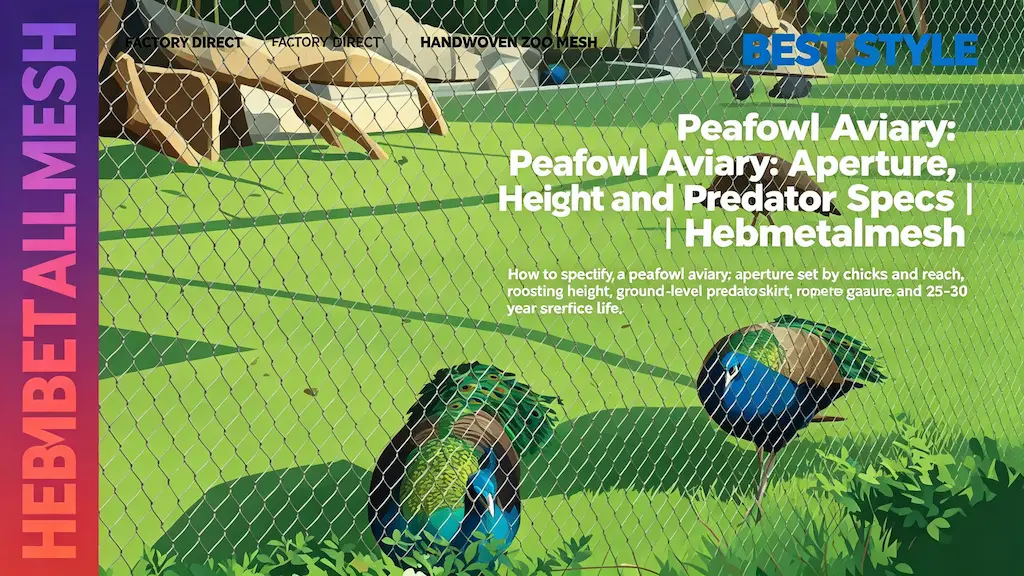
Peacock roof netting is specified for a property rather than for a box, and that one change moves every number on the schedule. A peafowl on a lawn is not confined by four walls; it is confined by a lid and a boundary, because the bird walks wherever it likes and flies only to roost. The panels that hold it are the field overhead and the run at the grass edge, and the dimension that decides both is not the bird’s body but its train.
Executive Summary
Peafowl are kept the way ornamental waterfowl are kept: loose on a property rather than behind four walls. The application that follows is a roof, a boundary and a ground skirt, each sized by something different. The roof is set by peacock roost height, because the bird sleeps high and the panel must carry a heavy bird leaving and landing under its own power. The boundary is set by the ground gap, because a peafowl walks and any opening at shoulder height is an exit. The skirt is set by the fox, which digs far more often than it climbs. Over all three sits the train, a metre and a half of loose covert that needs peacock train clearance where the bird displays and an aperture it cannot hook on withdrawal. A peacock habitat mesh chosen purely for containment very often damages the plumage it was bought to protect. The reference specification is the peacock enclosure netting range product page.
Netting a garden for peafowl? Send the flock size, the boundary length, the nearest roost height and whether foxes are present, and we will return panel schedule, aperture, edge cable, apron detail and fixing allowance as one document.
Request a specificationQuick Answer:
Peacock roof netting is the roof-and-boundary application used for free-ranging peafowl: a high overhead field carried on a load-bearing edge cable, a boundary run at the lawn edge, and an apron at the groundline. The roof is set by roost height and landing load, the boundary by the gap a walking bird will use, and the whole envelope by the train, which needs stand-off where the bird displays.
Key Takeaways
- A peafowl is a walker and a rooster, not a climber, so the mesh does two of the three jobs a wall would do.
- The train, not the body, sets the headroom at the display area and the aperture at the boundary.
- Roost height fixes the roof, and the roof is a load case: a heavy bird lands on it every night.
- The fox is stopped by an apron at the groundline, and by little else that is normally specified.
- The annual train moult writes the maintenance calendar, because shed covert occludes the aperture.
The husbandry and studbook records for Pavo cristatus are maintained by Species360 and the institutions that keep the species.
A Peafowl Is Kept on a Property, Not in an Enclosure
A peafowl walks. It does not test a panel the way a primate does, and a four-sided structure does very little for a bird that forages across ground it regards as its own and sleeps in a tree. What a bird like this needs is a defined volume it treats as home: a lid it cannot fly past, a boundary it will not walk across, a groundline it cannot dig under. That is why keeping peafowl in a garden is a different specification from building an aviary, and why peacock proofing a garden resembles proofing a room for a psittacine far more than it resembles a cage. The tools are the same — a tensioned field, a load-bearing edge, a surveyed boundary — but the geometry is inverted. On a cage the four walls do the work and the roof is a detail. Here the roof carries the bird and the boundary only has to survive a bird that is walking. The nearest neighbours to this page, the peafowl materials guide and the exhibit fencing guide, both assume the traditional walled structure. This page assumes it does not exist.
Three Lines, Three Jobs
| Line | What it holds back | The number that sets it |
| Roof | Take-off to roost, and descending raptors | Roost height plus landing clearance |
| Boundary | A walking bird, and ground predators | Aperture at ground level |
| Ground skirt | A digging fox | Apron width and edge fixing |
| Display zone | Feather contact during the fan | Stand-off distance |
Peacock free range netting is these three lines and nothing else. The roof is the line people forget, because a bird that walks all day does not look like a bird that flies, and it is the roof that decides whether the flock stays. The boundary is the line people over-build, since a walking bird cannot test a panel the way a climbing mammal can. The skirt is the line people omit, which is why losses usually begin about a year after installation. A stainless steel rope mesh, and a zoo grade enclosure mesh on every line, covers all three, because what changes between the lines is gauge, aperture and edge treatment rather than alloy. At scale this is the difference between peacock estate netting and peacock lawn netting — one specification run at two sizes, and worth writing as two line items even when one contractor builds both.
The Train Sets the Headroom, Not the Bird
The train is not a tail. It is a fan of upper tail coverts, a metre to a metre and a half on a mature male, and it is the most fragile object anywhere near the mesh. A feather shaft is a hollow composite tube: a barb bent past its elastic limit does not spring back, and a broken covert stays broken until the next moult. That makes peacock train clearance a specification line rather than a courtesy. A displaying male spreads the fan to somewhere between a metre and a half and two metres, so a panel inside that radius is brushed by the most expensive part of the bird several times a day, all season. The train feather clearance required is not large; the panel simply has to stay out of the arc the fan sweeps. Surface matters as much as distance, because a hand woven wire mesh or a ferrule-jointed panel is smooth at the crossing, where a knotted or welded grid presents a hard intersection at exactly the height a covert sweeps past. A peafowl netting field at 2.4 mm is generous for the bird and still forgiving at the crossing. The walled version of the same structure is on the peafowl aviary page.
The Roof Has to Be High, Because the Bird Sleeps in a Tree
Peacock roost height fixes the roof, and owners under-estimate it by a factor of two. Given the choice, peafowl roost three to five metres up and they do it communally, so the roof line is sized for a whole flock arriving within minutes of dusk rather than for one bird. That turns the overhead field into a load case rather than a lid: a take-off is a short, sharp impulse on the edge cable and the panel above it. None of that is a problem if the roof hangs on a real edge — a tensioned perimeter cable fixed at every corner of the run, not a post-and-staple line — and if the panel was sized for it. A 304 stainless steel mesh or a 316 field at 2.4–3.2 mm rope, in large panels so there are few joints to inspect, does the job for decades. The instruction to a buyer is simple: measure the tallest tree inside the boundary, add clearance for a bird standing on the crown, and take that as the roof line.
The Boundary Is Where the Bird Actually Leaves
A peafowl almost never leaves a property by flying. It leaves by walking, through a gate left open, a gap under a shed, a drain, or a stretch of boundary set at a coarser aperture than the rest. That makes peacock boundary netting a survey before it is a purchase: walking the line and listing the gaps takes an hour and decides more of the specification than any catalogue does. The governing number is the ground aperture, and it is a two-height problem. Fifty millimetres holds an adult and is the usual working figure for peafowl boundary netting; the difficulty is chicks, which are small enough to walk through an aperture that is perfectly adequate for their mother. Where the flock breeds, the lower 600 mm of the line wants to drop to 25–38 mm and be re-checked every spring, because netting a garden for peafowl is only ever as good as its worst three metres. The boundary method in the fencing guide assumes the same walking behaviour.
The Ground Skirt Is the Only Fox Detail That Works
Peacock fox protection is the most common reason an owner contacts us after the birds are already in the garden, and it is almost always the same failure. Foxes do not climb a boundary of this height; they dig under it, usually where the ground is soft or where the panel was laid on rather than keyed into the soil. One night is enough. The fix is a ground skirt peafowl detail at the base of the boundary and of any threatened section of the line, and there are two forms. A buried skirt is driven 300 mm down and backfilled; a surface apron is laid outward 400–450 mm and pinned. The surface apron is the more useful of the two on established ground, because it survives re-growth and it fails visibly, so a disturbed apron tells you a fox has been working the line. A peafowl apron of this kind is what makes a peacock dig proof boundary, and it has to be drawn at the same time as the boundary run rather than added afterwards.
The Moult Is the Maintenance Calendar
Peacock train moult happens once a year, after the breeding season, and it is the most useful maintenance prompt an owner has. The covert does not fall out of the sky: it lands on the roof, catches in the boundary and drifts into corners, and a single shed covert is a small sieve that traps the next one. Within a season the apertures along the roof line carry a pad of feather and dirt, which closes the aperture the specification was designed around, holds moisture against the panel long enough to matter on a corrosion resistant mesh, and hides the two defects worth finding — a slack edge and a worn ferrule. So the annual sweep is not housekeeping; it is the inspection. Walk the roof line and the boundary at the moult, clear the crossings, check tension on the edge cable and look at every ferrule and clamp while the panel is bare. What a flexible cable netting system needs is a short dated list: aperture clear, tension held, fixings sound, apron undisturbed.
What Goes Into the Order
Write the brief from the property rather than from the panel: the number and sex of the birds and whether the flock breeds; the boundary length and the roof height, with the tree it was measured from; the ground conditions at the skirt; the gates, drains and openings that have to be detailed; the display site and the stand-off it needs; and delivery, access and whether the work is done with the birds loose or moved. On a free-range job the sequence matters as much as the panel, because a boundary closed in one pass is a boundary nobody can get behind afterwards. Cost drivers run diameter first, then aperture, then panel size, with order volume a distant last. Fixings, edge cable, tensioners, ferrules and anchor plates add 10–20% to a mesh-only rate, with cutting waste another 5–10%. Two lines belong on any woven schedule: aperture tolerance, because a woven edge is a run of rope rather than a cut line, and isolation at every frame contact, because a stainless panel bolted to a galvanised frame is a galvanic cell. The envelope of sizes and grades for all three lines is on the peacock enclosure netting specification.
Frequently Asked Questions
Higher than most owners expect. Measure the tallest tree inside the boundary, allow for a bird standing on the top of the crown, and use that as the roof line — for most gardens that means four to six metres.
Around 50 mm holds an adult on both the roof and the boundary. Where chicks are reared, drop the lower 600 mm of the boundary to 25–38 mm, because a chick walks through an aperture that is fine for its mother.
Only if the panel sits inside the arc the fan sweeps, or if the crossing is hard. A ferrule-jointed or woven panel lets a covert slide past; a knotted grid at the display site will fray it.
Yes, wherever foxes are present. A boundary of this height stops a fox climbing but not digging, and the apron — buried, or laid outward 400–450 mm — is the only detail that reliably closes the groundline.
Send the boundary length, the roost height, the flock size and the predator pressure, and we will return the panel schedule, the aperture logic and the fixing allowance as one document — contact Hebmetalmesh.