
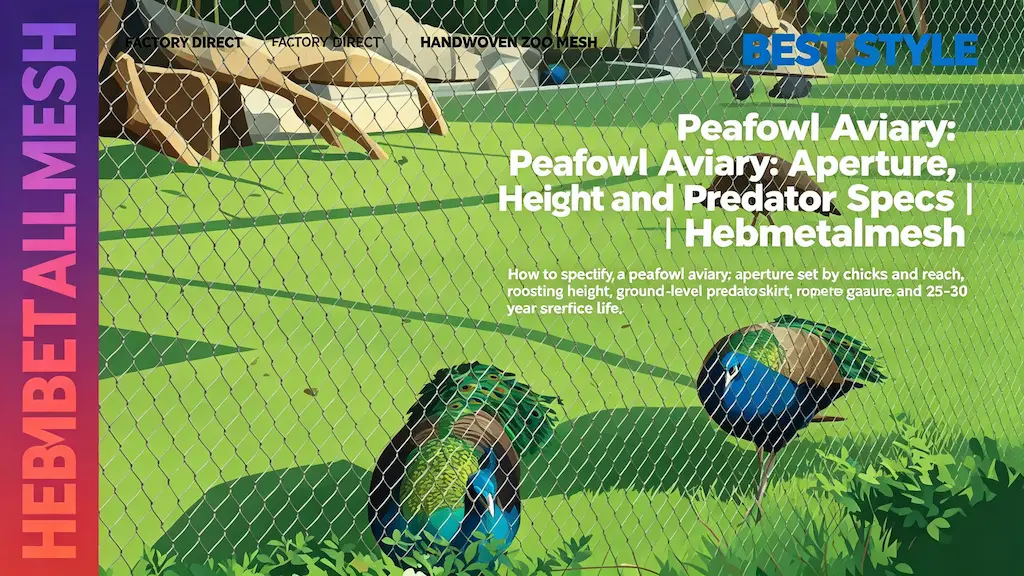
Peafowl exhibit fencing has to satisfy two requirements that pull against each other. The birds must be sealed away from foxes, raccoons, dogs and snakes, and the peacock’s train must come through a full display season without a single snagged or broken feather. Stainless steel woven mesh is the one fence metal that does both, because it is strong enough to hold a determined predator out and smooth enough that plumage slides across it instead of catching.
Executive Summary
Peafowl are strong short-burst fliers that roost in trees, so an exhibit needs a perimeter wall plus a roof cover, not a wall alone. The working specification is 2.0 mm stainless wire at 38 mm aperture for walls, 1.6 mm at 25 mm over the roof, and 1.2 mm at 20 mm for chick and breeding pens, all in hand-woven 7×7 strand construction. Galvanised steel is the false economy here: its zinc coating fails at the weave point in three to eight years, and its rough surface abrades the train. Stainless steel 304 suits inland sites and 316 is the correct choice within about 10 km of salt water. This guide covers grade and gauge selection, height and layout, installation, realistic budget drivers and plumage-safe maintenance. The reference specification is the core product page product page.
Specifying a peafowl exhibit? Send us the exhibit footprint, the local predators and whether the run is roofed. We will confirm wire diameter, aperture and panel sizes against your layout.
<div style=”border:1px solid #d8dee6;border-left:4px solid #1a5fb4;background:#f6f9fc;padding:16px 18px;margin:22px 0;border-radius:4px;”> <p style=”margin:0 0 10px 0;”><strong>Specifying a peafowl exhibit?</strong> Send us the exhibit footprint, the local predators and whether the run is roofed. We will confirm wire diameter, aperture and panel sizes against your layout.</p> <p style=”margin:0;”><a href=”https://hebmetalmesh.com/contact/” style=”display:inline-block;background:#1a5fb4;color:#ffffff;padding:10px 18px;border-radius:3px;text-decoration:none;font-weight:600;”>Request a specification</a></p> </div>
Quick Answer:
Peafowl exhibit fencing should be stainless steel woven mesh rather than chain link, welded wire or plastic netting. Use 2.0 mm wire at 38 mm aperture (HM2038) for the perimeter, 1.6 mm at 25 mm (HM1625) for the roof, and 1.2 mm at 20 mm (HM1220) for chicks — with a roof cover, because peafowl fly up to roost. Choose 316 stainless near the coast and 304 inland. Expect 2–4 weeks of fabrication and 2–6 weeks of transit.
Key Takeaways
- A wall alone will not hold peafowl. They are galliforms that fly well enough to reach a roost, so any open-topped run needs an inward-angled overhang or a full roof panel.
- Smooth stainless protects the train. The train is the exhibit’s commercial asset; rough galvanised or welded wire snags it, and a single damaged flight feather costs a season of display quality.
- Aperture is a predator calculation. 38 mm keeps foxes and raccoons out; 20–25 mm is needed where snakes or small mustelids are a genuine risk.
- Grade follows geography. 304 is correct inland, 316 where salt spray reaches the fence — the molybdenum in 316 is what holds up in coastal air.
- Budget tracks area, not length. One peafowl exhibit fencing panel runs to 9 m × 18 m, so a large exhibit is quoted by surface area with the roof as its own line.
Zoo exhibit design has a published body of reference work behind it, and ZooLex maintains a searchable archive of real exhibit drawings and specifications that is worth reading before you fix your own footprint.
Why Stainless Steel Is the Right Fence Metal for a Peafowl Exhibit
Peafowl pressure-test a fence in ways that hoofstock and even big cats do not. They walk the perimeter at speed, they launch vertically from a standing start, and the male trails 1.5 m of iridescent covert feathers behind him for most of the year. That combination rules out most cheap fencing materials for four different reasons.
Chain link is the wrong texture. It holds predators out, but its galvanised surface and cut wire ends act like a comb on the train. Exhibits that use chain link usually report visible feather damage by the second season, and once a train is broken it does not grow back until the next moult.
Plastic netting is the wrong strength. It is cheap and soft against plumage, but it degrades in ultraviolet light, it cannot hold a taut span, and it will not stop a fox that has learned to chew. The material comparison against plastic sets out exactly where the two materials diverge over a ten-year horizon.
Welded wire is the wrong geometry. Welded intersections make the panel rigid, and rigid panels crack at the welds when a bird hits the roof at speed. Hand-woven mesh flexes, spreads the impact, and returns to shape.
Galvanised steel is the wrong long game. The zinc coating protects the wire only until it is breached at the weave point, and a peafowl exhibit is a high-abrasion environment. Once the coating is gone, rust is fast. This is why the galvanised vs stainless comparison matters more here than on a low-contact fence.
The peafowl fence metal that survives all four tests is hand-woven stainless steel rope mesh. It is also the material the whole exhibit vocabulary is built around — see the woven mesh application guide for the forms it is used in.
Choosing the Grade and Gauge: Peafowl Exhibit Fencing Specification
The peafowl exhibit fencing specification that matters most is the pair of numbers describing the wire: diameter and aperture. The table below is the working range.
| Exhibit zone | Wire diameter | Aperture | Grade code |
| Perimeter wall | 2.0 mm | 38 mm | HM2038 |
| Overhead roof | 1.6 mm | 25 mm | HM1625 |
| Chick and breeding pen | 1.2 mm | 20 mm | HM1220 |
| High predator pressure | 2.4–3.2 mm | 38–51 mm | HM2438 / HM3250 |
Every panel is built from 7×7 strand construction — 49 wires in each rope — which is what gives a 3.2 mm rope a breaking load near 7 kN and a 2.4 mm rope about 4.4 kN. Panels are fabricated up to 9 m by 18 m, so a wall is normally one or two panels rather than a run of narrow strips. Weight runs around 2 kg per square metre, which matters when the roof is being sized. The stainless peacock enclosure range covers these grades as finished panels.
On grade, the choice is narrow and uncontroversial: 304 stainless (roughly 18% chromium, 8% nickel) for inland exhibits, and 316 with its molybdenum addition for anything within reach of salt spray. The 304 vs 316 breakdown explains the chemistry; the practical rule is that 316 is cheap insurance on a coast and unnecessary inland.
Peafowl Exhibit Fencing Height, Layout and Roof Cover
The peafowl exhibit fencing height is set by flight behaviour, not by the bird’s standing height. A male stands a little over a metre tall, but Indian peafowl fly strongly enough to reach a tree roost, which means an unroofed run at 2 m is an escape waiting to happen.
The working rule is a 2.4–3 m perimeter with either a full roof or an inward-angled overhang of at least 1 m at the top. A full roof is the better answer where the exhibit is also the night enclosure, because it protects the birds from aerial predators as well as keeping them in. A peafowl fence design that ignores the roof is the most common mistake on first builds. Give the birds a peafowl roost — a raised platform at 1.8–2.4 m, with perch spacing of about 400 mm so the train can hang clear — and they will use the roof structure rather than testing it.
A peafowl exhibit layout that works in practice separates three zones: a display lawn the visitors see, a service corridor the keeper walks, and a holding pen where birds can be shut in for health checks. A peafowl exhibit plan built around those three zones needs about 10–15 m² per adult bird as a floor, with more where the train is at full length during display season.
Installation: Frame Posts, Concrete Footings and Tensioning
Peafowl exhibit fencing installation follows a sequence that is unforgiving of shortcuts, because the roof and the wall share loads. In practice peafowl exhibit construction is mostly a frame-and-footing job with a tensioning stage at the end.
Set the frame post first. Posts go at 3–4 m centres on the perimeter and at the ridge and eaves of the roof, each on a concrete footing sized for the local wind and snow load. A post set in rammed earth will move within two seasons.
Deal with the ground line. A buried skirt of mesh turned outward at the base and covered with 150–200 mm of soil stops animals that dig, and it removes the gap at the bottom edge where a fox works at a fence.
Tension the panel by zone. A panel splice at the corners should carry the same load as the panel itself, so splices are made with matched rope clamps rather than laced wire. Tension the wall panels just tight enough to stop drumming in wind; tension the roof panels harder, because slack roof mesh is what a bird hits hardest.
Finish the edges. Every cut end is trimmed or capped. A sharp wire end inside a peafowl exhibit is a train injury with a date on it.
Budgeting the Build: Peafowl Exhibit Fencing Cost Drivers
A peafowl exhibit budget is driven by four numbers: total mesh surface area, wire diameter, aperture, and how much of the exhibit is roofed. Roof area is the single biggest variable, because a roofed 10 × 20 m exhibit carries the same mesh area again overhead.
As a planning range, hand-woven stainless material runs roughly $10–22 per square metre for aviary-grade mesh and $20–38 per square metre for heavier grades, with discounts at volume. The site’s containment netting price guide walks through the same cost logic. Fabrication takes 2–4 weeks followed by 2–6 weeks of transit for export orders, so an exhibit budget should carry a contingency for site works running late.
When you approach a peafowl exhibit fencing supplier, send the footprint drawing, the number of roofed versus open metres, the local predator list and the climate. A competent peafowl fence supplier will then return a single quote covering peafowl exhibit materials and freight rather than a per-metre figure you have to re-scope yourself. Specify the grade explicitly, because a quote that does not name 304 or 316 is not comparable to one that does.
Maintenance and Plumage Protection
Stainless needs far less upkeep than any coated metal, but a peafowl exhibit fencing design should still plan for two inspections a year.
Rinse the mesh with fresh water to remove dust and salts, and check the roof panels after storm season, since the roof takes the wind load. Look at every frame post base and at each panel splice for movement, because a loose clamp is always the first sign of trouble rather than a broken strand. Keep abrasive feeders, sharp brackets and exposed bolt threads out of the birds’ walking line, and give the train vertical clearance at every point where a displaying male turns. Those two habits — smooth surfaces and clear turning space — are what keep a flight feather intact through the season.
Specifying peafowl exhibit fencing? Send your exhibit footprint and predator list and we will return wire diameter, aperture, panel sizes and a planning price.
FAQ
Hand-woven stainless steel rope mesh, 2.0 mm wire at 38 mm aperture for walls and 1.6 mm at 25 mm for roofs. It is smooth enough not to snag the train and strong enough to exclude foxes and raccoons.
2.4–3 m, with a full roof or at least a 1 m inward-angled overhang. Peafowl fly well enough to reach a tree roost, so an open-topped run is an escape risk regardless of wall height.
Not for a permanent exhibit. The zinc coating breaks down at the weave point in 3–8 years, and the rougher surface abrades the train. Use it only for temporary holding.
Yes, if the exhibit is also the night enclosure. A roof keeps aerial predators out and stops the birds flying out, and it protects the train from weather during display season.
Plan on $10–22 per square metre for aviary-grade stainless mesh and $20–38 for heavier grades as a planning range, plus posts, footings and installation. Roofed area roughly doubles the mesh quantity.
304 for inland exhibits, 316 within reach of salt spray. The molybdenum in 316 resists chloride attack, and the cost difference is small next to the cost of replacing a coastal fence early.