
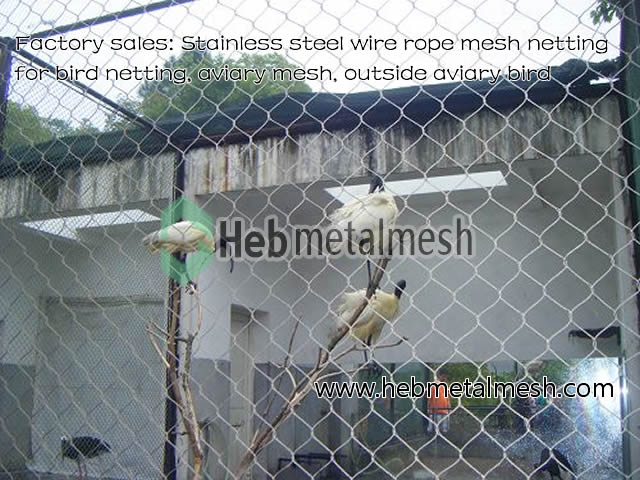
Aviary reviews are only useful when you read them for what failed, not for star ratings. The aviaries for birds reviews worth your time almost always mention three things: the mesh grade, the frame spacing, and how the structure came through its first hard winter. Reviews that only praise appearance tell you nothing about whether an enclosure will still be square and tight in year ten.
Executive Summary
When you compare aviaries for birds reviews, strip out the adjectives and look for four measurable facts: aperture in millimetres, rope or wire diameter, metal grade and panel span. A 20 mm aperture on 1.2 mm stainless rope suits finches and canaries; 25 mm on 1.6 mm rope covers budgerigars and cockatiels; a walk-through mixed flight is better on 38 mm with 2.0 mm rope or heavier. SS304 is the inland default and SS316 the coastal one. Panels to 9 m × 18 m are achievable, which removes most mid-span posts. The reference specification is the bird netting and aviary mesh product page product page.
Quick Answer:
A trustworthy aviary review states the aperture, the wire or rope diameter, the frame spacing and the metal grade, then reports how the structure behaved after a few seasons. If a review names none of those numbers, treat it as a lifestyle piece rather than buying evidence. For most garden and walk-in aviaries, 1.2–1.6 mm stainless rope at a 20–25 mm aperture is the sensible baseline.
Key Takeaways
- Read reviews for failure reports, not ratings: “how did it look after three winters” beats “sturdy and beautiful”.
- The four numbers that decide quality are aperture, cable diameter, frame spacing and metal grade.
- Aperture must be smaller than the smallest bird’s head — and it permanently fixes which species the aviary can hold.
- Galvanised mesh costs less but fails at the weave point; stainless rope has no coating to strip.
- Siting issues — sun orientation, windbreak and aviary drainage — generate more complaints than the mesh itself.
Those benchmarks only mean something against published welfare standards. The Association of Zoos and Aquariums (AZA) sets out bird care guidance on flight space, shelter and enclosure complexity that sensible review criteria should map onto.
What Aviary Reviews Actually Tell You
Reviews cluster into three groups, and they are not equally useful. An unboxing review, written in the first month, reports a purchase. A mid-term review, at six to twelve months, reports a product. A long-term review, at three years or more, reports a decision — and those are the ones worth hunting for.
The sentences that matter describe what happened after the novelty faded: whether the netting sagged between posts, whether a coating failed at the weave point, whether birds found a loose fixing to worry at. A reviewer who mentions a flight line that stayed taut, perches that never wobbled, and droppings that hosed off in minutes is describing a well-specified enclosure, even if they never use the word specification.
That is why what to look for in an aviary is less about the model on the box and more about the four numbers behind it. Learn to spot them and a stack of aviary reviews becomes a real aviary comparison guide rather than a mood board.
The Five Things Worth Reviewing
| What to check | Why it matters | Typical failure if ignored |
| Aperture | Escape control and foot safety | Bird pushes its head through and panics |
| Cable or wire diameter | Bite resistance and fatigue life | A strand parts after seasons of beak wear |
| Metal grade | Corrosion life, especially at fixings | Rust spreads from the anchor points |
| Frame spacing and panel span | Keeps the flight line taut | Netting sags into a climbable bowl |
| Siting and orientation | Bird health and cleaning effort | Damp floor, no shade, constant algae |
Read any aviary material comparison against that table. A cheap structure and an expensive one rarely differ in shape; they differ in those five rows.
The most efficient way to use aviary reviews is side by side. Put two reviews of comparable aviaries into the same table and fill in the four rows; the gaps usually decide the matter before you reach the price. A reviewer who answers all four has understood the build, and that alone is a useful signal.
Material Grades: The Biggest Single Price Driver
The largest cost variable is the metal. Welded wire is the cheapest option and perfectly adequate for a hen run, but a poor choice for a mixed bird flight: a rigid weld cannot absorb impact and cracks at the joint. Galvanised mesh sits in the middle — affordable, yet once the zinc is scratched it rusts from within, and the coating itself can be nibbled. Stainless steel rope mesh costs the most and lasts the longest, because there is no coating to strip and the flexible weave absorbs impact instead of resisting it.
Grade matters as much as material. SS304, at roughly 18% chromium and 8% nickel, is the inland default and will outlive most frames. SS316 adds molybdenum and belongs within a few kilometres of salt water. Any aviary buying guide that discusses price without discussing grade is not a buying guide at all.
Three comparisons do most of the work. The 304 vs 316 cable mesh comparison sets the chemistry side by side; the rope mesh vs welded wire comparison explains why flexibility, not rigidity, is what survives a bird hitting a wall at speed; and if a supplier quotes galvanised instead, the galvanized vs stainless steel cable mesh comparison is the honest read on where a saving turns into a liability.
Frame, Siting and the Details Owners Regret
Most long-term complaints are siting complaints wearing a mesh costume. Sun orientation decides whether the aviary bakes in summer and stays wet in winter; a windbreak on the prevailing weather side turns an exposed flight into a usable one; and aviary drainage is the difference between a floor you hose down and a floor that smells. A roof cover over part of the flight — never all of it — gives birds the choice of sun or shade and reduces the condensation that drives microclimate problems inside a closed shelter.
Two more details repay attention. Aerial predator pressure is easy to underestimate: a taut roof, sealed at the ridge with no loose overlap, is the practical answer and costs very little at build stage. And avian enrichment should be designed into the layout rather than bolted on later — swing mounts, foraging stations and natural perches all need fixing points, and a frame planned with them in mind looks deliberate instead of improvised.
Get those right and aviaries for birds design becomes straightforward: perimeter first, posts at the chosen span, full panels hung, gates and service doors last. That sequence is also what keeps aviaries for birds installation cheap, because nothing has to be adjusted twice.
One caution applies to every review, however detailed. Aviary performance is set by the whole envelope, not by one component, so a glowing account of a single material tells you little until you know the aperture and span it was paired with. The reference aviary mesh specification page shows how aperture, rope diameter and panel size are specified together — the baseline any review should be read against.
Red Flags in a Review — and in a Quote
The fastest way to filter aviaries for birds ratings is to look for what is missing. Reviews that omit the aperture; that say “rust proof” without naming a grade; that never touch on roof cover, drainage or how the birds settled in — those are marketing. A review that admits a mistake and explains the fix is worth ten that do not.
The same test works on a quotation. A credible aviaries for birds supplier states aperture, cable diameter, panel dimensions and edge finishing in writing, plus a production window. When you weigh aviaries for birds cost against aviaries for birds price, compare cost per square metre of enclosed surface rather than cost per panel, since a larger panel spreads the same fitting cost across more area. And when you read aviary kit reviews, remember that a kit is only as strong as its weakest component: a heavy frame paired with light netting will fail exactly where you would expect.
One further filter is sponsorship. A review that discloses a free or discounted unit is still usable, but its conclusions should be weighted accordingly — and the disclosure itself counts in the writer’s favour rather than against. Undisclosed promotional writing is the more common problem, and it is usually recognisable by the complete absence of criticism.
The single most useful piece of aviaries for birds buying guide advice is this — decide the species first, because the species sets the aperture and the aperture sets everything else. The best aviary brands have learned to ask that question before quoting, which is usually why the best aviary for birds also turns out to be the one specified around the birds already in it. For walk-through or multi-species flights, the heavy-duty bird netting guide for large-scale aviaries covers the heavier specifications those builds need.
Cost, Delivery and What to Compare
As a planning range, aviary-grade stainless rope mesh sits around $10–22/m² depending on rope diameter, aperture and finish, with frame, footings, gates and installation as separate line items. On a small garden build the frame can easily cost more than the mesh; on a large flight the mesh dominates.
Lead time is typically 2–4 weeks for production once the drawing is approved, plus 2–6 weeks for transit. Ask for the panel drawing before paying a deposit — it is the one document that shows whether a supplier has actually understood the build.
A quotation worth comparing carries five things: aperture, cable diameter, panel dimensions, edge finishing and a production window. Without the panel drawing the price is not final, because the drawing is what determines how many panels the job needs and how much edge work they require. Ask two suppliers for the same drawing and the comparison becomes honest rather than nominal.
FAQ
Look for four numbers — aperture, cable diameter, frame spacing and metal grade — plus any report of how the structure performed after two or three winters. A review without numbers is an advertisement, whatever its star rating.
For anything beyond a temporary run, yes. Stainless rope mesh has no coating to strip, resists corrosion at the fixings where galvanised fails first, and commonly performs for 30 years or more inland. Spread over that service life the annual difference is small.
Aperture must be narrower than the smallest bird’s head. Finches and canaries are usually housed behind 20 mm aperture on 1.2 mm rope; budgerigars and cockatiels behind 25 mm on 1.6 mm rope. Mixed flights must be sized to the smallest species, not the largest.
Seal the roof with a fully tensioned panel and no loose overlaps, bury a skirt around the base for soil-footed structures, and set a concrete plinth at the perimeter. Aerial predator pressure is the risk first-time builders most often underestimate.
The good ones do. Installation complaints usually trace back to a frame fabricated before the mesh was chosen, which forces on-site adjustment. Ask whether the supplier issues a panel drawing — that single document prevents the problem.
Inland, a stainless rope mesh flight commonly runs 30 years or more, with fixings and frame as the limiting factors rather than the netting. Coastal installations should move to SS316, and the fasteners should match the mesh grade.