
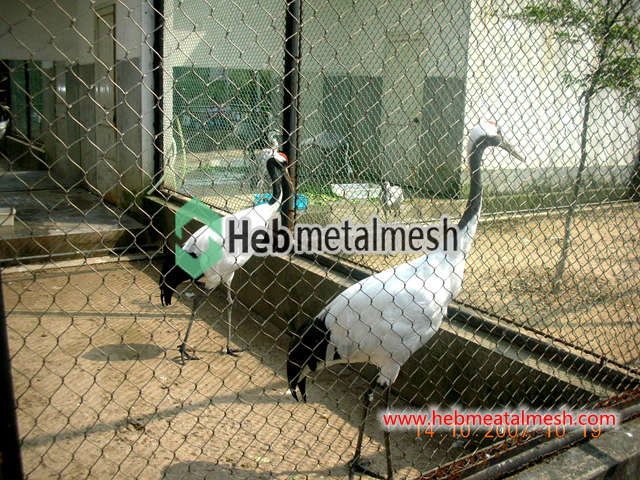
Crane fencing has a harder job than ordinary aviary fencing. The bird behind it stands up to 1.8 m tall, carries a wingspan of 2 m or more, and flies with its neck stretched forward and its legs trailing behind — a body plan that leaves a long legged bird completely exposed the moment it misjudges a landing. Cranes are the tallest flying birds in the world, and the enclosure has to be built around that fact rather than around the strength of the fence. Stainless steel rope mesh is the only skin that lets a crane land softly while still holding foxes, coyotes and raptors out.
Executive Summary
Cranes cannot be kept safely behind rigid fencing. A sandhill crane or whooping crane that flies into welded wire or chain link at speed will break a leg, and the stress of a heavy strike can trigger capture myopathy in a bird that was previously healthy. Build the enclosure tall, long and softly skinned instead. The working specification is 2.4 mm stainless rope at 38 mm aperture for the walls of a standard crane pen, 3.2 mm at 51–76 mm for the perimeter and roof of a large flight enclosure, and 1.6 mm at 25 mm for chick rearing pens, all in hand-woven 7×7 strand construction. Grade 304 suits inland sites and 316 is correct within reach of salt spray. This guide covers height, aperture and rope diameter, flight-line layout, predator sealing, installation over wet ground, crane mesh price and the health checks that catch a problem early. The reference specification is the core product page product page.
Specifying a crane enclosure? Send us the species, the enclosure footprint and the predators on site. We will confirm rope diameter, aperture, panel sizes and a planning price against your layout.
Quick Answer:
Crane fencing should be hand-woven stainless steel rope mesh rather than chain link, welded wire or plastic netting. Use 2.4 mm rope at 38 mm aperture (HM2438) for standard crane pens, 3.2 mm at 51 mm (HM3250) or 76 mm (HM3276) for tall flight enclosures and perimeter runs, and 1.6 mm at 25 mm (HM1625) for chick rearing. Allow a minimum height of 3.6 m with a full roof, and a horizontal flight run of 20–30 m. Choose 316 stainless near the coast and 304 inland. Expect 2–4 weeks of fabrication and 2–6 weeks of transit.
Key Takeaways
- Height is a welfare requirement, not just a security one. Cranes launch and land along a long diagonal, so a 2.5 m pen is an injury risk even when it is escape-proof. Plan 3.6 m as a floor and 5–6 m for whooping or sarus cranes.
- Flex is what protects the bird. Hand-woven rope mesh spreads an impact and returns to shape. Welded wire cracks at the weld and chain link presents a hard edge.
- Aperture is a predator calculation. 76 mm suits large cranes but passes small mustelids and snakes. Drop to 51 mm or 38 mm where those are a genuine risk.
- Grade follows geography. 304 inland, 316 within reach of salt spray — the molybdenum in 316 is what resists chloride attack.
- Budget tracks surface area. One panel runs to 9 m × 18 m, and a roofed flight enclosure carries roughly twice the mesh of an open pen.
Cranes are among the most threatened bird families on earth, and the IUCN Red List assessments for the whooping, red-crowned and Siberian crane species remain the standard reference for how enclosure design feeds into conservation breeding programmes.
Why Crane Fencing Fails When It Is Copied From Another Aviary
A crane behaves in an enclosure the way it behaves on a marsh: it walks long distances, probes the ground with its bill, and launches along a runway rather than straight up. That pattern breaks four fencing materials for four separate reasons.
Chain link is the wrong texture. It is strong enough, but the galvanised surface and cut wire ends abrade feathers on contact, and a trailing leg catches the diamond edge on landing. Apparent plumage damage often traces back to the fence, not the birds.
Welded wire is the wrong geometry. Rigid intersections make a panel that cannot give, so the impact energy goes into the bird instead of into the mesh. Welds also crack under repeated shock loading at the roof line, where strikes are most common.
Plastic netting is the wrong long game. It is soft against feathers but it cannot hold a taut span, it degrades under ultraviolet light, and a determined fox will chew through it. The material comparison against plastic sets out where the two diverge over ten years.
Galvanised steel is the wrong material science. The zinc coating protects the wire only until it is breached at the weave point, and once that happens rust moves quickly. The galvanised vs stainless comparison explains why a coastal crane exhibit loses that argument first.
What survives all four tests is hand-woven stainless steel rope mesh, and the woven mesh application guide shows the forms it takes across zoo and conservation work.
Crane Fencing Specification: Height, Aperture and Rope Diameter
The crane fencing specification that decides whether an enclosure works is the pair of numbers describing the wire — rope diameter and aperture — plus the height of the frame. The table below is the working range.
| Enclosure zone | Rope diameter | Aperture | Typical code | Why it is specified |
| Chick rearing pen | 1.6 mm | 25 mm | HM1625 | Excludes small predators and holds chicks in |
| Standard crane pen | 2.4 mm | 38 mm | HM2438 | About 4.4 kN breaking load; good flex |
| Flight enclosure wall | 3.2 mm | 51 mm | HM3250 | Gives under a landing impact without failing |
| Perimeter and roof | 3.2 mm | 76 mm | HM3276 | About 7 kN; suits the largest species |
| Wetland edge | 3.2 mm | 102 mm | HM32102 | Where the panel meets standing water |
Every aperture in the table is a stock configuration of the crane aviary mesh range, which runs from 1.2 mm rope for chick pens to 3.2 mm for perimeter work.
Height matters as much as the mesh. A crane approaches a landing along a shallow diagonal, so the usable height of a flight enclosure is the height at which it can still level out. A whooping crane mesh specification should assume 5–6 m, and a lighter sandhill crane mesh pen can work at 3.6–4 m provided the run is long. Width is the other half of the equation: cranes need a flight line, not a box, and 20–30 m of straight run is a realistic target for a breeding pair.
Flight Enclosure Layout and Soft Landings
Layout decides whether the crane flight mesh in the specification is ever tested in anger. Three rules cover most failures.
Radius the corners and keep the top clear of sharp projections. A crane turning at the end of a flight line drifts outward, and a square corner at the far wall is where wings meet wire. A radiused return, or a panel set at 45 degrees, gives the bird an unambiguous surface to read.
Put the roof on the frame, not on the bird. Cranes that launch vertically in a low pen strike the roof far more often than keepers expect. A full roof panel in 2.4 mm rope at 38 mm aperture is the working choice; it also excludes aerial predators, which matters most for cranes reared outdoors.
Keep perches and planting inside the safe envelope. Anything that narrows the flight corridor shortens the landing zone, and landing is the riskiest moment in the enclosure.
Predator Sealing for Crane Pens and Breeding Enclosures
A crane proof enclosure is a complete envelope, not a wall. Foxes and coyotes dig, raccoons climb and raptors come over the top; sealing only the perimeter means eventually losing a bird.
The standard solution is a buried skirt: carry the crane pen mesh 600–900 mm outward at the base and bury it, or pin it under a stone apron, so a digging predator meets wire rather than soil. Where a roof is impractical, fit an inward-angled overhang of at least 800 mm in the same aperture as the wall.
Interior partitions deserve the same treatment as the perimeter. A crane holding mesh gate between the pen and a transfer chute, and a separate crane breeding mesh partition for a pair that has to be separated after the breeding season, are both ordinary requirements in a conservation facility. Larger sites often run a shared pool with crane colony netting overhead and a crane roost netting island for overnight birds, and these are usually specified at 51 mm aperture so that a bird cannot push its head through at the water line.
Installation: Posts, Footings and Tension Over Wet Ground
Crane enclosures sit on ground that is often wet, soft or periodically flooded, and that changes the anchoring detail. A crane wetland netting panel loaded by wind and by a large bird needs a load path from the mesh back to something that will not move.
Concrete footings on a helical or cast pile suit most sites. On saturated ground, a wider pad and a longer pile is cheaper than draining the enclosure, and the mesh should stop 50 mm above the finished surface to let water pass. Use a tensioning turnbuckle at each corner and at the midpoint of any span over 6 m; the mesh should be taut enough to resist deflection but not so tight that it stops giving under impact. Guy the top rail rather than over-tensioning the panel itself.
Standing water is a maintenance issue too: a crane wetland netting or crane marsh netting run that floods seasonally collects debris at the base, and that debris abrades the wire.
Crane Mesh Price, Grade Choice and Maintenance
Crane mesh price is driven by four variables: rope diameter, aperture, grade and panel count. A 3.2 mm rope at 76 mm aperture uses far more steel per square metre than a 1.6 mm rope at 25 mm, and a rookery of roofed flight enclosures multiplies the total. As a planning range, aviary-grade stainless mesh lands between $10 and $22 per square metre, with the heavy 3.2 mm grades at the top of that band; posts, footings and installation sit on top, and a roofed enclosure roughly doubles the mesh quantity.
Grade choice is a geography question rather than a budget question. Stainless steel 304 handles inland sites for decades, while 316 adds molybdenum and is the correct choice within about 10 km of salt water — the difference between 304 and 316 is small in cost and large in coastal service life. The containment netting price guide covers how those numbers behave across enclosure types.
Inspection is where a facility earns back the specification. Walk the fence monthly looking for slack panel, a polished spot where wire has been rubbing, and any accumulating debris at the base. Watch the birds as closely as the fence: a crane that has begun to carry a leg, or is reluctant to fly, may be showing an early leg fracture from a previous strike. Cranes are long-lived, pair for life and are unusually prone to stress-related illness, so a bird that goes down without an obvious cause is a veterinary matter rather than a fencing one.
Applications multiply once the basics are right. The same 3.2 mm mesh works at 51 mm for crane migratory netting on a stopover pen, at 76 mm for crane release netting on a soft-release programme, and at 38 mm for the crane nesting netting that protects a nest mound and the waterfowl sharing the same pond. Crane fencing is not one product; it is one material family applied at four or five different apertures.
Specifying crane fencing? Send your species list, footprint and predator pressure and we will return rope diameter, aperture, panel sizes and a planning price.
FAQ
Hand-woven stainless steel rope mesh, 2.4 mm rope at 38 mm aperture for standard pens and 3.2 mm at 51–76 mm for tall flight enclosures and roofs. It flexes on impact rather than transmitting load into the bird’s legs.
3.6 m is the practical minimum and 5–6 m is correct for large species such as whooping or sarus cranes. Height only works with a long horizontal run — a tall, short pen still produces strikes.
Not in a permanent enclosure. Both are rigid, so impact energy goes into the bird, and chain link edges and cut wire ends abrade feathers. They are acceptable for temporary holding only.
Yes for breeding and rearing pens. A roof prevents vertical strike injuries, excludes aerial predators and stops a flighted crane from leaving. Where a roof is impossible, use an inward-angled overhang of at least 800 mm.
Plan on $10–22 per square metre for aviary-grade stainless mesh as a planning range, with heavy 3.2 mm grades at the upper end, plus posts, footings and installation. A roofed flight enclosure roughly doubles the mesh area.
304 for inland facilities, 316 within about 10 km of salt water. The molybdenum addition in 316 resists chloride attack, and the premium is small compared with replacing a coastal fence early.