
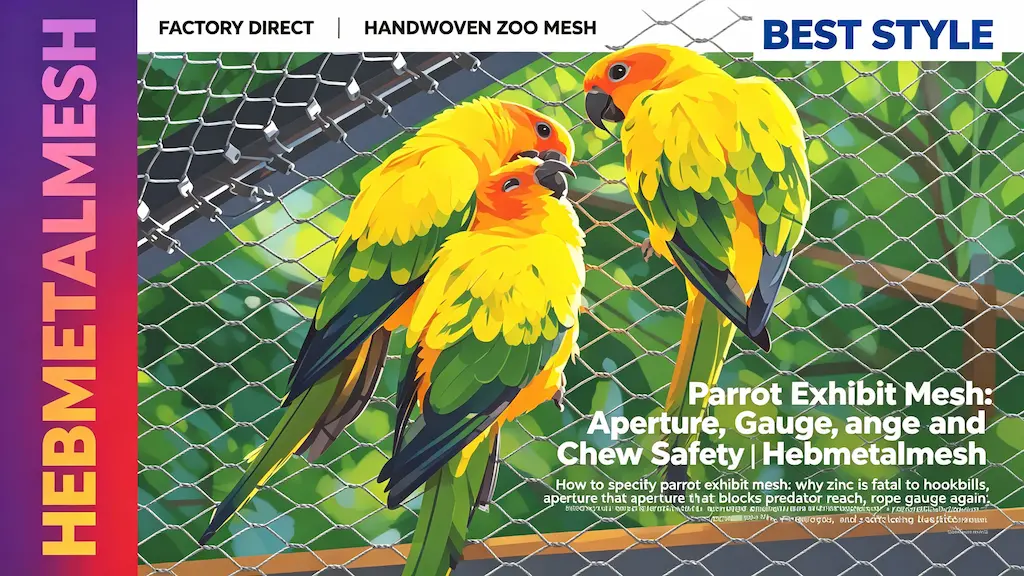
Parrots do not test a barrier the way a mammal does. A macaque pulls, a big cat lunges, a parrot works the same square centimetre with its beak for eleven months until the aperture opens enough to matter. That single habit dictates every line of a specification: the alloy has to be inert, the joint has to have nothing to pry, and the rope has to refuse to be bent open one millimetre at a time. A barrier chosen on price and breaking strength will hold on day one and fail in year three — and the failure will look like the bird simply figured it out.
Executive Summary
Three hazards govern parrot exhibit mesh, and only one of them is containment. The first is toxicological: parrots are hookbills that explore with the tongue as much as the beak, so any zinc, lead, or coated surface inside reach is a dosing device. The second is mechanical: a startled bird hits the boundary at speed, and a rigid welded wall converts that flight impact into a broken keel or a neck injury, where a tensioned rope field absorbs it and gives the bird a soft landing. The third is geometric: aperture has to satisfy two threats pulling in opposite directions — small enough that no predator can reach through and grab a sleeping bird, large enough that the birds still read as visible and the structure stays light. Our parrot enclosure mesh range is built around those three constraints rather than around a catalogue of gauges.
Quick Answer: What Makes Parrot Exhibit Mesh Different?
Parrot exhibit mesh is a hand-woven stainless steel rope panel specified for psittacine enclosures, defined by three properties that general-purpose fencing does not guarantee: an inert alloy with no zinc, lead, or organic coating anywhere a beak can contact; an interlaced structure with no weld or crimp to pry at; and an aperture resolved against predator reach rather than against the bird’s body size. It is ordered woven to the exhibit dimensions so a full face hangs as one piece with no mid-panel joint.
Key Takeaways
- Never use galvanized wire inside a parrot enclosure; ingested zinc causes heavy metal toxicosis.
- Aperture is set by what can reach through from outside, not by the bird’s head.
- Rope gauge buys chew resistance and fatigue life — almost no field failure is a tensile failure.
- A tensioned rope field absorbs flight impact; a rigid welded wall does not.
- Panels woven to size remove the horizontal joint that birds work at first.
The Material Question Is a Toxicology Question
Parrot exhibit mesh material choice is not a corrosion decision, it is a clinical one. A hookbill does not simply bite a wire; it grips, manipulates, and tastes it. Galvanized mesh carries a zinc coating, and zinc ingestion in psittacines produces heavy metal toxicosis — lethargy, polydipsia, feather picking, and at dose, organ failure. Because birds also manipulate surfaces with the tongue, a wire that looks clean can still deliver a dose over months.
The same logic rules out lead-containing alloys, brass fittings, and any painted or powder-coated surface inside reach, because a parrot will eventually remove the coating and eat it. Solid austenitic stainless is the practical answer: it has no coating to remove, and the alloy is inert in a gut. The full comparison, including where coated carbon steel genuinely is and is not acceptable, is set out in our galvanized versus stainless breakdown.
Parrot exhibit mesh grade is a site decision, not a budget one. SS304 (roughly 18% chromium, 8% nickel) is correct indoors and for most temperate outdoor work. SS316 adds molybdenum, typically 2–3%, which resists chloride pitting, and is the right call near the coast, in the tropics, and in any enclosure washed down with chlorinated water. Our 304 vs 316 mesh comparison sets out where that line falls.
Soft Landing: Why Elasticity Prevents Injuries
Most serious injuries in a flight enclosure happen at the boundary, not inside it. A bird flushed by a visitor, a shadow, or a hawk overhead does not slow down; it arrives at the wall at full speed. A welded panel is stiff and transfers that load straight back into the bird, and it also rebounds, throwing the bird back into the space where it can strike a perch.
A tensioned rope field behaves like a membrane. It deflects, absorbs the energy across many interlaced crossings, and returns flat without throwing the bird. That soft landing is the reason professional walk-in aviaries moved away from rigid wire decades ago, and it is the single strongest argument for rope over welded mesh in any enclosure where birds actually fly rather than hop.
There is a second benefit in the same property: an interlace has no free end. A weld nugget can crack and present a hard edge; a cut wire end can present a burr. Hand-woven rope presents a continuous surface to feet and beak.
Aperture: Two Threats Pulling in Opposite Directions
This is where most specifications go wrong, because the obvious answer — an opening smaller than the bird — is not the governing case.
Birds in. Parrots do not need to fit through; they need to not fit through, and even a small parrot’s head is larger than its keel. A 20–25 mm aperture contains finches and waxbills; 25–38 mm contains budgies, lovebirds, and most small psittacines; 38 mm is the working number for conures, Amazons, greys and macaws. But the number is not set by the head — a bird that can insert a beak and lever is a bird that can open an aperture, which is why gauge matters alongside it.
Predators out. Any opening a bird cannot pass can still admit a raccoon’s forelimb, and a raccoon will reach through and pull a sleeping bird apart through the mesh. This is the reach through case, and it usually governs. Where mammalian predators are present, either drop the aperture below about 25 mm or add a standoff so the outer surface sits beyond arm’s length. Raptors present the opposite problem: a hawk or owl will strike the panel, so the strength requirement comes from the raptor strike rather than from the bird inside. Predator exclusion is a design input, not an afterthought.
Ground level. Snakes and rodents enter at the base. The usual answer is a fine-gauge snake skirt around the bottom 600 mm, buried or turned outward, rather than tightening the whole exhibit to a rodent-proof aperture and paying for steel nobody can see through.
Gauge, Codes and Parrot Exhibit Mesh Width
Parrot exhibit mesh gauge is chosen against the beak rather than against body weight. Almost no field failure of parrot exhibit mesh is a tensile failure. A 3.2 mm rope breaks at roughly 7 kN and a 2.4 mm rope at roughly 4.4 kN — both absurdly strong relative to any bird. What gauge actually buys is chew resistance and bend-fatigue life: a thicker rope takes longer to be worked open at a single crossing, and it resists the slow levering that a large macaw applies.
| Species | Code | Rope Ø | Aperture | Note |
| Budgies, lovebirds, quail | HM1625 | 1.6 mm | 25 mm | Predator pressure sets the aperture |
| Conures, small parrots | HM2038 | 2.0 mm | 38 mm | Where raccoons are absent |
| Amazons, greys, cockatoos | HM2438 | 2.4 mm | 38 mm | Working number for medium hookbills |
| Macaws, large cockatoos | HM3238 | 3.2 mm | 38 mm | Beak leverage governs gauge |
Parrot exhibit mesh width is worth planning deliberately. Panels are woven to the exhibit rather than cut from stock, up to about 9 m by 18 m in one piece, so a full-height face can hang as a single panel with no horizontal joint — and the horizontal joint is exactly where birds start. Parrot exhibit mesh height follows the same logic: take each panel as tall as the flight volume and the access route allow, because a joint at head height is the one a bird finds first. The trade-off is handling: a very large single panel needs more crew and a clearer access route on site, and the parrot exhibit mesh frame has to be designed for the hang sequence rather than bolted up afterwards and hoped for.
Specification, Tension and Maintenance
A complete parrot exhibit mesh specification is six lines: alloy grade, rope diameter, aperture, panel dimensions, edge treatment, and hardware alloy. A parrot exhibit mesh supplier should be able to quote all six lines from your drawing without a round of questions, because each is a physical constraint of the weave rather than a preference. Custom parrot exhibit mesh is the default, not an upgrade — woven-to-order panels carry no offcut, and there is no border to discard.
Parrot exhibit mesh installation follows a fixed order: set and brace the frame, confirm it is plumb, hang the field slack, then work outward from the centre of each run so the geometry evens up. Parrot exhibit mesh tension is set by feel and by intent. Too slack and the face becomes a climbing surface and a beak-purchase; too tight and you preload the rope until it stops absorbing flight impact. Aim for a face that deflects under a firm push and returns flat.
Parrot exhibit mesh maintenance over a 25–30 year service life is genuinely light: rinse once or twice a year, walk the perimeter annually for hardware condition, and re-tension after the first season. There is no coating to renew. Where a dark oxide finish has been used for glare control, expect it to be the first thing to show wear at contact points — cosmetic, not structural.
Cost and Lifespan
Parrot exhibit mesh for aviaries is priced per square metre, and the number tracks kilograms of stainless, which in turn tracks rope diameter against aperture. Aviary-gauge work lands around $10–22 per square metre; heavy macaw specification sits at the top of that band and into carnivore territory where 3.2 mm is used. Parrot exhibit mesh cost also carries two items that are routinely left out: the sample panel, and the first-year re-tension.
Parrot exhibit mesh lifespan is 25–30 years and beyond in aviary service. The alloy does not degrade; tensioning hardware wears and gets replaced. Compare that with a galvanized or welded alternative on a replacement cycle of 8–15 years, and the lifecycle arithmetic favours stainless even before the toxicology argument is counted.
Frequently Asked Questions
Yes. Zinc ingestion causes heavy metal toxicosis in psittacines, and hookbills will remove and ingest a coating over time. There is no safe galvanized option inside beak reach.
Resolve to the smallest bird’s head, then check the reach through case. If raccoons are present, either go below about 25 mm or add a standoff so the outer face is beyond arm’s length.
Not through, but they can work an aperture open if the gauge is light for the species. HM3238 at 3.2 mm is the reference for large macaws; the failure mode is slow levering, not cutting.
Usually not. SS304 is correct for indoor and most temperate outdoor work; move to 316 near the coast, in the tropics, or where the enclosure is washed with chlorinated water.
Up to about 9 m by 18 m woven in one piece. Most exhibits use a width that suits the access route and crew size rather than the maximum.
At contact points, eventually. It is a glare-control measure for visibility and photography, not a protective coating, and its wear is cosmetic.
The Bottom Line
Specify against the beak, then against the predator, then against the climate — in that order. An inert austenitic alloy removes the toxicology risk entirely; a 3.2 mm or 2.4 mm rope at 38 mm denies the leverage a hookbill needs; an aperture resolved against reach through stops the raccoon; and a tensioned field turns a startled bird’s flight impact into a soft landing instead of a veterinary bill. Our parrot enclosure mesh page lists every code, the macaw housing guide covers the large-hookbill case in detail, and the bird exhibit mesh article goes deeper on service life. Mixed collections should also check the aviary netting range, where the small-species end of the table is set by predator pressure rather than by containment. Welfare guidance published by the World Association of Zoos and Aquariums is a useful external reference for enclosure standards.
Ready to specify your aviary? Contact our team with your species list and enclosure dimensions.