
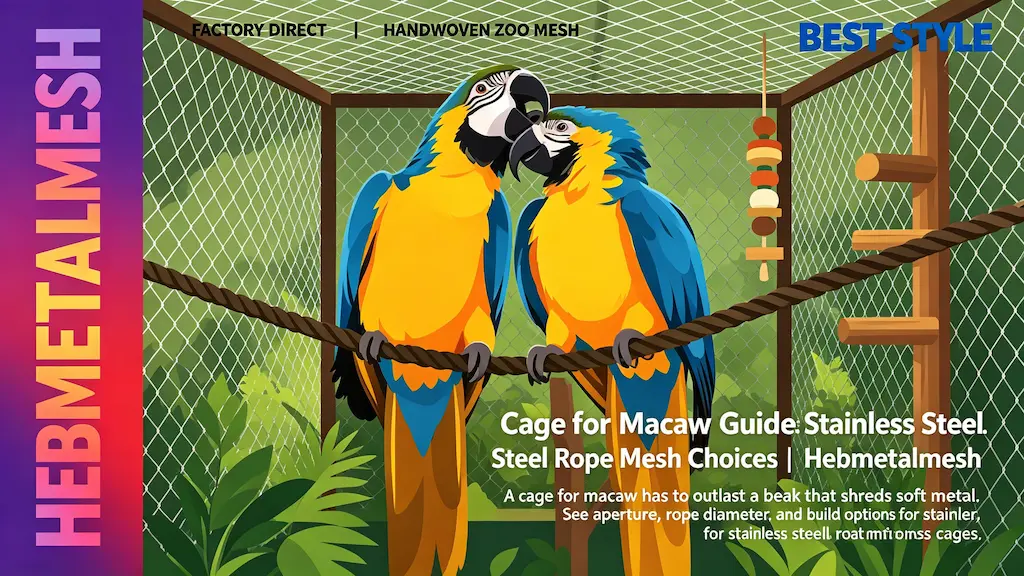
A macaw does not test an enclosure once. It tests it every day, with a beak that cracks Brazil nuts, and it keeps testing until something gives. Most macaw housing fails in the third year, and never in the way buyers expect: the mesh does not break and the frame stays upright. What fails is the aperture — the bird works one opening until the wire opens enough to take its head through, and the shoulders follow.
Good macaw housing design therefore starts from the beak, not from the bird’s dimensions. Containment is not a question of whether a panel holds a 1.2 kg animal; it is a question of whether the geometry denies the leverage needed to start working. What follows sets out the aperture, gauge, layout, and alloy decisions that separate an enclosure still holding in year twenty from one that quietly develops a hole behind a perch nobody inspects.
Executive Summary
A macaw defeats an enclosure by manipulation, not by force. Zygodactyl feet grip the wire, the beak hooks and levers, and the bird returns to the same opening for weeks until the strands separate. The answer is an aperture small enough to remove the purchase, a rope gauge heavy enough that no single strand can be worked loose, and a hand-woven interlace with no weld or crimp to pry at. At 38 mm a large macaw cannot get enough beak behind a strand to lever; at 51 mm and above it can. Gauge follows: 3.2 mm rope breaks around 7 kN, far beyond any bird load, so it is chosen for chew damage resistance rather than tension. Layout and hygiene then decide whether the bird thrives inside a boundary that holds; the macaw enclosure mesh product page is the reference specification.
Quick Answer:
What is the correct mesh for best macaw housing? Hand-woven stainless rope mesh at 38 mm aperture with 3.2 mm rope (HM3238) for large macaws, and 2.4 mm at the same aperture (HM2438) for smaller psittacines. The 38 mm opening is too small to insert a beak far enough to lever a strand apart, and 3.2 mm rope resists the cutting and bending that opens thinner wire. Use SS304 indoors and inland, SS316 outdoors in humid, tropical, or coastal sites. Never galvanize — zinc is toxic to birds.
Key Takeaways
- Aperture, not strength, decides containment. What opens a mesh is repeated levering at one opening, not one bite.
- 38 mm is the working maximum for large macaws. At 51 mm the largest species can get the beak behind a strand and start working.
- Gauge resists chewing, not load. 3.2 mm rope breaks around 7 kN — orders of magnitude above any bird load. Its job is refusing to be bent open.
- Never galvanize. Zinc and lead are both avian toxins.
- The failure point is usually behind the perch. Birds work the panel where they sit longest; inspect and specify that face like any other.
Why Most Macaw Housing Fails Early
Ask a keeper where a cage has opened and the answer is nearly always the same: the panel behind the favourite perch, or the seam nearest the door. A macaw spends hours in one spot, and the beak that preens a mate with precision spends them exploring the one irregularity it can feel.
Three mechanisms do the damage. Levering: the bird hooks its upper mandible behind a strand and pulls, and with welded mesh the weld fails — stiff, brittle, cracked after enough cycles. Cutting: repeated scraping thins a strand until it parts. Unravelling: once one crossing opens, the bird works along the line. Hand-woven interlace resists all three; there is no joint to attack, and the crossings slide rather than pivot, so load is redistributed.
That is the core point about macaw housing material: the question is not how strong the mesh is, but what happens after ten thousand cycles at one spot.
The Bite Is a Lever, Not a Crusher
Measured beak strength for large macaws lands in the few-hundred-PSI range — no bird will pull a 7 kN rope apart by force. What matters is geometry: the beak is a hook applied across a strand, and the failure mode is bending fatigue at one point.
So a heavier gauge buys fatigue life, not strength. Moving from 2.0 mm to 3.2 mm rope buys resistance to the bending and scraping that works a thinner strand loose, not margin against a load that was never going to break it.
Coatings are a liability: a macaw strips PVC or nylon in weeks and the fragments are an impaction risk. Bare stainless has nothing to strip, which is why husbandry guidance from the World Association of Zoos and Aquariums points to it throughout.
Aperture: The Number That Actually Decides
Aperture is where most specifications go wrong: buyers size to the body rather than to the beak. A large macaw’s head passes an opening far smaller than its wingspan suggests, and once the head is through, the bird has leverage.
| Aperture | Large macaws (Ara) | Small macaws / conures | Notes |
| 25 mm (HM1625) | Secure | Secure | Budgies, quail; restricts the view for large birds |
| 38 mm (HM2438 / HM3238) | Recommended | Secure | Too small for beak purchase; standard parrot spec |
| 51 mm (HM3250) | Marginal for the largest | Secure | Only where reach-through is not a factor |
| 76 mm (HM3276) | Not suitable | Not suitable | Large raptor and carnivore territory |
The practical rule: 38 mm with 2.4 mm rope (HM2438) is the baseline for most parrots, and 38 mm with 3.2 mm rope (HM3238) is correct for large macaws. Where an enclosure holds mixed psittacines, specify to the largest and strongest beak present rather than to the average.
Gauge: Choosing Fatigue Life
Rope diameter follows the same logic. 3.2 mm stainless wire rope breaks at roughly 7 kN and 2.4 mm at roughly 4.4 kN; neither figure is remotely challenged by a 1.2 kg bird. What differs is how each responds to being worked.
- 1.2 mm and 1.6 mm — finches, waxbills, small softbills; a macaw opens these in weeks.
- 2.0 mm — conures, small parrots, quail. Marginal for any macaw.
- 2.4 mm (HM2438) — the working macaw housing mesh baseline for small and medium species; roughly 4.4 kN.
- 3.2 mm (HM3238) — large macaws, cockatoos, any bird with a chew history; roughly 7 kN, and the code for an enclosure that must survive decades.
Where a panel has already been opened, replace it a gauge up rather than patch it. A macaw that has learned to open a mesh returns to the same face.
Material: Why Zinc Kills Birds
Galvanized wire is the most common mistake in macaw housing stainless decisions: cheap and poisonous to psittacines. Every chew releases zinc, and chronic zinc toxicity — weakness, polyuria, regurgitation — is routinely misdiagnosed because owners associate the cage with safety. Lead is worse: old solder, leaded hardware cloth, weighted hems, some imported fittings. Any macaw housing plan must specify hardware as well as alloy — matching-grade ferrules and eye bolts, nothing plated or painted within reach.
Between the two stainless grades:
- SS304 (roughly 18% chromium, 8% nickel) — indoor and inland; adequate for most aviaries.
- SS316 (adds molybdenum, which resists chloride pitting) — coastal, tropical, and humid sites, and any enclosure washed with chlorinated water.
The full comparison is in our 304 vs 316 mesh guide; outdoor macaw housing within a few kilometres of the sea should be SS316 without debate.
Size and Layout
Macaw housing size is usually quoted as a minimum, and minimums are the problem. A cage sized so the bird can extend its wings without touching the mesh is one in which it cannot damage the mesh at rest — the real reason the dimension matters. The baseline macaw housing requirements below assume a large Ara:
- Width — at least 1.5 times the extended wingspan of the largest bird, so a wingbeat in place clears both faces.
- Height — the highest perch well below the roof, head clear of the mesh when climbing.
- Flight — where flight training is a goal, the long axis should allow several wingbeats before a turn.
Perch placement drives welfare and wear alike. Keep the highest perch away from the mesh and rotate positions on a schedule — a bird that always roosts in one corner works that corner. Vary perch diameters to avoid pressure sores. Natural branches are better and are sacrificial; budget for replacement.
Ventilation, Light and Hygiene
Powder down is why macaw housing ventilation cannot be an afterthought: macaws shed a fine keratin powder that hangs in still air and irritates the respiratory tract of birds and staff. Design cross-ventilation at perch level, not just the roof.
Aviary hygiene is easier in mesh than in a solid enclosure, provided the design allows it. Three decisions do most of the work:
- Slope and drain the floor. Standing water holds faeces, driving parasite loads and ammonia.
- Keep the mesh off the ground. A bottom rail in standing water corrodes at the worst point.
- Make the shelter washable. Non-porous surfaces with a hose-down slope beat absorbent timber.
Stainless rope mesh helps directly: it pressure-washes, does not absorb, and has no coating for disinfectant to attack.
Enrichment Inside a Secure Boundary
A bored bird becomes a destructive bird. Foraging enrichment is the cheapest macaw housing enrichment available: food the bird must work for occupies hours that would otherwise go to the mesh. Rotate devices on a schedule — a macaw solves a static puzzle in days and ignores it. Hang enrichment from the frame, never the mesh: a branch tied to the netting adds a dynamic load and gives the bird a handle for working the strands.
Doors, Locks and the Human Factor
Most escapes happen at the door, because a macaw watched the latch. Psittacines read hands, and a bolt a keeper works twice a day will eventually be worked open. Specify two-action latches a beak cannot produce, a safety vestibule between the outer door and the enclosure, door leaf mesh matching the walls, and no exposed clips within reach.
Cost: What Macaw Housing Actually Runs
Mesh is the smaller line item. Hand-woven macaw housing panels run roughly $10–22 per square metre, with a 3.2 mm / 38 mm macaw housing cost face at the upper end. Frame, doors, shelter, and drainage typically exceed it.
What matters is lifecycle, not unit price. A galvanized cage costs a fraction up front and is replaced every few years, each time carrying escape and health risk. A 3.2 mm hand-woven panel is a twenty-year component needing washing and occasional re-tensioning, and because it is woven to the exhibit rather than cut from stock — up to 9 m by 18 m in one piece — it has no mid-panel seam where chewing starts.
Specification Checklist
Before requesting a quote, have five lines ready: the species list with the most destructive bird identified; aperture (38 mm for macaws); rope diameter (2.4 mm or 3.2 mm, chosen for chew history); alloy (SS304 inland, SS316 coastal or tropical); and panel dimensions with frame type and door positions marked. Add fitting alloy and edge treatment and a supplier can quote without a round of questions. Our macaw cage guide covers the same decisions for a single-bird enclosure.
Frequently Asked Questions
38 mm is the working maximum. At 51 mm the largest Ara species can get enough beak behind a strand to lever it, and sustained work at one opening eventually separates the wires.
Structurally yes — it breaks at roughly 4.4 kN, which no bird will approach. For large macaws 3.2 mm is the better call, because the failure mode is bending fatigue and chewing.
No, and nowhere in the enclosure. Zinc is a cumulative avian toxin, and birds reach surfaces you did not expect.
At minimum 1.5 times the extended wingspan in width, with the highest perch clear of the roof mesh. Larger keeps the bird off the boundary at rest.
A slack face deflects outward and gives the bird a surface to climb and work. Tension on a closed perimeter so it returns flat when pushed.
Twenty-five to thirty years and beyond in aviary service. The alloy does not degrade; tensioning hardware wears and should be inspected annually.
The Bottom Line
Design macaw housing around the beak, not the body. A 38 mm aperture denies the leverage, a 3.2 mm rope refuses to be bent open, a hand-woven interlace has no joint to pry at, and SS316 covers corrosion on any coastal or tropical site. Get those four right and zoo macaw housing becomes a background component for a generation; get one wrong and the bird finds it, usually behind the perch, in year three. Our bird exhibit mesh macaw housing guide covers service life in depth, the aviary netting page covers mixed-species collections, and the macaw enclosure mesh range lists every code.
Ready to specify your enclosure? Contact our aviary team with your species list and enclosure dimensions.